

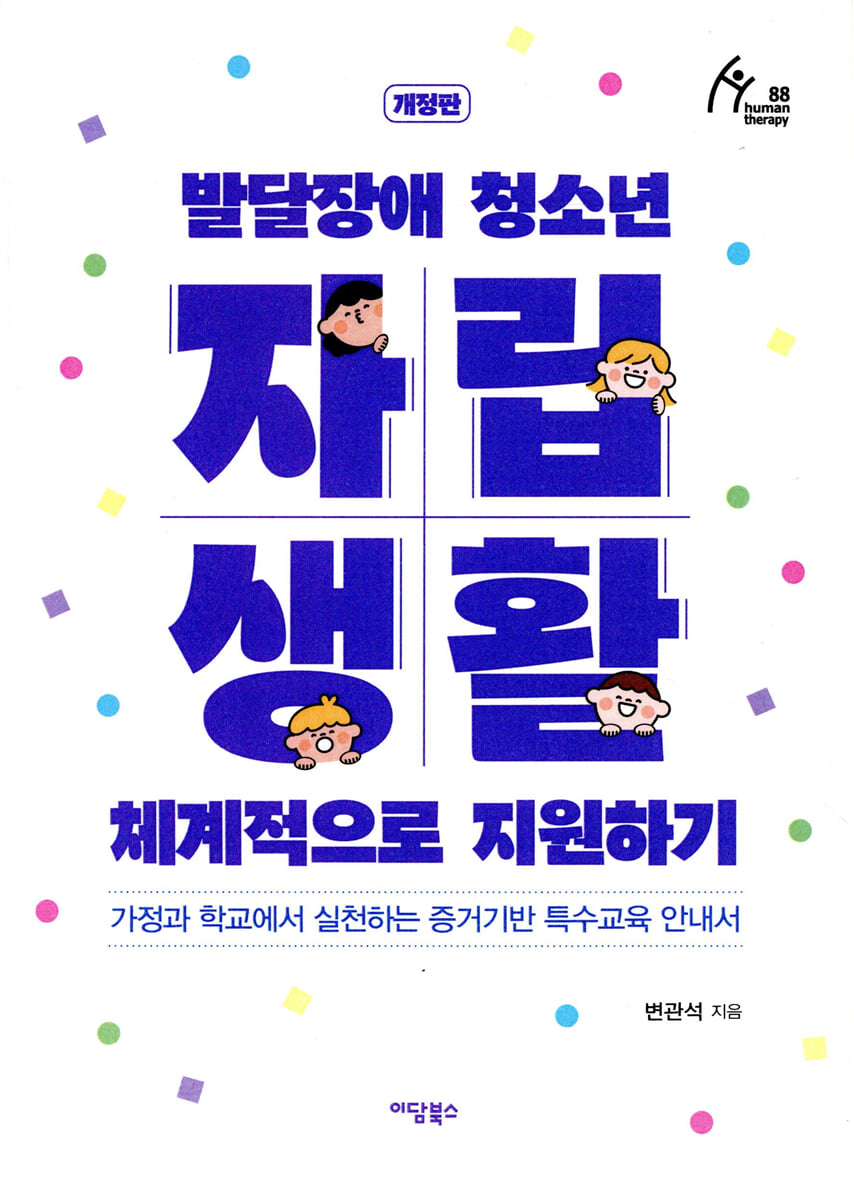
Systematically supporting independent living for youth with developmental disabilities
 |
Description
Book Introduction
For independent living of learners with developmental disabilities
Evidence-based special education curriculum based on Applied Behavior Analysis (ABA)
We provide guidance on teaching methods that have been proven effective in educating learners with specific disabilities or age groups through numerous scientific studies.
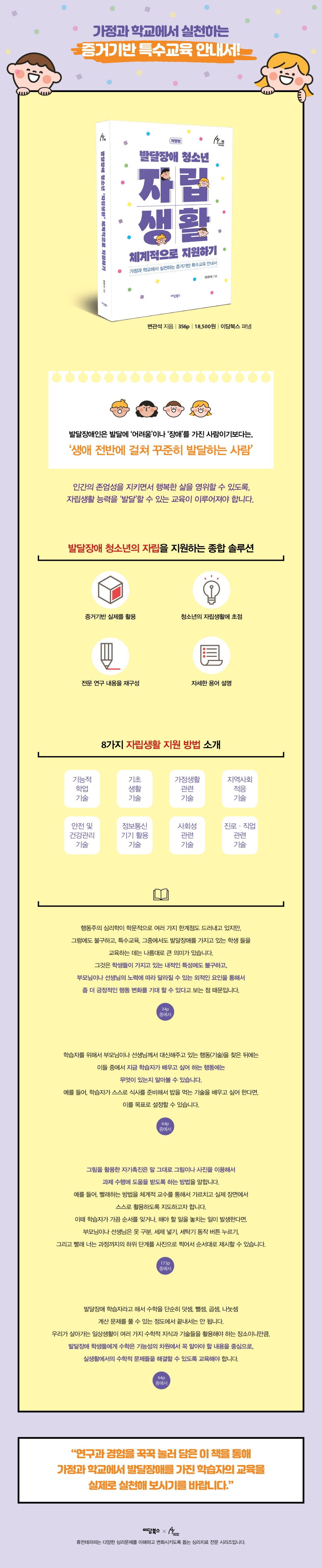
Additionally, through an educational program divided into eight areas, we have organized the educational content and goals necessary for learners with developmental disabilities from 5th and 6th grades of elementary school to middle and high school students and adolescents.
This book focuses on the independent living of youth, while also presenting expert research in a relatively easy-to-understand manner, making it suitable for use at home and school.
Evidence-based special education curriculum based on Applied Behavior Analysis (ABA)
We provide guidance on teaching methods that have been proven effective in educating learners with specific disabilities or age groups through numerous scientific studies.
Additionally, through an educational program divided into eight areas, we have organized the educational content and goals necessary for learners with developmental disabilities from 5th and 6th grades of elementary school to middle and high school students and adolescents.
This book focuses on the independent living of youth, while also presenting expert research in a relatively easy-to-understand manner, making it suitable for use at home and school.
- You can preview some of the book's contents.
Preview
index
To begin with
Preface to the Revised Edition
Step 1: Evidence-Based Special Education: What is Systematic Instruction Based on ABA Principles?
1 What is evidence-based practice?
2. Examining Applied Behavior Analysis (ABA) and Positive Behavior Support (PBS)
3 What is systematic teaching?
Step 2: 10 Steps to Systematic Teaching
- Before starting Step 2
1. Select and clearly define your target technology.
2 Divide it into parts so that you can teach it at once.
3. Create a checklist (evaluation sheet).
4. Determine your current performance level.
5 Decide on the teaching order.
6. Teach target skills systematically.
7. Provide feedback.
8. Evaluate your achievements frequently.
9. Aim to maintain and generalize acquired target skills.
10 Moving from ‘teaching’ to ‘learning’.
Step 3: Supporting Independent Living for Youth with Developmental Disabilities
- Before starting Step 3
1 Functional Academic Skills
Functional basic knowledge (cognition)
Functional communication skills
Functional Reading Skills
Functional writing skills
Functional Math Skills
2 Basic Life Skills
Toilet use related skills
Exercise and food intake skills
Dressing related skills
Sanitation-related technologies
Other basic life skills
3. Home life skills
4 Community Adaptation Skills
5 Safety and Health Management Technologies
6 Information and Communication Device Utilization Technology
7 Social Skills
8 Career and Vocational Education Related Technologies
Basic job skills
Career Path? Skills related to preparing for professional life
Going Out 1: For Your Child's Independent Life
Going Out 2: For Learners' Independent Living
References
Preface to the Revised Edition
Step 1: Evidence-Based Special Education: What is Systematic Instruction Based on ABA Principles?
1 What is evidence-based practice?
2. Examining Applied Behavior Analysis (ABA) and Positive Behavior Support (PBS)
3 What is systematic teaching?
Step 2: 10 Steps to Systematic Teaching
- Before starting Step 2
1. Select and clearly define your target technology.
2 Divide it into parts so that you can teach it at once.
3. Create a checklist (evaluation sheet).
4. Determine your current performance level.
5 Decide on the teaching order.
6. Teach target skills systematically.
7. Provide feedback.
8. Evaluate your achievements frequently.
9. Aim to maintain and generalize acquired target skills.
10 Moving from ‘teaching’ to ‘learning’.
Step 3: Supporting Independent Living for Youth with Developmental Disabilities
- Before starting Step 3
1 Functional Academic Skills
Functional basic knowledge (cognition)
Functional communication skills
Functional Reading Skills
Functional writing skills
Functional Math Skills
2 Basic Life Skills
Toilet use related skills
Exercise and food intake skills
Dressing related skills
Sanitation-related technologies
Other basic life skills
3. Home life skills
4 Community Adaptation Skills
5 Safety and Health Management Technologies
6 Information and Communication Device Utilization Technology
7 Social Skills
8 Career and Vocational Education Related Technologies
Basic job skills
Career Path? Skills related to preparing for professional life
Going Out 1: For Your Child's Independent Life
Going Out 2: For Learners' Independent Living
References
Detailed image
Into the book
Although behaviorist psychology has revealed several academic limitations, it nevertheless has significant significance in special education, especially in the education of students with developmental disabilities.
This is because, despite the internal characteristics of students, we believe that more positive behavioral changes can be expected through external factors that can be influenced by the efforts of parents or teachers.
--- p.34
After identifying the behaviors (skills) that parents or teachers are doing for the learner, you can then figure out which of these behaviors the learner would most like to learn.
For example, if a learner wants to learn the skill of preparing and eating meals on their own, they can set this as a goal.
--- p.64
If you teach serial skills backwards, it will inevitably take longer than if you teach them forwards.
However, there is an advantage in that parents or teachers can repeatedly observe the process of carrying out the steps before teaching and learning takes place through a single example.
--- p.91
Pictorial self-facilitation literally refers to a method of using pictures or photographs to help people complete a task.
For example, we want to teach students how to do laundry through systematic instruction and guide them to apply it on their own in real-life situations.
If learners sometimes forget the order or miss tasks, parents or teachers can take pictures of the sub-steps of sorting clothes, adding detergent, pressing the washing machine button, and then hanging the laundry to show them in order.
--- p.173
Even if a learner has a developmental disability, math should not end at simply being able to solve addition, subtraction, multiplication, and division problems.
Since our daily lives require the use of various mathematical knowledge and skills, mathematics education for students with developmental disabilities should focus on the essential knowledge required for functional purposes, enabling them to solve real-life mathematical problems.
--- p.240
In advanced welfare countries abroad, welfare professionals are deployed to support the daily life, housing, and health care of people with developmental disabilities such as intellectual disabilities or autism spectrum disorders, or relatively severe physical disabilities.
And one specialist is responsible for a relatively small number of disabled people.
This will naturally reduce the burden on parents.
As our country advances toward the ranks of advanced economies, I hope to see further advancements in the field of welfare for the disabled, a representative area of selective welfare.
This is because, despite the internal characteristics of students, we believe that more positive behavioral changes can be expected through external factors that can be influenced by the efforts of parents or teachers.
--- p.34
After identifying the behaviors (skills) that parents or teachers are doing for the learner, you can then figure out which of these behaviors the learner would most like to learn.
For example, if a learner wants to learn the skill of preparing and eating meals on their own, they can set this as a goal.
--- p.64
If you teach serial skills backwards, it will inevitably take longer than if you teach them forwards.
However, there is an advantage in that parents or teachers can repeatedly observe the process of carrying out the steps before teaching and learning takes place through a single example.
--- p.91
Pictorial self-facilitation literally refers to a method of using pictures or photographs to help people complete a task.
For example, we want to teach students how to do laundry through systematic instruction and guide them to apply it on their own in real-life situations.
If learners sometimes forget the order or miss tasks, parents or teachers can take pictures of the sub-steps of sorting clothes, adding detergent, pressing the washing machine button, and then hanging the laundry to show them in order.
--- p.173
Even if a learner has a developmental disability, math should not end at simply being able to solve addition, subtraction, multiplication, and division problems.
Since our daily lives require the use of various mathematical knowledge and skills, mathematics education for students with developmental disabilities should focus on the essential knowledge required for functional purposes, enabling them to solve real-life mathematical problems.
--- p.240
In advanced welfare countries abroad, welfare professionals are deployed to support the daily life, housing, and health care of people with developmental disabilities such as intellectual disabilities or autism spectrum disorders, or relatively severe physical disabilities.
And one specialist is responsible for a relatively small number of disabled people.
This will naturally reduce the burden on parents.
As our country advances toward the ranks of advanced economies, I hope to see further advancements in the field of welfare for the disabled, a representative area of selective welfare.
--- p.297
Publisher's Review
Life skills education through home and school collaboration
Comprehensive solutions to support the independence of youth with developmental disabilities.
It is said that a person with a developmental disability is not someone who has a 'difficulty' or 'disability' in development, but rather 'a person who develops steadily throughout his or her life.'
Especially from adolescence onwards, education must be provided to enable them to 'develop' their ability to live independently so that they can lead happy lives while maintaining human dignity in their families and communities as adults.
However, in public education, the period during which a teacher educates a youth with a developmental disability is at most 2 to 3 years.
Ultimately, the people who best understand the individual characteristics, strengths, and hopes of adolescents with developmental disabilities and who can watch over them for a long time are the adolescents themselves and their parents.
This book proposes a teaching method that focuses on the 'independent living' of adolescents with developmental disabilities, centered on systematic teaching based on the principles of applied behavior analysis.
Through an educational program divided into eight areas, the educational content and goals necessary for learners with developmental disabilities from 5th and 6th grades of elementary school to middle and high school students and adolescents were organized and explained in relatively detail so that parents can sufficiently utilize them at home.
In addition, this revised edition has been revised and supplemented with five main points in mind.
First, positive behavior support content for problem behavior intervention was added.
Second, the contents of Chapter 2 were revised and supplemented to make them more faithful.
Third, the home life-related skills introduced in Chapter 3 were categorized into several sub-areas and target skills were added.
Fourth, we added a text on individualized education plans for school teachers to support independent living for learners with developmental disabilities.
Fifth, we provided additional materials and videos for reference and included links to view them in the box.
This book, packed with research and experience, will enable parents and teachers to put into practice the education of learners with developmental disabilities at home and at school.
* Includes examples of ‘teaching and learning procedures’ and ‘comprehensive independent living plan’.
Comprehensive solutions to support the independence of youth with developmental disabilities.
It is said that a person with a developmental disability is not someone who has a 'difficulty' or 'disability' in development, but rather 'a person who develops steadily throughout his or her life.'
Especially from adolescence onwards, education must be provided to enable them to 'develop' their ability to live independently so that they can lead happy lives while maintaining human dignity in their families and communities as adults.
However, in public education, the period during which a teacher educates a youth with a developmental disability is at most 2 to 3 years.
Ultimately, the people who best understand the individual characteristics, strengths, and hopes of adolescents with developmental disabilities and who can watch over them for a long time are the adolescents themselves and their parents.
This book proposes a teaching method that focuses on the 'independent living' of adolescents with developmental disabilities, centered on systematic teaching based on the principles of applied behavior analysis.
Through an educational program divided into eight areas, the educational content and goals necessary for learners with developmental disabilities from 5th and 6th grades of elementary school to middle and high school students and adolescents were organized and explained in relatively detail so that parents can sufficiently utilize them at home.
In addition, this revised edition has been revised and supplemented with five main points in mind.
First, positive behavior support content for problem behavior intervention was added.
Second, the contents of Chapter 2 were revised and supplemented to make them more faithful.
Third, the home life-related skills introduced in Chapter 3 were categorized into several sub-areas and target skills were added.
Fourth, we added a text on individualized education plans for school teachers to support independent living for learners with developmental disabilities.
Fifth, we provided additional materials and videos for reference and included links to view them in the box.
This book, packed with research and experience, will enable parents and teachers to put into practice the education of learners with developmental disabilities at home and at school.
* Includes examples of ‘teaching and learning procedures’ and ‘comprehensive independent living plan’.
GOODS SPECIFICS
- Publication date: November 3, 2021
- Page count, weight, size: 356 pages | 594g | 152*215*30mm
- ISBN13: 9791168011731
- ISBN10: 1168011736
You may also like
카테고리
korean


korean

![ELLE 엘르 스페셜 에디션 A형 : 12월 [2025]](http://librairie.coreenne.fr/cdn/shop/files/b8e27a3de6c9538896439686c6b0e8fb.jpg?v=1766436872&width=3840)


