

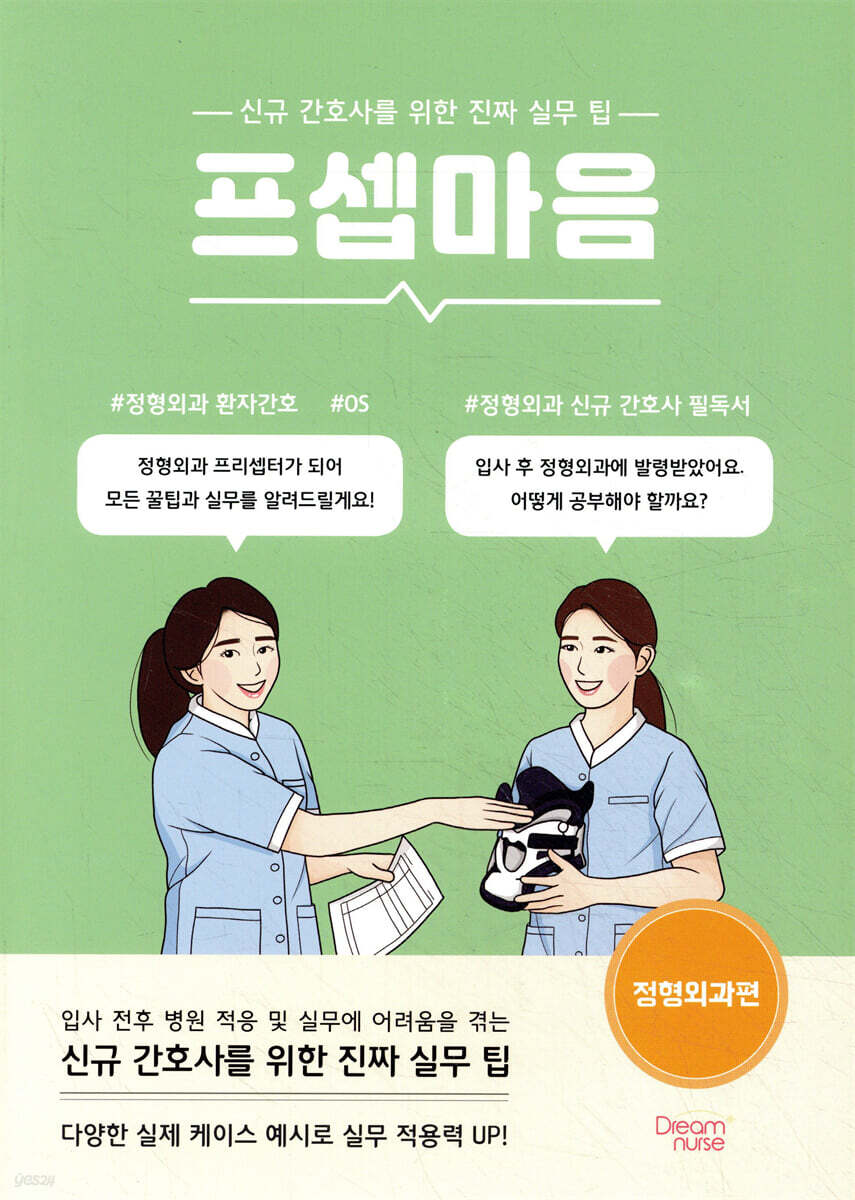
Psepmaum: Orthopedics
 |
Description
index
Part 1.
Laying the foundation of orthopedics
1) Essential knowledge for orthopedic nurses (What should an orthopedic nurse know?)
(1) Anatomy class for orthopedic nurses: arm skeleton, leg skeleton, spinal skeleton
(2) Main orthopedic supplies
(3) Conquering Splints and Casts
(4) Types of fractures
Part 2.
Pre- and post-operative examinations, surgical nursing
1) Pre- and post-operative examinations (this is a frequently performed examination that you should know about!)
(1) General examination: blood test, urine test, electrocardiogram, echocardiogram, pulmonary function test
(2) Imaging tests: X-ray, CT, MRI, bone density, PET CT, bone scan, bone SPECT
2) Frequent Procedure Nursing (How should I prepare and care for the procedure?)
(1) Central venous line: Subclavian catheter, PICC
(2) Orthopedic procedures: Aspiration, CT-guided biopsy
Part 3.
Pre- and post-operative nursing care for orthopedic surgery
1) Preoperative care (What should I do first to prepare for surgery?)
(1) Preoperative education
(2) Surgical consent form, surgical site marking
2) Postoperative care (What happens to the patient after surgery?)
(1) Postoperative education
(2) Postoperative complications: respiratory complications, DVT, PTE, stroke, MI, delirium
(3) Disinfection of surgical site: dressing products, types of disinfectants, types of sutures, dressing methods for each part
Part 4.
Orthopedic Diseases and Surgeries by Case
1) Shoulder and collarbone (I have pain in my shoulder!)
1) Shoulder diseases: rotator cuff tear, calcific tendonitis, adhesive capsulitis, superior labral tear
(2) Clavicle fracture
(3) Shoulder disease as seen in a case study
2) Finger (It hurts when I bend my finger, but it's not a fracture!)
(1) Hand diseases: distal radius fracture, trigger finger, hallux valgus, carpal tunnel syndrome, Dupuytren's contracture
(2) Hand disease as seen in cases
3) Spine (My back hurts!)
(1) Spinal diseases: spinal stenosis, herniated disc, tuberculous spondylitis
(2) Spinal deformities: spondylolisthesis, idiopathic scoliosis, kyphosis
(3) Spinal disease as seen in cases
4) Hip joint (I came here because my hip joint hurt, and they said the bone was necrotic!)
(1) Hip joint diseases: femoral fracture, osteonecrosis of the femoral head, femoroacetabular impingement syndrome
(4) Hip joint disease as seen in cases
5) Knees (I guess it's because I'm getting older, but my knees are sore!)
(1) Knee diseases: degenerative arthritis, anterior cruciate ligament damage, posterior cruciate ligament damage, meniscus damage
(2) Knee disease as seen in a case study
6) Foot (What if a diabetic patient has a wound on their foot?)
(1) Foot diseases: tibial and fibular fractures, diabetic foot, hallux valgus
(2) Foot disease as seen in cases
Appendix: Must-know! Basic Orthopedic Knowledge
1.
Common medical terms
2.
High-frequency drugs
Laying the foundation of orthopedics
1) Essential knowledge for orthopedic nurses (What should an orthopedic nurse know?)
(1) Anatomy class for orthopedic nurses: arm skeleton, leg skeleton, spinal skeleton
(2) Main orthopedic supplies
(3) Conquering Splints and Casts
(4) Types of fractures
Part 2.
Pre- and post-operative examinations, surgical nursing
1) Pre- and post-operative examinations (this is a frequently performed examination that you should know about!)
(1) General examination: blood test, urine test, electrocardiogram, echocardiogram, pulmonary function test
(2) Imaging tests: X-ray, CT, MRI, bone density, PET CT, bone scan, bone SPECT
2) Frequent Procedure Nursing (How should I prepare and care for the procedure?)
(1) Central venous line: Subclavian catheter, PICC
(2) Orthopedic procedures: Aspiration, CT-guided biopsy
Part 3.
Pre- and post-operative nursing care for orthopedic surgery
1) Preoperative care (What should I do first to prepare for surgery?)
(1) Preoperative education
(2) Surgical consent form, surgical site marking
2) Postoperative care (What happens to the patient after surgery?)
(1) Postoperative education
(2) Postoperative complications: respiratory complications, DVT, PTE, stroke, MI, delirium
(3) Disinfection of surgical site: dressing products, types of disinfectants, types of sutures, dressing methods for each part
Part 4.
Orthopedic Diseases and Surgeries by Case
1) Shoulder and collarbone (I have pain in my shoulder!)
1) Shoulder diseases: rotator cuff tear, calcific tendonitis, adhesive capsulitis, superior labral tear
(2) Clavicle fracture
(3) Shoulder disease as seen in a case study
2) Finger (It hurts when I bend my finger, but it's not a fracture!)
(1) Hand diseases: distal radius fracture, trigger finger, hallux valgus, carpal tunnel syndrome, Dupuytren's contracture
(2) Hand disease as seen in cases
3) Spine (My back hurts!)
(1) Spinal diseases: spinal stenosis, herniated disc, tuberculous spondylitis
(2) Spinal deformities: spondylolisthesis, idiopathic scoliosis, kyphosis
(3) Spinal disease as seen in cases
4) Hip joint (I came here because my hip joint hurt, and they said the bone was necrotic!)
(1) Hip joint diseases: femoral fracture, osteonecrosis of the femoral head, femoroacetabular impingement syndrome
(4) Hip joint disease as seen in cases
5) Knees (I guess it's because I'm getting older, but my knees are sore!)
(1) Knee diseases: degenerative arthritis, anterior cruciate ligament damage, posterior cruciate ligament damage, meniscus damage
(2) Knee disease as seen in a case study
6) Foot (What if a diabetic patient has a wound on their foot?)
(1) Foot diseases: tibial and fibular fractures, diabetic foot, hallux valgus
(2) Foot disease as seen in cases
Appendix: Must-know! Basic Orthopedic Knowledge
1.
Common medical terms
2.
High-frequency drugs
Detailed image

Publisher's Review
* Book Features
A Guidebook Full of Tips for New Orthopedic Nurses
From anatomy to pre- and post-operative nursing care, explored through disease-specific cases!
· Vividness UP with case studies of each part that can be seen in an actual orthopedic ward!
· Focus on practice over theory! Improve your clinical application skills!
· Improve your understanding with easy explanations for beginners in orthopedic nursing!
· Preceptor-preceptee conversation format makes difficult terms and concepts as easy as possible!
* Recommended in these situations:
· New nurses about to join the orthopedic ward
.
Orthopedic nurses who are not new but feel they need to study more
.
A nurse preparing to become a preceptor in the orthopedic department
.
Nurses curious about orthopedic diseases and surgical nursing
· Student nurses preparing case studies after orthopedic ward practice
· A prospective nurse who wants to go into orthopedics
A Guidebook Full of Tips for New Orthopedic Nurses
From anatomy to pre- and post-operative nursing care, explored through disease-specific cases!
· Vividness UP with case studies of each part that can be seen in an actual orthopedic ward!
· Focus on practice over theory! Improve your clinical application skills!
· Improve your understanding with easy explanations for beginners in orthopedic nursing!
· Preceptor-preceptee conversation format makes difficult terms and concepts as easy as possible!
* Recommended in these situations:
· New nurses about to join the orthopedic ward
.
Orthopedic nurses who are not new but feel they need to study more
.
A nurse preparing to become a preceptor in the orthopedic department
.
Nurses curious about orthopedic diseases and surgical nursing
· Student nurses preparing case studies after orthopedic ward practice
· A prospective nurse who wants to go into orthopedics
GOODS SPECIFICS
- Date of issue: June 3, 2021
- Page count, weight, size: 312 pages | 182*257*30mm
- ISBN13: 9791190939539
- ISBN10: 1190939533
You may also like
카테고리
korean


korean

![ELLE 엘르 스페셜 에디션 A형 : 12월 [2025]](http://librairie.coreenne.fr/cdn/shop/files/b8e27a3de6c9538896439686c6b0e8fb.jpg?v=1766436872&width=3840)


