

Ultrasound Physics (SPI) Review Guide
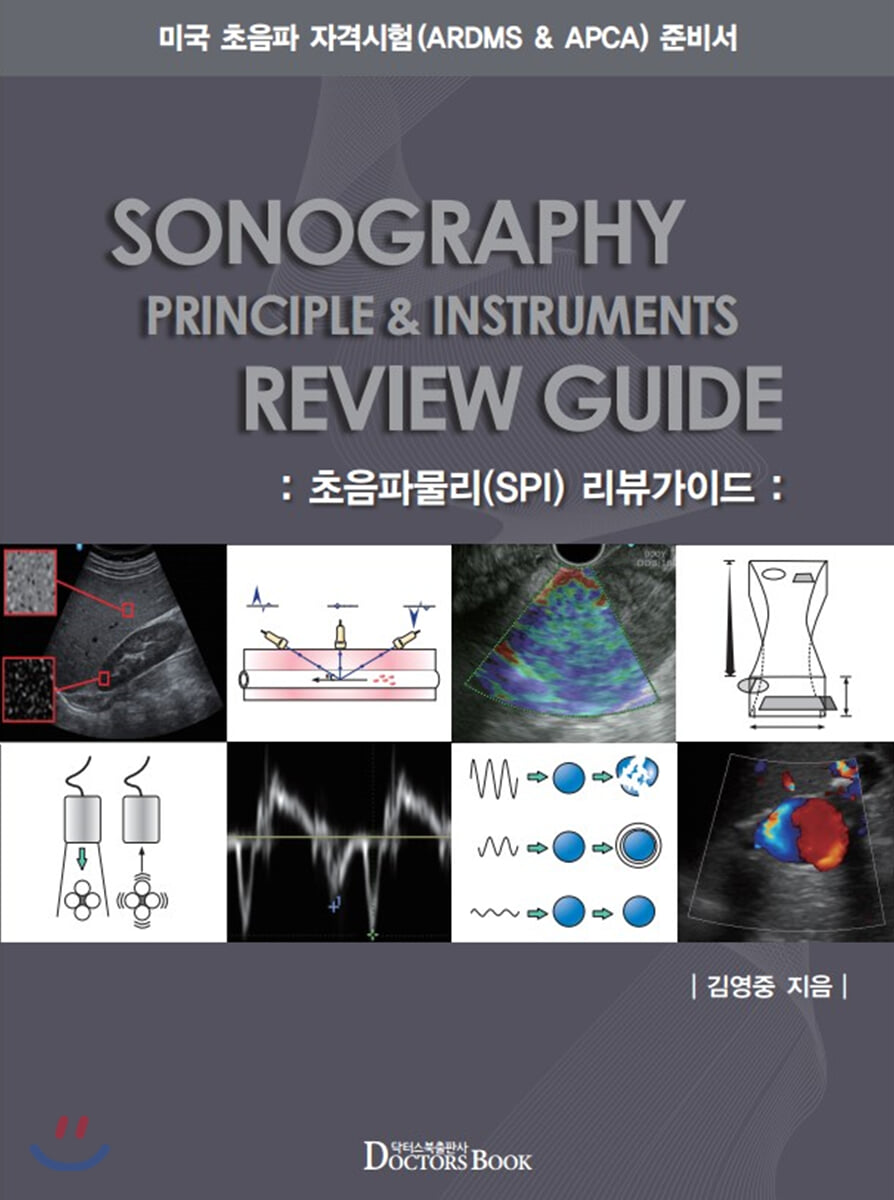 |
Description
Book Introduction
Interest in the US ultrasound certification exam has been growing recently, whether for overseas expansion or to enhance one's qualifications. Issued by the American Registry for Diagnostic Medical Sonography (ARDMS), the certification exam covers not only clinical knowledge but also the fundamental principles of ultrasound. Therefore, preparing for the exam naturally deepens one's understanding of ultrasound imaging and equipment.
Currently, there is no textbook in Korea that can be used as a basic textbook for the ARDMS exam.
The author, recognizing this situation, has published a basic textbook for the ARDMS exam.
The Ultrasound Physics (SPI) part serves as the first gateway that must be passed to obtain various certifications (RDMS, RDCS, RVT, RMSKS, RPVI, RMSK) issued by ARDMS.
There are already many excellent books overseas that cover only the ultrasound physics part, but the specialized nature of the field and language barriers make them difficult to access.
This textbook was written in Korean to facilitate easy learning for readers, with important words and key concept sentences written in English.
In addition, by referencing various foreign books and papers, we have systematically organized the material so that readers can pass the exam with just this one textbook, saving them the trouble of having to look for other textbooks.
By providing various color illustrations, it is designed to help readers intuitively understand difficult content through pictures.
Textbook Structure: This textbook consists of 4 parts.
The first is the main part, which summarizes the main theories.
At the end of each chapter, we provide review exercises similar to the actual exam, so that you can check what you have learned.
The second part, "Semi-interactive console (SIC)", consists of a basic explanation of SIC and 16 problems. Based on the SIC interface officially provided by ARDMS, it aims to provide an opportunity to adapt to unfamiliar problem types.
Third, the test questions that were previously given were summarized in short sentences so that they could be reviewed quickly.
Finally, we have summarized the important formulas so that you can use them to prepare for the exam.
Currently, there is no textbook in Korea that can be used as a basic textbook for the ARDMS exam.
The author, recognizing this situation, has published a basic textbook for the ARDMS exam.
The Ultrasound Physics (SPI) part serves as the first gateway that must be passed to obtain various certifications (RDMS, RDCS, RVT, RMSKS, RPVI, RMSK) issued by ARDMS.
There are already many excellent books overseas that cover only the ultrasound physics part, but the specialized nature of the field and language barriers make them difficult to access.
This textbook was written in Korean to facilitate easy learning for readers, with important words and key concept sentences written in English.
In addition, by referencing various foreign books and papers, we have systematically organized the material so that readers can pass the exam with just this one textbook, saving them the trouble of having to look for other textbooks.
By providing various color illustrations, it is designed to help readers intuitively understand difficult content through pictures.
Textbook Structure: This textbook consists of 4 parts.
The first is the main part, which summarizes the main theories.
At the end of each chapter, we provide review exercises similar to the actual exam, so that you can check what you have learned.
The second part, "Semi-interactive console (SIC)", consists of a basic explanation of SIC and 16 problems. Based on the SIC interface officially provided by ARDMS, it aims to provide an opportunity to adapt to unfamiliar problem types.
Third, the test questions that were previously given were summarized in short sentences so that they could be reviewed quickly.
Finally, we have summarized the important formulas so that you can use them to prepare for the exam.
index
Part 1: PHYSICAL PRINCIPLES
1.
Units & Unit Conversion 4
2.
Basics of Sound Waves 5
3.
Parameters of Sound
⑴ Frequency, Period and Wavelength 8
⑵ Propagating Speed 10
⑶ Amplitude, Power and Intensity 12
⑷ Range equation 13
4.
Continuous & Pulsed wave principles 16
5.
Terms describing pulsed waves
⑴ PD, PRP, PRF 18
⑵ Duty factor (DF) 21
⑶ Spatial Pulse Length (SPL) 22
6.
Interference 25
7.
Attenuation
⑴ Decibels 26
⑵ Attenuation 27
8.
Tissue echogenicity 34
Review Exercise 35
Part 2 TRANSDUCERS
1.
Transducer Construction
⑴ Piezoelectric Element 46
⑵ Backing Layer 48
⑶ Matching Layer 51
⑷ Electric Shield 52
2.
Sound Beam & Focusing
⑴ Sound beam formation 53
⑵ Unfocused beam 56
⑶ Focused beam 58
3.
Real-Time Scanning
⑴ Mechanical transducer 65
⑵ Electronic transducer 66
⑶ Other arrays 70
⑷ Summary of Common transducer types 73
⑸ Scanning speed limitation 74
⑹ Temporal resolution 77
4.
Spatial Resolution
⑴ Axial resolution 79
⑵ Lateral resolution 81
⑶ Elevational resolution 81
Review Exercise 83
Part 3 DOPPLER
1.
Doppler Principle
⑴ Doppler effect 102
⑵ Doppler shift 102
⑶ Doppler angle 103
⑷ Doppler equation 104
2.
Color Doppler
⑴ Color box 105
⑵ Color map 106
⑶ Variance map 107
⑷ Packet size 108
3.
Pulsed vs Continuous wave Doppler
⑴ Pulsed wave Doppler 110
⑵ Continuous wave Doppler 113
4.
Spectral Doppler
⑴ Spectral analysis 114
⑵ Spectral window 117
⑶ Nyquist limit 118
⑷ How to remove aliasing in Spectral Doppler 119
⑸ Other Artifact & Noise Removal Methods in Spectral Doppler 121
⑹ Sweep speed 122
⑺ High PRF Doppler setting 123
⑻ Duplex & Triplex imaging 123
5.
Power Doppler 124
6.
Tissue Doppler Imaging 125
7.
Hemodynamics
⑴Type of arterial blood flow 126
⑵ The basic equations of fluid dynamics 128
⑶ Systematic characterization of all waveforms 130
⑷ Waveform of flow in stenosis 132
Review Exercise 134
Part 4 IMAGING PRINCIPLES & INSTRUMENTS
1.
Transmission & Reception
⑴ Pulser 158
⑵ Beamformer 160
⑶ Receiver: Five Functions 161
2.
Images, Storage, and Display
⑴ Scan converter 168
⑵ Image processing 174
⑶ Display and Storage devices 177
⑷ Display mode 177
Review Exercise 181
Part 5 ARTIFACTS
1.
Spatial Resolution Artifacts
⑴ Axial resolution artifact 194
⑵ Lateral resolution artifact 195
⑶ Elevational resolution artifact 196
2.
Propagation Speed & Path Artifacts
⑴ Reverberation artifact 197
⑵ Comet tail sign 197
⑶ Refraction artifact 199
⑷ Multipath artifact 201
⑸ Mirror image artifact 201
⑹Secondary lobes artifact 202
⑺ Propagation speed error 204
3.
Attenuation Artifacts
⑴ Posterior acoustic shadowing 205
⑵ Posterior acoustic enhancement 205
4.
Doppler Artifacts
⑴ Aliasing 207
⑵ Motion artifact 209
⑶ Blooming artifact 210
⑷ Crosstalk 211
⑸ Color twinkling artifact 212
5.
Other Artifacts
⑴ Speckle 214
⑵ Noise 215
⑶ Equipment malfunction 217
Review Exercise 218
Part 6 Quality Assurance
1.
Quality Assurance 230
2.
User-specific Roles 230
3.
Equipment Cleaning 231
4.
Tissue-Equivalent Phantom 232
⑴ Dead zone 234
⑵ Spatial resolution 235
⑶ Accuracy 237
⑷ Sensitivity 238
⑸ Contrast resolution 239
5.
Elevational Resolution Phantom
⑴ Spherical void phantom 240
⑵ Slice thickness phantom 241
6. AIUM 100mm Test Object 242
7.
Doppler Testing Phantom 243
8.
Other Testing Equipment 244
9.
Statistical Parameters 245
Review Exercise 248
Part 7 PATIENT CARE AND NEW TECHNOLOGIES
1.
Patient Care 258
2.
Occupational Safety & Health Act 260
3.
Bioeffects and Safety
⑴ Spatial & Temporal intensity 262
⑵ Thermal index 264
⑶ Mechanical index 265
⑷ ALARA principle 266
4.
New Technologies
⑴ Elastography 268
⑵ Tissue harmonic imaging (THI) 268
⑶ Contrast-enhanced ultrasound (CEUS) 271
⑷ Spatial compounding 272
⑸ Frequency compounding 273
⑹ Persistence 273
⑺ Extended Field of view 274
⑻ Fusion imaging 275
Review Exercise 276
SIC (semi-interactive console) 283
A glance at past exam questions 303
Summary of Formulas 313
Bibliography & Figure Credits 319
INDEX 325
1.
Units & Unit Conversion 4
2.
Basics of Sound Waves 5
3.
Parameters of Sound
⑴ Frequency, Period and Wavelength 8
⑵ Propagating Speed 10
⑶ Amplitude, Power and Intensity 12
⑷ Range equation 13
4.
Continuous & Pulsed wave principles 16
5.
Terms describing pulsed waves
⑴ PD, PRP, PRF 18
⑵ Duty factor (DF) 21
⑶ Spatial Pulse Length (SPL) 22
6.
Interference 25
7.
Attenuation
⑴ Decibels 26
⑵ Attenuation 27
8.
Tissue echogenicity 34
Review Exercise 35
Part 2 TRANSDUCERS
1.
Transducer Construction
⑴ Piezoelectric Element 46
⑵ Backing Layer 48
⑶ Matching Layer 51
⑷ Electric Shield 52
2.
Sound Beam & Focusing
⑴ Sound beam formation 53
⑵ Unfocused beam 56
⑶ Focused beam 58
3.
Real-Time Scanning
⑴ Mechanical transducer 65
⑵ Electronic transducer 66
⑶ Other arrays 70
⑷ Summary of Common transducer types 73
⑸ Scanning speed limitation 74
⑹ Temporal resolution 77
4.
Spatial Resolution
⑴ Axial resolution 79
⑵ Lateral resolution 81
⑶ Elevational resolution 81
Review Exercise 83
Part 3 DOPPLER
1.
Doppler Principle
⑴ Doppler effect 102
⑵ Doppler shift 102
⑶ Doppler angle 103
⑷ Doppler equation 104
2.
Color Doppler
⑴ Color box 105
⑵ Color map 106
⑶ Variance map 107
⑷ Packet size 108
3.
Pulsed vs Continuous wave Doppler
⑴ Pulsed wave Doppler 110
⑵ Continuous wave Doppler 113
4.
Spectral Doppler
⑴ Spectral analysis 114
⑵ Spectral window 117
⑶ Nyquist limit 118
⑷ How to remove aliasing in Spectral Doppler 119
⑸ Other Artifact & Noise Removal Methods in Spectral Doppler 121
⑹ Sweep speed 122
⑺ High PRF Doppler setting 123
⑻ Duplex & Triplex imaging 123
5.
Power Doppler 124
6.
Tissue Doppler Imaging 125
7.
Hemodynamics
⑴Type of arterial blood flow 126
⑵ The basic equations of fluid dynamics 128
⑶ Systematic characterization of all waveforms 130
⑷ Waveform of flow in stenosis 132
Review Exercise 134
Part 4 IMAGING PRINCIPLES & INSTRUMENTS
1.
Transmission & Reception
⑴ Pulser 158
⑵ Beamformer 160
⑶ Receiver: Five Functions 161
2.
Images, Storage, and Display
⑴ Scan converter 168
⑵ Image processing 174
⑶ Display and Storage devices 177
⑷ Display mode 177
Review Exercise 181
Part 5 ARTIFACTS
1.
Spatial Resolution Artifacts
⑴ Axial resolution artifact 194
⑵ Lateral resolution artifact 195
⑶ Elevational resolution artifact 196
2.
Propagation Speed & Path Artifacts
⑴ Reverberation artifact 197
⑵ Comet tail sign 197
⑶ Refraction artifact 199
⑷ Multipath artifact 201
⑸ Mirror image artifact 201
⑹Secondary lobes artifact 202
⑺ Propagation speed error 204
3.
Attenuation Artifacts
⑴ Posterior acoustic shadowing 205
⑵ Posterior acoustic enhancement 205
4.
Doppler Artifacts
⑴ Aliasing 207
⑵ Motion artifact 209
⑶ Blooming artifact 210
⑷ Crosstalk 211
⑸ Color twinkling artifact 212
5.
Other Artifacts
⑴ Speckle 214
⑵ Noise 215
⑶ Equipment malfunction 217
Review Exercise 218
Part 6 Quality Assurance
1.
Quality Assurance 230
2.
User-specific Roles 230
3.
Equipment Cleaning 231
4.
Tissue-Equivalent Phantom 232
⑴ Dead zone 234
⑵ Spatial resolution 235
⑶ Accuracy 237
⑷ Sensitivity 238
⑸ Contrast resolution 239
5.
Elevational Resolution Phantom
⑴ Spherical void phantom 240
⑵ Slice thickness phantom 241
6. AIUM 100mm Test Object 242
7.
Doppler Testing Phantom 243
8.
Other Testing Equipment 244
9.
Statistical Parameters 245
Review Exercise 248
Part 7 PATIENT CARE AND NEW TECHNOLOGIES
1.
Patient Care 258
2.
Occupational Safety & Health Act 260
3.
Bioeffects and Safety
⑴ Spatial & Temporal intensity 262
⑵ Thermal index 264
⑶ Mechanical index 265
⑷ ALARA principle 266
4.
New Technologies
⑴ Elastography 268
⑵ Tissue harmonic imaging (THI) 268
⑶ Contrast-enhanced ultrasound (CEUS) 271
⑷ Spatial compounding 272
⑸ Frequency compounding 273
⑹ Persistence 273
⑺ Extended Field of view 274
⑻ Fusion imaging 275
Review Exercise 276
SIC (semi-interactive console) 283
A glance at past exam questions 303
Summary of Formulas 313
Bibliography & Figure Credits 319
INDEX 325
Detailed image
.jpg)
GOODS SPECIFICS
- Date of issue: January 8, 2021
- Page count, weight, size: 336 pages | 188*257*30mm
- ISBN13: 9791185065168
- ISBN10: 1185065164
You may also like
카테고리
korean


korean

![GQ KOREA Mark (Monthly): December [2025]](http://librairie.coreenne.fr/cdn/shop/files/8ef265dbbfbf186523ed75ba7319009d.jpg?v=1765340328&width=3840)


