

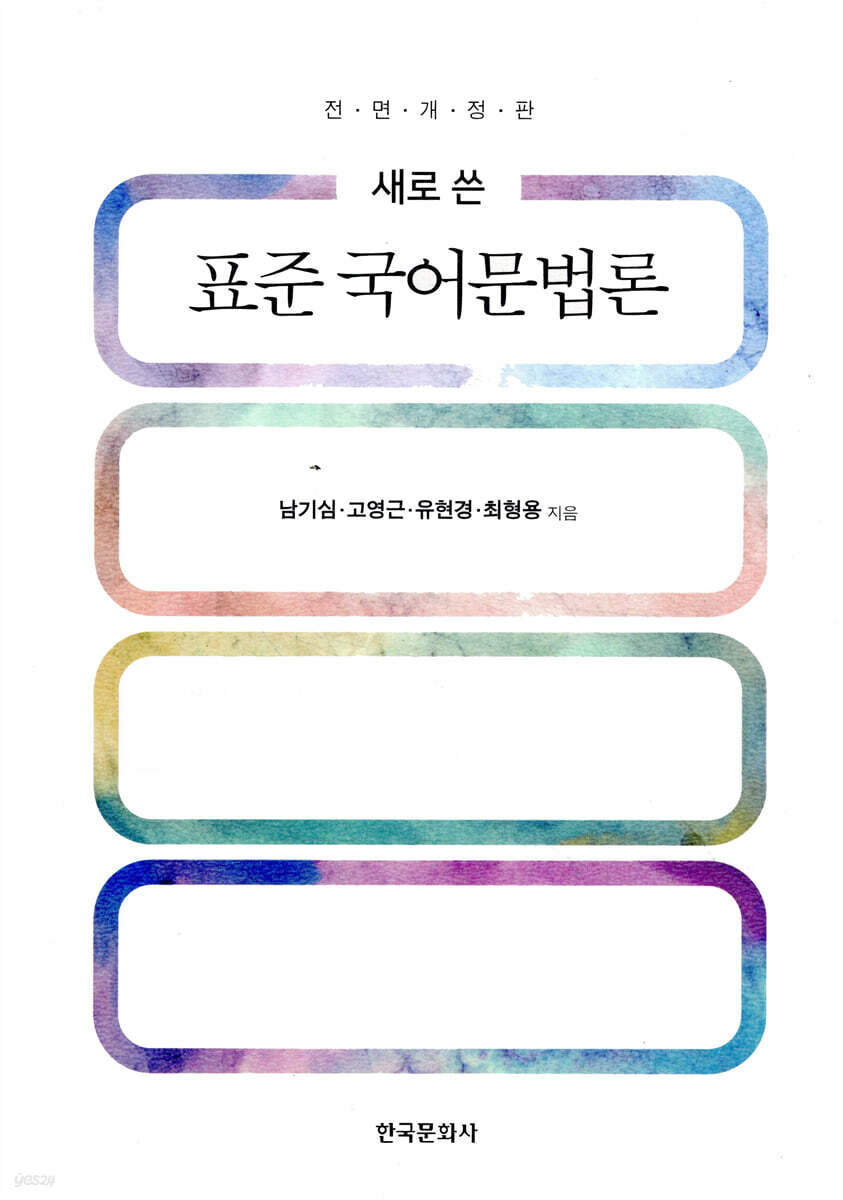
Standard Korean Grammar
 |
Description
Book Introduction
Since the launch of the national grammar in 1985, Standard Korean Grammar has faithfully fulfilled its role as a basic textbook for both school grammar and academic grammar for nearly 35 years.
We have continuously strived to reflect the changing grammar research at home and abroad by publishing revised editions in 1993, 2011, and 2014.
However, it is true that there were limitations to the content and scope of the revision as it was done by maintaining the framework of the first edition in 1985 and adding or subtracting content within it.
The [Completely Revised Edition], which is being published this time, lives up to its name by revising and supplementing not only the content but also the overall system, while inheriting the spirit of the first edition from 1985, it focuses on more actively reflecting the rapidly changing trends in grammar research both domestically and internationally.
At the same time, as we return to the era of textbook certification, we have tried to respond to the direction and demands of school grammar.
To achieve this, we recruited new authors and established a separate research team to regularly and openly discuss opinions, ensuring a certain level of consensus was reached even on the use of a single example or term.
As a result, the total composition of 13 chapters is the same as before, but morphology was divided into 6 chapters instead of the existing 7 chapters, and syntax was divided into 6 chapters instead of the existing 3 chapters to achieve a balance in terms of structure.
Meanwhile, the general introduction section, which was divided into three chapters, was simplified into one chapter to maximize the concentration of the content.
Additionally, unlike before, a separate space has been provided in the main text to allow for in-depth discussion and diverse discussions.
This is to maintain the theoretical framework of the first edition while incorporating recent research issues by presenting in-depth grammatical knowledge through in-depth boxes.
Footnotes were separated from content notes and reference notes that had been mixed together until then.
Therefore, footnotes were composed only of content notes that are helpful in understanding the main text.
Instead, those that have a reference format are grouped separately as 'Further Reading' at the end of the chapter, and are systematized so that they can be reviewed from a historical perspective by organizing them into topics.
Practice and inquiry problems, which are among the most intensive parts of this revision, are structured in a step-by-step manner to foster inquiry skills by starting from an understanding of the text and directly applying them to linguistic phenomena.
At this time, by presenting a wide range of actual language materials, the theory and practice were arranged to be in harmony.
Additionally, to improve readability for readers, the format was enlarged and colors were added to make the content stand out.
The full support of the Korean Cultural Center was a great help in successfully carrying out this work for a relatively long period of time.
We would like to express our sincere gratitude for your consideration in accommodating all the demanding requirements of the new writing team, down to the specific details of design and editing, which are the publisher's exclusive rights, and for giving top priority to the work related to the [Completely Revised Edition] despite the tight schedule.
I would also like to express my special gratitude to Professors Oh Gyu-hwan and Kim Min-guk, who, as researchers, meticulously reviewed the entire content, selected and organized 'further reading material,' and developed and reviewed practice and inquiry problems.
We have continuously strived to reflect the changing grammar research at home and abroad by publishing revised editions in 1993, 2011, and 2014.
However, it is true that there were limitations to the content and scope of the revision as it was done by maintaining the framework of the first edition in 1985 and adding or subtracting content within it.
The [Completely Revised Edition], which is being published this time, lives up to its name by revising and supplementing not only the content but also the overall system, while inheriting the spirit of the first edition from 1985, it focuses on more actively reflecting the rapidly changing trends in grammar research both domestically and internationally.
At the same time, as we return to the era of textbook certification, we have tried to respond to the direction and demands of school grammar.
To achieve this, we recruited new authors and established a separate research team to regularly and openly discuss opinions, ensuring a certain level of consensus was reached even on the use of a single example or term.
As a result, the total composition of 13 chapters is the same as before, but morphology was divided into 6 chapters instead of the existing 7 chapters, and syntax was divided into 6 chapters instead of the existing 3 chapters to achieve a balance in terms of structure.
Meanwhile, the general introduction section, which was divided into three chapters, was simplified into one chapter to maximize the concentration of the content.
Additionally, unlike before, a separate space has been provided in the main text to allow for in-depth discussion and diverse discussions.
This is to maintain the theoretical framework of the first edition while incorporating recent research issues by presenting in-depth grammatical knowledge through in-depth boxes.
Footnotes were separated from content notes and reference notes that had been mixed together until then.
Therefore, footnotes were composed only of content notes that are helpful in understanding the main text.
Instead, those that have a reference format are grouped separately as 'Further Reading' at the end of the chapter, and are systematized so that they can be reviewed from a historical perspective by organizing them into topics.
Practice and inquiry problems, which are among the most intensive parts of this revision, are structured in a step-by-step manner to foster inquiry skills by starting from an understanding of the text and directly applying them to linguistic phenomena.
At this time, by presenting a wide range of actual language materials, the theory and practice were arranged to be in harmony.
Additionally, to improve readability for readers, the format was enlarged and colors were added to make the content stand out.
The full support of the Korean Cultural Center was a great help in successfully carrying out this work for a relatively long period of time.
We would like to express our sincere gratitude for your consideration in accommodating all the demanding requirements of the new writing team, down to the specific details of design and editing, which are the publisher's exclusive rights, and for giving top priority to the work related to the [Completely Revised Edition] despite the tight schedule.
I would also like to express my special gratitude to Professors Oh Gyu-hwan and Kim Min-guk, who, as researchers, meticulously reviewed the entire content, selected and organized 'further reading material,' and developed and reviewed practice and inquiry problems.
- You can preview some of the book's contents.
Preview
index
1.
Korean language and Korean grammar
1.1.
Language and Korean
1.2.
grammar
1.3.
Characteristics of the Korean language
2.
Morphemes and words
2.1.
morpheme
2.2.
word
3.
Nouns and particles
3.1.
Noun
3.2.
inspection
4.
Verbs and endings
4.1.
Verb
4.2.
ending of a word
5.
Modifiers, independent words, and parts of speech
5.1.
Modifier
5.2.
Independence speech
5.3.
Common parts of speech
6.
Word structure and materials for word formation
6.1.
word structure
6.2.
Materials for word formation
7.
Derivative and synthetic methods
7.1.
Derivatives
7.2.
Synthesis method
8.
Sentence components and basic sentence patterns
8.1.
Sentence elements and materials
8.2.
chief ingredient
8.3.
accessory ingredients
8.4.
Independent component
8.5.
Basic sentence patterns
9.
Sentence types and structure
9.1.
Sentence types
9.2.
Sentence structure
10.
Tense, action, and aspect
10.1.
tense
10.2.
Action
10.3.
mode
11.
Honorifics
11.1.
elevate the subject
11.2.
Elevate objects
11.3.
Relative honorifics
11.4.
expression of humility
11.5.
Honorific expressions using special vocabulary
12.
causative and passive voice
12.1.
Sadongmun
12.2.
Passive sentence
13.
Negative sentences
13.1.
Scope and types of negative sentences
13.2.
Characteristics of each type of negative sentence
Korean language and Korean grammar
1.1.
Language and Korean
1.2.
grammar
1.3.
Characteristics of the Korean language
2.
Morphemes and words
2.1.
morpheme
2.2.
word
3.
Nouns and particles
3.1.
Noun
3.2.
inspection
4.
Verbs and endings
4.1.
Verb
4.2.
ending of a word
5.
Modifiers, independent words, and parts of speech
5.1.
Modifier
5.2.
Independence speech
5.3.
Common parts of speech
6.
Word structure and materials for word formation
6.1.
word structure
6.2.
Materials for word formation
7.
Derivative and synthetic methods
7.1.
Derivatives
7.2.
Synthesis method
8.
Sentence components and basic sentence patterns
8.1.
Sentence elements and materials
8.2.
chief ingredient
8.3.
accessory ingredients
8.4.
Independent component
8.5.
Basic sentence patterns
9.
Sentence types and structure
9.1.
Sentence types
9.2.
Sentence structure
10.
Tense, action, and aspect
10.1.
tense
10.2.
Action
10.3.
mode
11.
Honorifics
11.1.
elevate the subject
11.2.
Elevate objects
11.3.
Relative honorifics
11.4.
expression of humility
11.5.
Honorific expressions using special vocabulary
12.
causative and passive voice
12.1.
Sadongmun
12.2.
Passive sentence
13.
Negative sentences
13.1.
Scope and types of negative sentences
13.2.
Characteristics of each type of negative sentence
GOODS SPECIFICS
- Date of issue: February 25, 2019
- Page count, weight, size: Checking page count | 175*250*35mm
- ISBN13: 9788968177231
- ISBN10: 8968177236
You may also like
카테고리
korean


korean

![ELLE 엘르 스페셜 에디션 A형 : 12월 [2025]](http://librairie.coreenne.fr/cdn/shop/files/b8e27a3de6c9538896439686c6b0e8fb.jpg?v=1766436872&width=3840)


