

Social Skills Instruction Manual
 |
Description
Book Introduction
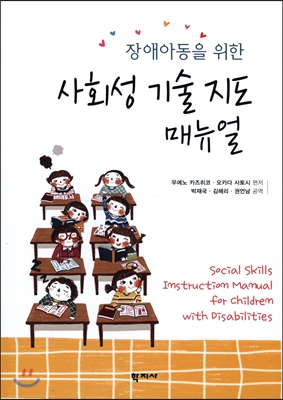
This book broadly divides social skills into four areas: group behavior, self-regulation, peer relationships, and communication. It carefully selects specific cases in each area where children with developmental disabilities actually experience difficulties, and presents specific guidance content and methods in the form of an easy-to-understand manual.
In addition, to help children with disabilities understand, we provide a variety of illustrations as well as a variety of play activities and worksheets that children can experience and perform themselves, thereby personally practicing experience- and activity-centered education.
In addition, to help children with disabilities understand, we provide a variety of illustrations as well as a variety of play activities and worksheets that children can experience and perform themselves, thereby personally practicing experience- and activity-centered education.
index
Translator's Preface
Editor's Preface
PART 1: What You Need to Know Before You Start Teaching Social Skills
1.
Reasons for implementing social skills guidance
2.
Children called mildly developmentally disabled
3.
Coaching methods based on theory of mind and behaviorist theories
4.
Social Skills Guidance
5.
Focus of Social Skills Instruction
6.
Evaluation of Social Skills Instruction
PART 2 Social Skills Guidance Program
No. 1 Goal Setting/Group Action, Self-Regulation, Peer Relationships, Communication
No.2 Greeting/Group Action
No.3 View/Self-regulation
No.4 Listening/Self-regulation
No.5 Losing/Self-control
No.6 Breaking the rules/Self-control
No. 7 Presentation/Collective Action/Communication
No.8 Listening to stories/collective action
No.9 Talking/Communicating
No. 10 Borrowing Items/Collective Action
No.11 Making Friends/Peer Relationships
No. 12 Self-introduction/Group action
No.13 Remembering names/Peer relationships
No. 14 Calling names and responding / Peer relationships and communication
No. 15 Knowing Good and Bad Words / Group Behavior, Self-Regulation, Peer Relationships, and Communication
No.16 Moving with Friends/Peer Relationships
No. 17 Giving and Receiving Help/Peer Relationships
No. 18 Regulating Various Emotions/Self-Regulation
No. 19 Decision-making/Communication Together
No. 20 Understanding Social Skills/Group Behavior, Self-Regulation, Peer Relationships, and Communication
No. 21 Communicating in an Easy-to-Understand Way
No.22 Suggestion/Communication
No.23 Listening/Communication
No.24 Emotion Guessing/Self-Regulation
No. 25 Cooperation to Accomplish Things / Peer Relationships
No. 26 Finding Commonalities Between You and Your Partner/Peer Relationships
No.27 Knowing Friends/Peer Relationships
No.28 Self-expression/Peer relationships
No. 29 Problem Solving/Group Action, Self-Regulation, Peer Relations, Communication
No.30 Sharing Opinions/Communication
No.31 Try to understand the other person's feelings/Peer relationships
No. 32 Reading Other People's Minds/Peer Relationships/Communication
No. 33 Empathy/Self, Peers, Communication
No.34 Coping with Stress/Self-Regulation
No. 35 Understanding Common Sense and Nonsense / Group Action
No. 36 Learning Conversational Manners/Peer Relationships and Communication
No. 37 Learning Collaboration Skills/Peer Relationships and Communication
No. 38 Expressing Gratitude/Peer Relationships/Communication
Appendix [For Elementary and Middle School Students] Social Skills Scale
Editor's Preface
PART 1: What You Need to Know Before You Start Teaching Social Skills
1.
Reasons for implementing social skills guidance
2.
Children called mildly developmentally disabled
3.
Coaching methods based on theory of mind and behaviorist theories
4.
Social Skills Guidance
5.
Focus of Social Skills Instruction
6.
Evaluation of Social Skills Instruction
PART 2 Social Skills Guidance Program
No. 1 Goal Setting/Group Action, Self-Regulation, Peer Relationships, Communication
No.2 Greeting/Group Action
No.3 View/Self-regulation
No.4 Listening/Self-regulation
No.5 Losing/Self-control
No.6 Breaking the rules/Self-control
No. 7 Presentation/Collective Action/Communication
No.8 Listening to stories/collective action
No.9 Talking/Communicating
No. 10 Borrowing Items/Collective Action
No.11 Making Friends/Peer Relationships
No. 12 Self-introduction/Group action
No.13 Remembering names/Peer relationships
No. 14 Calling names and responding / Peer relationships and communication
No. 15 Knowing Good and Bad Words / Group Behavior, Self-Regulation, Peer Relationships, and Communication
No.16 Moving with Friends/Peer Relationships
No. 17 Giving and Receiving Help/Peer Relationships
No. 18 Regulating Various Emotions/Self-Regulation
No. 19 Decision-making/Communication Together
No. 20 Understanding Social Skills/Group Behavior, Self-Regulation, Peer Relationships, and Communication
No. 21 Communicating in an Easy-to-Understand Way
No.22 Suggestion/Communication
No.23 Listening/Communication
No.24 Emotion Guessing/Self-Regulation
No. 25 Cooperation to Accomplish Things / Peer Relationships
No. 26 Finding Commonalities Between You and Your Partner/Peer Relationships
No.27 Knowing Friends/Peer Relationships
No.28 Self-expression/Peer relationships
No. 29 Problem Solving/Group Action, Self-Regulation, Peer Relations, Communication
No.30 Sharing Opinions/Communication
No.31 Try to understand the other person's feelings/Peer relationships
No. 32 Reading Other People's Minds/Peer Relationships/Communication
No. 33 Empathy/Self, Peers, Communication
No.34 Coping with Stress/Self-Regulation
No. 35 Understanding Common Sense and Nonsense / Group Action
No. 36 Learning Conversational Manners/Peer Relationships and Communication
No. 37 Learning Collaboration Skills/Peer Relationships and Communication
No. 38 Expressing Gratitude/Peer Relationships/Communication
Appendix [For Elementary and Middle School Students] Social Skills Scale
Publisher's Review
The proposition that "humans are social animals" is an immutable truth regardless of the times, and "sociality" is considered an essential ability required for human survival.
Therefore, the aspect of ‘acquisition and improvement of social skills’ can be said to be a common major goal of special education and general education.
Given that the ultimate goal of special education is the social participation and independence of children with disabilities, teaching social skills is a cross-curricular educational content and a primary educational goal in the school curriculum. However, despite its importance, many in the field say that putting it into practice is difficult and daunting.
Providing a specific and systematic social skills improvement program for children with developmental disabilities such as high-functioning autism and Asperger's syndrome, which show a significant lack of social skills compared to other abilities, as well as learning disabilities and attention deficit hyperactivity disorder, is undoubtedly one way to relieve the frustration and thirst of teachers and parents in the field.
This book broadly divides social skills into four areas: group behavior, self-regulation, peer relationships, and communication. It carefully selects specific cases in each area where children with developmental disabilities actually experience difficulties, and presents specific guidance content and methods in the form of an easy-to-understand manual.
In addition, to help children with disabilities understand, we provide a variety of illustrations as well as a variety of play activities and worksheets that children can experience and practice directly, thereby personally practicing experience- and activity-centered education.
Therefore, I believe that this book can be a meaningful and useful practical manual for teachers, parents, and related personnel who are struggling with children with disabilities who have difficulty adapting to society in general, including interpersonal relationships and communication, due to lack of social skills, and who are struggling and making efforts to teach their social skills even at this very moment.
Therefore, the aspect of ‘acquisition and improvement of social skills’ can be said to be a common major goal of special education and general education.
Given that the ultimate goal of special education is the social participation and independence of children with disabilities, teaching social skills is a cross-curricular educational content and a primary educational goal in the school curriculum. However, despite its importance, many in the field say that putting it into practice is difficult and daunting.
Providing a specific and systematic social skills improvement program for children with developmental disabilities such as high-functioning autism and Asperger's syndrome, which show a significant lack of social skills compared to other abilities, as well as learning disabilities and attention deficit hyperactivity disorder, is undoubtedly one way to relieve the frustration and thirst of teachers and parents in the field.
This book broadly divides social skills into four areas: group behavior, self-regulation, peer relationships, and communication. It carefully selects specific cases in each area where children with developmental disabilities actually experience difficulties, and presents specific guidance content and methods in the form of an easy-to-understand manual.
In addition, to help children with disabilities understand, we provide a variety of illustrations as well as a variety of play activities and worksheets that children can experience and practice directly, thereby personally practicing experience- and activity-centered education.
Therefore, I believe that this book can be a meaningful and useful practical manual for teachers, parents, and related personnel who are struggling with children with disabilities who have difficulty adapting to society in general, including interpersonal relationships and communication, due to lack of social skills, and who are struggling and making efforts to teach their social skills even at this very moment.
GOODS SPECIFICS
- Date of publication: October 20, 2015
- Page count, weight, size: 172 pages | 396g | 188*254*10mm
- ISBN13: 9788999708176
- ISBN10: 8999708179
You may also like
카테고리
korean


korean

![ELLE 엘르 스페셜 에디션 A형 : 12월 [2025]](http://librairie.coreenne.fr/cdn/shop/files/b8e27a3de6c9538896439686c6b0e8fb.jpg?v=1766436872&width=3840)


