

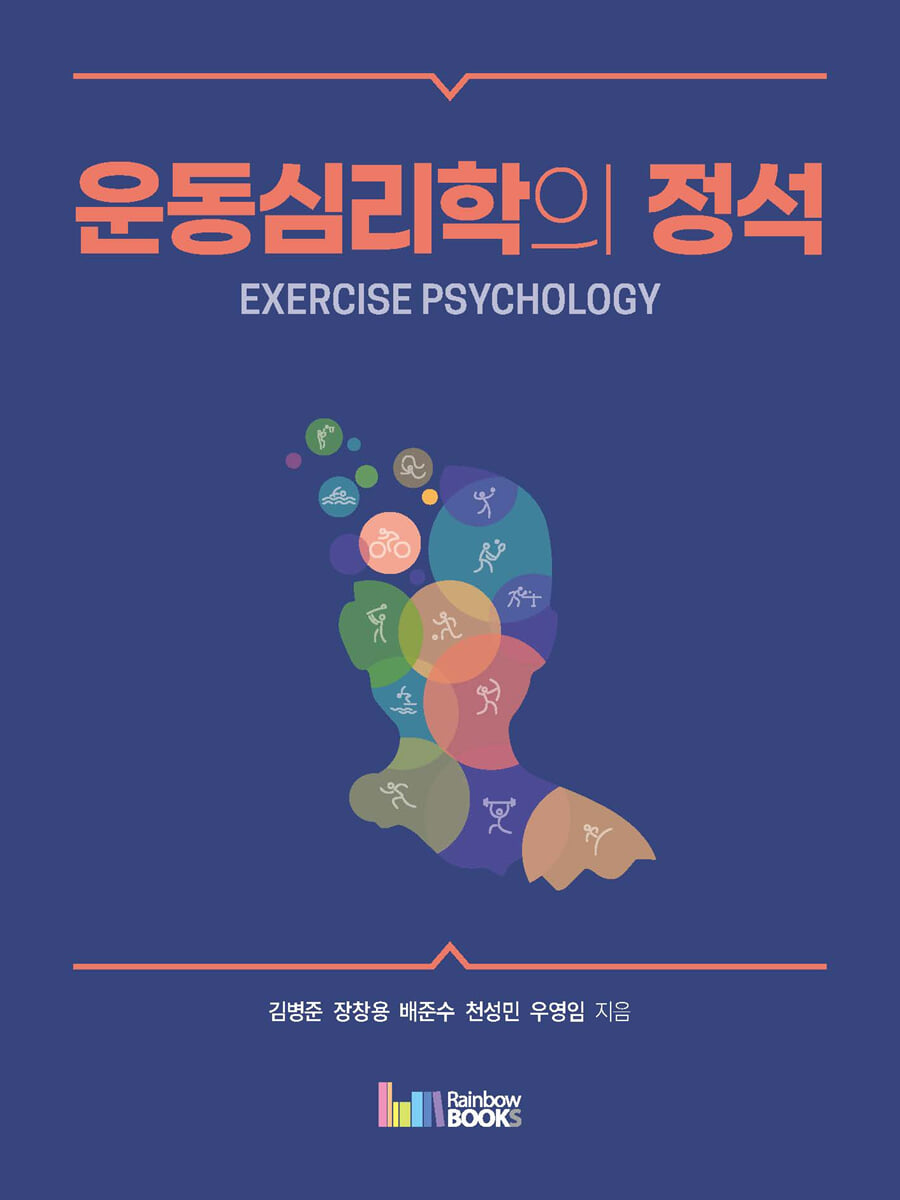
The classics of exercise psychology
 |
Description
Book Introduction
This book offers deep insights into why people don't exercise, along with practical solutions to how to start and sustain exercise.
Exercise psychology is a field that studies the perception of exercise practice, the psychological effects of exercise, theoretical explanations related to exercise practice, and strategies for promoting exercise practice.
This book is largely divided into introduction, theory, intervention, and effectiveness, and consists of 13 chapters.
Exercise psychology is a field that studies the perception of exercise practice, the psychological effects of exercise, theoretical explanations related to exercise practice, and strategies for promoting exercise practice.
This book is largely divided into introduction, theory, intervention, and effectiveness, and consists of 13 chapters.
- You can preview some of the book's contents.
Preview
index
Part 1 Introduction
Chapter 1: Introduction to Exercise Psychology
01 Definition of Exercise Psychology 5
02 Developments in Exercise Psychology 8
03 Effects of Exercise 11
04 Exercise practice rate 14
05 Academic Societies and Journals 17
06 Exercise Guidelines 20
07 Key Concepts 27
References / Review Questions / Practice Assignments / Evaluation Questions / Model Answers 29
Chapter 2 Measurement of Physical Activity
01 Key Concepts 41
02 Physical Activity Intensity Classification 42
03 Physical Activity Measurement Method 44
04 Measurement Method Utilization Guidelines 62
References / Review Questions / Practice Assignments / Evaluation Questions / Model Answers 67
Part 2 Theory
Chapter 3 Exercise Practice Theory I
01 Health Belief Model 81
02 Stimulus-Response Theory 88
03 Theory of Reasoned Action and Theory of Planned Behavior 92
References / Review Questions / Practice Assignments / Evaluation Questions / Model Answers 98
Chapter 4 Exercise Practice Theory II
01 Self-Efficacy Theory 109
02 Self-Determination Theory 118
References / Review Questions / Practice Assignments / Evaluation Questions / Model Answers 130
Chapter 5: Integration Theory
01 Stages of Change Theory 143
02 Social Ecology Theory 153
References / Review Questions / Practice Assignments / Evaluation Questions / Model Answers 165
Part 3: Arbitration
Chapter 6: Factors in Exercise Practice
01 Personal Factors 179
02 Environmental Factors 183
03 Psychological Factors 193
04 Exercise Characteristics Factor 195
05 Exercise Disturbances 196
06 Implications 199
References / Review Questions / Assessment Questions / Model Answers 200
Chapter 7 Exercise Practice Intervention Strategies
01 Arbitration Strategy Design Step 211
02 Theory-Based Mediation Strategy 219
03 Behavior Modification Strategies 222
04 Cognitive Strategy 226
05 Intrinsic Motivation Strategy 229
06 Implications 232
References / Review Questions / Practice Assignments / Evaluation Questions / Model Answers 233
Part 4: Effects
Chapter 8 Exercise, Personality, and Cognitive Function
01 Understanding Personality 245
02 Personality Factors and Exercise 249
03 Personality Traits and Exercise 253
04 Exercise and Cognitive Function 261
05 Mechanism 266
06 Summary 268
References / Review Questions / Practice Assignments / Evaluation Questions / Model Answers 270
Chapter 9 Exercise and Self-Esteem
01 Concept Classification 285
02 Theory Development 287
03 Measuring Tools 289
04 Exercise and Self-Esteem 295
05 Mechanism 300
06 Summary 303
References / Review Questions / Practice Assignments / Evaluation Questions / Model Answers 304
Chapter 10 Exercise and Stress
01 Understanding Stress 319
02 The Relationship Between Stress and Psychological and Physiological Responses 322
03 Stress Measurement and Assessment 327
04 Mechanisms of Exercise and Stress 331
05 Exercise for Stress Management 335
References / Review Questions / Practice Assignments / Evaluation Questions / Model Answers 338
Chapter 11 Exercise and Anxiety
01 Understanding Anxiety 351
02 Symptoms, Measurement, and Treatment of Anxiety 356
03 Exercise and Anxiety 362
04 Exercise Mechanisms for Anxiety Improvement 367
05 Anxiety Sensitivity 369
References / Review Questions / Practice Assignments / Evaluation Questions / Model Answers 372
Chapter 12 Exercise and Depression
01 Understanding Depression 385
02 Causes of Depression 390
03 Measurement and Assessment of Depression 393
04 Exercise Mechanisms for Improving Depression 396
05 Treatment for Depression 398
06 The Relationship Between Exercise and Depression 399
References / Review Questions / Practice Assignments / Evaluation Questions / Model Answers 406
Chapter 13: Exercise and Emotion
01 Concept Classification 419
02 Measurement of Emotions 423
03 The Relationship Between Exercise and Emotions 427
04 Exercise and Emotional Change Mechanisms 433
05 Exercise Addiction 438
References / Review Questions / Practice Assignments / Evaluation Questions / Model Answers 443
Chapter 1: Introduction to Exercise Psychology
01 Definition of Exercise Psychology 5
02 Developments in Exercise Psychology 8
03 Effects of Exercise 11
04 Exercise practice rate 14
05 Academic Societies and Journals 17
06 Exercise Guidelines 20
07 Key Concepts 27
References / Review Questions / Practice Assignments / Evaluation Questions / Model Answers 29
Chapter 2 Measurement of Physical Activity
01 Key Concepts 41
02 Physical Activity Intensity Classification 42
03 Physical Activity Measurement Method 44
04 Measurement Method Utilization Guidelines 62
References / Review Questions / Practice Assignments / Evaluation Questions / Model Answers 67
Part 2 Theory
Chapter 3 Exercise Practice Theory I
01 Health Belief Model 81
02 Stimulus-Response Theory 88
03 Theory of Reasoned Action and Theory of Planned Behavior 92
References / Review Questions / Practice Assignments / Evaluation Questions / Model Answers 98
Chapter 4 Exercise Practice Theory II
01 Self-Efficacy Theory 109
02 Self-Determination Theory 118
References / Review Questions / Practice Assignments / Evaluation Questions / Model Answers 130
Chapter 5: Integration Theory
01 Stages of Change Theory 143
02 Social Ecology Theory 153
References / Review Questions / Practice Assignments / Evaluation Questions / Model Answers 165
Part 3: Arbitration
Chapter 6: Factors in Exercise Practice
01 Personal Factors 179
02 Environmental Factors 183
03 Psychological Factors 193
04 Exercise Characteristics Factor 195
05 Exercise Disturbances 196
06 Implications 199
References / Review Questions / Assessment Questions / Model Answers 200
Chapter 7 Exercise Practice Intervention Strategies
01 Arbitration Strategy Design Step 211
02 Theory-Based Mediation Strategy 219
03 Behavior Modification Strategies 222
04 Cognitive Strategy 226
05 Intrinsic Motivation Strategy 229
06 Implications 232
References / Review Questions / Practice Assignments / Evaluation Questions / Model Answers 233
Part 4: Effects
Chapter 8 Exercise, Personality, and Cognitive Function
01 Understanding Personality 245
02 Personality Factors and Exercise 249
03 Personality Traits and Exercise 253
04 Exercise and Cognitive Function 261
05 Mechanism 266
06 Summary 268
References / Review Questions / Practice Assignments / Evaluation Questions / Model Answers 270
Chapter 9 Exercise and Self-Esteem
01 Concept Classification 285
02 Theory Development 287
03 Measuring Tools 289
04 Exercise and Self-Esteem 295
05 Mechanism 300
06 Summary 303
References / Review Questions / Practice Assignments / Evaluation Questions / Model Answers 304
Chapter 10 Exercise and Stress
01 Understanding Stress 319
02 The Relationship Between Stress and Psychological and Physiological Responses 322
03 Stress Measurement and Assessment 327
04 Mechanisms of Exercise and Stress 331
05 Exercise for Stress Management 335
References / Review Questions / Practice Assignments / Evaluation Questions / Model Answers 338
Chapter 11 Exercise and Anxiety
01 Understanding Anxiety 351
02 Symptoms, Measurement, and Treatment of Anxiety 356
03 Exercise and Anxiety 362
04 Exercise Mechanisms for Anxiety Improvement 367
05 Anxiety Sensitivity 369
References / Review Questions / Practice Assignments / Evaluation Questions / Model Answers 372
Chapter 12 Exercise and Depression
01 Understanding Depression 385
02 Causes of Depression 390
03 Measurement and Assessment of Depression 393
04 Exercise Mechanisms for Improving Depression 396
05 Treatment for Depression 398
06 The Relationship Between Exercise and Depression 399
References / Review Questions / Practice Assignments / Evaluation Questions / Model Answers 406
Chapter 13: Exercise and Emotion
01 Concept Classification 419
02 Measurement of Emotions 423
03 The Relationship Between Exercise and Emotions 427
04 Exercise and Emotional Change Mechanisms 433
05 Exercise Addiction 438
References / Review Questions / Practice Assignments / Evaluation Questions / Model Answers 443
Publisher's Review
introduction
With approximately 72% of adults worldwide meeting the WHO (2022) recommended levels of physical activity, healthy movement is now deeply ingrained in our daily lives.
The fact that the exercise participation rate among adults has surpassed 70% is truly a remarkable change compared to just a few decades ago, when it was around 20-30%.
Today, exercise goes beyond simply promoting health and has become an important medium for revealing personal identity and forming social relationships.
People satisfy their innate need to belong to a community through exercise, and social media authentication culture is further accelerating this phenomenon.
Whereas luxury goods and travel were once symbols of social display, exercise is now taking their place.
The popularization of running, the spread of crew culture, and the emergence of the new term "fashion runner" demonstrate that exercise has gone beyond a simple habit to become a cultural trend and lifestyle.
But behind this craze, one question remains.
'Why are we so fascinated by exercise?' The answer lies in the psychological and social value exercise brings to humanity.
Nevertheless, traditional sports psychology has focused on competition and victory, making it difficult to fully address the needs of modern people seeking health and well-being.
《The Essentials of Exercise Psychology》 aims to fill this gap.
This book offers deep insights into why people don't exercise, along with practical solutions to how to start and sustain exercise.
Exercise psychology is a field that studies the perception of exercise practice, the psychological effects of exercise, theoretical explanations related to exercise practice, and strategies for promoting exercise practice.
This book is largely divided into introduction, theory, intervention, and effectiveness, and consists of 13 chapters.
[Part 1 Introduction] explains the concept and necessity of exercise psychology (Chapter 1) and covers how to measure physical activity (Chapter 2).
[Part 2: Theory] covers various behavioral theories to understand and explain exercise practice.
This book systematically organizes the health belief model, stimulus-response theory, planned behavior theory, self-efficacy theory, self-determination theory, stages of change theory, and social ecological theory (Chapters 3-5).
[Part 3: Mediation] examines the influence of individual and environmental factors on exercise practice (Chapter 6) and introduces specific mediation strategies based on this (Chapter 7).
finally
[Part 4: Effects] covers the psychological effects of exercise on humans.
This book organizes the personality and cognitive functions, self-esteem, stress, anxiety, depression, and emotions related to exercise by topic, and highlights the psychological value of exercise based on related research (Chapters 8-13).
《The Essentials of Exercise Psychology》 strives to contain both academic depth and practicality.
It is written not only for those majoring in physical education and psychology, but also for professionals working in the field and anyone who wants to improve their quality of life through exercise.
Additionally, each chapter includes key concepts, review problems, discussion questions, and projects to ensure that this book can be used as a textbook in classroom settings.
Above all, we focused on improving readability by drawing on the latest research and empirical evidence to ensure easy understanding for readers.
Exercise is more than just the act of moving the body; it is the result of the interaction between the human mind and the external environment.
I hope this book will help you understand the psychological value of exercise and serve as a solid companion on your journey to creating sustainable exercise habits.
Many people's interest and effort went into bringing this book to light.
I would like to express my deepest gratitude to Rainbow Books CEO Min Seon-hong, who took charge of publishing and supported me with encouragement and trust until the very end.
I would also like to express my deepest gratitude to Professors Song Jae-kyung, Lee Bo-yeon, Lee Ji-yeon, Bang Jun-hyeok, Choi Yu-jeong, and Lee Jeong-mu of Inha University, and Professors Baek Seung-min, Yang Won-jun, and Park Kang-ju of Kyungkuk National University for their support during the research and writing process.
I believe this process will be of great help in my future research journey.
September 2025
All authors
With approximately 72% of adults worldwide meeting the WHO (2022) recommended levels of physical activity, healthy movement is now deeply ingrained in our daily lives.
The fact that the exercise participation rate among adults has surpassed 70% is truly a remarkable change compared to just a few decades ago, when it was around 20-30%.
Today, exercise goes beyond simply promoting health and has become an important medium for revealing personal identity and forming social relationships.
People satisfy their innate need to belong to a community through exercise, and social media authentication culture is further accelerating this phenomenon.
Whereas luxury goods and travel were once symbols of social display, exercise is now taking their place.
The popularization of running, the spread of crew culture, and the emergence of the new term "fashion runner" demonstrate that exercise has gone beyond a simple habit to become a cultural trend and lifestyle.
But behind this craze, one question remains.
'Why are we so fascinated by exercise?' The answer lies in the psychological and social value exercise brings to humanity.
Nevertheless, traditional sports psychology has focused on competition and victory, making it difficult to fully address the needs of modern people seeking health and well-being.
《The Essentials of Exercise Psychology》 aims to fill this gap.
This book offers deep insights into why people don't exercise, along with practical solutions to how to start and sustain exercise.
Exercise psychology is a field that studies the perception of exercise practice, the psychological effects of exercise, theoretical explanations related to exercise practice, and strategies for promoting exercise practice.
This book is largely divided into introduction, theory, intervention, and effectiveness, and consists of 13 chapters.
[Part 1 Introduction] explains the concept and necessity of exercise psychology (Chapter 1) and covers how to measure physical activity (Chapter 2).
[Part 2: Theory] covers various behavioral theories to understand and explain exercise practice.
This book systematically organizes the health belief model, stimulus-response theory, planned behavior theory, self-efficacy theory, self-determination theory, stages of change theory, and social ecological theory (Chapters 3-5).
[Part 3: Mediation] examines the influence of individual and environmental factors on exercise practice (Chapter 6) and introduces specific mediation strategies based on this (Chapter 7).
finally
[Part 4: Effects] covers the psychological effects of exercise on humans.
This book organizes the personality and cognitive functions, self-esteem, stress, anxiety, depression, and emotions related to exercise by topic, and highlights the psychological value of exercise based on related research (Chapters 8-13).
《The Essentials of Exercise Psychology》 strives to contain both academic depth and practicality.
It is written not only for those majoring in physical education and psychology, but also for professionals working in the field and anyone who wants to improve their quality of life through exercise.
Additionally, each chapter includes key concepts, review problems, discussion questions, and projects to ensure that this book can be used as a textbook in classroom settings.
Above all, we focused on improving readability by drawing on the latest research and empirical evidence to ensure easy understanding for readers.
Exercise is more than just the act of moving the body; it is the result of the interaction between the human mind and the external environment.
I hope this book will help you understand the psychological value of exercise and serve as a solid companion on your journey to creating sustainable exercise habits.
Many people's interest and effort went into bringing this book to light.
I would like to express my deepest gratitude to Rainbow Books CEO Min Seon-hong, who took charge of publishing and supported me with encouragement and trust until the very end.
I would also like to express my deepest gratitude to Professors Song Jae-kyung, Lee Bo-yeon, Lee Ji-yeon, Bang Jun-hyeok, Choi Yu-jeong, and Lee Jeong-mu of Inha University, and Professors Baek Seung-min, Yang Won-jun, and Park Kang-ju of Kyungkuk National University for their support during the research and writing process.
I believe this process will be of great help in my future research journey.
September 2025
All authors
GOODS SPECIFICS
- Date of issue: September 15, 2025
- Page count, weight, size: 480 pages | 180*240*30mm
- ISBN13: 9788962065800
- ISBN10: 8962065800
You may also like
카테고리
korean


korean

![GQ KOREA Mark (Monthly): December [2025]](http://librairie.coreenne.fr/cdn/shop/files/8ef265dbbfbf186523ed75ba7319009d.jpg?v=1765340328&width=3840)


