

Penetrating reasoning
 |
Description
Book Introduction
A Teacher's Reference Book that Can Be Applied Immediately to Real-World Classes
A must-read for students that will improve their skills in all subjects, starting with Korean.
A Citizen's Guide to Social Life
Reduce conflict and deepen conversations,
The power of life that engages us in social issues!
ㆍAre inference and reasoning the same or different?
ㆍWhy do we have difficulty communicating?
ㆍWhat efforts should I make to have a 'tactful' conversation?
ㆍWhy are linguistic clues necessary for effective inference?
How do investigators and judges arrive at the substantive truth?
When we talk about 'reasoning', we often think of it as a difficult and complex concept, a high-level activity that only experts can do.
However, reasoning is not the exclusive domain of those who have received special training; it is a thought process that we all experience constantly in our daily lives as we read, listen, speak, and write.
In all processes of listening, speaking, reading, and writing, inference is the most basic and important foundation, and when we learn how to understand and utilize its meaning, our language life can become much deeper and richer.
This book expands the concept of reasoning into a concept that connects with the communication that takes place in the real world.
When we talk to friends, read the news, discuss social issues, handle evidence in court, test scientific hypotheses, or interpret art and poetry, we each examine what inferences we are making and then clarify their meaning.
By connecting reasoning to contemporary linguistic phenomena, the authors emphasize that reasoning is not an abstract concept but is closely intertwined with our lives today.
A must-read for students that will improve their skills in all subjects, starting with Korean.
A Citizen's Guide to Social Life
Reduce conflict and deepen conversations,
The power of life that engages us in social issues!
ㆍAre inference and reasoning the same or different?
ㆍWhy do we have difficulty communicating?
ㆍWhat efforts should I make to have a 'tactful' conversation?
ㆍWhy are linguistic clues necessary for effective inference?
How do investigators and judges arrive at the substantive truth?
When we talk about 'reasoning', we often think of it as a difficult and complex concept, a high-level activity that only experts can do.
However, reasoning is not the exclusive domain of those who have received special training; it is a thought process that we all experience constantly in our daily lives as we read, listen, speak, and write.
In all processes of listening, speaking, reading, and writing, inference is the most basic and important foundation, and when we learn how to understand and utilize its meaning, our language life can become much deeper and richer.
This book expands the concept of reasoning into a concept that connects with the communication that takes place in the real world.
When we talk to friends, read the news, discuss social issues, handle evidence in court, test scientific hypotheses, or interpret art and poetry, we each examine what inferences we are making and then clarify their meaning.
By connecting reasoning to contemporary linguistic phenomena, the authors emphasize that reasoning is not an abstract concept but is closely intertwined with our lives today.
- You can preview some of the book's contents.
Preview
index
A word from the 'Conceptual Korean Language Life' project
preface
Class 1.
Why do we have trouble communicating?
Class 2.
How far can the meaning of inference be expanded or narrowed?
Are inference and reasoning the same or different?
What is the difference between reasoning and imagination?
What is inference?
Class 3.
Effective reasoning: how to do it?
How can we better understand the intent of a conversation?
What if the person you're talking to seems to be saying something out of the blue?
What efforts should we make to have a 'tactful' conversation?
Can the expressions in the text provide clues to inference?
Why are linguistic clues necessary for effective reasoning?
What linguistic clues are needed for inference?
In such cases, what kind of reasoning does this take - what does reasoning look like in different fields?
Poetry and Reasoning - Can Poetry Be Written with Facts Alone?
Law and Reasoning - How Do Investigators and Judges Get to the Substantive Truth?
Inferences from Politics and Economics - When things go well, you feel safe; when things don't go well, you feel anxious.
Inference in Science - What Does Scientific Research Methodology Mean for Inference in General?
Good reasoning that contributes to individuals and society
Note
References
preface
Class 1.
Why do we have trouble communicating?
Class 2.
How far can the meaning of inference be expanded or narrowed?
Are inference and reasoning the same or different?
What is the difference between reasoning and imagination?
What is inference?
Class 3.
Effective reasoning: how to do it?
How can we better understand the intent of a conversation?
What if the person you're talking to seems to be saying something out of the blue?
What efforts should we make to have a 'tactful' conversation?
Can the expressions in the text provide clues to inference?
Why are linguistic clues necessary for effective reasoning?
What linguistic clues are needed for inference?
In such cases, what kind of reasoning does this take - what does reasoning look like in different fields?
Poetry and Reasoning - Can Poetry Be Written with Facts Alone?
Law and Reasoning - How Do Investigators and Judges Get to the Substantive Truth?
Inferences from Politics and Economics - When things go well, you feel safe; when things don't go well, you feel anxious.
Inference in Science - What Does Scientific Research Methodology Mean for Inference in General?
Good reasoning that contributes to individuals and society
Note
References
Detailed image
Publisher's Review
From 'Reasons for Difficulty in Communication'
Up to 'effective reasoning methods'
Chapter 1 begins with examples of misunderstandings and conflicts that arise in everyday life, and examines the importance of understanding context and the ability to reason.
The authors examine the current linguistic reality of Korean society through the recent literacy controversy sparked by some netizens misinterpreting "three days" as "four days."
The essence of the so-called 'three-day debate' is not a simple lack of vocabulary, but 'the inability to understand the meaning of words in context.'
What's important in conversation or reading is not understanding vocabulary and sentences, but the ability to guess meaning based on context and situation without saying anything, and to read the hidden intentions and implications behind sentences.
This is what is called 'reasoning', and it is the core power that enables communication beyond simple understanding.
Chapter 2 explores the broader and deeper meaning of the concept of 'inference'.
First, the authors explain how inference is similar to and different from 'reasoning' or 'imagination', saying that inference is 'the act of finding out what is not revealed based on what is revealed'.
In the fields of logic and science, 'reasoning' and 'inference' are closely linked, but reasoning is more broadly extended to become an ability that operates in everyday life and overall thinking.
Furthermore, while 'imagination' is the power to create something new from nothing, 'inference' is distinguished in that it is the power to find hidden meaning based on given evidence.
Meanwhile, this chapter explains that deductive reasoning, inductive reasoning, and analogical reasoning play a key role in various fields such as scientific research, medical diagnosis, and legal judgment. However, all types of reasoning are equally important tools for enhancing human thinking and problem-solving abilities.
Furthermore, psychology uses reasoning to understand human cognitive processes and behavior, and the fields of artificial intelligence and machine learning implement automated reasoning processes through data analysis and pattern recognition. These diverse fields emphasize that reasoning is a fundamental principle that enables human thought and language understanding.
Chapter 3 specifically presents the conditions and methods necessary for ‘effective inference.’
First, it demonstrates the importance of 'conversational inference', the ability to read the hidden intentions or implied meanings in the other person's words in everyday conversation, through real-life examples.
On the surface, it may seem like a simple conversation, but misunderstandings and conflicts can arise when the nuances of speech or the context of the situation are not understood. The authors argue that solving these problems requires comprehensive thinking that captures not only verbal cues but also nonverbal elements such as facial expressions, intonation, and the situation.
It also presents case studies of how reasoning is applied in various fields such as literature, law, politics and economics, and science, and emphasizes that good reasoning is a process of thinking critically and creatively while being based on facts.
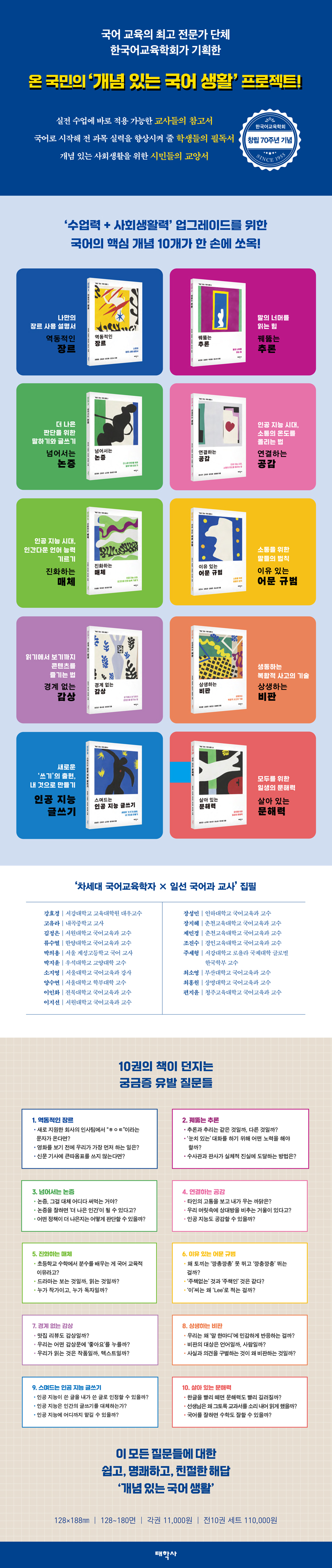
Korean Language Life with 'Concepts' (10 Volumes, Part 1)
"Conceptual Korean Language Life" is a publication by the Korean Language Education Society, Korea's first, best, and largest academic organization. To celebrate its 70th anniversary (launched as the "Korean Language Education Research Society" in 1955), the Society selects and publishes 20 of the most important "concepts" in Korean language education to summarize its academic achievements to date. The publication plan is to begin with the first 10 volumes in 2025, with the remaining 10 volumes to be completed in 2026.
This series was centered around the next generation of Korean language education scholars who will lead the Korean language education field and teachers who are leading the Korean language education field. It was planned with the goal of providing practical help not only to teachers and students in school education, but also to contribute to the language life of ordinary citizens by writing easy-to-understand content on the 'concepts' that are important in Korean language education.
Up to 'effective reasoning methods'
Chapter 1 begins with examples of misunderstandings and conflicts that arise in everyday life, and examines the importance of understanding context and the ability to reason.
The authors examine the current linguistic reality of Korean society through the recent literacy controversy sparked by some netizens misinterpreting "three days" as "four days."
The essence of the so-called 'three-day debate' is not a simple lack of vocabulary, but 'the inability to understand the meaning of words in context.'
What's important in conversation or reading is not understanding vocabulary and sentences, but the ability to guess meaning based on context and situation without saying anything, and to read the hidden intentions and implications behind sentences.
This is what is called 'reasoning', and it is the core power that enables communication beyond simple understanding.
Chapter 2 explores the broader and deeper meaning of the concept of 'inference'.
First, the authors explain how inference is similar to and different from 'reasoning' or 'imagination', saying that inference is 'the act of finding out what is not revealed based on what is revealed'.
In the fields of logic and science, 'reasoning' and 'inference' are closely linked, but reasoning is more broadly extended to become an ability that operates in everyday life and overall thinking.
Furthermore, while 'imagination' is the power to create something new from nothing, 'inference' is distinguished in that it is the power to find hidden meaning based on given evidence.
Meanwhile, this chapter explains that deductive reasoning, inductive reasoning, and analogical reasoning play a key role in various fields such as scientific research, medical diagnosis, and legal judgment. However, all types of reasoning are equally important tools for enhancing human thinking and problem-solving abilities.
Furthermore, psychology uses reasoning to understand human cognitive processes and behavior, and the fields of artificial intelligence and machine learning implement automated reasoning processes through data analysis and pattern recognition. These diverse fields emphasize that reasoning is a fundamental principle that enables human thought and language understanding.
Chapter 3 specifically presents the conditions and methods necessary for ‘effective inference.’
First, it demonstrates the importance of 'conversational inference', the ability to read the hidden intentions or implied meanings in the other person's words in everyday conversation, through real-life examples.
On the surface, it may seem like a simple conversation, but misunderstandings and conflicts can arise when the nuances of speech or the context of the situation are not understood. The authors argue that solving these problems requires comprehensive thinking that captures not only verbal cues but also nonverbal elements such as facial expressions, intonation, and the situation.
It also presents case studies of how reasoning is applied in various fields such as literature, law, politics and economics, and science, and emphasizes that good reasoning is a process of thinking critically and creatively while being based on facts.
Korean Language Life with 'Concepts' (10 Volumes, Part 1)
"Conceptual Korean Language Life" is a publication by the Korean Language Education Society, Korea's first, best, and largest academic organization. To celebrate its 70th anniversary (launched as the "Korean Language Education Research Society" in 1955), the Society selects and publishes 20 of the most important "concepts" in Korean language education to summarize its academic achievements to date. The publication plan is to begin with the first 10 volumes in 2025, with the remaining 10 volumes to be completed in 2026.
This series was centered around the next generation of Korean language education scholars who will lead the Korean language education field and teachers who are leading the Korean language education field. It was planned with the goal of providing practical help not only to teachers and students in school education, but also to contribute to the language life of ordinary citizens by writing easy-to-understand content on the 'concepts' that are important in Korean language education.
GOODS SPECIFICS
- Date of issue: October 18, 2025
- Page count, weight, size: 128 pages | 128*188*20mm
- ISBN13: 9791168103825
- ISBN10: 1168103827
You may also like
카테고리
korean


korean

![ELLE 엘르 스페셜 에디션 A형 : 12월 [2025]](http://librairie.coreenne.fr/cdn/shop/files/b8e27a3de6c9538896439686c6b0e8fb.jpg?v=1766436872&width=3840)


