

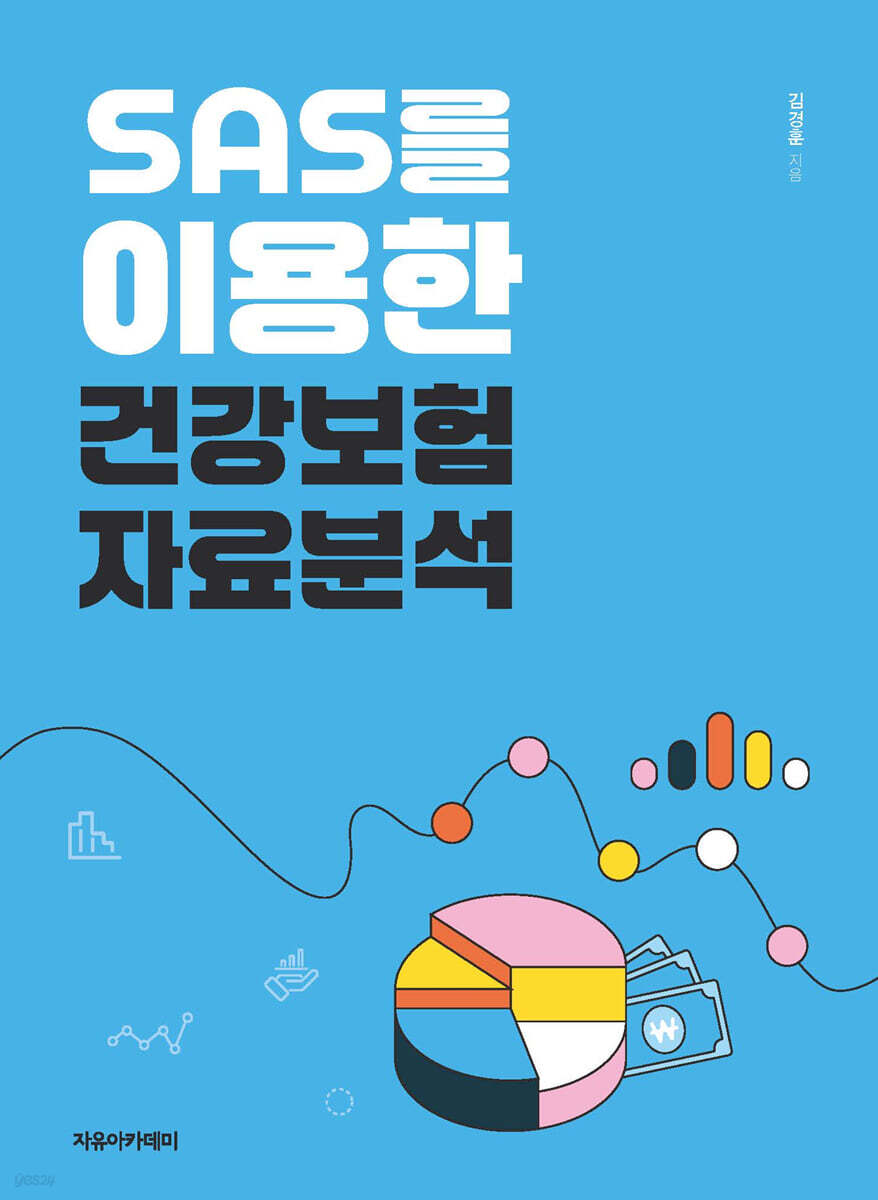
Health Insurance Data Analysis Using SAS
 |
Description
Book Introduction
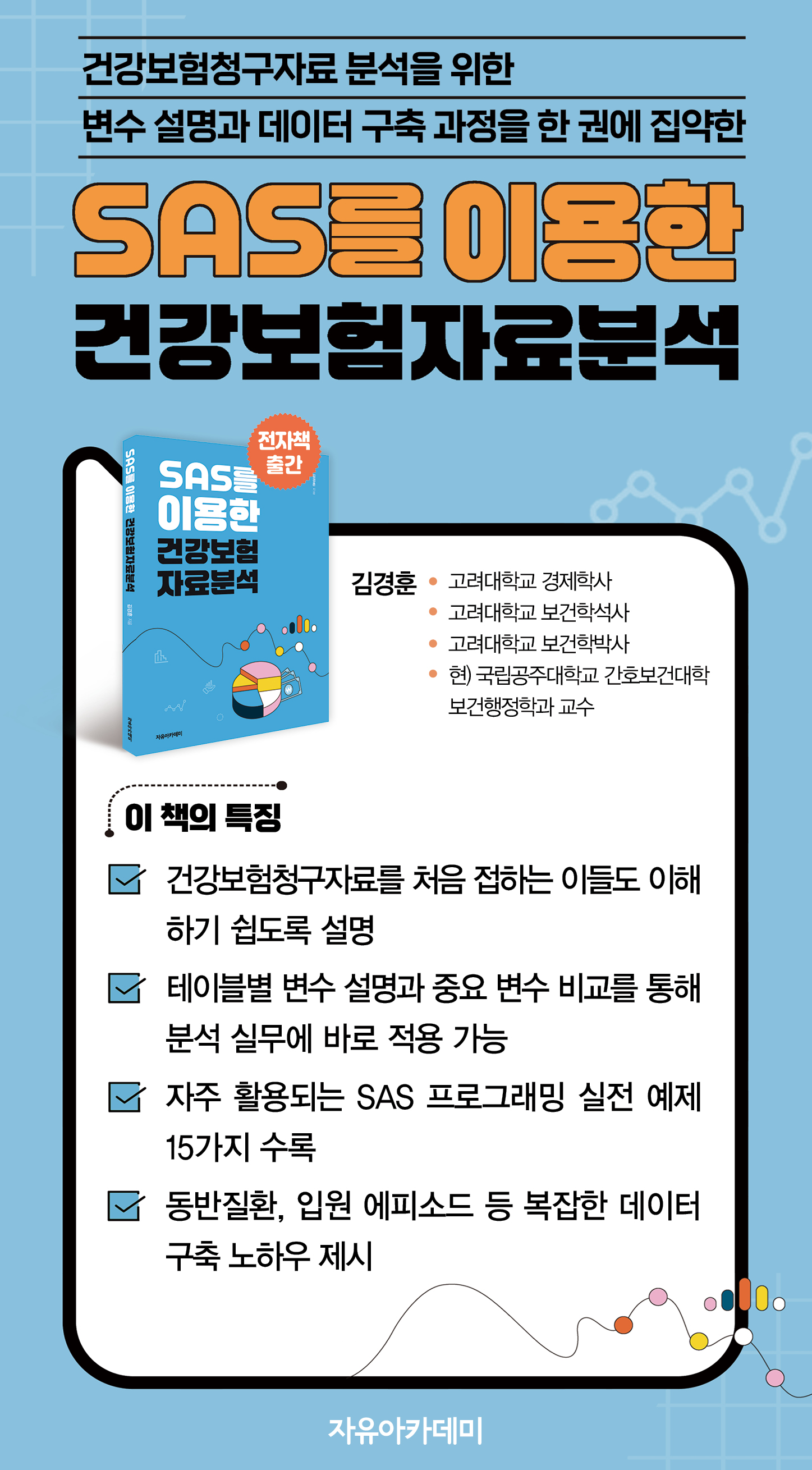
『Health Insurance Data Analysis Using SAS』 consists of a total of 5 chapters.
Chapter 1 briefly describes the construction and use of health insurance claim data.
The process and characteristics of constructing health insurance claim data have been presented numerous times in academic conferences and journals, so this article was written briefly to meet the needs of readers who are encountering health insurance claim data for the first time.
Chapter 2 introduces data sets made available by the Health Insurance Review & Assessment Service and the National Health Insurance Service.
In addition to health insurance claim data, the two organizations are opening up data collected in the course of carrying out their respective businesses, such as hospital evaluation data and health checkup data.
In Chapter 3, the list of variables shared with researchers is organized into a table and the variables of the two institutions are compared.
In addition, based on the experience of analyzing health insurance claim data, we tried to increase understanding of variables by suggesting variable meanings and considerations during analysis.
Chapter 4 extends the description of variables covered in Chapter 3 and presents confounding factors that can be utilized in outcome studies.
In the last five chapters, the most frequently used SAS programs for analyzing health insurance claim data are organized into 15 areas.
In particular, we hope that this will be helpful to researchers who recognize the need to build comorbidities and hospitalization episodes in the process of building analysis data, but have difficulty implementing this in SAS programs.
Chapter 1 briefly describes the construction and use of health insurance claim data.
The process and characteristics of constructing health insurance claim data have been presented numerous times in academic conferences and journals, so this article was written briefly to meet the needs of readers who are encountering health insurance claim data for the first time.
Chapter 2 introduces data sets made available by the Health Insurance Review & Assessment Service and the National Health Insurance Service.
In addition to health insurance claim data, the two organizations are opening up data collected in the course of carrying out their respective businesses, such as hospital evaluation data and health checkup data.
In Chapter 3, the list of variables shared with researchers is organized into a table and the variables of the two institutions are compared.
In addition, based on the experience of analyzing health insurance claim data, we tried to increase understanding of variables by suggesting variable meanings and considerations during analysis.
Chapter 4 extends the description of variables covered in Chapter 3 and presents confounding factors that can be utilized in outcome studies.
In the last five chapters, the most frequently used SAS programs for analyzing health insurance claim data are organized into 15 areas.
In particular, we hope that this will be helpful to researchers who recognize the need to build comorbidities and hospitalization episodes in the process of building analysis data, but have difficulty implementing this in SAS programs.
- You can preview some of the book's contents.
Preview
index
Chapter 1: Use of Health Insurance Claim Data
1.
Building health insurance claim data
2.
Use of health care research
3.
Pros and Cons of Health Insurance Claims
Chapter 2: Opening Customized Health Insurance Claims Data
1.
Opening of health insurance claim data
2.
Table structure of health insurance claim data
Chapter 3: Variable Description by Table
1.
Specification General Table
2.
Medical history table
3.
Table of military service records
4.
Prescription issuance details table
5.
Eligibility and Premium Table
6.
Death Table
Chapter 4 Confounding Factors
Chapter 5 SAS Programming
1.
Check the list of variables and specify the library
2.
Data extraction and variable creation
3.
Extracting a specific string from a character variable
4.
Create a date variable
5.
Create a variable at a specific point in time
6.
Separate year, quarter, month, and day from date variables
7.
Calculating the interval between two date variables
8.
Extract specifications or patient data that meet specific conditions
9.
Combine data horizontally and vertically
10.
Setting a reference point
11.
Building tracking data
12.
Building a comorbidity
13.
Calculating cumulative sum
14.
Building a hospitalization episode
15. MACRO statement
In conclusion
References
supplement
Appendix 1.
City/county/district code
Appendix 2.
Drug classification number and efficacy classification
Appendix 3.
Specific symbol details
Appendix 4.
Nursing institution table variable name
Search
1.
Building health insurance claim data
2.
Use of health care research
3.
Pros and Cons of Health Insurance Claims
Chapter 2: Opening Customized Health Insurance Claims Data
1.
Opening of health insurance claim data
2.
Table structure of health insurance claim data
Chapter 3: Variable Description by Table
1.
Specification General Table
2.
Medical history table
3.
Table of military service records
4.
Prescription issuance details table
5.
Eligibility and Premium Table
6.
Death Table
Chapter 4 Confounding Factors
Chapter 5 SAS Programming
1.
Check the list of variables and specify the library
2.
Data extraction and variable creation
3.
Extracting a specific string from a character variable
4.
Create a date variable
5.
Create a variable at a specific point in time
6.
Separate year, quarter, month, and day from date variables
7.
Calculating the interval between two date variables
8.
Extract specifications or patient data that meet specific conditions
9.
Combine data horizontally and vertically
10.
Setting a reference point
11.
Building tracking data
12.
Building a comorbidity
13.
Calculating cumulative sum
14.
Building a hospitalization episode
15. MACRO statement
In conclusion
References
supplement
Appendix 1.
City/county/district code
Appendix 2.
Drug classification number and efficacy classification
Appendix 3.
Specific symbol details
Appendix 4.
Nursing institution table variable name
Search
Detailed image
Publisher's Review
The author first analyzed health insurance claims data in 2006, 20 years ago.
At that time, unlike now, there was no way to connect to a server and analyze it, or to run a program and have the results output in just a few seconds.
I had to spend a lot of money on external hard drives and a noisy computer, and wait patiently for the analysis results.
In particular, there was no documentation at all on how health insurance claim data was collected and analyzed, and a single word from a Health Insurance Review & Assessment Service official served as a ray of sunshine, providing an analysis guide.
The person who gave me, who had just started my master's degree, the big task of analyzing health insurance claim data was the late Professor Ahn Hyeong-sik.
Thanks to the professor, I became interested in health insurance claims data and was able to gain experience analyzing health insurance claims data at the Health Insurance Review & Assessment Service.
In 2017, while working at the Health Information Convergence Lab (now Big Data Lab) of the Health Insurance Review & Assessment Service, I developed a manual for analyzing health insurance claims data.
I remember that development began with the realization that even with identical health insurance claim data, different results could be produced depending on the user's data extraction method and analysis perspective. I wondered if there was a way to build analysis data more efficiently.
Currently, as a researcher not affiliated with the Health Insurance Review & Assessment Service, I am requesting and analyzing customized data from the Health Insurance Review & Assessment Service and the National Health Insurance Service.
The two organizations open the same health insurance claim data, but the variable names are different and the variable ranges and tables that are opened are different, so the variable lists of the two organizations have been slightly compared and organized.
And, for students or researchers who are new to health insurance claim data, it was thought that the usability of health insurance claim data would increase if variable descriptions and the data construction process were included in one book.
Perhaps, the purpose of publishing “Health Insurance Data Analysis Using SAS” is the same as that of the analysis manual.
This book consists of five chapters.
Chapter 1 briefly describes the construction and use of health insurance claim data.
The process and characteristics of constructing health insurance claim data have been presented numerous times in academic conferences and journals, so this article was written briefly to meet the needs of readers who are encountering health insurance claim data for the first time.
Chapter 2 introduces data sets made public by the Health Insurance Review & Assessment Service and the National Health Insurance Service.
In addition to health insurance claim data, the two organizations are opening up data collected in the course of carrying out their respective businesses, such as hospital evaluation data and health checkup data.
In Chapter 3, the list of variables shared with researchers is organized into a table and the variables of the two institutions are compared.
In addition, based on the experience of analyzing health insurance claim data, we tried to increase understanding of variables by suggesting variable meanings and considerations during analysis.
Chapter 4 extends the description of variables covered in Chapter 3 and presents confounding factors that can be utilized in outcome studies.
In the last five chapters, the most frequently used SAS programs for analyzing health insurance claim data are organized into 15 areas.
In particular, we hope that this will be helpful to researchers who recognize the need to build comorbidities and hospitalization episodes in the process of building analysis data, but have difficulty implementing this in SAS programs.
Publishing "Health Insurance Data Analysis Using SAS" was not an easy decision, and the process itself was not easy.
Although we spent a lot of time collecting data, writing and verifying programs, and writing manuscripts for the publication of this book, there may be some shortcomings.
Please note that any revisions that may occur after publication will be posted on the Free Academy website (www.freeaca.com).
Finally, I would like to express my gratitude to my colleagues at the Health Insurance Review & Assessment Service for their great assistance during the writing process.
At that time, unlike now, there was no way to connect to a server and analyze it, or to run a program and have the results output in just a few seconds.
I had to spend a lot of money on external hard drives and a noisy computer, and wait patiently for the analysis results.
In particular, there was no documentation at all on how health insurance claim data was collected and analyzed, and a single word from a Health Insurance Review & Assessment Service official served as a ray of sunshine, providing an analysis guide.
The person who gave me, who had just started my master's degree, the big task of analyzing health insurance claim data was the late Professor Ahn Hyeong-sik.
Thanks to the professor, I became interested in health insurance claims data and was able to gain experience analyzing health insurance claims data at the Health Insurance Review & Assessment Service.
In 2017, while working at the Health Information Convergence Lab (now Big Data Lab) of the Health Insurance Review & Assessment Service, I developed a manual for analyzing health insurance claims data.
I remember that development began with the realization that even with identical health insurance claim data, different results could be produced depending on the user's data extraction method and analysis perspective. I wondered if there was a way to build analysis data more efficiently.
Currently, as a researcher not affiliated with the Health Insurance Review & Assessment Service, I am requesting and analyzing customized data from the Health Insurance Review & Assessment Service and the National Health Insurance Service.
The two organizations open the same health insurance claim data, but the variable names are different and the variable ranges and tables that are opened are different, so the variable lists of the two organizations have been slightly compared and organized.
And, for students or researchers who are new to health insurance claim data, it was thought that the usability of health insurance claim data would increase if variable descriptions and the data construction process were included in one book.
Perhaps, the purpose of publishing “Health Insurance Data Analysis Using SAS” is the same as that of the analysis manual.
This book consists of five chapters.
Chapter 1 briefly describes the construction and use of health insurance claim data.
The process and characteristics of constructing health insurance claim data have been presented numerous times in academic conferences and journals, so this article was written briefly to meet the needs of readers who are encountering health insurance claim data for the first time.
Chapter 2 introduces data sets made public by the Health Insurance Review & Assessment Service and the National Health Insurance Service.
In addition to health insurance claim data, the two organizations are opening up data collected in the course of carrying out their respective businesses, such as hospital evaluation data and health checkup data.
In Chapter 3, the list of variables shared with researchers is organized into a table and the variables of the two institutions are compared.
In addition, based on the experience of analyzing health insurance claim data, we tried to increase understanding of variables by suggesting variable meanings and considerations during analysis.
Chapter 4 extends the description of variables covered in Chapter 3 and presents confounding factors that can be utilized in outcome studies.
In the last five chapters, the most frequently used SAS programs for analyzing health insurance claim data are organized into 15 areas.
In particular, we hope that this will be helpful to researchers who recognize the need to build comorbidities and hospitalization episodes in the process of building analysis data, but have difficulty implementing this in SAS programs.
Publishing "Health Insurance Data Analysis Using SAS" was not an easy decision, and the process itself was not easy.
Although we spent a lot of time collecting data, writing and verifying programs, and writing manuscripts for the publication of this book, there may be some shortcomings.
Please note that any revisions that may occur after publication will be posted on the Free Academy website (www.freeaca.com).
Finally, I would like to express my gratitude to my colleagues at the Health Insurance Review & Assessment Service for their great assistance during the writing process.
GOODS SPECIFICS
- Date of issue: June 10, 2025
- Page count, weight, size: 164 pages | 188*257*10mm
- ISBN13: 9791158087159
- ISBN10: 1158087152
You may also like
카테고리
korean


korean

![GQ KOREA Mark (Monthly): December [2025]](http://librairie.coreenne.fr/cdn/shop/files/8ef265dbbfbf186523ed75ba7319009d.jpg?v=1765340328&width=3840)


