

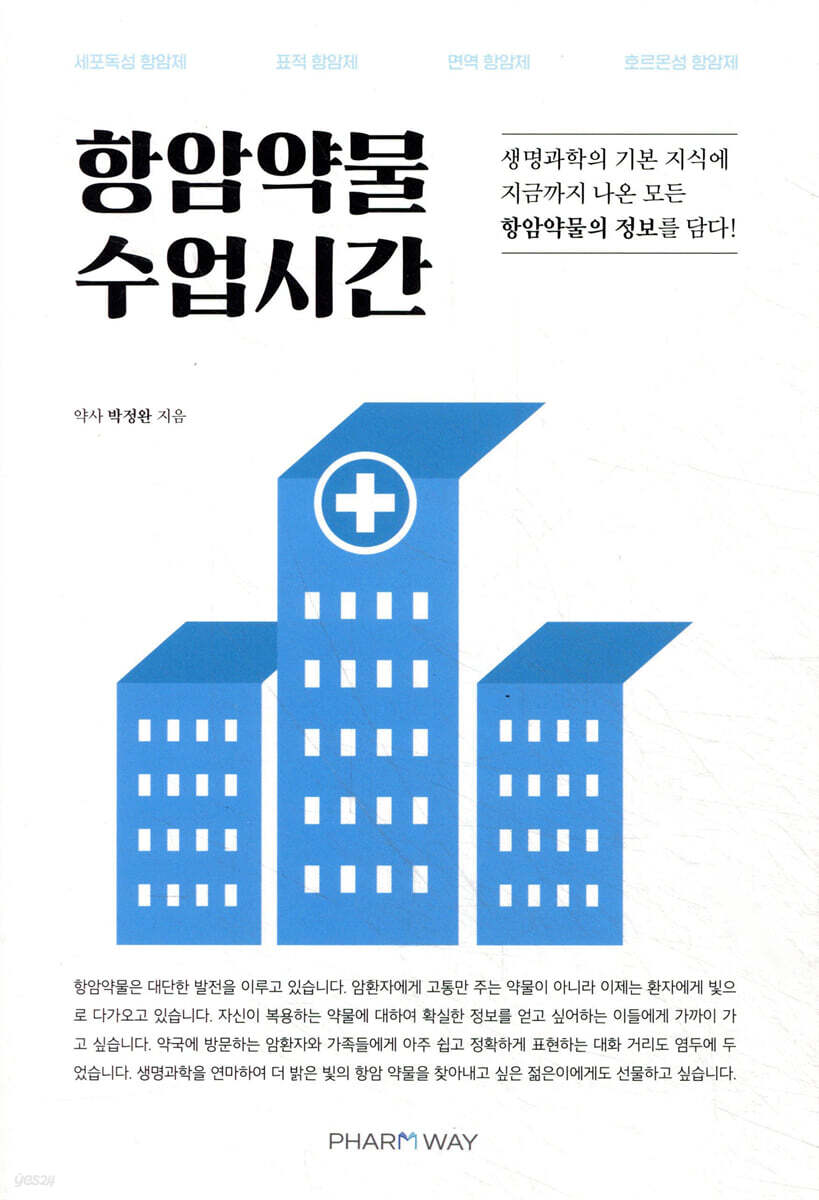
Anticancer drug class time
 |
Description
Book Introduction
A veteran pharmacist tells the story of anticancer drugs in an easy-to-understand Q&A format.
Pharmacist Park Jeong-wan, who has been walking the path of a founding pharmacist for over 40 years and has been writing steadily under the pen name ‘Yakiyagi’, has now returned with a book titled [Anti-Cancer Drug Class Time].
This is a story about medicine written in an easy-to-understand way by linking anticancer drugs to basic knowledge of life sciences. It is conducted in the form of a question-and-answer session between a senior pharmacist who writes under the pen name ‘Yakiyagi’ and a ‘freshman’ who has just entered pharmacy school.
In particular, the title, which refers to anticancer drugs rather than anticancer drugs commonly used in daily life, stands out.
The author is a veteran pharmacist who has walked the path of a founding pharmacist, and since this is a story told to junior pharmacists and pharmacy students who dream of becoming pharmacists in the future, he said that he decided on the title from a pharmacist's perspective and ended up expressing it as an anticancer drug rather than an anticancer drug.
The term "anticancer drug" is closer to the realm of a "doctor" who prescribes a mixture of several drugs, while the term "anticancer drug" is closer to the realm of a "pharmacist" who is an expert in handling drugs and medications.
Pharmacist Park Jeong-wan, who has been walking the path of a founding pharmacist for over 40 years and has been writing steadily under the pen name ‘Yakiyagi’, has now returned with a book titled [Anti-Cancer Drug Class Time].
This is a story about medicine written in an easy-to-understand way by linking anticancer drugs to basic knowledge of life sciences. It is conducted in the form of a question-and-answer session between a senior pharmacist who writes under the pen name ‘Yakiyagi’ and a ‘freshman’ who has just entered pharmacy school.
In particular, the title, which refers to anticancer drugs rather than anticancer drugs commonly used in daily life, stands out.
The author is a veteran pharmacist who has walked the path of a founding pharmacist, and since this is a story told to junior pharmacists and pharmacy students who dream of becoming pharmacists in the future, he said that he decided on the title from a pharmacist's perspective and ended up expressing it as an anticancer drug rather than an anticancer drug.
The term "anticancer drug" is closer to the realm of a "doctor" who prescribes a mixture of several drugs, while the term "anticancer drug" is closer to the realm of a "pharmacist" who is an expert in handling drugs and medications.
index
CHAPTER 1.
protein synthesis
01 Proteins are peptide bonds
02 Covalent and hydrogen bonds in proteins
03 Protein Decomposition
04 Classification of amino acids
05 Protein Synthesis (Gene Expression)
06 Central dogma
07 Eukaryotic and Prokaryotic Cells
08 DNA Structure
09 Acetylation and methylation
10 transcription factors (TF)
11 Transcription
12 Ribosomes, the site of protein synthesis
13 Translation
14 Translation termination and the ubiquitin-proteasome system
15 miRNAs and siRNAs
CHAPTER 2.
cell division
01 Cleavage
02 Folic acid
03 Interphase, mitotic phase
04 Anticancer drug start nitrogen mustard
05 Alkylating agent
06 Antimetabolites
07 Anticancer drugs that act on mitosis
08 Blood-Brain-Barrier (BBB) and Anticancer Drugs
09 Antitumor antibiotics
10 Anticancer drugs using topoisomerase
11 Cisplatin
CHAPTER 3.
targeted anticancer drugs
01 All trans-retinoic acid (ATRA) vesanoid
02 Imatinib (Gleevec)
03 Gastrointestinal stromal tumor (GIST)
04 Signaling by GPCR (G Protein Coupled Receptor)
05 Signal transduction by receptor tyrosine kinase (RTK)
06 EGFR mutations and lung cancer
07 PI3K-AKT-mTOR pathway
08 PI3K inhibitors
09 Phosphorylation by AKT (protein kinase B, PKB)
10 Apoptosis
11 Venetoclax
12 mTOR(mammalian target of rapamycin)
13 Antibody drugs
14 Epitope (antigenic determinant)
15 First commercially available antibody drugs
16 The first approved antibody drug, muromonab-CD3
17 fully human antibodies -umab
18 Monoclonal antibody drugs that block EGFR
19 Monoclonal antibody trastuzumab (Herceptin)
20 Pertuzumab (Perjeta)
21 VEGF antibody drug Bevacizumab (Avastin)
22 Aflibercept (Ilia, Zaltrap)
23 Sorafenib (Nexavar)
24 Pazopanib (Votrient)
25 Hypomethylation
26 Myelodysplastic syndrome
27 Asparaginase
28 Bruton's tyrosin kinase (BTK) inhibitors
29 Proteasome inhibitors
CHAPTER 4.
Immunity and anticancer
01 Hematopoietic stem cell
02 Mast cells
03 Mast cell stabilizers
04 Antihistamine
05 Anaphylaxis
06 Neutrophil
07 Chemotaxis
08 Neutropenia
09 Colchicine
10 eosinophils
11 Natural killer cells (NK cells)
12 Macrophages
13 Dendritic cells
14 Major Histocompatibility Complex
15 T cells and B cells
16 Helper T cells
17 Acquired Immune Deficiency Syndrome (AIDS)
18 Polysaccharide vaccines and protein conjugate vaccines
19 Conditions for activating T cells
20 Immune Checkpoint CTLA-4
21. Immune checkpoint inhibitors
22 CAR-T (chimeric antigen receptor-T)
23 T-VEC (talimogene laherparepvec)
24 Anticancer Immune Cell Therapy
25 Adjuvant
CHAPTER 5.
hormonal anticancer drugs
1.
anticancer drugs for prostate cancer
01 Prostate Cancer and Testosterone
02 GnRH receptor agonist drugs
03 GnRH receptor inhibitor drugs
04 Antiandrogen drugs
05 Castration-resistant prostate cancer (CRPC)
06 Nonmetastatic castration-resistant prostate cancer (nmCRPC)
2.
anticancer drugs for breast cancer
01 Hormone receptor-positive breast cancer
02 Gonadotropin-releasing hormone (GnRH) receptor agonist
03 Tamoxifen (Nolvadex)
04 Aromatase inhibitor
05 CDK 4/6 inhibitor
06 Triple negative breast cancer (TNBC)
07 Polymerization of ADP-glucose polymerase (PARP)
protein synthesis
01 Proteins are peptide bonds
02 Covalent and hydrogen bonds in proteins
03 Protein Decomposition
04 Classification of amino acids
05 Protein Synthesis (Gene Expression)
06 Central dogma
07 Eukaryotic and Prokaryotic Cells
08 DNA Structure
09 Acetylation and methylation
10 transcription factors (TF)
11 Transcription
12 Ribosomes, the site of protein synthesis
13 Translation
14 Translation termination and the ubiquitin-proteasome system
15 miRNAs and siRNAs
CHAPTER 2.
cell division
01 Cleavage
02 Folic acid
03 Interphase, mitotic phase
04 Anticancer drug start nitrogen mustard
05 Alkylating agent
06 Antimetabolites
07 Anticancer drugs that act on mitosis
08 Blood-Brain-Barrier (BBB) and Anticancer Drugs
09 Antitumor antibiotics
10 Anticancer drugs using topoisomerase
11 Cisplatin
CHAPTER 3.
targeted anticancer drugs
01 All trans-retinoic acid (ATRA) vesanoid
02 Imatinib (Gleevec)
03 Gastrointestinal stromal tumor (GIST)
04 Signaling by GPCR (G Protein Coupled Receptor)
05 Signal transduction by receptor tyrosine kinase (RTK)
06 EGFR mutations and lung cancer
07 PI3K-AKT-mTOR pathway
08 PI3K inhibitors
09 Phosphorylation by AKT (protein kinase B, PKB)
10 Apoptosis
11 Venetoclax
12 mTOR(mammalian target of rapamycin)
13 Antibody drugs
14 Epitope (antigenic determinant)
15 First commercially available antibody drugs
16 The first approved antibody drug, muromonab-CD3
17 fully human antibodies -umab
18 Monoclonal antibody drugs that block EGFR
19 Monoclonal antibody trastuzumab (Herceptin)
20 Pertuzumab (Perjeta)
21 VEGF antibody drug Bevacizumab (Avastin)
22 Aflibercept (Ilia, Zaltrap)
23 Sorafenib (Nexavar)
24 Pazopanib (Votrient)
25 Hypomethylation
26 Myelodysplastic syndrome
27 Asparaginase
28 Bruton's tyrosin kinase (BTK) inhibitors
29 Proteasome inhibitors
CHAPTER 4.
Immunity and anticancer
01 Hematopoietic stem cell
02 Mast cells
03 Mast cell stabilizers
04 Antihistamine
05 Anaphylaxis
06 Neutrophil
07 Chemotaxis
08 Neutropenia
09 Colchicine
10 eosinophils
11 Natural killer cells (NK cells)
12 Macrophages
13 Dendritic cells
14 Major Histocompatibility Complex
15 T cells and B cells
16 Helper T cells
17 Acquired Immune Deficiency Syndrome (AIDS)
18 Polysaccharide vaccines and protein conjugate vaccines
19 Conditions for activating T cells
20 Immune Checkpoint CTLA-4
21. Immune checkpoint inhibitors
22 CAR-T (chimeric antigen receptor-T)
23 T-VEC (talimogene laherparepvec)
24 Anticancer Immune Cell Therapy
25 Adjuvant
CHAPTER 5.
hormonal anticancer drugs
1.
anticancer drugs for prostate cancer
01 Prostate Cancer and Testosterone
02 GnRH receptor agonist drugs
03 GnRH receptor inhibitor drugs
04 Antiandrogen drugs
05 Castration-resistant prostate cancer (CRPC)
06 Nonmetastatic castration-resistant prostate cancer (nmCRPC)
2.
anticancer drugs for breast cancer
01 Hormone receptor-positive breast cancer
02 Gonadotropin-releasing hormone (GnRH) receptor agonist
03 Tamoxifen (Nolvadex)
04 Aromatase inhibitor
05 CDK 4/6 inhibitor
06 Triple negative breast cancer (TNBC)
07 Polymerization of ADP-glucose polymerase (PARP)
Publisher's Review
Pharmacists' knowledge of anticancer drugs for cancer patients and their families visiting the pharmacy
The author runs an actual pharmacy and has consistently received visits and consultations from cancer patients and their families.
What I've learned from them is that they want to get clear information about the medications they're taking.
For example, if a patient is prescribed and taking targeted anticancer drug 000, there are often cases where the pharmacist who dispenses the drug only explains how to take it and is unable to provide sufficient answers to the patient's questions.
However, the reality is that it is difficult for patients to ask their doctor everything.
While doctors only need to delve into their own specialty, pharmacies handle a wide range of medications, from prescription drugs to over-the-counter drugs, health functional foods, and products derived from folk remedies. Therefore, the author believes that continuous study to enhance the expertise and insight of pharmacists is essential.
In the existing [Story of Drugs Used at Pharmacies (5 Volumes)] series, the author has explained in a story format the various drugs available at pharmacies, ranging from anticancer drugs to vitamins, and from psychiatric medications to herbal medicines… up to 276 in all.
So this time, I decided to write a new 'Medicine Story' in a class format, focusing only on 'anticancer drugs'.
Incorporating information on anticancer drugs developed to date into the basic knowledge of life sciences.
A unique feature of this book is that rather than explaining anticancer drugs from the past to the present in detail by type, it begins with basic knowledge to understand how anticancer drugs work.
The author argues that both medicine and pharmacy develop within the framework of life sciences, and urges interest in life sciences, a relatively unpopular field.
Chapters 1 and 2 cover 'protein synthesis and cell division,' which is the basic knowledge for understanding how anticancer drugs work.
The main topics include protein binding and decomposition, DNA structure, transcription and translation, the process of cell division, and anticancer drugs that act at each stage of cell division.
It talks about the central dogma, a fundamental principle of life science, that is, the process of transcription from DNA to RNA and translation from RNA to protein.
The 'Cell Division' chapter covers cytotoxic anticancer drugs, which are commonly used representative treatments and attack the characteristics of rapidly dividing cancer cells.
Chapter 3 approaches 'targeted anticancer drugs' that target only specific parts of cancer cells through 29 topics.
It contains information on how targeted anticancer drugs work, representative antibody drugs and antibody drugs for each period.
Chapters 4 and 5 cover the latest anticancer drugs that have been in the spotlight since the 2000s.
Chapter 4 contains 25 articles covering the immune process in our body, representative immune cells, and information on immune anticancer drugs utilizing them.
Chapter 5 examines hormonal anticancer agents, divided into those related to prostate cancer and those related to breast cancer.
This is because the goal of hormonal anticancer drugs is to control and utilize sex hormones to treat common cancers in men and women.
A 'story' is an easy way to express a certain content about an object, event, or phenomenon.
Being a good storyteller means being able to translate given information into easy-to-understand expressions for the listener to understand.
The author says he wanted to explain difficult life sciences in an easy-to-understand way, making it less boring and more like a one-liner story.
The author's pen name, 'Yakiyagi', appears as it is, and easily conveys the difficult story of anticancer drugs to 'freshmen' in pharmacy school.
The author runs an actual pharmacy and has consistently received visits and consultations from cancer patients and their families.
What I've learned from them is that they want to get clear information about the medications they're taking.
For example, if a patient is prescribed and taking targeted anticancer drug 000, there are often cases where the pharmacist who dispenses the drug only explains how to take it and is unable to provide sufficient answers to the patient's questions.
However, the reality is that it is difficult for patients to ask their doctor everything.
While doctors only need to delve into their own specialty, pharmacies handle a wide range of medications, from prescription drugs to over-the-counter drugs, health functional foods, and products derived from folk remedies. Therefore, the author believes that continuous study to enhance the expertise and insight of pharmacists is essential.
In the existing [Story of Drugs Used at Pharmacies (5 Volumes)] series, the author has explained in a story format the various drugs available at pharmacies, ranging from anticancer drugs to vitamins, and from psychiatric medications to herbal medicines… up to 276 in all.
So this time, I decided to write a new 'Medicine Story' in a class format, focusing only on 'anticancer drugs'.
Incorporating information on anticancer drugs developed to date into the basic knowledge of life sciences.
A unique feature of this book is that rather than explaining anticancer drugs from the past to the present in detail by type, it begins with basic knowledge to understand how anticancer drugs work.
The author argues that both medicine and pharmacy develop within the framework of life sciences, and urges interest in life sciences, a relatively unpopular field.
Chapters 1 and 2 cover 'protein synthesis and cell division,' which is the basic knowledge for understanding how anticancer drugs work.
The main topics include protein binding and decomposition, DNA structure, transcription and translation, the process of cell division, and anticancer drugs that act at each stage of cell division.
It talks about the central dogma, a fundamental principle of life science, that is, the process of transcription from DNA to RNA and translation from RNA to protein.
The 'Cell Division' chapter covers cytotoxic anticancer drugs, which are commonly used representative treatments and attack the characteristics of rapidly dividing cancer cells.
Chapter 3 approaches 'targeted anticancer drugs' that target only specific parts of cancer cells through 29 topics.
It contains information on how targeted anticancer drugs work, representative antibody drugs and antibody drugs for each period.
Chapters 4 and 5 cover the latest anticancer drugs that have been in the spotlight since the 2000s.
Chapter 4 contains 25 articles covering the immune process in our body, representative immune cells, and information on immune anticancer drugs utilizing them.
Chapter 5 examines hormonal anticancer agents, divided into those related to prostate cancer and those related to breast cancer.
This is because the goal of hormonal anticancer drugs is to control and utilize sex hormones to treat common cancers in men and women.
A 'story' is an easy way to express a certain content about an object, event, or phenomenon.
Being a good storyteller means being able to translate given information into easy-to-understand expressions for the listener to understand.
The author says he wanted to explain difficult life sciences in an easy-to-understand way, making it less boring and more like a one-liner story.
The author's pen name, 'Yakiyagi', appears as it is, and easily conveys the difficult story of anticancer drugs to 'freshmen' in pharmacy school.
GOODS SPECIFICS
- Date of issue: April 24, 2025
- Page count, weight, size: 312 pages | 150*220*30mm
- ISBN13: 9791198472052
- ISBN10: 1198472057
You may also like
카테고리
korean


korean

![GQ KOREA Mark (Monthly): December [2025]](http://librairie.coreenne.fr/cdn/shop/files/8ef265dbbfbf186523ed75ba7319009d.jpg?v=1765340328&width=3840)


