

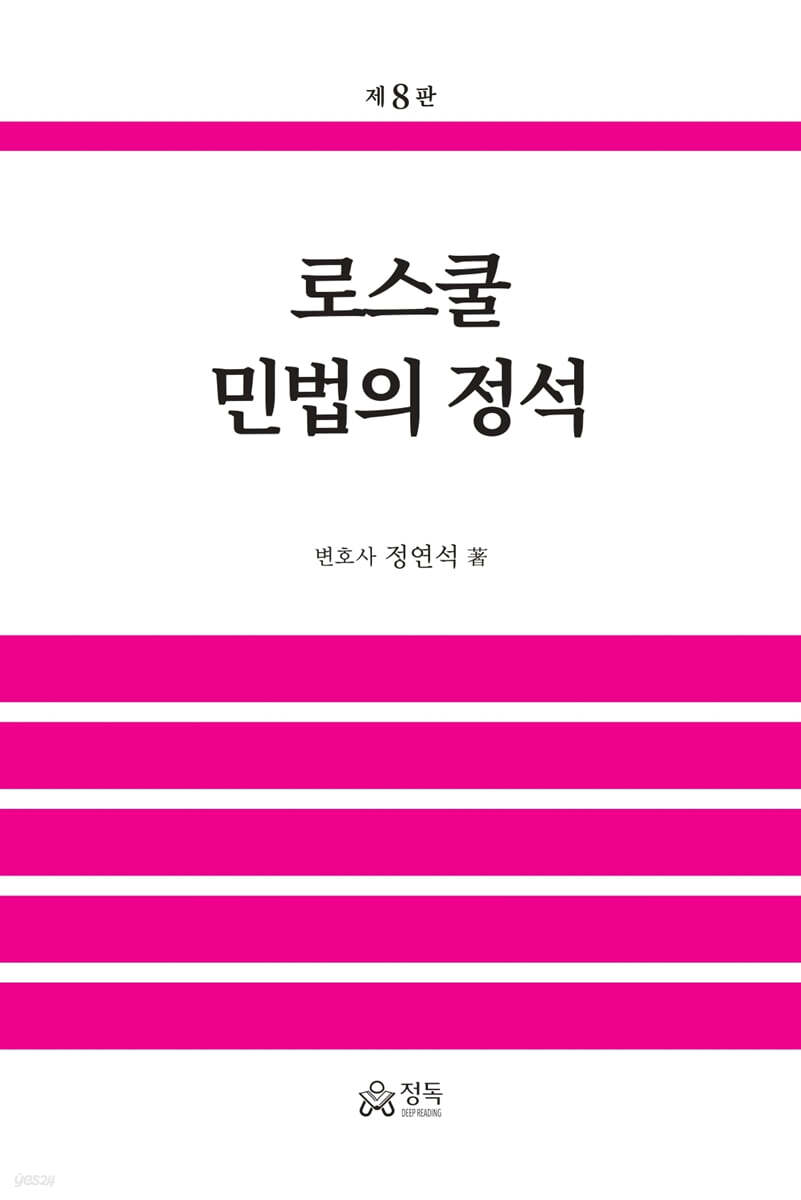
Law School Civil Law Standards
 |
Description
Book Introduction
The 8th edition had the following 'improvements':
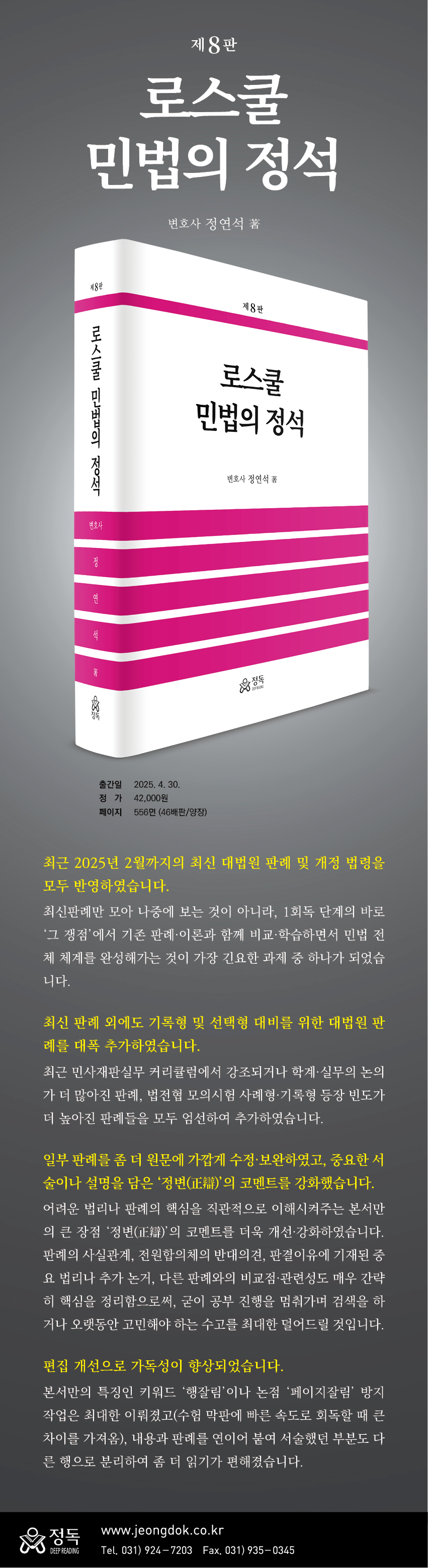
First, all the latest Supreme Court precedents and revised laws up to February 2025 were reflected.
Second, in addition to the latest case law, we added existing case law for comparison with the recorded and selective types, and at the same time, we shortened or deleted sentences in some case law with low importance.
Third, some precedents were revised and supplemented to be closer to the original text, and the comments in the ‘Jeongbyeon (正辯)’ section containing important descriptions or explanations were further strengthened.
Fourth, there have been a number of editing improvements, and this year, readability has been greatly improved by displaying some words in the text in bold.
First, all the latest Supreme Court precedents and revised laws up to February 2025 were reflected.
Second, in addition to the latest case law, we added existing case law for comparison with the recorded and selective types, and at the same time, we shortened or deleted sentences in some case law with low importance.
Third, some precedents were revised and supplemented to be closer to the original text, and the comments in the ‘Jeongbyeon (正辯)’ section containing important descriptions or explanations were further strengthened.
Fourth, there have been a number of editing improvements, and this year, readability has been greatly improved by displaying some words in the text in bold.
index
Part 1 General Bonds
General theory
Purpose of bonds
Compensation for damages
creditor's right of subrogation
Creditor's right of cancellation
Infringement of claims by third parties
Assignment of bonds
Debt assumption
liquidation
Payment in kind, deposit, novation, exemption, confusion
Offset
Introduction, Divisible Claims Relationship, Indivisible Claims Relationship
joint and several debts
Unsecured joint debt
Guaranteed debt
Part 2 Bond Theory
Types of contracts, establishment
Right to object to simultaneous performance
Risk
Contract for third parties
clear
bestowal
General effect of sale
Seller's warranty liability
Lease under civil law
Housing Lease Protection Act
Commercial Building Lease Protection Act
subcontracting
Other typical contracts
Office management
Unjust enrichment
General torts
Special illegal acts
Part 3 General Provisions of Civil Law
customary law, the principle of private autonomy
Principle of good faith
Fetal capacity for rights
Estimation of simultaneous deaths
Capacity to act, limited capacity system
Absence and disappearance
General corporations, establishment, and termination
Liability of a corporation for the acts of its representative body
Division without legal capacity
thing
General legal acts, interpretation of legal acts
Contents (purpose) of the legal act
Expression of intent
deputy
invalidity
cancellation
Terms and conditions
period
Statute of limitations
Part 4 Property Law
Extinction of property rights, introduction to ownership, etc.
Registration system
Changes in real estate rights according to legal provisions
Good faith acquisition, change in movable property rights
Property rights claims
occupation
statute of limitations
coincidence
Shared, joint, and collective ownership
Nominal trust
surface rights
easement
Statutory superficies
leasehold
General provisions on collateral rights
Kindergarten
lien
mortgage
Act on Registered Mortgage, etc.
Transfer of collateral, etc.
General theory
Purpose of bonds
Compensation for damages
creditor's right of subrogation
Creditor's right of cancellation
Infringement of claims by third parties
Assignment of bonds
Debt assumption
liquidation
Payment in kind, deposit, novation, exemption, confusion
Offset
Introduction, Divisible Claims Relationship, Indivisible Claims Relationship
joint and several debts
Unsecured joint debt
Guaranteed debt
Part 2 Bond Theory
Types of contracts, establishment
Right to object to simultaneous performance
Risk
Contract for third parties
clear
bestowal
General effect of sale
Seller's warranty liability
Lease under civil law
Housing Lease Protection Act
Commercial Building Lease Protection Act
subcontracting
Other typical contracts
Office management
Unjust enrichment
General torts
Special illegal acts
Part 3 General Provisions of Civil Law
customary law, the principle of private autonomy
Principle of good faith
Fetal capacity for rights
Estimation of simultaneous deaths
Capacity to act, limited capacity system
Absence and disappearance
General corporations, establishment, and termination
Liability of a corporation for the acts of its representative body
Division without legal capacity
thing
General legal acts, interpretation of legal acts
Contents (purpose) of the legal act
Expression of intent
deputy
invalidity
cancellation
Terms and conditions
period
Statute of limitations
Part 4 Property Law
Extinction of property rights, introduction to ownership, etc.
Registration system
Changes in real estate rights according to legal provisions
Good faith acquisition, change in movable property rights
Property rights claims
occupation
statute of limitations
coincidence
Shared, joint, and collective ownership
Nominal trust
surface rights
easement
Statutory superficies
leasehold
General provisions on collateral rights
Kindergarten
lien
mortgage
Act on Registered Mortgage, etc.
Transfer of collateral, etc.
Detailed image
Publisher's Review
preface
The 8th edition has the following 'improvements':
First, we have reflected all the latest Supreme Court precedents and revised laws up to February 2025.
My bar exam lecture principle of continuously repeating the "basic textbook" from the first reading stage up to the most recent case law is becoming more and more steadfast with each passing year.
As the importance of studying the latest case law, which becomes more difficult and complex every year, increases, one of the most urgent tasks is to complete the entire civil law system by comparing and studying existing case law and theories at the very "issue" at the first reading stage, rather than simply collecting the latest case law and reviewing it later. This book will be the only textbook that meets this task.
Students who have completed the second reading of this book by August this year will only need to update the case law handed down in the past 3-4 months (indicated separately in the relevant textbook) in the "Comprehensive Summary of the Latest 1.5 Years of Civil Case Law" lecture opening in September, which will greatly reduce the burden of studying the latest case law (among them, very important case law will be distributed in advance in the second reading lecture in August and will also be tested on mock exams based on progress).
Second, we added not only the latest case law but also existing case law for comparison with the recorded and selective cases, and at the same time, we shortened or deleted sentences in some case law with low importance.
We have added some case laws that have been recently emphasized in the civil trial practice curriculum or have been the subject of more discussion in academia and practice, as well as case laws that have appeared more frequently in the case-based, documentary-based, and multiple-choice mock exams of the Korean Bar Association.
This work increased significantly in the 5th and 6th editions, was relatively small in the 7th edition, and then increased somewhat again in this year's 8th edition.
Accordingly, the total number of Supreme Court precedents included in this book is 2,149 based on the index, and approximately 100 of them are new precedents added to the 8th edition.
Third, some case law cases were revised and supplemented to be closer to the original text, and the comments in the ‘Jeongbyeon (正辯)’ section containing important descriptions or explanations were further strengthened.
From its first publication, this book has maintained as an important narrative principle the following: between [Case] and [Case Number], only the original sentences of Supreme Court decisions are included (the so-called 'Case Original Text ZONE'), and applications or modifications of the relevant legal principles or additional explanations by the author are organized after the case number or in the comments of "Corrective Action."
This provides a clear distinction between 'official phrases from case law that can be trusted and written on the answer sheet' and 'internal phrases that must be familiarized for exam-related understanding or organization', and this principle continues to be maintained in the 7th edition.
In particular, we have further improved and strengthened the comments of 'Jeongbyeon (正辯),' a great advantage of this book, to summarize the facts of the case, the dissenting opinion of the full bench, the important legal principles and additional arguments stated in the reasons for the decision, and the points of comparison and relevance with other similar case laws very briefly. This will minimize the effort of having to stop reading to search or think about it for a long time.
Fourth, there have been a number of editing improvements, and this year, readability has been greatly improved by displaying some words in bold.
In order to ensure efficient reading at the last minute of the exam, we have done our best to prevent keyword 'line breaks' and issue 'page breaks' in this year's 8th edition, and parts that were difficult to read have been separated into different lines or organized into columns to make them easier to read.
In particular, starting with the 7th edition last year, some words in the text were marked in 'bold' for the first time in this book.
Since this book was originally a textbook that summarized the core 'keywords' for the purpose of exam efficiency, I thought that it was unnecessary to highlight the keywords again. However, since the detailed table of contents was omitted, it was somewhat difficult to understand the system, so in order to compensate for this, some of the keywords that were helpful in understanding the table of contents were highlighted in bold, and there was a great response from many test takers last year.
As I always say about the features, usage, and author's efforts of this book, due to its nature, this book may be a meaningless textbook if not linked to a 'lecture,' and attending the 'lecture' is the best way to utilize this book.
In actual lectures, we also provide specific instructions on how to use this book every hour.
When listening to the lecture, please clarify your understanding and organization through the author's accurate and efficient explanation of the 'essential phrases for answering' in this book. Through this repeated process, you will study so that you can recall the content by looking only at the essential phrases.
For basic features and usage instructions for this book, please refer to the preface to the first edition that follows.
However, since this is a preface written in 2018, some of the contents need to be revised to fit the current situation. These include ① the fact that it has achieved a coverage of more than 95% of the multiple-choice questions, not just 70%, and ② that for lower-year law school students, I strongly recommend the book "The Basic Civil Law - Summary of Articles and Case Law" published in 2020 before this book.
In the 8th edition, all the prefaces from the 2nd through 7th editions were deleted due to space constraints. However, I would like to say that throughout the history of revisions, this book has always strived for improvement and development, and has achieved this, whenever there is even the slightest room for improvement.
I would also like to say that this year, we are still proud to say that our ‘effort’ is the best.
This year marks the 11th year of my teaching career, and looking back, I've recently spent over 1,200 hours teaching at 'MegaRoyals' alone.
If you add in special lectures at 13 law schools across the country and lectures by mega patent attorneys, I have given many more lectures.
The reason I don't give up on this is because I strongly believe that the more lectures I give, the better my skills will become.
If you want to open a lecture, the preparation process must be followed by adequate and thorough research.
Conversely, I believe that the more you reduce the number of lectures and the more you stop giving lectures, the more your instructor's skills will decrease in direct proportion.
Even up until this year, I have kept my promise to myself to ① open a full course and type of civil law lectures with about 40 regular lectures, ② hold 1:1 consultations and meetings with hundreds of law school students to prepare for the GPA and bar exam, and ③ solve and reanalyze all selected, case, and written questions from previous bar exams and bar exams (55 sessions this year).
What I feel every year as I practice this is that these efforts inevitably determine the quality of the 'textbook' written by the author.
If the author were to diminish or become even slightly complacent in his multifaceted lectures and research, I believe that would first be evident in his textbook.
In conclusion
I would like to express my deepest gratitude to the many people who helped me publish this book.
I will always live my life lecturing and writing with a deep sense of gratitude to all of my mentors, including Judge Lee Won-hyung, Judge Yeo Mi-sook, and Prosecutor Lee Hyeon-cheol, who helped me grow from someone who only knew how to deal with legal theory during my time at the Judicial Research and Training Institute to a ‘legal practitioner,’ as well as CEO Yoon Yong-guk of MegaMD, Director Kang Jin-seop, Director Ahn Myeong-jae, Team Leader Chae Yun-seok, and Assistant Manager Heo Ji-yeon, Director Kwak Se-hee of Megaroyers Sinchon Campus, Managers Yoon Chang-gi and Yoon Ho-jae, CEO Park Jae-myeong of Jeongryul Law Firm, CEO Kim Jung-yong of Jeongdok Publishing, Director Sim Seong-bo, Director Kwon Hyeong-rak, and Assistant Professor Park So-i.
Above all, I would like to express my deepest gratitude to the law school students who have always shown their love, and I firmly promise to repay you with even better lectures and teaching materials, even this year.
2025.
4.
Attorney Jeong Yeon-seok
Preface to the First Edition
The 'Jeonseok' is not a 'handbook'.
The existing 'handbook' is 'a compressed version of the expressions after extracting only the most important content.'
While handbooks may have their own usefulness, the following limitations mean that studying civil law from the beginning with a handbook is essentially giving up on civil law.
First, the handbook omits content that is not of high objective importance (=frequency of appearance), but when taking the exam, subjective importance (=your own shortcomings) is also an essential checklist for passing.
This is especially true in a subject like 'Civil Law', which is so vast in quantity and 'can appear anywhere', like the recent bar exam.
From this perspective, handbooks with many omissions are very dangerous.
Second, because the handbook is more like a simple list of knowledge that lacks the logic and context of civil law, reading it repeatedly will only lead to memorization, but it will never improve your civil law skills.
That is, after reading, nothing remains in your head and nothing is held in your hands.
Of course, memorization is an important part of civil law, but the era of passing the civil law exam by memorizing it is definitely over.
'Jeongseok' left almost no content out.
This book aims to cover 100% of the bar exam questions in the 'case-based' and 'record-based' format, and 70% in the 'multiple-choice' format (based on 'content' such as precedents, excluding examples of recorded cases and required facts).
Among the contents of the textbook 'Civil Law Lectures' by Jun-ho Kim, on which this book is based, the following are not included in this book: ① Basic concepts that are not useful for the exam, ② Case studies that are unlikely to appear in the exam, ③ Multiple-choice questions that are unlikely to appear or, even if they do appear, will not be able to determine the correct answer, and ④ They are nothing more than extremely common-sense variations or combinations of other contents.
However, these boundaries are not necessarily clear, so the author's (instructor's) judgment may vary slightly, and there are new case laws and mock exam contents from the Korean Bar Association that appear every year. Therefore, those studying with this book are advised to download the 'Summary' of this book, which is distributed at the end of the year, from the academy's website, etc.
Meanwhile, the remaining 30% of the multiple-choice questions are mostly fragmentary case law that can only appear as multiple-choice passages. This can be supplemented with multiple-choice questions or explanatory lectures. However, in urgent situations where the exam is imminent, it is okay to think of it as a lower priority.
'Jeongseok' kept the logic and context intact.
As you can see, this book contains almost all of the contents of the Civil Code in 350 pages, so naturally, there are some omissions and compression of the original text.
However, even in this case, in order to ensure that there is no problem at all in writing a high-scoring case-based answer from the examinee's perspective, ① the original text of the case law was compressed to only include the sentences while leaving the 'keywords' or 'key phrases' that are the scoring points intact, ② the 'conclusion-argument' structure of the case law or the logical development order was made visible at a glance by making maximum use of conjunctions or diagrams (∵ ∴ → ← ≠ ≒ But), and ③ the author's explanations or advice on particularly difficult issues were marked as 'correct arguments' to help understanding.
If you understand and utilize all of these parts well, you can achieve the same effect as reading a thick textbook.
However, unless it is in the form of a textbook with complete sentences, it is unlikely that the logic and context will be read in one go.
The way to completely solve this is to be found in the 'textbooks' and 'lectures', which will be discussed later.
There are other parts that I paid a little more attention to.
① [Case law] is bolded to allow for easy identification of “case law” at a glance, and as we live in an era where people are accustomed to searching for case law on mobile devices, most case law cases are indicated with case numbers.
However, contents that have been established as general opinions and precedents beyond specific precedents are marked as [General].
② All “legal provisions” are also displayed in bold to make them stand out.
Although the vast majority of students neglect it, the civil law provisions are the starting point for all discussions and problem-solving in law.
As you read this book, please take the time to look up legal provisions whenever they appear.
③ The “∵” diagram is the most important diagram.
The 'reasoning' that supports the conclusion of a precedent is the part that contains all the legal principles, which is why we often say 'this precedent is important'.
Also, remembering the arguments has the effect of helping you remember the conclusions as well, and furthermore, learning the arguments of case law has the miraculous effect of improving your actual civil law skills.
Because it is a trace of the Supreme Court Justice's legal concerns.
④ We have done our best to prevent important words from being cut off by line or important paragraphs from being cut off by page.
It may seem like a small part, but I thought it would bring about surprisingly great efficiency in the final editing stage, so I paid close attention to it during the typesetting of this book.
There are three things that make it the best civil law study book.
This book has attempted to satisfy all three of the author's essential requirements for a civil law exam preparation book.
① This is a book that will actually improve your civil law skills if you read it.
(= I will teach you the context and logic of case law and discussion)
② The book must be reliable and contain no missing content for the exam.
(= The entire scope of case-based questions will be included)
③ The book should be of a length that does not burden repetition or last-minute final review.
(= Must be less than 500 pages)
Just a year or two ago, 'instructor-written exam preparation books' were a realistic alternative to 'professor-written textbooks' of 1,800 to 2,200 pages, and had an independent volume of about 1,600 to 2,000 pages. However, perhaps to reduce the psychological burden on law school students, instructor-written exam preparation books have been gradually reducing in volume, and now most are around 1,000 pages.
But the problem is 'how' to reduce the amount.
From the beginning, the lecturer's work took a different path from the professor's work, and was a kind of collection of short essays that did not have the same logic and context as the professor's work. If, instead of choosing a direction that would enhance the logic and context, simply omit some content or further eliminate the context, it could become a very ambiguous form that is 'less readable while still being burdensome in length.'
I thought that recent exam preparation books written by instructors were like that, and in a way, that concern was the motivation for writing this book.
How to use this book
1) In the case of “lower year law school students”
For law school juniors who need to gradually perfect their basic civil law skills, I recommend that they do not start with this book on civil law, but rather start with the textbook “Civil Law Lectures (written by Kim Jun-ho, Beopmunsa)” on which this book is based officially.
A beginner's basic civil law skills can be improved through a book that has been refined by the instructor to his own standards for the exam, but there are certain limitations to this, and this book is no exception.
In the same vein, law school students who study civil law solely with the help of textbooks written by instructors may find it difficult to achieve "high grades" regardless of whether they pass or fail the exam, and may also feel insecure about their basic skills throughout the exam period, which is not good.
In contrast, if you start reading this book together with Kim Jun-ho's textbook once or twice, you will be able to clearly learn how the content you have accumulated should be organized and summarized for the 'exam'.
And as the exam approaches, you can shift your focus from the textbook to the actual book. From then on, you can use the textbook to look up or read excerpts from the textbook to understand the content you don't know well.
However, these excerpts are difficult to read for those who have not read the textbook itself properly.
2) For “test takers” who do not have a well-organized textbook
If you are a third-year law school student or a test taker with less than a year left until the bar exam and do not have a basic civil law textbook that you have compiled yourself, the reality is that you have no choice but to prepare for civil law with this book alone.
In this case, attending the 'lecture' taught in this book is mandatory.
As mentioned above, this book uses very concise expressions and diagrams to capture almost all of the content and context of the textbook. Therefore, unless you have a solid foundation in civil law, it may be very difficult to understand the content by reading this book alone without carefully reading Kim Jun-ho's textbook.
The author's "lectures" based on this book are conducted with the primary goal of enabling students who fall into this category to fully understand the logic and context of the textbook, to a degree similar to that of having thoroughly read it, even without having to spend any special time reading it.
3) Maximize your lectures
It's actually quite embarrassing to say that when publishing a book, you should not only read the book but also attend lectures.
But apart from the embarrassment, it would be right to convey the honest truth.
The author is someone whose entire interest in life has been in civil law lectures at the academy in recent years, and it is true that he began writing this book to make the lectures he so fond of even better.
As such, this book was written almost entirely with the 'lecture' in mind.
Of course, if you have already taken my lectures or have a very solid foundation in civil law, I believe it is entirely possible to study this book on your own.
For your information, the “Basic Lecture for Examinees” (in the case of 2018, [Prehistory] Complete Summary of Civil Law + Practical Practice Lecture) that starts around the end of April every year at Megaroyal Academy, as well as all subsequent lectures for exam takers and civil law lectures for students during summer vacation, will all be conducted using “The Classics of Civil Law,” and the “[Basic] Civil Law Textbook Lecture (Introduction/Basic)” held in the winter will be conducted using “Civil Law Lectures by Jun-ho Kim” as before.
In conclusion
As I publish this book, I would like to first express my deepest gratitude to Professor Kim Jun-ho of Yonsei University Law School, who kindly allowed me to write an “official” summary of his “Civil Law Lectures,” a course most beloved by law students.
Professor Kim Jun-ho is a benefactor who has always given me much teaching and advice.
I would also like to express my deepest gratitude to the staff of Beopmunsa Temple.
And I would like to express my sincere gratitude to CEO Im Su-ah of MegaMD, Director Son Wan-ho, Director Park Jong-in and Vice Director Hwang Seul-gi of Megaroyal Academy, Team Leader Kim Eo-jin and Employee Lee Da-eun of the headquarters, and all the other staff members who have always been a great support.
I also express my deepest gratitude and apologies to CEOs Park No-il and Kim Jung-yong, Director Sim Seong-bo, and Director Kwon Hyeong-rak of PNC Media, the publishing company that has worked so hard for me.
In the case of the on-site lectures held at the Civil Law and Civil Procedure Academy for the Bar Exam in April and May of 2018, the overwhelming majority of students attended my lectures, even though it had been less than three years since I began teaching.
Finally, I promise to repay the gratitude of my students who believe in me and diligently listen to my lectures, the reason for my lectures' existence, with even better lectures and better teaching materials.
The 8th edition has the following 'improvements':
First, we have reflected all the latest Supreme Court precedents and revised laws up to February 2025.
My bar exam lecture principle of continuously repeating the "basic textbook" from the first reading stage up to the most recent case law is becoming more and more steadfast with each passing year.
As the importance of studying the latest case law, which becomes more difficult and complex every year, increases, one of the most urgent tasks is to complete the entire civil law system by comparing and studying existing case law and theories at the very "issue" at the first reading stage, rather than simply collecting the latest case law and reviewing it later. This book will be the only textbook that meets this task.
Students who have completed the second reading of this book by August this year will only need to update the case law handed down in the past 3-4 months (indicated separately in the relevant textbook) in the "Comprehensive Summary of the Latest 1.5 Years of Civil Case Law" lecture opening in September, which will greatly reduce the burden of studying the latest case law (among them, very important case law will be distributed in advance in the second reading lecture in August and will also be tested on mock exams based on progress).
Second, we added not only the latest case law but also existing case law for comparison with the recorded and selective cases, and at the same time, we shortened or deleted sentences in some case law with low importance.
We have added some case laws that have been recently emphasized in the civil trial practice curriculum or have been the subject of more discussion in academia and practice, as well as case laws that have appeared more frequently in the case-based, documentary-based, and multiple-choice mock exams of the Korean Bar Association.
This work increased significantly in the 5th and 6th editions, was relatively small in the 7th edition, and then increased somewhat again in this year's 8th edition.
Accordingly, the total number of Supreme Court precedents included in this book is 2,149 based on the index, and approximately 100 of them are new precedents added to the 8th edition.
Third, some case law cases were revised and supplemented to be closer to the original text, and the comments in the ‘Jeongbyeon (正辯)’ section containing important descriptions or explanations were further strengthened.
From its first publication, this book has maintained as an important narrative principle the following: between [Case] and [Case Number], only the original sentences of Supreme Court decisions are included (the so-called 'Case Original Text ZONE'), and applications or modifications of the relevant legal principles or additional explanations by the author are organized after the case number or in the comments of "Corrective Action."
This provides a clear distinction between 'official phrases from case law that can be trusted and written on the answer sheet' and 'internal phrases that must be familiarized for exam-related understanding or organization', and this principle continues to be maintained in the 7th edition.
In particular, we have further improved and strengthened the comments of 'Jeongbyeon (正辯),' a great advantage of this book, to summarize the facts of the case, the dissenting opinion of the full bench, the important legal principles and additional arguments stated in the reasons for the decision, and the points of comparison and relevance with other similar case laws very briefly. This will minimize the effort of having to stop reading to search or think about it for a long time.
Fourth, there have been a number of editing improvements, and this year, readability has been greatly improved by displaying some words in bold.
In order to ensure efficient reading at the last minute of the exam, we have done our best to prevent keyword 'line breaks' and issue 'page breaks' in this year's 8th edition, and parts that were difficult to read have been separated into different lines or organized into columns to make them easier to read.
In particular, starting with the 7th edition last year, some words in the text were marked in 'bold' for the first time in this book.
Since this book was originally a textbook that summarized the core 'keywords' for the purpose of exam efficiency, I thought that it was unnecessary to highlight the keywords again. However, since the detailed table of contents was omitted, it was somewhat difficult to understand the system, so in order to compensate for this, some of the keywords that were helpful in understanding the table of contents were highlighted in bold, and there was a great response from many test takers last year.
As I always say about the features, usage, and author's efforts of this book, due to its nature, this book may be a meaningless textbook if not linked to a 'lecture,' and attending the 'lecture' is the best way to utilize this book.
In actual lectures, we also provide specific instructions on how to use this book every hour.
When listening to the lecture, please clarify your understanding and organization through the author's accurate and efficient explanation of the 'essential phrases for answering' in this book. Through this repeated process, you will study so that you can recall the content by looking only at the essential phrases.
For basic features and usage instructions for this book, please refer to the preface to the first edition that follows.
However, since this is a preface written in 2018, some of the contents need to be revised to fit the current situation. These include ① the fact that it has achieved a coverage of more than 95% of the multiple-choice questions, not just 70%, and ② that for lower-year law school students, I strongly recommend the book "The Basic Civil Law - Summary of Articles and Case Law" published in 2020 before this book.
In the 8th edition, all the prefaces from the 2nd through 7th editions were deleted due to space constraints. However, I would like to say that throughout the history of revisions, this book has always strived for improvement and development, and has achieved this, whenever there is even the slightest room for improvement.
I would also like to say that this year, we are still proud to say that our ‘effort’ is the best.
This year marks the 11th year of my teaching career, and looking back, I've recently spent over 1,200 hours teaching at 'MegaRoyals' alone.
If you add in special lectures at 13 law schools across the country and lectures by mega patent attorneys, I have given many more lectures.
The reason I don't give up on this is because I strongly believe that the more lectures I give, the better my skills will become.
If you want to open a lecture, the preparation process must be followed by adequate and thorough research.
Conversely, I believe that the more you reduce the number of lectures and the more you stop giving lectures, the more your instructor's skills will decrease in direct proportion.
Even up until this year, I have kept my promise to myself to ① open a full course and type of civil law lectures with about 40 regular lectures, ② hold 1:1 consultations and meetings with hundreds of law school students to prepare for the GPA and bar exam, and ③ solve and reanalyze all selected, case, and written questions from previous bar exams and bar exams (55 sessions this year).
What I feel every year as I practice this is that these efforts inevitably determine the quality of the 'textbook' written by the author.
If the author were to diminish or become even slightly complacent in his multifaceted lectures and research, I believe that would first be evident in his textbook.
In conclusion
I would like to express my deepest gratitude to the many people who helped me publish this book.
I will always live my life lecturing and writing with a deep sense of gratitude to all of my mentors, including Judge Lee Won-hyung, Judge Yeo Mi-sook, and Prosecutor Lee Hyeon-cheol, who helped me grow from someone who only knew how to deal with legal theory during my time at the Judicial Research and Training Institute to a ‘legal practitioner,’ as well as CEO Yoon Yong-guk of MegaMD, Director Kang Jin-seop, Director Ahn Myeong-jae, Team Leader Chae Yun-seok, and Assistant Manager Heo Ji-yeon, Director Kwak Se-hee of Megaroyers Sinchon Campus, Managers Yoon Chang-gi and Yoon Ho-jae, CEO Park Jae-myeong of Jeongryul Law Firm, CEO Kim Jung-yong of Jeongdok Publishing, Director Sim Seong-bo, Director Kwon Hyeong-rak, and Assistant Professor Park So-i.
Above all, I would like to express my deepest gratitude to the law school students who have always shown their love, and I firmly promise to repay you with even better lectures and teaching materials, even this year.
2025.
4.
Attorney Jeong Yeon-seok
Preface to the First Edition
The 'Jeonseok' is not a 'handbook'.
The existing 'handbook' is 'a compressed version of the expressions after extracting only the most important content.'
While handbooks may have their own usefulness, the following limitations mean that studying civil law from the beginning with a handbook is essentially giving up on civil law.
First, the handbook omits content that is not of high objective importance (=frequency of appearance), but when taking the exam, subjective importance (=your own shortcomings) is also an essential checklist for passing.
This is especially true in a subject like 'Civil Law', which is so vast in quantity and 'can appear anywhere', like the recent bar exam.
From this perspective, handbooks with many omissions are very dangerous.
Second, because the handbook is more like a simple list of knowledge that lacks the logic and context of civil law, reading it repeatedly will only lead to memorization, but it will never improve your civil law skills.
That is, after reading, nothing remains in your head and nothing is held in your hands.
Of course, memorization is an important part of civil law, but the era of passing the civil law exam by memorizing it is definitely over.
'Jeongseok' left almost no content out.
This book aims to cover 100% of the bar exam questions in the 'case-based' and 'record-based' format, and 70% in the 'multiple-choice' format (based on 'content' such as precedents, excluding examples of recorded cases and required facts).
Among the contents of the textbook 'Civil Law Lectures' by Jun-ho Kim, on which this book is based, the following are not included in this book: ① Basic concepts that are not useful for the exam, ② Case studies that are unlikely to appear in the exam, ③ Multiple-choice questions that are unlikely to appear or, even if they do appear, will not be able to determine the correct answer, and ④ They are nothing more than extremely common-sense variations or combinations of other contents.
However, these boundaries are not necessarily clear, so the author's (instructor's) judgment may vary slightly, and there are new case laws and mock exam contents from the Korean Bar Association that appear every year. Therefore, those studying with this book are advised to download the 'Summary' of this book, which is distributed at the end of the year, from the academy's website, etc.
Meanwhile, the remaining 30% of the multiple-choice questions are mostly fragmentary case law that can only appear as multiple-choice passages. This can be supplemented with multiple-choice questions or explanatory lectures. However, in urgent situations where the exam is imminent, it is okay to think of it as a lower priority.
'Jeongseok' kept the logic and context intact.
As you can see, this book contains almost all of the contents of the Civil Code in 350 pages, so naturally, there are some omissions and compression of the original text.
However, even in this case, in order to ensure that there is no problem at all in writing a high-scoring case-based answer from the examinee's perspective, ① the original text of the case law was compressed to only include the sentences while leaving the 'keywords' or 'key phrases' that are the scoring points intact, ② the 'conclusion-argument' structure of the case law or the logical development order was made visible at a glance by making maximum use of conjunctions or diagrams (∵ ∴ → ← ≠ ≒ But), and ③ the author's explanations or advice on particularly difficult issues were marked as 'correct arguments' to help understanding.
If you understand and utilize all of these parts well, you can achieve the same effect as reading a thick textbook.
However, unless it is in the form of a textbook with complete sentences, it is unlikely that the logic and context will be read in one go.
The way to completely solve this is to be found in the 'textbooks' and 'lectures', which will be discussed later.
There are other parts that I paid a little more attention to.
① [Case law] is bolded to allow for easy identification of “case law” at a glance, and as we live in an era where people are accustomed to searching for case law on mobile devices, most case law cases are indicated with case numbers.
However, contents that have been established as general opinions and precedents beyond specific precedents are marked as [General].
② All “legal provisions” are also displayed in bold to make them stand out.
Although the vast majority of students neglect it, the civil law provisions are the starting point for all discussions and problem-solving in law.
As you read this book, please take the time to look up legal provisions whenever they appear.
③ The “∵” diagram is the most important diagram.
The 'reasoning' that supports the conclusion of a precedent is the part that contains all the legal principles, which is why we often say 'this precedent is important'.
Also, remembering the arguments has the effect of helping you remember the conclusions as well, and furthermore, learning the arguments of case law has the miraculous effect of improving your actual civil law skills.
Because it is a trace of the Supreme Court Justice's legal concerns.
④ We have done our best to prevent important words from being cut off by line or important paragraphs from being cut off by page.
It may seem like a small part, but I thought it would bring about surprisingly great efficiency in the final editing stage, so I paid close attention to it during the typesetting of this book.
There are three things that make it the best civil law study book.
This book has attempted to satisfy all three of the author's essential requirements for a civil law exam preparation book.
① This is a book that will actually improve your civil law skills if you read it.
(= I will teach you the context and logic of case law and discussion)
② The book must be reliable and contain no missing content for the exam.
(= The entire scope of case-based questions will be included)
③ The book should be of a length that does not burden repetition or last-minute final review.
(= Must be less than 500 pages)
Just a year or two ago, 'instructor-written exam preparation books' were a realistic alternative to 'professor-written textbooks' of 1,800 to 2,200 pages, and had an independent volume of about 1,600 to 2,000 pages. However, perhaps to reduce the psychological burden on law school students, instructor-written exam preparation books have been gradually reducing in volume, and now most are around 1,000 pages.
But the problem is 'how' to reduce the amount.
From the beginning, the lecturer's work took a different path from the professor's work, and was a kind of collection of short essays that did not have the same logic and context as the professor's work. If, instead of choosing a direction that would enhance the logic and context, simply omit some content or further eliminate the context, it could become a very ambiguous form that is 'less readable while still being burdensome in length.'
I thought that recent exam preparation books written by instructors were like that, and in a way, that concern was the motivation for writing this book.
How to use this book
1) In the case of “lower year law school students”
For law school juniors who need to gradually perfect their basic civil law skills, I recommend that they do not start with this book on civil law, but rather start with the textbook “Civil Law Lectures (written by Kim Jun-ho, Beopmunsa)” on which this book is based officially.
A beginner's basic civil law skills can be improved through a book that has been refined by the instructor to his own standards for the exam, but there are certain limitations to this, and this book is no exception.
In the same vein, law school students who study civil law solely with the help of textbooks written by instructors may find it difficult to achieve "high grades" regardless of whether they pass or fail the exam, and may also feel insecure about their basic skills throughout the exam period, which is not good.
In contrast, if you start reading this book together with Kim Jun-ho's textbook once or twice, you will be able to clearly learn how the content you have accumulated should be organized and summarized for the 'exam'.
And as the exam approaches, you can shift your focus from the textbook to the actual book. From then on, you can use the textbook to look up or read excerpts from the textbook to understand the content you don't know well.
However, these excerpts are difficult to read for those who have not read the textbook itself properly.
2) For “test takers” who do not have a well-organized textbook
If you are a third-year law school student or a test taker with less than a year left until the bar exam and do not have a basic civil law textbook that you have compiled yourself, the reality is that you have no choice but to prepare for civil law with this book alone.
In this case, attending the 'lecture' taught in this book is mandatory.
As mentioned above, this book uses very concise expressions and diagrams to capture almost all of the content and context of the textbook. Therefore, unless you have a solid foundation in civil law, it may be very difficult to understand the content by reading this book alone without carefully reading Kim Jun-ho's textbook.
The author's "lectures" based on this book are conducted with the primary goal of enabling students who fall into this category to fully understand the logic and context of the textbook, to a degree similar to that of having thoroughly read it, even without having to spend any special time reading it.
3) Maximize your lectures
It's actually quite embarrassing to say that when publishing a book, you should not only read the book but also attend lectures.
But apart from the embarrassment, it would be right to convey the honest truth.
The author is someone whose entire interest in life has been in civil law lectures at the academy in recent years, and it is true that he began writing this book to make the lectures he so fond of even better.
As such, this book was written almost entirely with the 'lecture' in mind.
Of course, if you have already taken my lectures or have a very solid foundation in civil law, I believe it is entirely possible to study this book on your own.
For your information, the “Basic Lecture for Examinees” (in the case of 2018, [Prehistory] Complete Summary of Civil Law + Practical Practice Lecture) that starts around the end of April every year at Megaroyal Academy, as well as all subsequent lectures for exam takers and civil law lectures for students during summer vacation, will all be conducted using “The Classics of Civil Law,” and the “[Basic] Civil Law Textbook Lecture (Introduction/Basic)” held in the winter will be conducted using “Civil Law Lectures by Jun-ho Kim” as before.
In conclusion
As I publish this book, I would like to first express my deepest gratitude to Professor Kim Jun-ho of Yonsei University Law School, who kindly allowed me to write an “official” summary of his “Civil Law Lectures,” a course most beloved by law students.
Professor Kim Jun-ho is a benefactor who has always given me much teaching and advice.
I would also like to express my deepest gratitude to the staff of Beopmunsa Temple.
And I would like to express my sincere gratitude to CEO Im Su-ah of MegaMD, Director Son Wan-ho, Director Park Jong-in and Vice Director Hwang Seul-gi of Megaroyal Academy, Team Leader Kim Eo-jin and Employee Lee Da-eun of the headquarters, and all the other staff members who have always been a great support.
I also express my deepest gratitude and apologies to CEOs Park No-il and Kim Jung-yong, Director Sim Seong-bo, and Director Kwon Hyeong-rak of PNC Media, the publishing company that has worked so hard for me.
In the case of the on-site lectures held at the Civil Law and Civil Procedure Academy for the Bar Exam in April and May of 2018, the overwhelming majority of students attended my lectures, even though it had been less than three years since I began teaching.
Finally, I promise to repay the gratitude of my students who believe in me and diligently listen to my lectures, the reason for my lectures' existence, with even better lectures and better teaching materials.
GOODS SPECIFICS
- Date of issue: April 30, 2025
- Format: Hardcover book binding method guide
- Page count, weight, size: 556 pages | 188*257*35mm
- ISBN13: 9791168583726
- ISBN10: 1168583721
You may also like
카테고리
korean


korean

![GQ KOREA Mark (Monthly): December [2025]](http://librairie.coreenne.fr/cdn/shop/files/8ef265dbbfbf186523ed75ba7319009d.jpg?v=1765340328&width=3840)


