

Constitutional law
 |
Description
Book Introduction
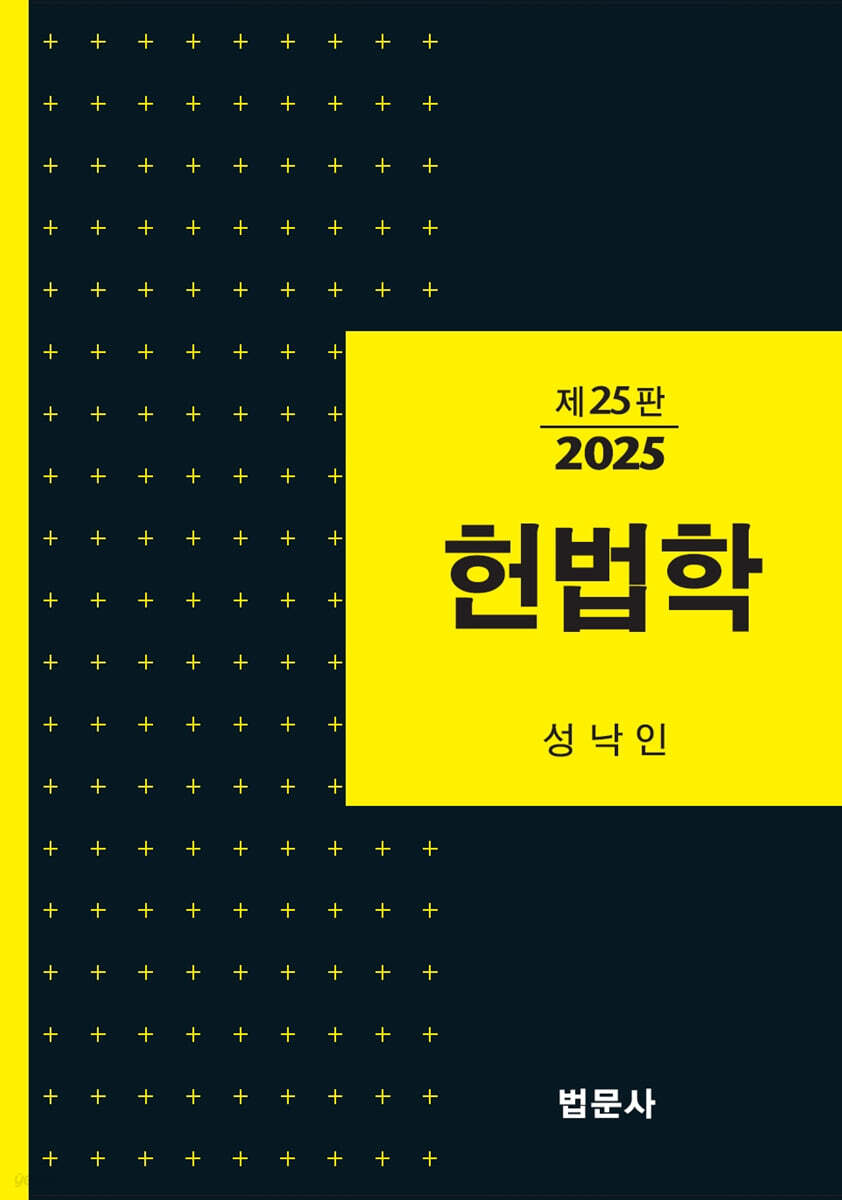
The 25th edition reflects recent legal debates regarding the president's criminal privilege, the right to demand consideration of legislation, and the National Assembly's impeachment proceedings.
In addition, the subject of basic rights, freedom of broadcasting, etc. were significantly revised.
In addition, the subject of basic rights, freedom of broadcasting, etc. were significantly revised.
- You can preview some of the book's contents.
Preview
index
Part 1: General Provisions of the Constitution
Chapter 1 Constitution and Constitutional Law
Chapter 2: Enactment and Amendment of the Constitution and Changes and Guarantees of the Constitution
Chapter 3: The Nature and Form of the State
Chapter 4: Structure and Basic Principles of the Constitution of the Republic of Korea
Part 2: Political Institutions
Chapter 1 General Theory of Political Institutions
Chapter 2 National Assembly
Chapter 3 Government
Chapter 4 Courts
Chapter 5 Constitutional Court
Part 3: Fundamental Rights
Chapter 1 General Theory of Fundamental Rights
Chapter 2 Human Dignity and Value and the Right to Pursuit of Happiness
Chapter 3 Right to Equality
Chapter 4 Liberty
Chapter 5: Voting Rights (Political Rights)
Chapter 6 Social Rights (Right to Survival)
Chapter 7 Fundamental Rights of Claim
Chapter 8 Basic Duties of Citizens
Chapter 1 Constitution and Constitutional Law
Chapter 2: Enactment and Amendment of the Constitution and Changes and Guarantees of the Constitution
Chapter 3: The Nature and Form of the State
Chapter 4: Structure and Basic Principles of the Constitution of the Republic of Korea
Part 2: Political Institutions
Chapter 1 General Theory of Political Institutions
Chapter 2 National Assembly
Chapter 3 Government
Chapter 4 Courts
Chapter 5 Constitutional Court
Part 3: Fundamental Rights
Chapter 1 General Theory of Fundamental Rights
Chapter 2 Human Dignity and Value and the Right to Pursuit of Happiness
Chapter 3 Right to Equality
Chapter 4 Liberty
Chapter 5: Voting Rights (Political Rights)
Chapter 6 Social Rights (Right to Survival)
Chapter 7 Fundamental Rights of Claim
Chapter 8 Basic Duties of Citizens
Publisher's Review
preface
The 25th edition of Constitutional Law is published.
It has been a quarter of a century since the first edition was published.
I would like to thank the professors and readers who have supported 『Constitutional Law』.
The 25th edition faithfully reflects case law, revised laws, and constitutional law-related papers as of January 2025.
The content has been updated through repeated revisions and supplements, but the overall volume has been maintained as much as possible.
The 25th edition reflects recent legal debates regarding the president's criminal privilege, the right to demand consideration of legislation, and the National Assembly's impeachment proceedings.
In addition, the subject of basic rights, freedom of broadcasting, etc. were significantly revised.
As the world enters the era of artificial intelligence (AI), fundamental changes are being demanded in legal systems and legal theory.
Many laws were enacted or revised, including the National Assembly Act, Government Organization Act, Public Official Election Act, Political Funds Act, Court Organization Act, Act on the Establishment and Jurisdiction of Courts at All Levels, Constitutional Court Act, Criminal Procedure Act, Civil Act, State Compensation Act, Act on Promotion of Information and Communications Network Utilization and Information Protection, and Act on the Protection of Crime Victims.
The results of the 22nd general election on April 10, 2024 are shocking.
In 2022, President Yoon Seok-yeol took office with a minority government and a majority opposition party.
However, in the 22nd National Assembly, for the first time since the 1987 Constitution, a single opposition party won an overwhelming majority in the National Assembly.
The Democratic Party of Korea alone secured 175 seats, including satellite parties.
When the four minor opposition parties, including the Fatherland Innovation Party, are included, the opposition parties hold a total of 192 seats, while the ruling People Power Party holds 108 seats, barely securing the threshold to block constitutional amendments and the impeachment of the president.
From the first edition, the author classified the relationship between the two axes of national legitimacy in the 1987 system, that is, the president and the National Assembly, into six categories.
The last case, that is, a single opposition party holding a majority in parliament during the president's term, has been left as a hypothesis until now.
And that hypothesis has become reality.
As soon as the 22nd National Assembly opened, an extreme situation was created due to conflict between the president and the majority faction in the National Assembly.
The opposition party is passing bills opposed by the ruling party, including the Special Prosecutor Act for the President's Spouse, and the vicious cycle continues in which the President exercises his right to demand deliberation on the bill.
The opposition party advocates shortening the president's term or impeachment.
However, the legal risk to the leader of the main opposition party has become a reality.
Even though the divided government has become a reality in the presidential system, there is no sign of any will from either the ruling or opposition parties to actively respond to it.
The political world must keep in mind the fear and weight of public sentiment (Seong Nak-in's Constitutional Politics, "Public sentiment is the will of heaven," Aju Economy, October 25, 2024).
With just a little more deliberation, a grand compromise between the ruling and opposition parties is certainly possible.
The four major national reforms, namely labor, pension, education, and healthcare reforms, as well as the population cliff and regional extinction issues that are crucial to the survival of the nation, are issues that can be compromised.
Regarding healthcare reform, which has caused hardship to the people throughout the past year, a decision is now needed, putting aside partisan interests.
The Constitutional Court has become a vegetable court.
Even though three judges, including the chief justice, whose term ended on October 17, 2024, retired, no successors were appointed for a while, and the acting president barely managed to extend the court's life by appointing only two judges (December 31, 2024) (Seong Nak-in, “The political world that paralyzed the Constitutional Court” (Window of Korea), Hankook Ilbo, November 6, 2024).
However, in the midst of this chaos, President Yoon Seok-yeol declared martial law on the night of December 3rd.
This is the first martial law in 45 years, and the entire nation is shocked.
The “post-democracy” that had been built up over the years under the 1987 constitutional system was completely destroyed.
It is even more surprising that this was ordered by a president who is a former lawyer and holds the highest position as the Prosecutor General.
It was a coup d'Etat, literally a "shock to the nation" that dealt a fatal blow to the healthy development of the Republic of Korea.
It is painful that despite the considerable period of simulation, there has not been a single whistleblower, or "watchdog," during this time.
Fortunately, the National Assembly immediately demanded the lifting of martial law, and the President lifted it in accordance with the National Assembly's request.
The National Assembly subsequently passed the impeachment motion against President Yoon Seok-yeol, a former member of the National Assembly, after a single rejection.
The ball is now in the Constitutional Court's court for an impeachment trial.
The president's duties are suspended and the prime minister acts on his behalf. However, the prime minister is also impeached, and for the first time in history, the deputy prime minister for economic affairs acts on his behalf.
It is a tragic result of endless struggle that does not uphold the norms of democracy.
As a foreign scholar put it, if martial law had succeeded in Korea, it would have set a world historical record of a successful coup in the wealthiest country in the world.
We have committed the historical sin of destroying overnight the great achievements of our ancestors, who achieved both industrialization and democratization simultaneously.
Fortunately, with the support of democratic citizens, the impeachment situation is finding stability (Seong Nak-in's Constitutional Politics, '12ㆍ Seoul Night', Destroying the Rule of Law Economy, Aju Economy, December 26, 2024).
Instead of student activist songs, K-Pop is working, and pre-orders from all over the world are melting the cold.
The protest culture reported by foreign media has now become K-culture.
The power of the citizens is truly amazing.
Compared to that, the political leaders who are leading the Republic of Korea today are far behind.
It is time to end the politics of demonizing the other side.
In this unfortunate history, constitutional issues are once again highlighted.
The scope of the acting president's duties and the quorum for impeachment resolution, etc.
The impeachment situation only hinders the sound development of Korean democracy.
This is already the third presidential impeachment vote in the 87-year constitutional system.
Things that could happen in Latin America or Africa are happening in the 21st century Republic of Korea.
Now the 1987 Constitution has fulfilled its mandate.
It is time to establish the Constitution of the Seventh Republic (Seong Nak-in, special contribution, “We need a constitution in which the president and the National Assembly share responsibility,” Hankook Ilbo, December 19, 2024; “Overcoming the constitutional crisis and a grand compromise between the ruling and opposition parties” (Korea’s Window), Hankook Ilbo, January 1, 2025).
The Korean Society of Civil Engineering Law has inaugurated President Jeon Hak-seon and elected next president Lee Hee-jung.
The Korean Constitutional Law Association has appointed President Jae-Hyeon Cho as its new president and elected President Bo-Geon Seo as its new president.
Please also refer to the author's other works: 『Constitutional Case Law』, 『Constitutional Litigation』 (co-authored by Professors Kwon Geon-bo, Jeong Cheol, Jeon Sang-hyeon, Park Jin-woo, Heo Jin-seong, and Kim Yong-hoon), 『History of the Constitution of the Republic of Korea』, 『Collection of Essays on Constitutional Law』, 『Constitution and National Identity』, 『Introduction to the Constitution』, 『State and Constitution』Ⅰ (General Theory of the Constitution·Political System)·Ⅱ (Fundamental Rights), 『Overview of Korean Constitutional Law』 (Chinese edition translated by Professors Cai Ying-ho and Park Dae-heon).
I would like to express my gratitude to the constitutional law professors across the country, Professors Lee Woo-young and Jeon Sang-hyun of Seoul National University, and Dr. Kim Seon-hwa of the National Assembly Research Service for their valuable advice and encouragement while teaching 『Constitutional Law』.
The completeness of this work is enhanced by the continued assistance and corrections of Professor Jinwoo Park of Gachon University and Dr. Taeyeol Kim (Research Fellow, Institute of Audit and Inspection).
Thanks to your support, 『Constitutional Law』 has been able to receive even greater love.
I would like to thank the president of Beopmunsa, Deputy Director Kim Yong-seok of the Editorial Department, Deputy Director Kwon Hyeok-gi of the Planning and Sales Department, Managers Yoo Jin-geol and Kim Seong-ju, and Ms. Lee Seon-mi of the IT Department.
The 25th edition of Constitutional Law is published.
It has been a quarter of a century since the first edition was published.
I would like to thank the professors and readers who have supported 『Constitutional Law』.
The 25th edition faithfully reflects case law, revised laws, and constitutional law-related papers as of January 2025.
The content has been updated through repeated revisions and supplements, but the overall volume has been maintained as much as possible.
The 25th edition reflects recent legal debates regarding the president's criminal privilege, the right to demand consideration of legislation, and the National Assembly's impeachment proceedings.
In addition, the subject of basic rights, freedom of broadcasting, etc. were significantly revised.
As the world enters the era of artificial intelligence (AI), fundamental changes are being demanded in legal systems and legal theory.
Many laws were enacted or revised, including the National Assembly Act, Government Organization Act, Public Official Election Act, Political Funds Act, Court Organization Act, Act on the Establishment and Jurisdiction of Courts at All Levels, Constitutional Court Act, Criminal Procedure Act, Civil Act, State Compensation Act, Act on Promotion of Information and Communications Network Utilization and Information Protection, and Act on the Protection of Crime Victims.
The results of the 22nd general election on April 10, 2024 are shocking.
In 2022, President Yoon Seok-yeol took office with a minority government and a majority opposition party.
However, in the 22nd National Assembly, for the first time since the 1987 Constitution, a single opposition party won an overwhelming majority in the National Assembly.
The Democratic Party of Korea alone secured 175 seats, including satellite parties.
When the four minor opposition parties, including the Fatherland Innovation Party, are included, the opposition parties hold a total of 192 seats, while the ruling People Power Party holds 108 seats, barely securing the threshold to block constitutional amendments and the impeachment of the president.
From the first edition, the author classified the relationship between the two axes of national legitimacy in the 1987 system, that is, the president and the National Assembly, into six categories.
The last case, that is, a single opposition party holding a majority in parliament during the president's term, has been left as a hypothesis until now.
And that hypothesis has become reality.
As soon as the 22nd National Assembly opened, an extreme situation was created due to conflict between the president and the majority faction in the National Assembly.
The opposition party is passing bills opposed by the ruling party, including the Special Prosecutor Act for the President's Spouse, and the vicious cycle continues in which the President exercises his right to demand deliberation on the bill.
The opposition party advocates shortening the president's term or impeachment.
However, the legal risk to the leader of the main opposition party has become a reality.
Even though the divided government has become a reality in the presidential system, there is no sign of any will from either the ruling or opposition parties to actively respond to it.
The political world must keep in mind the fear and weight of public sentiment (Seong Nak-in's Constitutional Politics, "Public sentiment is the will of heaven," Aju Economy, October 25, 2024).
With just a little more deliberation, a grand compromise between the ruling and opposition parties is certainly possible.
The four major national reforms, namely labor, pension, education, and healthcare reforms, as well as the population cliff and regional extinction issues that are crucial to the survival of the nation, are issues that can be compromised.
Regarding healthcare reform, which has caused hardship to the people throughout the past year, a decision is now needed, putting aside partisan interests.
The Constitutional Court has become a vegetable court.
Even though three judges, including the chief justice, whose term ended on October 17, 2024, retired, no successors were appointed for a while, and the acting president barely managed to extend the court's life by appointing only two judges (December 31, 2024) (Seong Nak-in, “The political world that paralyzed the Constitutional Court” (Window of Korea), Hankook Ilbo, November 6, 2024).
However, in the midst of this chaos, President Yoon Seok-yeol declared martial law on the night of December 3rd.
This is the first martial law in 45 years, and the entire nation is shocked.
The “post-democracy” that had been built up over the years under the 1987 constitutional system was completely destroyed.
It is even more surprising that this was ordered by a president who is a former lawyer and holds the highest position as the Prosecutor General.
It was a coup d'Etat, literally a "shock to the nation" that dealt a fatal blow to the healthy development of the Republic of Korea.
It is painful that despite the considerable period of simulation, there has not been a single whistleblower, or "watchdog," during this time.
Fortunately, the National Assembly immediately demanded the lifting of martial law, and the President lifted it in accordance with the National Assembly's request.
The National Assembly subsequently passed the impeachment motion against President Yoon Seok-yeol, a former member of the National Assembly, after a single rejection.
The ball is now in the Constitutional Court's court for an impeachment trial.
The president's duties are suspended and the prime minister acts on his behalf. However, the prime minister is also impeached, and for the first time in history, the deputy prime minister for economic affairs acts on his behalf.
It is a tragic result of endless struggle that does not uphold the norms of democracy.
As a foreign scholar put it, if martial law had succeeded in Korea, it would have set a world historical record of a successful coup in the wealthiest country in the world.
We have committed the historical sin of destroying overnight the great achievements of our ancestors, who achieved both industrialization and democratization simultaneously.
Fortunately, with the support of democratic citizens, the impeachment situation is finding stability (Seong Nak-in's Constitutional Politics, '12ㆍ Seoul Night', Destroying the Rule of Law Economy, Aju Economy, December 26, 2024).
Instead of student activist songs, K-Pop is working, and pre-orders from all over the world are melting the cold.
The protest culture reported by foreign media has now become K-culture.
The power of the citizens is truly amazing.
Compared to that, the political leaders who are leading the Republic of Korea today are far behind.
It is time to end the politics of demonizing the other side.
In this unfortunate history, constitutional issues are once again highlighted.
The scope of the acting president's duties and the quorum for impeachment resolution, etc.
The impeachment situation only hinders the sound development of Korean democracy.
This is already the third presidential impeachment vote in the 87-year constitutional system.
Things that could happen in Latin America or Africa are happening in the 21st century Republic of Korea.
Now the 1987 Constitution has fulfilled its mandate.
It is time to establish the Constitution of the Seventh Republic (Seong Nak-in, special contribution, “We need a constitution in which the president and the National Assembly share responsibility,” Hankook Ilbo, December 19, 2024; “Overcoming the constitutional crisis and a grand compromise between the ruling and opposition parties” (Korea’s Window), Hankook Ilbo, January 1, 2025).
The Korean Society of Civil Engineering Law has inaugurated President Jeon Hak-seon and elected next president Lee Hee-jung.
The Korean Constitutional Law Association has appointed President Jae-Hyeon Cho as its new president and elected President Bo-Geon Seo as its new president.
Please also refer to the author's other works: 『Constitutional Case Law』, 『Constitutional Litigation』 (co-authored by Professors Kwon Geon-bo, Jeong Cheol, Jeon Sang-hyeon, Park Jin-woo, Heo Jin-seong, and Kim Yong-hoon), 『History of the Constitution of the Republic of Korea』, 『Collection of Essays on Constitutional Law』, 『Constitution and National Identity』, 『Introduction to the Constitution』, 『State and Constitution』Ⅰ (General Theory of the Constitution·Political System)·Ⅱ (Fundamental Rights), 『Overview of Korean Constitutional Law』 (Chinese edition translated by Professors Cai Ying-ho and Park Dae-heon).
I would like to express my gratitude to the constitutional law professors across the country, Professors Lee Woo-young and Jeon Sang-hyun of Seoul National University, and Dr. Kim Seon-hwa of the National Assembly Research Service for their valuable advice and encouragement while teaching 『Constitutional Law』.
The completeness of this work is enhanced by the continued assistance and corrections of Professor Jinwoo Park of Gachon University and Dr. Taeyeol Kim (Research Fellow, Institute of Audit and Inspection).
Thanks to your support, 『Constitutional Law』 has been able to receive even greater love.
I would like to thank the president of Beopmunsa, Deputy Director Kim Yong-seok of the Editorial Department, Deputy Director Kwon Hyeok-gi of the Planning and Sales Department, Managers Yoo Jin-geol and Kim Seong-ju, and Ms. Lee Seon-mi of the IT Department.
GOODS SPECIFICS
- Date of issue: February 25, 2025
- Format: Hardcover book binding method guide
- Page count, weight, size: 1,880 pages | 174*246*80mm
- ISBN13: 9788918915913
- ISBN10: 8918915918
You may also like
카테고리
korean


korean

![GQ KOREA Mark (Monthly): December [2025]](http://librairie.coreenne.fr/cdn/shop/files/8ef265dbbfbf186523ed75ba7319009d.jpg?v=1765340328&width=3840)


