

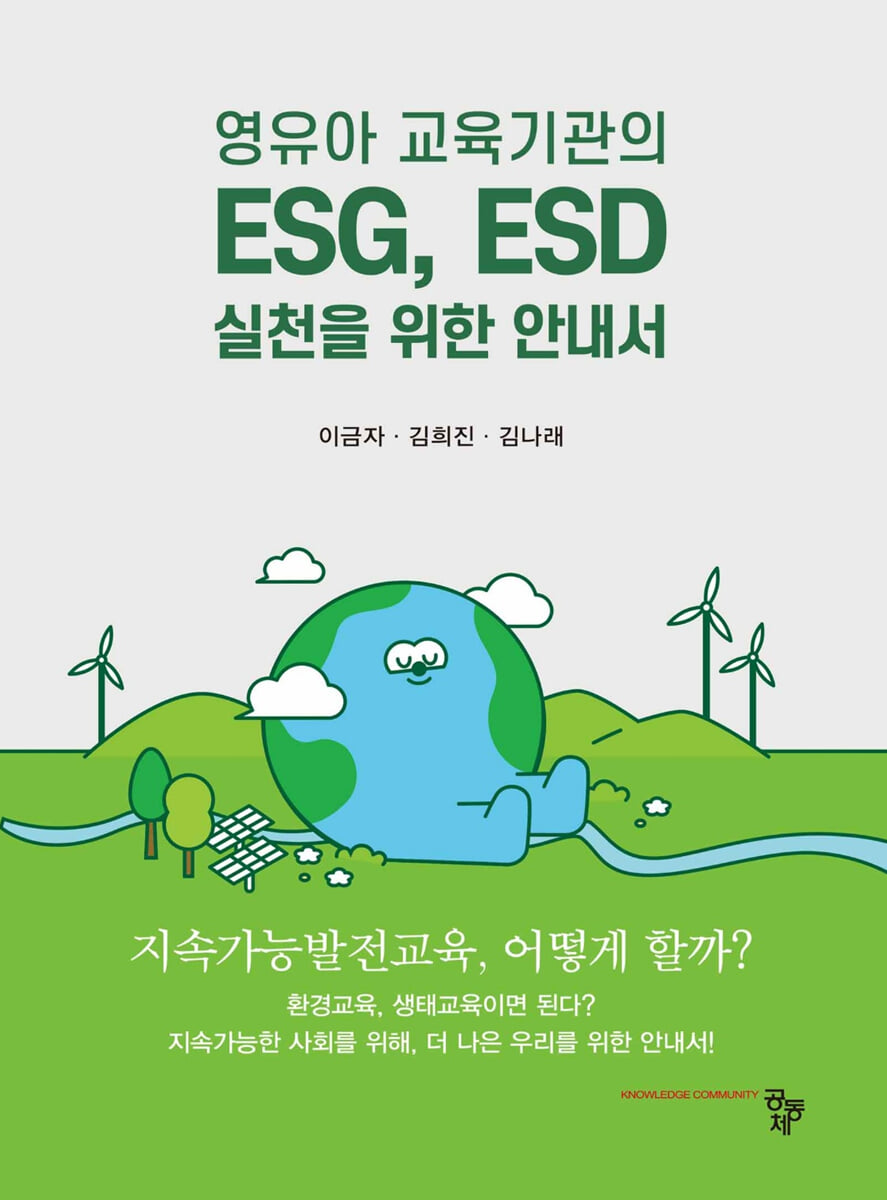
A Guide to ESG and ESD Practices in Early Childhood Education Institutions
 |
Description
Book Introduction
Part 1 was written to provide time to rethink the current state of early childhood education from an ESG perspective.
Part 2 revisits the existing practices of early childhood education institutions through a new perspective, revisiting their ‘operation’ and ‘curriculum’, adding educational imagination.
Part 3 contains the contents of ‘ESD educational imagination in practice.’
From 2023 to the present, the authors presented actual cases of application and implementation by working with early childhood education institutions and cooperative communities.
Part 4 is a record and case study of the transformative role of teachers in implementing ESD.
Part 2 revisits the existing practices of early childhood education institutions through a new perspective, revisiting their ‘operation’ and ‘curriculum’, adding educational imagination.
Part 3 contains the contents of ‘ESD educational imagination in practice.’
From 2023 to the present, the authors presented actual cases of application and implementation by working with early childhood education institutions and cooperative communities.
Part 4 is a record and case study of the transformative role of teachers in implementing ESD.
index
· Recommendation 5
· Preface 8
Part 1: Why Now?
01 ESG Values, Why 17
02 ESD 21 linked to ESG
03 Looking at it through the Sustainability Paradigm 23
04 Understanding 'Value' through New Practices 31
Part 2 ESD: Educational Imagination
01 Reorienting the Curriculum for Sustainability: What's Missing? 36
02 Teacher Competencies for ESD 38
03 The Teacher's Role in ESD 42
04 Imagining the Practice of Early Childhood Education Institutions 47
Part 3 ESD: The Practice of Educational Imagination
01 Educational Goals and Annual Plan 61
02 Playground 71
Part 4: Teacher Reflections on ESD
01 Teacher's Reflection Time 101
02 Reflection with Colleagues 108
03 Creating Meaning with Collaborative Communities 122
· Appendix
01 ESD Teacher Training Case Study 148 Based on ESG Values
02 Home-Linked Card News 155
03 Domestic and International ESD Practice Help Materials 163
04 Pre- and Post-Test Awareness Survey Questionnaire 175
05 Q&A on Participation in the UNESCO Education for Sustainable Development (ESD) Official Project Certification System 177
06 UNESCO Education for Sustainable Development (ESD) Official Project Certification System Operation Guidelines 183
· Conclusion: Writing Our Imagination into a Book 187
· Preface 8
Part 1: Why Now?
01 ESG Values, Why 17
02 ESD 21 linked to ESG
03 Looking at it through the Sustainability Paradigm 23
04 Understanding 'Value' through New Practices 31
Part 2 ESD: Educational Imagination
01 Reorienting the Curriculum for Sustainability: What's Missing? 36
02 Teacher Competencies for ESD 38
03 The Teacher's Role in ESD 42
04 Imagining the Practice of Early Childhood Education Institutions 47
Part 3 ESD: The Practice of Educational Imagination
01 Educational Goals and Annual Plan 61
02 Playground 71
Part 4: Teacher Reflections on ESD
01 Teacher's Reflection Time 101
02 Reflection with Colleagues 108
03 Creating Meaning with Collaborative Communities 122
· Appendix
01 ESD Teacher Training Case Study 148 Based on ESG Values
02 Home-Linked Card News 155
03 Domestic and International ESD Practice Help Materials 163
04 Pre- and Post-Test Awareness Survey Questionnaire 175
05 Q&A on Participation in the UNESCO Education for Sustainable Development (ESD) Official Project Certification System 177
06 UNESCO Education for Sustainable Development (ESD) Official Project Certification System Operation Guidelines 183
· Conclusion: Writing Our Imagination into a Book 187
Detailed image

Publisher's Review
This book is divided into four parts and an appendix.
Part 1 was written to provide an opportunity to rethink the current state of early childhood education through the lens of ESG values. The content explores the significance of ESG values for early childhood education institutions and their importance as a paradigm for sustainability.
Part 2 revisits the existing practices of early childhood education institutions through a new perspective, revisiting their ‘operation’ and ‘curriculum’, adding educational imagination.
This will be a time to seek to reorient the curriculum and operational contents of sustainable education through the new lens of 'ESG, ESD: Education for Sustainable Development.'
Part 3 contains the contents of ‘ESD educational imagination in practice.’
From 2023 to the present, the authors presented actual cases of application and implementation by working with early childhood education institutions and cooperative communities.
In 2024, the authors visited institutions and shared ESG and ESD values with teachers through teacher training and collaborative community gatherings. They explored our identity at the crossroads of an uncertain future for education and reflected on the role of teachers.
This year, the authors participated as members of a 'collaborative community', sharing, learning, and putting into practice what they learned through collaboration.
Two of the five play cases actually implemented and supported sustainable projects in the field.
Part 4 is a record and case study of the transformative role of teachers in implementing ESD.
For a sustainable society, teachers must possess professional skills such as reflective capacity.
We have included materials to help teachers recognize and practice the role of reflective teachers, and a template to help teachers easily apply 'reflection with colleagues' when implementing ESD.
It also contains examples of cooperative communities coming together to reflect together.
Finally, the appendix contains information materials that can be easily implemented in early childhood education institutions.
We have compiled materials to help connect families and communities, questionnaires used for project activities, and internet information materials.
I hope this book will serve as a helpful guide for those working to create a sustainable society and a world where precious children can live.
Part 1 was written to provide an opportunity to rethink the current state of early childhood education through the lens of ESG values. The content explores the significance of ESG values for early childhood education institutions and their importance as a paradigm for sustainability.
Part 2 revisits the existing practices of early childhood education institutions through a new perspective, revisiting their ‘operation’ and ‘curriculum’, adding educational imagination.
This will be a time to seek to reorient the curriculum and operational contents of sustainable education through the new lens of 'ESG, ESD: Education for Sustainable Development.'
Part 3 contains the contents of ‘ESD educational imagination in practice.’
From 2023 to the present, the authors presented actual cases of application and implementation by working with early childhood education institutions and cooperative communities.
In 2024, the authors visited institutions and shared ESG and ESD values with teachers through teacher training and collaborative community gatherings. They explored our identity at the crossroads of an uncertain future for education and reflected on the role of teachers.
This year, the authors participated as members of a 'collaborative community', sharing, learning, and putting into practice what they learned through collaboration.
Two of the five play cases actually implemented and supported sustainable projects in the field.
Part 4 is a record and case study of the transformative role of teachers in implementing ESD.
For a sustainable society, teachers must possess professional skills such as reflective capacity.
We have included materials to help teachers recognize and practice the role of reflective teachers, and a template to help teachers easily apply 'reflection with colleagues' when implementing ESD.
It also contains examples of cooperative communities coming together to reflect together.
Finally, the appendix contains information materials that can be easily implemented in early childhood education institutions.
We have compiled materials to help connect families and communities, questionnaires used for project activities, and internet information materials.
I hope this book will serve as a helpful guide for those working to create a sustainable society and a world where precious children can live.
GOODS SPECIFICS
- Date of issue: September 30, 2024
- Page count, weight, size: 200 pages | 190*257*20mm
- ISBN13: 9791167257727
- ISBN10: 1167257723
You may also like
카테고리
korean


korean

![ELLE 엘르 스페셜 에디션 A형 : 12월 [2025]](http://librairie.coreenne.fr/cdn/shop/files/b8e27a3de6c9538896439686c6b0e8fb.jpg?v=1766436872&width=3840)


