

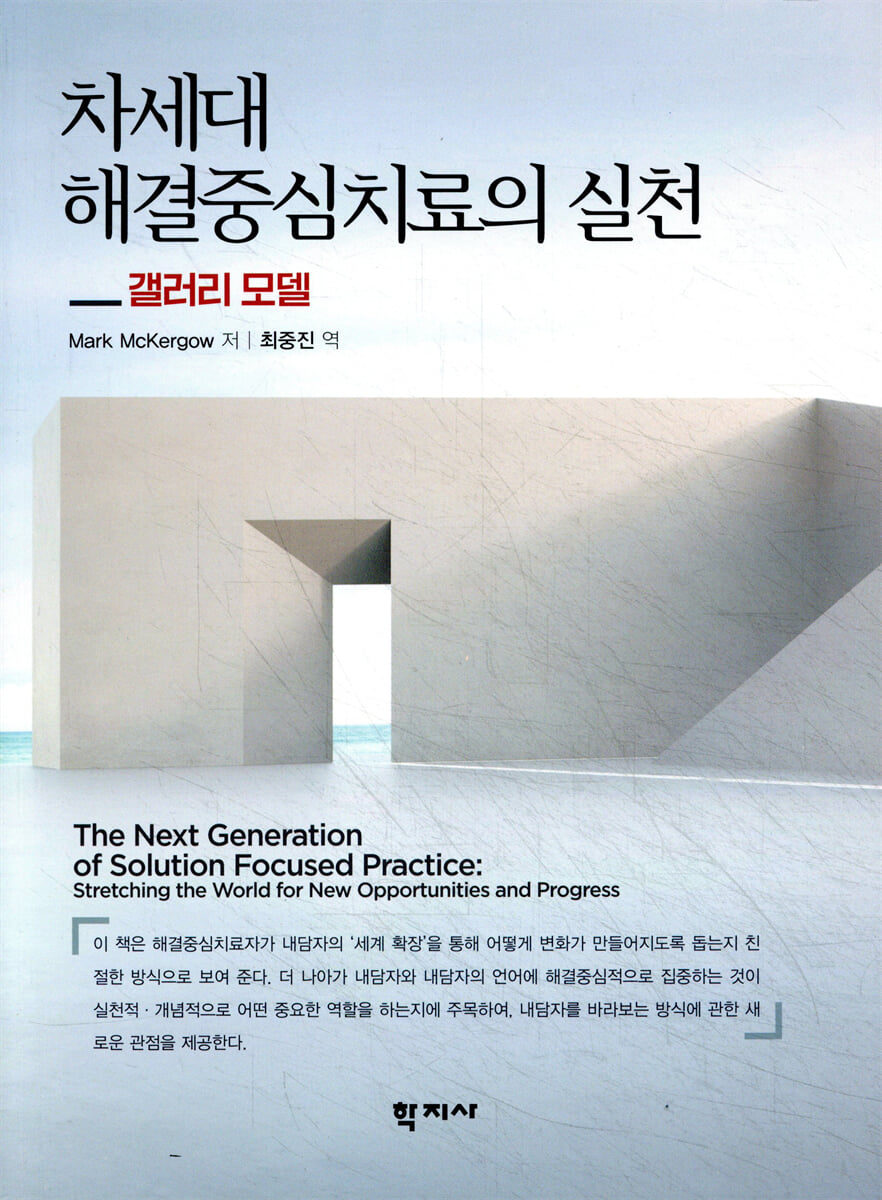
Implementing Next-Generation Solution-Focused Therapy
 |
Description
Book Introduction
It has been 40 years since solution-focused therapy was developed.
Solution-focused therapy, which focuses on solutions rather than problems and leads clients to positive changes in their lives, is undergoing ongoing changes in theory and practice, just as its therapeutic principles are characterized.
While discussions on the development of vibrant treatment are actively taking place overseas, there has been a relative dearth of books in Korea that provide a foundation of value justification and solid theoretical grounding.
In this context, Dr. Mark McKergow's book, which can quench the thirst of solution-focused practitioners who feel thirsty for excellent resources, has been translated and published.
This book presents the 'solution-focused gallery model' among the changes in solution-focused therapy that are undergoing various theoretical and practical changes.
This practice, which possesses both efficiency and theoretical consistency, has the characteristic of moving beyond the conventional step-by-step and linear solution-focused therapy and leading to a theme-centered practice.
In this model, the solution-focused practitioner helps the client, like a painter, to describe in detail the future they want.
This book balances theoretical foundations with practical approaches to explain how interventions in this detailed descriptive process can influence the likelihood of future action.
Solution-focused therapy focuses on the client's language, expanding their world and bringing about change.
Just as this kind and nuanced conversation broadens the client's world and opens them to greater possibilities, I hope that "Practicing Next-Generation Solution-Focused Therapy" will further expand the world of solution-focused practitioners, leading to a broader understanding.
Solution-focused therapy, which focuses on solutions rather than problems and leads clients to positive changes in their lives, is undergoing ongoing changes in theory and practice, just as its therapeutic principles are characterized.
While discussions on the development of vibrant treatment are actively taking place overseas, there has been a relative dearth of books in Korea that provide a foundation of value justification and solid theoretical grounding.
In this context, Dr. Mark McKergow's book, which can quench the thirst of solution-focused practitioners who feel thirsty for excellent resources, has been translated and published.
This book presents the 'solution-focused gallery model' among the changes in solution-focused therapy that are undergoing various theoretical and practical changes.
This practice, which possesses both efficiency and theoretical consistency, has the characteristic of moving beyond the conventional step-by-step and linear solution-focused therapy and leading to a theme-centered practice.
In this model, the solution-focused practitioner helps the client, like a painter, to describe in detail the future they want.
This book balances theoretical foundations with practical approaches to explain how interventions in this detailed descriptive process can influence the likelihood of future action.
Solution-focused therapy focuses on the client's language, expanding their world and bringing about change.
Just as this kind and nuanced conversation broadens the client's world and opens them to greater possibilities, I hope that "Practicing Next-Generation Solution-Focused Therapy" will further expand the world of solution-focused practitioners, leading to a broader understanding.
index
Translator's Preface
Getting started
The goal of this book
Tradition of an outsider perspective
Why Solution-Focused Therapy is Interesting
About this book
Key Points
Part 1: The Development of Solution-Focused Brief Therapy
Chapter 1: The Roots of Solution-Focused Brief Therapy: An Interactional Perspective
Gregory Bateson, Milton Erickson, and the Bateson Project
MRI, family therapy, and short-term treatment centers
A key idea that's still with us
Key Points
Chapter 2: Steve de Shazer, Insu Kim, and Solution-Focused Brief Therapy
Steve de Sager and Kim In-soo
Development of short-term treatment
The emergence of solution-focused brief therapy
Key Points
Chapter 3: The Evolution of Solution-Focused Brief Therapy: Expansion and Refinement of Practice
Solution-Focused Therapy Goes Global
Organization of solution-focused therapy
Definition of Solution-Focused Therapy
Emergence and connection with national organizations
Simplify, not summarize
The 'official' version of solution-focused therapy
Key Points
Part 2: Building Detailed Descriptions and Expanding the Client's World
Chapter 4: The Evolution of Next-Generation Solution-Focused Therapy
Dialogue as Intervention
Development focused on description
The Position of the Virtual Future in the Practice of Solution-Focused Therapy - From the End to the Beginning
What is the miracle question for?
Transition from exceptions to examples (instances)
Building a (detailed) description
Breaking free from the norms and practices of traditional family therapy
End of session (conveying gratitude summary)
Next-generation solution-focused therapy
Key Points
Chapter 5: The Client's "Expansion of the World"
The attitude of not knowing
How to explain solution-focused therapy
Advances in brain science
Where is the 'world'?
The World: A Field of Affordances
Solution-Focused Therapy as 'World Expansion'
Case: Jane, I want to assign a new assignment.
Why we "expand" the world instead of "changing" or "rebuilding" it
conclusion
Key Points
Chapter 6: The Role of Practitioners
Practitioner as a global expander
Construction of a description
Development through microanalysis
Selection of keywords
The role of practitioners
Key Points
Part 3: Next-Generation Solution-Focused Therapy
Chapter 7: Introduction to the Solution-Focused Gallery Model
Gallery Model
Key Points
Chapter 8: Ticket Office: Getting Your Tickets to Start
Definition of a joint project
What is your 'best hope'?
Circle of recognition and progress
Extending the best hope
Decide on a name for your project
Case: Mary, I want to fly freely.
Case: Jane, I want to add a new assignment (continued)
Reflection
Key Points
Chapter 9: The Future: Miracles and Parallel Worlds
Breaking the causal link between past and future
The development of the miracle question
Expansion of the description: detailed scenes
Case: Mary, I Want to Fly Free (continued)
Key Points
Chapter 10: Example: Connecting with a Better Future
Scale, a strong starting point
Progress Scale/Miracle Scale
Discussion of progress metrics
Other forms of scale4
Case: Jack, please listen to my story.
Key Points
Chapter 11: Souvenir Shop: What to Take Home as a Souvenir
Change: From Tasks to Audit Summary
Small signs of progress
Confidence in the Future Scale
When it is difficult to find signs of progress
Provides options for future sessions
Case: Jack, please listen to my story (continued)
Key Points
Chapter 12: Revisiting the Gallery: Follow-up Session
What's better?
Recent changes to the question "What's better?"
If… … it seems like there is nothing better
Try something different
End of treatment
Case: Jack, please listen to my story (follow-up session)
Key Points
Part 4: Solution-Oriented Aesthetics
Chapter 13: The Beauty of Solution-Focused Therapy: What Is Beautiful and Why?
What is 'aesthetics'?
Conciseness
Client autonomy
Radical acceptance
Stay on the surface
Cherish the small differences
Connecting the past and the future
conclusion
Key Points
Search
Getting started
The goal of this book
Tradition of an outsider perspective
Why Solution-Focused Therapy is Interesting
About this book
Key Points
Part 1: The Development of Solution-Focused Brief Therapy
Chapter 1: The Roots of Solution-Focused Brief Therapy: An Interactional Perspective
Gregory Bateson, Milton Erickson, and the Bateson Project
MRI, family therapy, and short-term treatment centers
A key idea that's still with us
Key Points
Chapter 2: Steve de Shazer, Insu Kim, and Solution-Focused Brief Therapy
Steve de Sager and Kim In-soo
Development of short-term treatment
The emergence of solution-focused brief therapy
Key Points
Chapter 3: The Evolution of Solution-Focused Brief Therapy: Expansion and Refinement of Practice
Solution-Focused Therapy Goes Global
Organization of solution-focused therapy
Definition of Solution-Focused Therapy
Emergence and connection with national organizations
Simplify, not summarize
The 'official' version of solution-focused therapy
Key Points
Part 2: Building Detailed Descriptions and Expanding the Client's World
Chapter 4: The Evolution of Next-Generation Solution-Focused Therapy
Dialogue as Intervention
Development focused on description
The Position of the Virtual Future in the Practice of Solution-Focused Therapy - From the End to the Beginning
What is the miracle question for?
Transition from exceptions to examples (instances)
Building a (detailed) description
Breaking free from the norms and practices of traditional family therapy
End of session (conveying gratitude summary)
Next-generation solution-focused therapy
Key Points
Chapter 5: The Client's "Expansion of the World"
The attitude of not knowing
How to explain solution-focused therapy
Advances in brain science
Where is the 'world'?
The World: A Field of Affordances
Solution-Focused Therapy as 'World Expansion'
Case: Jane, I want to assign a new assignment.
Why we "expand" the world instead of "changing" or "rebuilding" it
conclusion
Key Points
Chapter 6: The Role of Practitioners
Practitioner as a global expander
Construction of a description
Development through microanalysis
Selection of keywords
The role of practitioners
Key Points
Part 3: Next-Generation Solution-Focused Therapy
Chapter 7: Introduction to the Solution-Focused Gallery Model
Gallery Model
Key Points
Chapter 8: Ticket Office: Getting Your Tickets to Start
Definition of a joint project
What is your 'best hope'?
Circle of recognition and progress
Extending the best hope
Decide on a name for your project
Case: Mary, I want to fly freely.
Case: Jane, I want to add a new assignment (continued)
Reflection
Key Points
Chapter 9: The Future: Miracles and Parallel Worlds
Breaking the causal link between past and future
The development of the miracle question
Expansion of the description: detailed scenes
Case: Mary, I Want to Fly Free (continued)
Key Points
Chapter 10: Example: Connecting with a Better Future
Scale, a strong starting point
Progress Scale/Miracle Scale
Discussion of progress metrics
Other forms of scale4
Case: Jack, please listen to my story.
Key Points
Chapter 11: Souvenir Shop: What to Take Home as a Souvenir
Change: From Tasks to Audit Summary
Small signs of progress
Confidence in the Future Scale
When it is difficult to find signs of progress
Provides options for future sessions
Case: Jack, please listen to my story (continued)
Key Points
Chapter 12: Revisiting the Gallery: Follow-up Session
What's better?
Recent changes to the question "What's better?"
If… … it seems like there is nothing better
Try something different
End of treatment
Case: Jack, please listen to my story (follow-up session)
Key Points
Part 4: Solution-Oriented Aesthetics
Chapter 13: The Beauty of Solution-Focused Therapy: What Is Beautiful and Why?
What is 'aesthetics'?
Conciseness
Client autonomy
Radical acceptance
Stay on the surface
Cherish the small differences
Connecting the past and the future
conclusion
Key Points
Search
GOODS SPECIFICS
- Date of issue: September 20, 2024
- Format: Paperback book binding method guide
- Page count, weight, size: 352 pages | 173*235*15mm
- ISBN13: 9788999732010
- ISBN10: 8999732010
You may also like
카테고리
korean


korean

![GQ KOREA Mark (Monthly): December [2025]](http://librairie.coreenne.fr/cdn/shop/files/8ef265dbbfbf186523ed75ba7319009d.jpg?v=1765340328&width=3840)


