

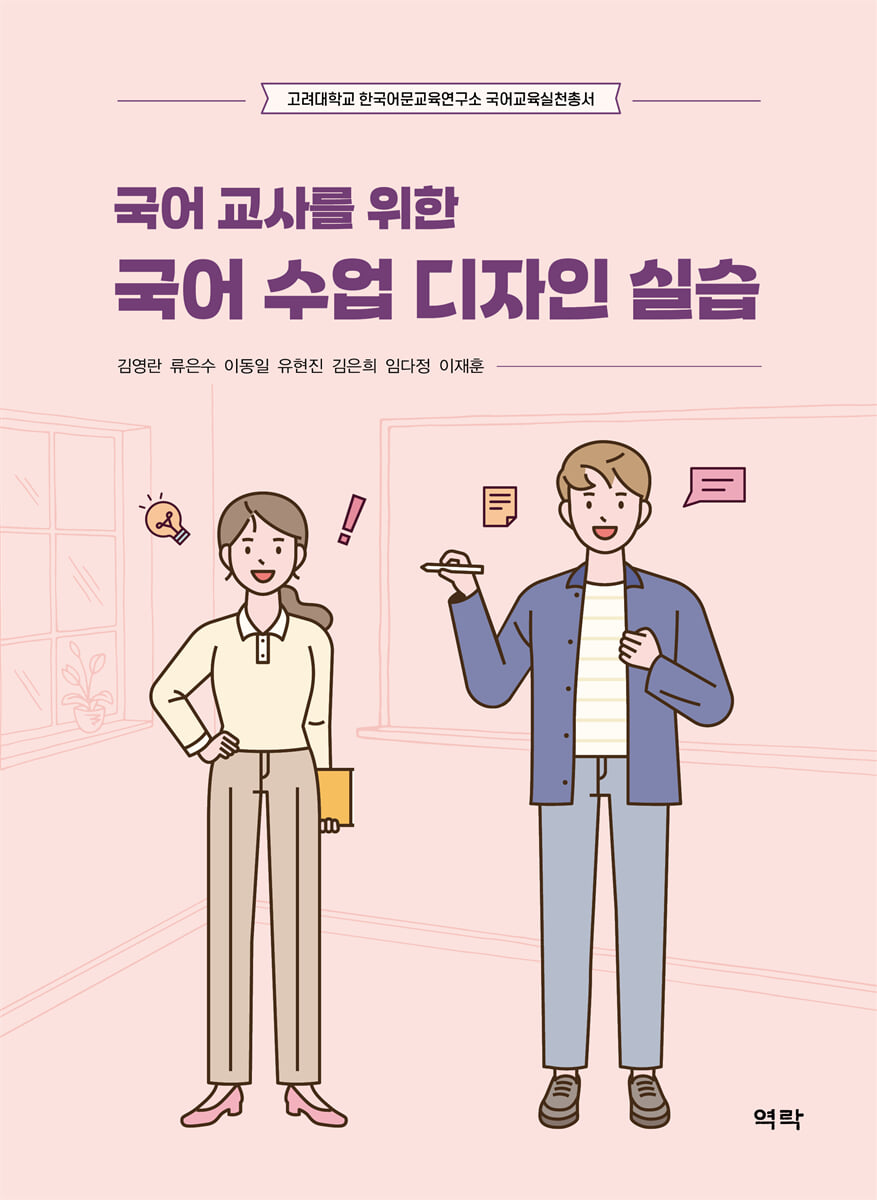
Korean Language Class Design Practice for Korean Language Teachers
 |
Description
Book Introduction
『Korean Language Class Design Practice for Korean Language Teachers』 is a guide for those who are teaching Korean language for the first time.
Anyone who wants to take a Korean language class for the first time in their life will face difficulties.
When planning a lesson, you'll constantly feel overwhelmed by questions like how many 45- or 50-minute lessons should be divided into each unit, how to begin, develop, and conclude each lesson, and how to keep students interested, focused, and on track to achieve their learning goals.
Anyone who goes through that daunting process will be left with a series of questions about what to do and how to do it.
There are few places where you can get help with these difficulties, so beginning Korean language teachers have to fend for themselves.
This book aims to provide guidance by focusing on the questions asked by those who experience recurring difficulties.
Anyone who wants to take a Korean language class for the first time in their life will face difficulties.
When planning a lesson, you'll constantly feel overwhelmed by questions like how many 45- or 50-minute lessons should be divided into each unit, how to begin, develop, and conclude each lesson, and how to keep students interested, focused, and on track to achieve their learning goals.
Anyone who goes through that daunting process will be left with a series of questions about what to do and how to do it.
There are few places where you can get help with these difficulties, so beginning Korean language teachers have to fend for themselves.
This book aims to provide guidance by focusing on the questions asked by those who experience recurring difficulties.
index
Part 1: What are the first things you'll be confused about when designing a Korean language class, and what should you do?
What do you find most confusing when first designing a Korean language class?
What to do when designing a Korean language class
Part 2: Preparing for the First Class Demonstration of Korean Language Classes by Area
Chapter 1 To actually practice listening and speaking
Chapter 2: How to Use Self-Directed Reading Strategies
Chapter 3: How to Get Every Student to Write
Chapter 4: Grammar: What is the best order for students to learn it?
Chapter 5 How to Make Literature Classes Not Boring
Chapter 6: How Should Media Conduct Classes?
Korean language classes based on the 3rd part of the curriculum restructuring, preparing for the educational field.
How can we integrate performance standards within Chapter 7?
What kind of classes are possible when achievement standards across eight areas are linked?
Chapter 9: What Kind of Class Will Be Created When Subjects Meet Subjects?
Chapter 10: How Can School Life Be Connected to Classes?
What do you find most confusing when first designing a Korean language class?
What to do when designing a Korean language class
Part 2: Preparing for the First Class Demonstration of Korean Language Classes by Area
Chapter 1 To actually practice listening and speaking
Chapter 2: How to Use Self-Directed Reading Strategies
Chapter 3: How to Get Every Student to Write
Chapter 4: Grammar: What is the best order for students to learn it?
Chapter 5 How to Make Literature Classes Not Boring
Chapter 6: How Should Media Conduct Classes?
Korean language classes based on the 3rd part of the curriculum restructuring, preparing for the educational field.
How can we integrate performance standards within Chapter 7?
What kind of classes are possible when achievement standards across eight areas are linked?
Chapter 9: What Kind of Class Will Be Created When Subjects Meet Subjects?
Chapter 10: How Can School Life Be Connected to Classes?
Publisher's Review
This book is a guide for those who are taking Korean language classes for the first time in their lives.
Anyone who wants to take a Korean language class for the first time in their life will face difficulties.
When planning a lesson, you'll constantly feel overwhelmed by questions like how many 45- or 50-minute lessons should be divided into each unit, how to begin, develop, and conclude each lesson, and how to keep students interested, focused, and on track to achieve their learning goals.
Anyone who goes through that daunting process will be left with a series of questions about what to do and how to do it.
There are few places where you can get help with these difficulties, so beginning Korean language teachers have to fend for themselves.
This book aims to provide guidance by focusing on the questions asked by those who experience recurring difficulties.
In Part 1, concerns about designing Korean language classes were investigated and listed as questions. In Part 2, examples of class design were provided to answer the questions, and answers from field teachers were presented in the 'Questions and Answers' section.
The difficulties faced by beginning Korean language teachers are not easily solved by a technical rationalist approach that assumes that theories about what to teach, teaching and learning methods, and assessment can be applied to classes.
Teachers must make pedagogical transitions to a form appropriate for the learners based on their understanding of the content to be taught.
It is necessary to provide a device that will attract students' attention and interest in the content to be taught, and to design learning activities that ensure student learning in harmony with the teacher's appropriate teaching practices. At the end of the class, the learned content should be summarized and reviewed to ensure a transition to the next class.
This requires practical knowledge from educational experts.
Those who write textbooks based on the curriculum or teachers who skillfully plan classes based on the Korean language curriculum while using textbooks as reference materials possess this practical knowledge.
This book systematically organizes lesson design into four stages by reviewing the practical work of educational experts who develop textbooks or design lessons while detailing the curriculum.
The lesson designs for Parts 2 and 3 are all completed by following these four steps.
In Part 2, considering that Korean language classes are generally conducted based on achievement standards for each area, we proposed lesson designs for six areas with the hope that no area is overlooked in Korean language classes.
Part 3 provides examples of integrated Korean language class designs that can be implemented in educational settings.
We covered lesson designs based on curriculum reconstruction, such as lessons that integrate achievement standards within the Korean language subject area, lessons that integrate achievement standards across subjects, lessons that integrate the educational content of Korean language with other subjects, and lessons that link Korean language with creative experiential activities.
Chapters 2 and 3 of each part are '1.
Designing a Class, Part 2.
Questions and Answers, 3.
By structuring it in the order of 'Practicing Lesson Design', readers can check the lesson design method and then practice lesson design by referring to the answers to the questions of beginner teachers mentioned above.
Anyone who wants to take a Korean language class for the first time in their life will face difficulties.
When planning a lesson, you'll constantly feel overwhelmed by questions like how many 45- or 50-minute lessons should be divided into each unit, how to begin, develop, and conclude each lesson, and how to keep students interested, focused, and on track to achieve their learning goals.
Anyone who goes through that daunting process will be left with a series of questions about what to do and how to do it.
There are few places where you can get help with these difficulties, so beginning Korean language teachers have to fend for themselves.
This book aims to provide guidance by focusing on the questions asked by those who experience recurring difficulties.
In Part 1, concerns about designing Korean language classes were investigated and listed as questions. In Part 2, examples of class design were provided to answer the questions, and answers from field teachers were presented in the 'Questions and Answers' section.
The difficulties faced by beginning Korean language teachers are not easily solved by a technical rationalist approach that assumes that theories about what to teach, teaching and learning methods, and assessment can be applied to classes.
Teachers must make pedagogical transitions to a form appropriate for the learners based on their understanding of the content to be taught.
It is necessary to provide a device that will attract students' attention and interest in the content to be taught, and to design learning activities that ensure student learning in harmony with the teacher's appropriate teaching practices. At the end of the class, the learned content should be summarized and reviewed to ensure a transition to the next class.
This requires practical knowledge from educational experts.
Those who write textbooks based on the curriculum or teachers who skillfully plan classes based on the Korean language curriculum while using textbooks as reference materials possess this practical knowledge.
This book systematically organizes lesson design into four stages by reviewing the practical work of educational experts who develop textbooks or design lessons while detailing the curriculum.
The lesson designs for Parts 2 and 3 are all completed by following these four steps.
In Part 2, considering that Korean language classes are generally conducted based on achievement standards for each area, we proposed lesson designs for six areas with the hope that no area is overlooked in Korean language classes.
Part 3 provides examples of integrated Korean language class designs that can be implemented in educational settings.
We covered lesson designs based on curriculum reconstruction, such as lessons that integrate achievement standards within the Korean language subject area, lessons that integrate achievement standards across subjects, lessons that integrate the educational content of Korean language with other subjects, and lessons that link Korean language with creative experiential activities.
Chapters 2 and 3 of each part are '1.
Designing a Class, Part 2.
Questions and Answers, 3.
By structuring it in the order of 'Practicing Lesson Design', readers can check the lesson design method and then practice lesson design by referring to the answers to the questions of beginner teachers mentioned above.
GOODS SPECIFICS
- Date of issue: September 2, 2024
- Page count, weight, size: 308 pages | 188*257*13mm
- ISBN13: 9791167428493
You may also like
카테고리
korean


korean

![GQ KOREA Mark (Monthly): December [2025]](http://librairie.coreenne.fr/cdn/shop/files/8ef265dbbfbf186523ed75ba7319009d.jpg?v=1765340328&width=3840)


