

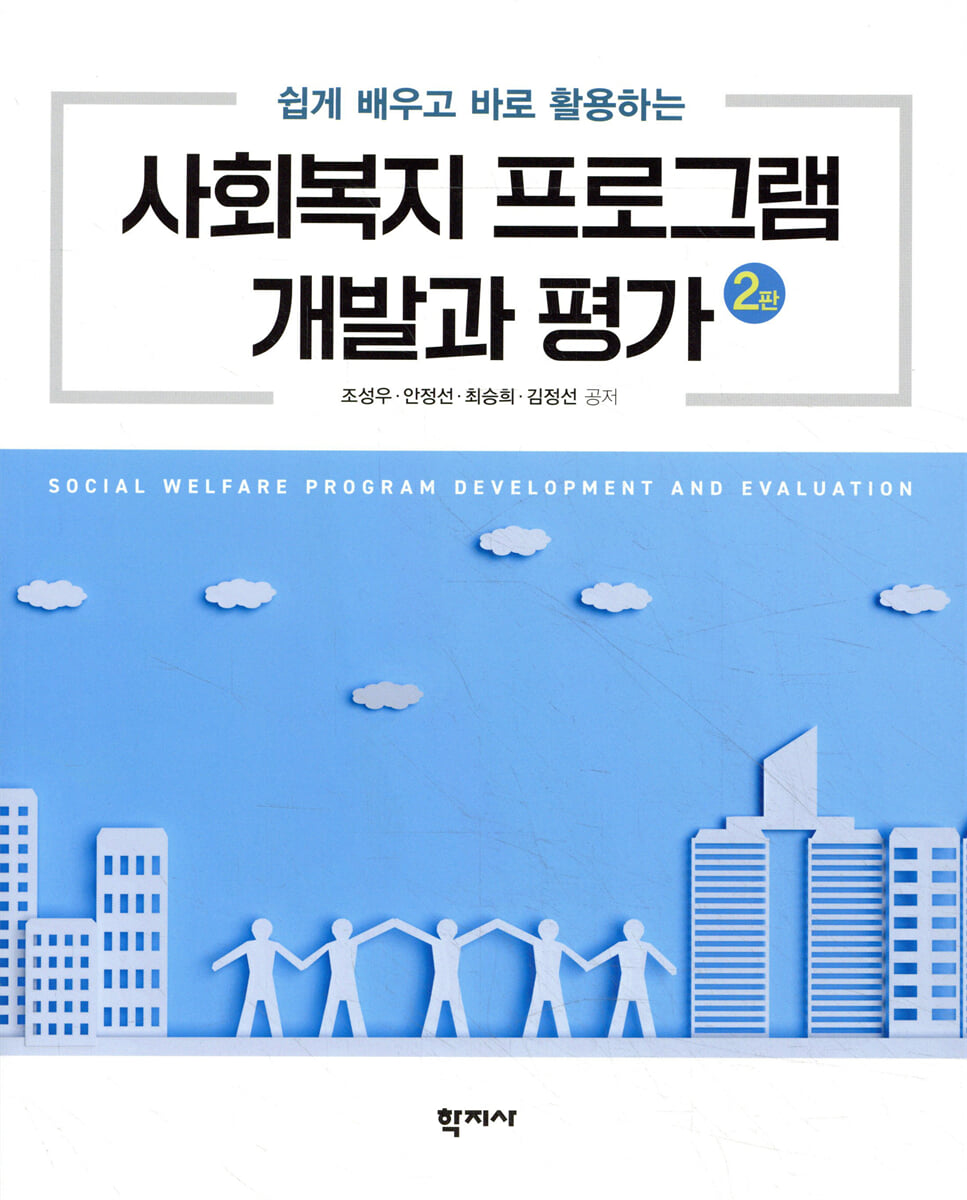
Development and Evaluation of Social Welfare Programs
 |
Description
index
Preface to the 2nd edition
Part 1: Entering the World of Social Welfare Programs
Chapter 1: What is a Social Welfare Program?
1.
What is the subject of social welfare program development and evaluation?
2.
What's happening in the social welfare field?
3.
What is a social welfare program?
4.
The three major functions of social welfare centers and community-based projects
5.
Are business, program, and service the same concept?
6.
Program development capabilities
Chapter 2: Preparing to Create a Good Program
1.
What makes a good program?
2.
Preparing to create a good program
Part 2: Developing and Running a Program
Chapter 3: Analyzing Social Problems and Needs to Understand the Situation
1.
Definition and analytical framework for social problems
2.
Analysis of social problems and needs
3.
Types of needs and analysis methods
4.
Program theory and hypothesis
Chapter 4: Setting the Direction of Intervention by Writing Goals and Objectives
1.
Relationship between program name, purpose, performance goals, and output goals
2.
Program name and purpose
3.
How to Write Performance Goals
4.
How to write output objectives
5.
Other goal writing methods
Chapter 5: Designing the Program Contents in Detail
1.
Designing program content
2.
Challenges for Developing Creative Program Activities: Brainstorming and Brainwriting
3.
Understand the program components and principles
Chapter 6: Determining Which Resources to Invest in Solving a Problem
1.
What resources are utilized and what is the acquisition strategy?
2.
How will you promote and communicate about the program?
3.
Establishing a reasonable program budget
Chapter 7 Running and Managing Programs
1.
What are the main tasks of the program execution phase?
2.
Review ethical issues related to program implementation
3.
Managing information systems and records/documents
4.
Using management techniques to monitor programs
5.
How to manage program quality
6.
How to manage human resources, the key to program success
Part 3: Evaluating Program Performance
Chapter 8: What is Program Evaluation?
1.
Program Evaluation
2.
Two Evaluation Methods Understanding the Logical Model
3.
Relationship between program goals and outcomes
4.
Expanding the performance
5.
Community influence
Chapter 9: Following Evaluation Procedures and Ethical Standards
1.
Evaluation procedure
2.
Evaluation Ethics
Chapter 10: Learning Quantitative Assessment Techniques
1.
Use of measurement tools
2.
Evaluation of results against goals
3.
Experimental design: single-group pre- and post-test design
4.
Service Satisfaction Survey
5.
How to Evaluate Individuals: Single-Case Design
Chapter 11: Learning Qualitative Evaluation Techniques
1.
Comparison of quantitative and qualitative evaluation
2.
Definition and Uses of Qualitative Assessment
3.
Qualitative evaluation design
4.
qualitative evaluation techniques
5.
Utilizing Qualitative Evaluation: Applying Integrated Research Methods
Chapter 12: Conducting Program Performance Evaluation and Process Evaluation
1.
Performance evaluation
2.
The concept of process evaluation
3.
Indicators of process evaluation
4.
Evaluation method
5.
The importance of feedback
Part 4: The Path to Becoming a Program Expert
Chapter 13: Persuasive Reports and Captivating Presentations
1.
Requirements for Writing a Persuasive Report
2.
Prepare a captivating presentation
Chapter 14: Using Programming Theory for Advanced Programming
1.
Design, develop, and distribute programs using intervention research models.
2.
Conducting the 'best' programming for clients based on the 'best' evidence through an evidence-based practice model.
3. Continuously improve the program by applying the PDCA cycle.
Chapter 15: Learning Business Proposal Writing Techniques
1.
Business name
2.
Business contents and promotion strategy
3.
Budget preparation
4.
Problem awareness (necessity of business)
5.
Goals and Evaluation
6.
Goals after business closure
Model answers to practical practice problems
Appendix 1 Program Plan
Appendix 2 Program Results Report
Appendix 3: Example Proposal
Appendix 4 Community Chest of Korea Proposal Form (Performance-Based)
Appendix 5: List of 500 Key Performance Indicators Available for Social Welfare Program Evaluation
Appendix 6 Korean Social Welfare Service User Satisfaction Scale
References
Search
Part 1: Entering the World of Social Welfare Programs
Chapter 1: What is a Social Welfare Program?
1.
What is the subject of social welfare program development and evaluation?
2.
What's happening in the social welfare field?
3.
What is a social welfare program?
4.
The three major functions of social welfare centers and community-based projects
5.
Are business, program, and service the same concept?
6.
Program development capabilities
Chapter 2: Preparing to Create a Good Program
1.
What makes a good program?
2.
Preparing to create a good program
Part 2: Developing and Running a Program
Chapter 3: Analyzing Social Problems and Needs to Understand the Situation
1.
Definition and analytical framework for social problems
2.
Analysis of social problems and needs
3.
Types of needs and analysis methods
4.
Program theory and hypothesis
Chapter 4: Setting the Direction of Intervention by Writing Goals and Objectives
1.
Relationship between program name, purpose, performance goals, and output goals
2.
Program name and purpose
3.
How to Write Performance Goals
4.
How to write output objectives
5.
Other goal writing methods
Chapter 5: Designing the Program Contents in Detail
1.
Designing program content
2.
Challenges for Developing Creative Program Activities: Brainstorming and Brainwriting
3.
Understand the program components and principles
Chapter 6: Determining Which Resources to Invest in Solving a Problem
1.
What resources are utilized and what is the acquisition strategy?
2.
How will you promote and communicate about the program?
3.
Establishing a reasonable program budget
Chapter 7 Running and Managing Programs
1.
What are the main tasks of the program execution phase?
2.
Review ethical issues related to program implementation
3.
Managing information systems and records/documents
4.
Using management techniques to monitor programs
5.
How to manage program quality
6.
How to manage human resources, the key to program success
Part 3: Evaluating Program Performance
Chapter 8: What is Program Evaluation?
1.
Program Evaluation
2.
Two Evaluation Methods Understanding the Logical Model
3.
Relationship between program goals and outcomes
4.
Expanding the performance
5.
Community influence
Chapter 9: Following Evaluation Procedures and Ethical Standards
1.
Evaluation procedure
2.
Evaluation Ethics
Chapter 10: Learning Quantitative Assessment Techniques
1.
Use of measurement tools
2.
Evaluation of results against goals
3.
Experimental design: single-group pre- and post-test design
4.
Service Satisfaction Survey
5.
How to Evaluate Individuals: Single-Case Design
Chapter 11: Learning Qualitative Evaluation Techniques
1.
Comparison of quantitative and qualitative evaluation
2.
Definition and Uses of Qualitative Assessment
3.
Qualitative evaluation design
4.
qualitative evaluation techniques
5.
Utilizing Qualitative Evaluation: Applying Integrated Research Methods
Chapter 12: Conducting Program Performance Evaluation and Process Evaluation
1.
Performance evaluation
2.
The concept of process evaluation
3.
Indicators of process evaluation
4.
Evaluation method
5.
The importance of feedback
Part 4: The Path to Becoming a Program Expert
Chapter 13: Persuasive Reports and Captivating Presentations
1.
Requirements for Writing a Persuasive Report
2.
Prepare a captivating presentation
Chapter 14: Using Programming Theory for Advanced Programming
1.
Design, develop, and distribute programs using intervention research models.
2.
Conducting the 'best' programming for clients based on the 'best' evidence through an evidence-based practice model.
3. Continuously improve the program by applying the PDCA cycle.
Chapter 15: Learning Business Proposal Writing Techniques
1.
Business name
2.
Business contents and promotion strategy
3.
Budget preparation
4.
Problem awareness (necessity of business)
5.
Goals and Evaluation
6.
Goals after business closure
Model answers to practical practice problems
Appendix 1 Program Plan
Appendix 2 Program Results Report
Appendix 3: Example Proposal
Appendix 4 Community Chest of Korea Proposal Form (Performance-Based)
Appendix 5: List of 500 Key Performance Indicators Available for Social Welfare Program Evaluation
Appendix 6 Korean Social Welfare Service User Satisfaction Scale
References
Search
Publisher's Review
Why study social work program development and evaluation? To become a competent social worker, you must be able to change clients' lives for the better and objectively demonstrate that change.
The way to make this happen is to develop program development and evaluation capabilities.
As recently as 20 years ago, the importance of program development and evaluation was not greatly emphasized in social welfare settings.
There was a tendency to recognize only those who were dedicated to helping clients and worked hard as excellent social workers.
But the atmosphere on the ground has changed significantly recently.
As interest in social welfare has grown significantly, organizations such as the Community Chest of Korea, the Corporate Welfare Foundation, and Happy Bean have begun to provide massive funds to support social welfare organizations.
This is a significant opportunity for social workers, who receive financial support to run their programs and successfully transform their clients.
On the other hand, unfortunately, social workers who did not receive financial support had a hard time running their programs under relatively difficult conditions.
Therefore, the ability to systematically develop good programs and submit them as a plan is becoming increasingly important for all social workers.
Additionally, with the implementation of the national social welfare facility evaluation system, all social workers are required to evaluate the performance of their programs and report it to the institution.
Programs by social workers who are good at evaluating their work are recognized as being effective, while programs by social workers who are not good at evaluating their work are judged to be ineffective.
As a result, programs that have demonstrated excellent performance may continue to operate, while programs that have failed to demonstrate performance may not be able to continue operating.
Looking at this situation, we can clearly see how important it is for all students studying social welfare to study this subject diligently.
Every social worker's hope is to transform clients through their practice.
The social welfare program scene is where these changes unfold.
Therefore, to become a truly competent social worker, you must enter the world of program development and evaluation with a strong will to learn.
The way to make this happen is to develop program development and evaluation capabilities.
As recently as 20 years ago, the importance of program development and evaluation was not greatly emphasized in social welfare settings.
There was a tendency to recognize only those who were dedicated to helping clients and worked hard as excellent social workers.
But the atmosphere on the ground has changed significantly recently.
As interest in social welfare has grown significantly, organizations such as the Community Chest of Korea, the Corporate Welfare Foundation, and Happy Bean have begun to provide massive funds to support social welfare organizations.
This is a significant opportunity for social workers, who receive financial support to run their programs and successfully transform their clients.
On the other hand, unfortunately, social workers who did not receive financial support had a hard time running their programs under relatively difficult conditions.
Therefore, the ability to systematically develop good programs and submit them as a plan is becoming increasingly important for all social workers.
Additionally, with the implementation of the national social welfare facility evaluation system, all social workers are required to evaluate the performance of their programs and report it to the institution.
Programs by social workers who are good at evaluating their work are recognized as being effective, while programs by social workers who are not good at evaluating their work are judged to be ineffective.
As a result, programs that have demonstrated excellent performance may continue to operate, while programs that have failed to demonstrate performance may not be able to continue operating.
Looking at this situation, we can clearly see how important it is for all students studying social welfare to study this subject diligently.
Every social worker's hope is to transform clients through their practice.
The social welfare program scene is where these changes unfold.
Therefore, to become a truly competent social worker, you must enter the world of program development and evaluation with a strong will to learn.
GOODS SPECIFICS
- Date of issue: March 25, 2024
- Page count, weight, size: 424 pages | 188*235*17mm
- ISBN13: 9788999730924
You may also like
카테고리
korean


korean

![GQ KOREA Mark (Monthly): December [2025]](http://librairie.coreenne.fr/cdn/shop/files/8ef265dbbfbf186523ed75ba7319009d.jpg?v=1765340328&width=3840)


