

macroeconomics
 |
Description
Book Introduction
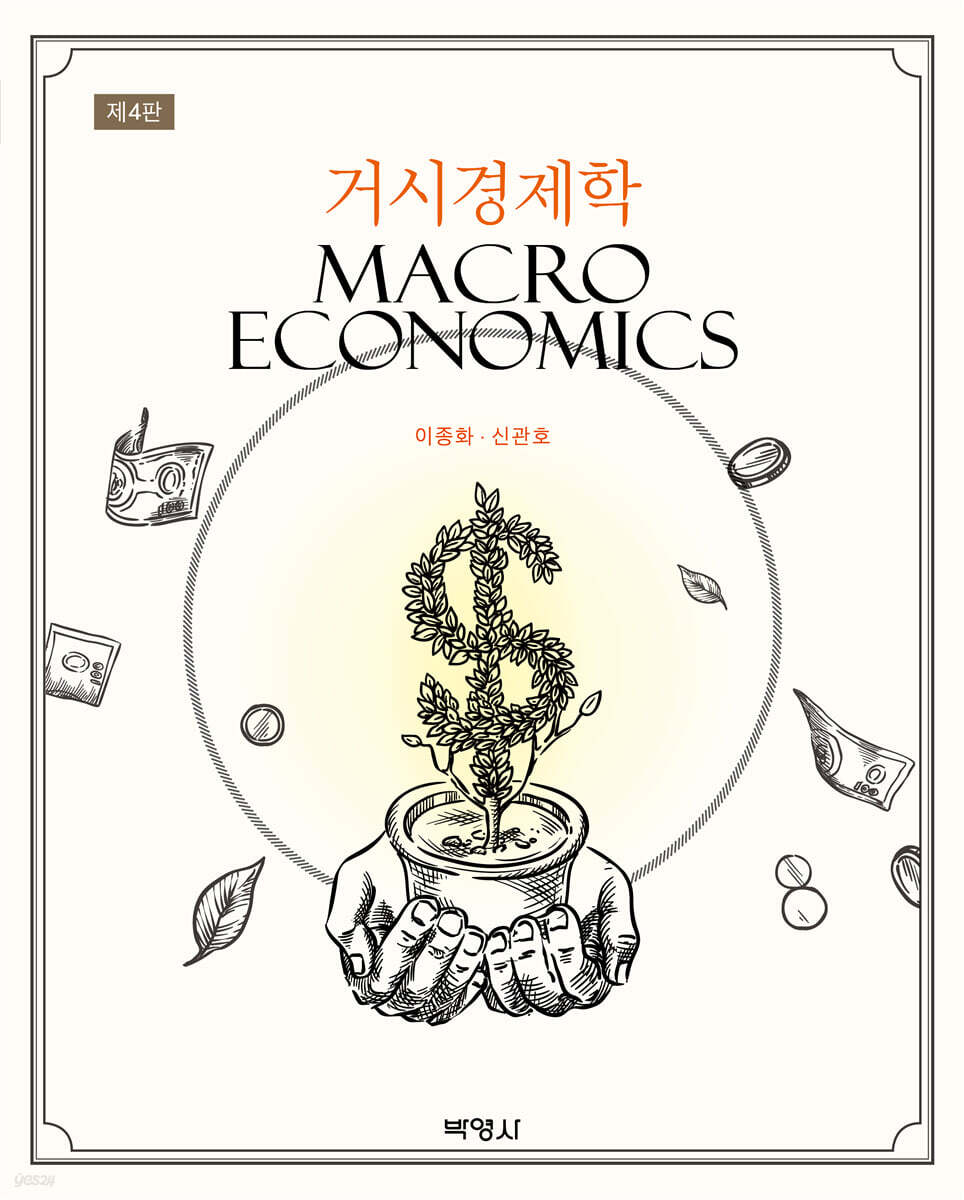
It has already been four years since the third edition of Macroeconomics was published.
During this time, the Korean and global economies have experienced experiences that were previously unimaginable.
The COVID-19 pandemic, which began in early 2020, has caused enormous damage to the economy by contracting both aggregate demand and aggregate supply.
In response, governments around the world have developed and implemented various policies to revive their collapsing economies and alleviate the suffering of their people.
In this process, we were able to realize once again how useful a tool economic analysis is.
Without policy responses based on economic principles, the world economy would undoubtedly have suffered even greater hardship.
However, during the COVID-19 pandemic, government officials and economists around the world made the mistake of underestimating the inflation risk that could arise from expansionary macroeconomic policies.
As prices rise rapidly and interest rates rise, lowering high inflation expectations and stabilizing the inflation rate have emerged as urgent tasks.
As we navigate these changes, we feel the need to revise our macroeconomics textbooks more strongly than ever before.
The result was this 4th revised edition.
The revised edition maintains the features that make it easy for readers to read and understand, while adding content that helps them understand and analyze new macroeconomic phenomena.
During this time, the Korean and global economies have experienced experiences that were previously unimaginable.
The COVID-19 pandemic, which began in early 2020, has caused enormous damage to the economy by contracting both aggregate demand and aggregate supply.
In response, governments around the world have developed and implemented various policies to revive their collapsing economies and alleviate the suffering of their people.
In this process, we were able to realize once again how useful a tool economic analysis is.
Without policy responses based on economic principles, the world economy would undoubtedly have suffered even greater hardship.
However, during the COVID-19 pandemic, government officials and economists around the world made the mistake of underestimating the inflation risk that could arise from expansionary macroeconomic policies.
As prices rise rapidly and interest rates rise, lowering high inflation expectations and stabilizing the inflation rate have emerged as urgent tasks.
As we navigate these changes, we feel the need to revise our macroeconomics textbooks more strongly than ever before.
The result was this 4th revised edition.
The revised edition maintains the features that make it easy for readers to read and understand, while adding content that helps them understand and analyze new macroeconomic phenomena.
index
PART I: INTRODUCTION TO MACROECONOMICS
Chapter 01 What is Macroeconomics?
Chapter 2 Understanding the Structure of the National Economy and Macroeconomic Variables
PART II Determination of Income, Employment, and Prices under Full Employment
Chapter 3 Determination of National Income under Full Employment
Chapter 4 Labor Market and Unemployment
Chapter 5 Money and Inflation
PART III Economic Growth
Chapter 6 Long-Term Economic Growth I: The Solow Model
Chapter 7 Long-Term Economic Growth II: Endogenous Growth Theory
PART IV: Short-Run Macroeconomic Model of Aggregate Demand and Aggregate Supply
Chapter 8: Business Fluctuations and Short-Term and Long-Term Equilibrium
Chapter 9 Determining Aggregate Demand in Macroeconomics
Chapter 10: The IS-LM Model and the Government's Aggregate Demand Management Policy
Chapter 11 Aggregate Demand and Aggregate Supply Model I: Basic Concepts
Chapter 12 Aggregate Demand and Aggregate Supply Model II: Introduction to Expectations and the Phillips Curve
PART V OPEN ECONOMY MODEL
Chapter 13: Macroeconomic Theory of the Open Economy I: Basic Concepts and Long-Run Models
Chapter 14 Macroeconomic Theory of the Open Economy II: Short-Run Model
PART VI MICROBASIS OF AGGREGATE DEMAND
Chapter 15 Consumption
Chapter 16 Investment
Chapter 17 Government Finance
PART VII Recent Trends in Macroeconomic Theory
Chapter 18: Recent Economic Cycle Theories
Chapter 19: Finance, Monetary Policy, and Macroeconomics
Chapter 01 What is Macroeconomics?
Chapter 2 Understanding the Structure of the National Economy and Macroeconomic Variables
PART II Determination of Income, Employment, and Prices under Full Employment
Chapter 3 Determination of National Income under Full Employment
Chapter 4 Labor Market and Unemployment
Chapter 5 Money and Inflation
PART III Economic Growth
Chapter 6 Long-Term Economic Growth I: The Solow Model
Chapter 7 Long-Term Economic Growth II: Endogenous Growth Theory
PART IV: Short-Run Macroeconomic Model of Aggregate Demand and Aggregate Supply
Chapter 8: Business Fluctuations and Short-Term and Long-Term Equilibrium
Chapter 9 Determining Aggregate Demand in Macroeconomics
Chapter 10: The IS-LM Model and the Government's Aggregate Demand Management Policy
Chapter 11 Aggregate Demand and Aggregate Supply Model I: Basic Concepts
Chapter 12 Aggregate Demand and Aggregate Supply Model II: Introduction to Expectations and the Phillips Curve
PART V OPEN ECONOMY MODEL
Chapter 13: Macroeconomic Theory of the Open Economy I: Basic Concepts and Long-Run Models
Chapter 14 Macroeconomic Theory of the Open Economy II: Short-Run Model
PART VI MICROBASIS OF AGGREGATE DEMAND
Chapter 15 Consumption
Chapter 16 Investment
Chapter 17 Government Finance
PART VII Recent Trends in Macroeconomic Theory
Chapter 18: Recent Economic Cycle Theories
Chapter 19: Finance, Monetary Policy, and Macroeconomics
Detailed image
Publisher's Review
It has already been four years since the third edition of Macroeconomics was published.
During this time, the Korean and global economies have experienced experiences that were previously unimaginable.
The COVID-19 pandemic, which began in early 2020, has caused enormous damage to the economy by contracting both aggregate demand and aggregate supply.
In response, governments around the world have developed and implemented various policies to revive their collapsing economies and alleviate the suffering of their people.
In this process, we were able to realize once again how useful a tool economic analysis is.
Without policy responses based on economic principles, the world economy would undoubtedly have suffered even greater hardship.
However, during the COVID-19 pandemic, government officials and economists around the world made the mistake of underestimating the inflation risk that could arise from expansionary macroeconomic policies.
As prices rise rapidly and interest rates rise, lowering high inflation expectations and stabilizing the inflation rate have emerged as urgent tasks.
As we navigate these changes, we feel the need to revise our macroeconomics textbooks more strongly than ever before.
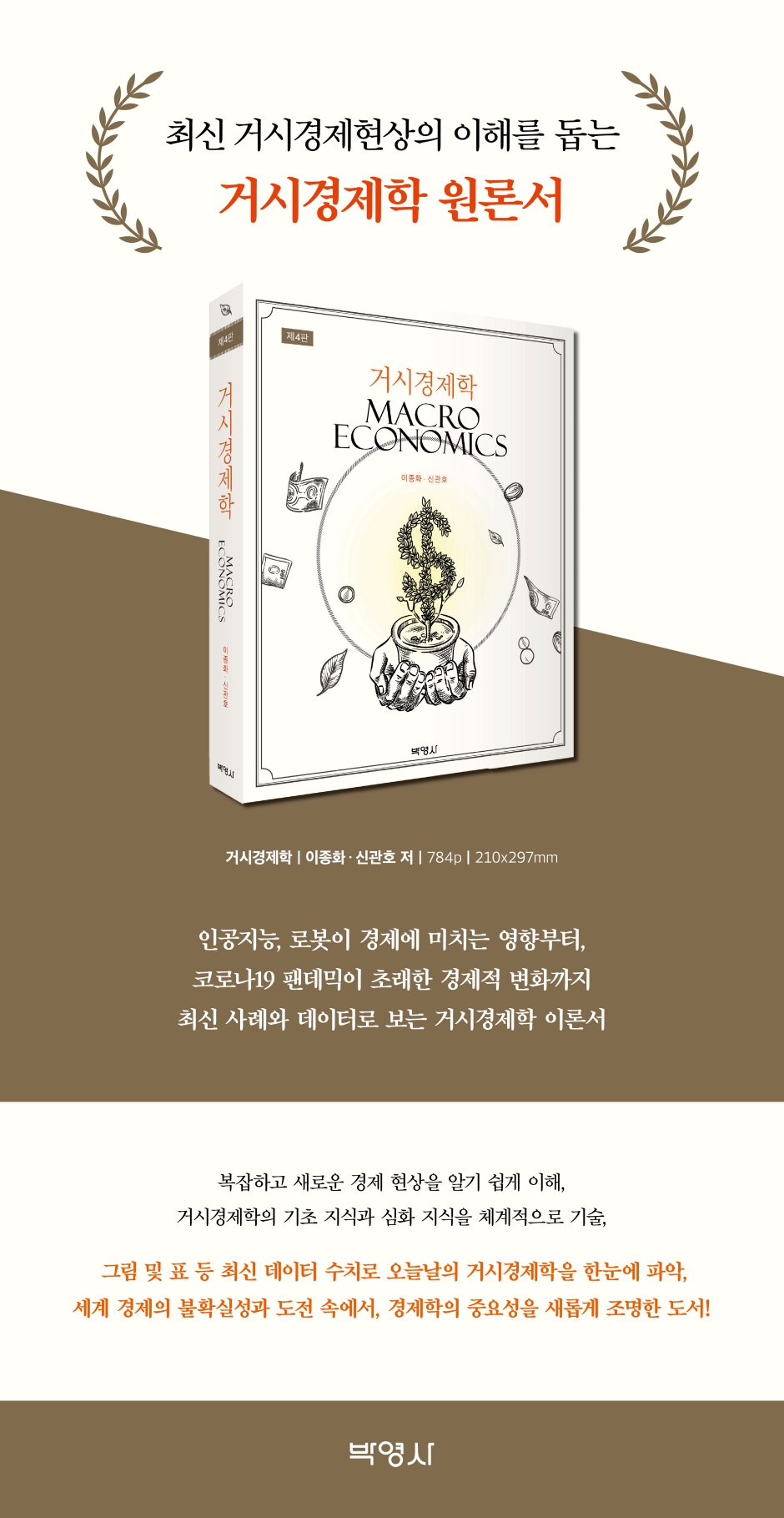
The result was this 4th revised edition.
The revised edition maintains the features that make it easy for readers to read and understand, while adding content that helps them understand and analyze new macroeconomic phenomena.
Notable changes in this revised edition include:
First, all cases where actual data figures were used in the text, tables, figures, etc. of the textbook were revised to the most recent data.
Second, Chapter 7 explains the impact of new technologies such as artificial intelligence and robots on economic growth and employment, and discusses the role of human capital.
Third, in Chapter 8, when dealing with economic fluctuations, we included a jobless recovery as a new case study.
The structural changes in the labor market brought about by the development of information and communication technology were explained as one of the reasons why employment is not easily restored.
Fourth, Chapter 10 explains the case where expected inflation changes according to monetary policy, considering that the determination of expected inflation plays an important role in the macroeconomy.
Fifth, a new IS-LM model was added to Chapter 10.
This model assumes a more realistic case where the central bank sets interest rates directly rather than determining the money supply.
Sixth, Chapter 11 explains the aggregate demand and aggregate supply shocks caused by the COVID-19 pandemic and discusses government policies in response.
This explains how the economy recovered and how inflation may worsen in the process.
Seventh, Chapter 11 adds an explanation of how global value chains are related to the expansion of the aggregate supply shock caused by the COVID-19 pandemic.
Eighth, Chapter 13 provides a supplementary explanation of the changed standards for the balance of payments.
Ninth, Chapter 15 analyzes the reasons for the sustained consumption boom following the COVID-19 pandemic through changes in American consumption patterns.
Tenth, Chapter 19 explains the impact on central bank credibility if preemptive guidance policies, which have continued to be used even after the global financial crisis, are not properly utilized among unconventional monetary policies.
Lastly, we have added new practice problems, including recent national exam questions and Bank of Korea exam questions.
While revising this book, I received a lot of help from graduate and undergraduate students at Korea University.
PhD student Jongwon Kim and MA student Jaewon Lee created updated figures and tables.
Also, master's student Park Yeon-su read the revised part carefully and found it awkward.
I edited some parts and found typos.
Many instructors and students who have used the book as a textbook in class have pointed out parts that were difficult to understand.
And Park Young-sa's Deputy Director Bae Geun-ha and the editorial staff presented the cover design and carried out the proofreading work without any gaps.
I sincerely thank all of you.
December 2023
Lee Jong-hwa and Shin Gwan-ho
During this time, the Korean and global economies have experienced experiences that were previously unimaginable.
The COVID-19 pandemic, which began in early 2020, has caused enormous damage to the economy by contracting both aggregate demand and aggregate supply.
In response, governments around the world have developed and implemented various policies to revive their collapsing economies and alleviate the suffering of their people.
In this process, we were able to realize once again how useful a tool economic analysis is.
Without policy responses based on economic principles, the world economy would undoubtedly have suffered even greater hardship.
However, during the COVID-19 pandemic, government officials and economists around the world made the mistake of underestimating the inflation risk that could arise from expansionary macroeconomic policies.
As prices rise rapidly and interest rates rise, lowering high inflation expectations and stabilizing the inflation rate have emerged as urgent tasks.
As we navigate these changes, we feel the need to revise our macroeconomics textbooks more strongly than ever before.
The result was this 4th revised edition.
The revised edition maintains the features that make it easy for readers to read and understand, while adding content that helps them understand and analyze new macroeconomic phenomena.
Notable changes in this revised edition include:
First, all cases where actual data figures were used in the text, tables, figures, etc. of the textbook were revised to the most recent data.
Second, Chapter 7 explains the impact of new technologies such as artificial intelligence and robots on economic growth and employment, and discusses the role of human capital.
Third, in Chapter 8, when dealing with economic fluctuations, we included a jobless recovery as a new case study.
The structural changes in the labor market brought about by the development of information and communication technology were explained as one of the reasons why employment is not easily restored.
Fourth, Chapter 10 explains the case where expected inflation changes according to monetary policy, considering that the determination of expected inflation plays an important role in the macroeconomy.
Fifth, a new IS-LM model was added to Chapter 10.
This model assumes a more realistic case where the central bank sets interest rates directly rather than determining the money supply.
Sixth, Chapter 11 explains the aggregate demand and aggregate supply shocks caused by the COVID-19 pandemic and discusses government policies in response.
This explains how the economy recovered and how inflation may worsen in the process.
Seventh, Chapter 11 adds an explanation of how global value chains are related to the expansion of the aggregate supply shock caused by the COVID-19 pandemic.
Eighth, Chapter 13 provides a supplementary explanation of the changed standards for the balance of payments.
Ninth, Chapter 15 analyzes the reasons for the sustained consumption boom following the COVID-19 pandemic through changes in American consumption patterns.
Tenth, Chapter 19 explains the impact on central bank credibility if preemptive guidance policies, which have continued to be used even after the global financial crisis, are not properly utilized among unconventional monetary policies.
Lastly, we have added new practice problems, including recent national exam questions and Bank of Korea exam questions.
While revising this book, I received a lot of help from graduate and undergraduate students at Korea University.
PhD student Jongwon Kim and MA student Jaewon Lee created updated figures and tables.
Also, master's student Park Yeon-su read the revised part carefully and found it awkward.
I edited some parts and found typos.
Many instructors and students who have used the book as a textbook in class have pointed out parts that were difficult to understand.
And Park Young-sa's Deputy Director Bae Geun-ha and the editorial staff presented the cover design and carried out the proofreading work without any gaps.
I sincerely thank all of you.
December 2023
Lee Jong-hwa and Shin Gwan-ho
GOODS SPECIFICS
- Date of issue: January 1, 2024
- Page count, weight, size: 784 pages | 205*255*30mm
- ISBN13: 9791130318776
You may also like
카테고리
korean


korean

![ELLE 엘르 스페셜 에디션 A형 : 12월 [2025]](http://librairie.coreenne.fr/cdn/shop/files/b8e27a3de6c9538896439686c6b0e8fb.jpg?v=1766436872&width=3840)


