

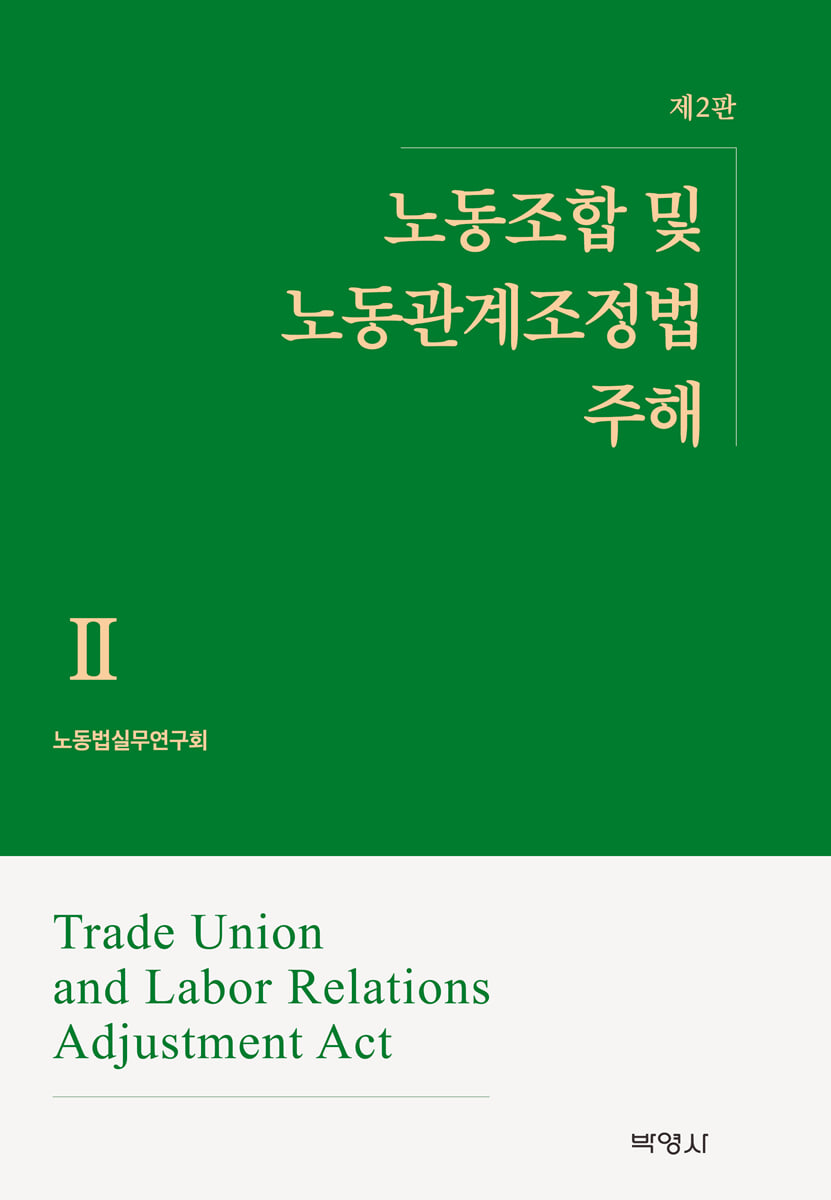
Trade Union and Labor Relations Adjustment Act Commentary 2
 |
Description
Book Introduction
Seven years have passed since the first edition was published thanks to the dedication of members of the Supreme Court Labor Law Practice Research Association.
This second edition aims to reflect legal revisions and new case law, and to organize new discussions surrounding the labor environment.
While revising the parts collected in the first edition, five new topics were added: the content of the ILO fundamental conventions on collective labor relations and their application to domestic law, a comparative legal study of workers and employers under collective labor relations law, provision of convenience, bankruptcy and collective labor relations, and laws on the establishment and operation of public servant workplace councils.
For new topics, presentations and discussions were held at the Labor Law Practice Research Association, and for existing articles, a draft was written followed by a more thorough reading and revision process.
This second edition aims to reflect legal revisions and new case law, and to organize new discussions surrounding the labor environment.
While revising the parts collected in the first edition, five new topics were added: the content of the ILO fundamental conventions on collective labor relations and their application to domestic law, a comparative legal study of workers and employers under collective labor relations law, provision of convenience, bankruptcy and collective labor relations, and laws on the establishment and operation of public servant workplace councils.
For new topics, presentations and discussions were held at the Labor Law Practice Research Association, and for existing articles, a draft was written followed by a more thorough reading and revision process.
index
Chapter 3 Collective Bargaining and Collective Agreements
Collective Bargaining: Introduction 1: The Concept, Nature, and Methods of Collective Bargaining [Kwon Young-guk, Park Ga-hyeon] 3
Collective Bargaining: Preliminary Theory 2: The Object of Collective Bargaining [Jeong Jin-gyeong and Kim Seon-il] 12
Article 29 (Authority to Negotiate and Conclude Agreements) [Kwon Young-guk and Park Ga-hyeon] 66
Preliminary Discussion on Unifying Negotiation Channels [Kwon Young-guk and Lim Sang-min] 89
Article 29-2 (Procedures for Unifying Negotiation Channels) [Kwon Young-guk and Lim Sang-min] 107
Article 29-3 (Determination of Negotiating Unit) [Kwon Young-guk and Jeong Ji-won] 132
Article 29-4 (Duty of Fair Representation, etc.) [Kwon Young-guk and Lim Sang-min] 158
Article 29-5 (Other Matters Related to Unification of Negotiation Channels) [Kwon Young-guk and Lim Sang-min] 183
Article 30 (Principles of Negotiation, etc.) [Kwon Chang-young] 190
Article 31 (Preparation of Collective Agreements) [Ma Eun-hyeok] 233
Article 32 (Upper Limit of Collective Agreement Validity Period) [Ma Eun-hyeok] 282
Article 33 (Effectiveness of Standards) [Ma Eun-hyeok] 361
Article 34 (Interpretation of Collective Agreements) [Ma Eun-hyeok] 511
Article 35 (General Binding Force) [Ma Eun-hyeok] 517
Article 36 (Regional Binding) [Ma Eun-hyeok] 554
Dosan and Collective Labor Relations: A Supplement [Bae Jin-ho] 559
Chapter 4 Dispute Action
Article 37 (Basic Principles of Industrial Dispute) [Kim Min-ki] [Jeong Jin-kyung and Kwon Yeong-hwan] [Kim Min-ki and Kim Jin] 605
Article 38 (Labor Union Guidance and Responsibilities) [Kim Min-ki] 673
Article 39 (Restrictions on Workers' Restraints) [Shin Kwon-cheol] 676
Article 40 Deleted 688
Article 41 (Restrictions and Prohibitions on Industrial Actions) [Kim Jin] 689
Article 42 (Prohibition of Acts of Violence, etc.) [Jeong Jae-heon and Lee Jeong-ah] 711
Article 42-2 (Restrictions on Industrial Actions Concerning Essential Maintenance Work) [Ku Min-kyung] 769
Article 42-3 (Agreement on Essential Maintenance Services) [Ku Min-kyung] 769
Article 42-4 (Determination of the Level of Maintenance and Operation of Essential Maintenance Services, etc.) [Ku Min-kyung] 769
Article 42-5 (Dispute Actions Based on Decisions of the Labor Relations Commission) [Ku Min-kyung] 769
Article 42-6 (Designation of Workers Performing Essential Maintenance Work) [Ku Min-kyung] 770
Article 43 (Restrictions on Employment by Employers) [Lee Myeong-cheol] 807
Article 44 (Prohibition on Demanding Wage Payment During a Labor Dispute) [Jeong Jin-gyeong and Hong Jun-ho] 818
Article 45 (Precedence of Adjustment) [Kim Won-jeong] 851
Article 46 (Requirements for Closure of Workplace) [Lee Myeong-cheol] 883
Supplementary Discussion on Illegal Disputes and Responsibility [Kim Ki-deok] 915
Item Index 993
Collective Bargaining: Introduction 1: The Concept, Nature, and Methods of Collective Bargaining [Kwon Young-guk, Park Ga-hyeon] 3
Collective Bargaining: Preliminary Theory 2: The Object of Collective Bargaining [Jeong Jin-gyeong and Kim Seon-il] 12
Article 29 (Authority to Negotiate and Conclude Agreements) [Kwon Young-guk and Park Ga-hyeon] 66
Preliminary Discussion on Unifying Negotiation Channels [Kwon Young-guk and Lim Sang-min] 89
Article 29-2 (Procedures for Unifying Negotiation Channels) [Kwon Young-guk and Lim Sang-min] 107
Article 29-3 (Determination of Negotiating Unit) [Kwon Young-guk and Jeong Ji-won] 132
Article 29-4 (Duty of Fair Representation, etc.) [Kwon Young-guk and Lim Sang-min] 158
Article 29-5 (Other Matters Related to Unification of Negotiation Channels) [Kwon Young-guk and Lim Sang-min] 183
Article 30 (Principles of Negotiation, etc.) [Kwon Chang-young] 190
Article 31 (Preparation of Collective Agreements) [Ma Eun-hyeok] 233
Article 32 (Upper Limit of Collective Agreement Validity Period) [Ma Eun-hyeok] 282
Article 33 (Effectiveness of Standards) [Ma Eun-hyeok] 361
Article 34 (Interpretation of Collective Agreements) [Ma Eun-hyeok] 511
Article 35 (General Binding Force) [Ma Eun-hyeok] 517
Article 36 (Regional Binding) [Ma Eun-hyeok] 554
Dosan and Collective Labor Relations: A Supplement [Bae Jin-ho] 559
Chapter 4 Dispute Action
Article 37 (Basic Principles of Industrial Dispute) [Kim Min-ki] [Jeong Jin-kyung and Kwon Yeong-hwan] [Kim Min-ki and Kim Jin] 605
Article 38 (Labor Union Guidance and Responsibilities) [Kim Min-ki] 673
Article 39 (Restrictions on Workers' Restraints) [Shin Kwon-cheol] 676
Article 40 Deleted 688
Article 41 (Restrictions and Prohibitions on Industrial Actions) [Kim Jin] 689
Article 42 (Prohibition of Acts of Violence, etc.) [Jeong Jae-heon and Lee Jeong-ah] 711
Article 42-2 (Restrictions on Industrial Actions Concerning Essential Maintenance Work) [Ku Min-kyung] 769
Article 42-3 (Agreement on Essential Maintenance Services) [Ku Min-kyung] 769
Article 42-4 (Determination of the Level of Maintenance and Operation of Essential Maintenance Services, etc.) [Ku Min-kyung] 769
Article 42-5 (Dispute Actions Based on Decisions of the Labor Relations Commission) [Ku Min-kyung] 769
Article 42-6 (Designation of Workers Performing Essential Maintenance Work) [Ku Min-kyung] 770
Article 43 (Restrictions on Employment by Employers) [Lee Myeong-cheol] 807
Article 44 (Prohibition on Demanding Wage Payment During a Labor Dispute) [Jeong Jin-gyeong and Hong Jun-ho] 818
Article 45 (Precedence of Adjustment) [Kim Won-jeong] 851
Article 46 (Requirements for Closure of Workplace) [Lee Myeong-cheol] 883
Supplementary Discussion on Illegal Disputes and Responsibility [Kim Ki-deok] 915
Item Index 993
Publisher's Review
It has already been seven years since the first edition was published thanks to the dedication of members of the Supreme Court Labor Law Practice Research Association.
Over the years, the commentary on the Trade Union and Labor Relations Adjustment Act has become a must-read not only for practitioners but also for academia, and has established itself as an authoritative commentary in the labor field.
There have been amendments to the law since the first edition was published.
The Constitutional Court ruled that the prohibition on subsidizing labor union operating expenses was unconstitutional (2012 Heon-Ba 90) and that the double punishment provision for unfair labor practices against corporations' agents, etc. was unconstitutional (2017 Heon-Ga 30).
6. 9.
The Trade Union Act has been amended.
While promoting the ratification of the International Labor Organization (ILO)'s fundamental convention, the "Convention on Freedom of Association," in 2021.
1. 5.
The Trade Union Act has been revised to expand the scope of guaranteeing workers' right to organize.
Furthermore, the government in 2021.
4. 20.
Deposited the instruments of ratification of the ILO Fundamental Conventions on Freedom of Association (Conventions No. 87 and No. 98), which came into force in 2022.
4. 20.
It has come into effect and has domestic legal effect.
A lot of new case law has also been accumulated.
Supreme Court 2015.
6. 25.
The Supreme Court's decision in 2007du4995 ruled that foreigners without a residence permit for employment activities can be included in the scope of workers under the Trade Union Act, and the Supreme Court's decision in 2020.
8. 27.
The full bench decision in case 2016da248998 ruled that the special employment clause for bereaved families of industrial accident victims in collective agreements is valid as long as it does not excessively restrict the freedom of employment or significantly harm the fairness of employment opportunities.
Supreme Court 2020.
9. 3.
The full bench decision in case No. 2016du32992 declared that the enforcement decree provisions regarding the notification of an illegal union by the Minister of Employment and Labor against the Korean Federation of Teachers' and Education Workers' Unions were invalid.
There were also other Supreme Court decisions that had important implications for collective labor relations, such as a new ruling on procedures for unifying negotiation channels for multiple labor unions.
This second edition reflects these legal revisions and new case law, and aims to organize new discussions surrounding the labor environment.
While revising the parts collected in the first edition, we added five new topics: the content of the ILO fundamental conventions on collective labor relations and their application to domestic law, a comparative legal study of workers and employers under collective labor relations law, provision of convenience, bankruptcy and collective labor relations, and laws on the establishment and operation of public servant workplace councils.
For new topics, we held presentations and discussions at the Labor Law Practice Research Association, and for existing articles, we went through a more thorough reading and revision process following the drafting.
As with the first edition, the first chairman, Kim Ji-hyung, and Supreme Court Justice Kim Seon-su led the overall work, including readings and manuscript writing, while the writing staff and editorial committee members, Kwon Oh-seong, Kwon Chang-yeong, Kim Min-ki, Kim Young-jin, Kim Jin-seok, Kim Jin, Kim Hee-soo, Do Jae-hyung, Park Ga-hyeon, Seong Jun-gyu, Shin Kwon-cheol, Yeo Yeon-sim, Yoo Dong-gyun, Lee Myeong-cheol, Lee Byeong-hee, Lim Sang-min, and Choi Eun-bae, added their dedicated efforts.
Eunhyeok Ma, the editorial committee secretary, took charge of everything from planning to detailed execution of the revision.
Without the dedicated efforts of these people, this book would not have been possible.
Thank you very much for your hard work.
I would also like to express my gratitude to the staff at Park Young-sa, who took charge of publishing the book following the first edition.
Through labor, humans have realized themselves, maintained society, and developed history.
Therefore, human history is also the history of labor.
I hope this book will contribute, even if only slightly, to a fairer view of collective labor relations and the proper implementation of the three labor rights guaranteed by the Constitution.
thank you
2023.
2.
Co-editor-in-chief
Lee Heung-gu
Over the years, the commentary on the Trade Union and Labor Relations Adjustment Act has become a must-read not only for practitioners but also for academia, and has established itself as an authoritative commentary in the labor field.
There have been amendments to the law since the first edition was published.
The Constitutional Court ruled that the prohibition on subsidizing labor union operating expenses was unconstitutional (2012 Heon-Ba 90) and that the double punishment provision for unfair labor practices against corporations' agents, etc. was unconstitutional (2017 Heon-Ga 30).
6. 9.
The Trade Union Act has been amended.
While promoting the ratification of the International Labor Organization (ILO)'s fundamental convention, the "Convention on Freedom of Association," in 2021.
1. 5.
The Trade Union Act has been revised to expand the scope of guaranteeing workers' right to organize.
Furthermore, the government in 2021.
4. 20.
Deposited the instruments of ratification of the ILO Fundamental Conventions on Freedom of Association (Conventions No. 87 and No. 98), which came into force in 2022.
4. 20.
It has come into effect and has domestic legal effect.
A lot of new case law has also been accumulated.
Supreme Court 2015.
6. 25.
The Supreme Court's decision in 2007du4995 ruled that foreigners without a residence permit for employment activities can be included in the scope of workers under the Trade Union Act, and the Supreme Court's decision in 2020.
8. 27.
The full bench decision in case 2016da248998 ruled that the special employment clause for bereaved families of industrial accident victims in collective agreements is valid as long as it does not excessively restrict the freedom of employment or significantly harm the fairness of employment opportunities.
Supreme Court 2020.
9. 3.
The full bench decision in case No. 2016du32992 declared that the enforcement decree provisions regarding the notification of an illegal union by the Minister of Employment and Labor against the Korean Federation of Teachers' and Education Workers' Unions were invalid.
There were also other Supreme Court decisions that had important implications for collective labor relations, such as a new ruling on procedures for unifying negotiation channels for multiple labor unions.
This second edition reflects these legal revisions and new case law, and aims to organize new discussions surrounding the labor environment.
While revising the parts collected in the first edition, we added five new topics: the content of the ILO fundamental conventions on collective labor relations and their application to domestic law, a comparative legal study of workers and employers under collective labor relations law, provision of convenience, bankruptcy and collective labor relations, and laws on the establishment and operation of public servant workplace councils.
For new topics, we held presentations and discussions at the Labor Law Practice Research Association, and for existing articles, we went through a more thorough reading and revision process following the drafting.
As with the first edition, the first chairman, Kim Ji-hyung, and Supreme Court Justice Kim Seon-su led the overall work, including readings and manuscript writing, while the writing staff and editorial committee members, Kwon Oh-seong, Kwon Chang-yeong, Kim Min-ki, Kim Young-jin, Kim Jin-seok, Kim Jin, Kim Hee-soo, Do Jae-hyung, Park Ga-hyeon, Seong Jun-gyu, Shin Kwon-cheol, Yeo Yeon-sim, Yoo Dong-gyun, Lee Myeong-cheol, Lee Byeong-hee, Lim Sang-min, and Choi Eun-bae, added their dedicated efforts.
Eunhyeok Ma, the editorial committee secretary, took charge of everything from planning to detailed execution of the revision.
Without the dedicated efforts of these people, this book would not have been possible.
Thank you very much for your hard work.
I would also like to express my gratitude to the staff at Park Young-sa, who took charge of publishing the book following the first edition.
Through labor, humans have realized themselves, maintained society, and developed history.
Therefore, human history is also the history of labor.
I hope this book will contribute, even if only slightly, to a fairer view of collective labor relations and the proper implementation of the three labor rights guaranteed by the Constitution.
thank you
2023.
2.
Co-editor-in-chief
Lee Heung-gu
GOODS SPECIFICS
- Date of issue: February 10, 2023
- Page count, weight, size: 1,032 pages | 1,540g | 176*248*45mm
- ISBN13: 9791130342931
- ISBN10: 113034293X
You may also like
카테고리
korean


korean

![GQ KOREA Mark (Monthly): December [2025]](http://librairie.coreenne.fr/cdn/shop/files/8ef265dbbfbf186523ed75ba7319009d.jpg?v=1765340328&width=3840)


