

First Steps in Topology
 |
Description
Book Introduction
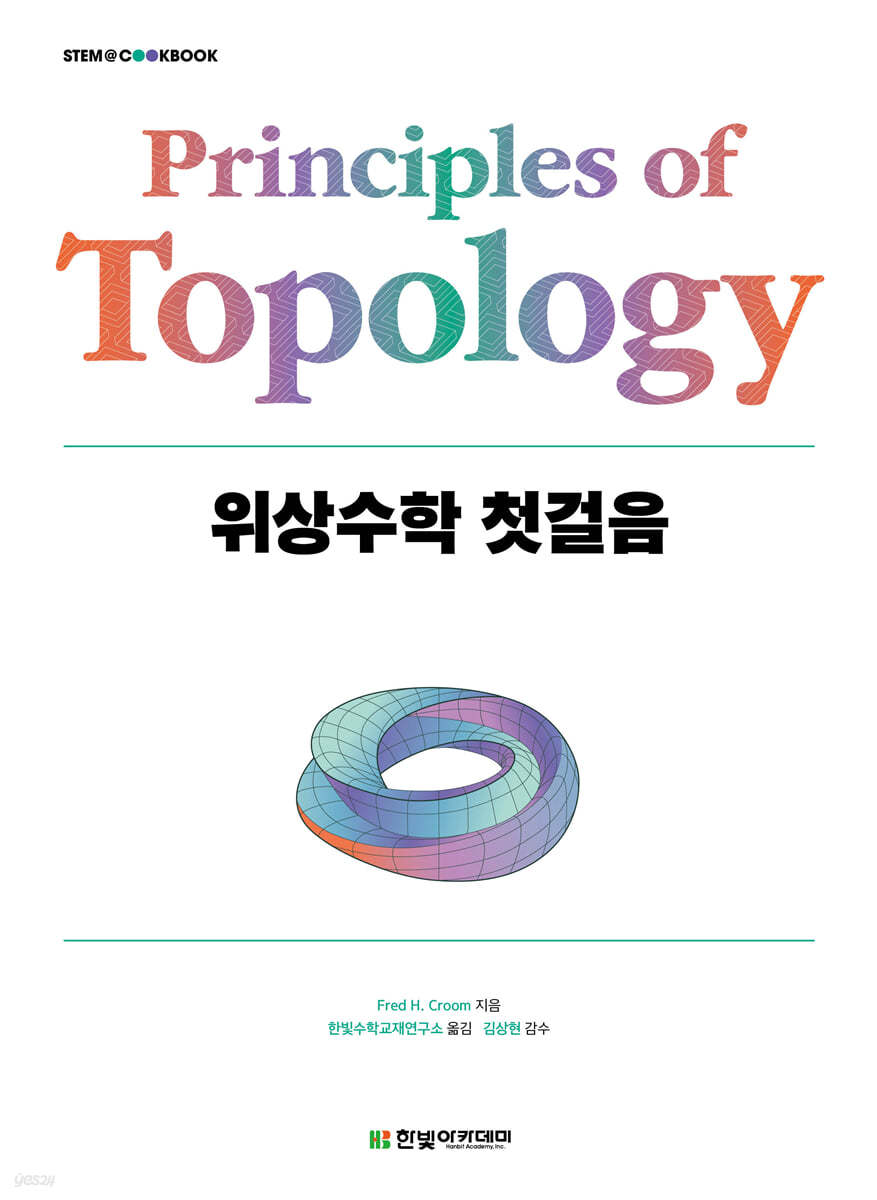
An introductory book that explains the fundamental principles of topology in a rigorous yet easy-to-understand manner.
Topology is a great subject for undergraduates to learn when studying advanced mathematics, as it is natural, geometric, and intuitively appealing.
This book is designed to be used as an introductory course in topology over the course of one semester, and introduces the geometric principles underlying each topic in topology and how topological ideas are applied to geometry and analysis.
This book mainly deals with point-set topology, and briefly introduces geometric topology, differential topology, and algebraic topology.
Topology is a great subject for undergraduates to learn when studying advanced mathematics, as it is natural, geometric, and intuitively appealing.
This book is designed to be used as an introductory course in topology over the course of one semester, and introduces the geometric principles underlying each topic in topology and how topological ideas are applied to geometry and analysis.
This book mainly deals with point-set topology, and briefly introduces geometric topology, differential topology, and algebraic topology.
- You can preview some of the book's contents.
Preview
index
Chapter 1: Introduction to Topology
1.1 Characteristics of topology
1.2 Origins of Topology
1.3 Prerequisites for Understanding Topology: Set Theory
1.4 Set operations: union, intersection, difference
1.5 Cartesian product
1.6 Function
1.7 Equivalence Relations
Chapter 2: Straight Lines and Planes
2.1 Upper and lower bounds
2.2 Finite and infinite sets
2.3 Open and closed sets on the real line
2.4 Reduced interval summary
2.5 flat
Simple history of mathematics
Chapter 3 Distance Space
3.1 Definition and examples of metric space
3.2 Open and closed sets in metric space
3.3 Internal, alveolar, and border
3.4 Continuous functions
3.5 Equivalence in distance space
3.6 New space derived from existing space
3.7 Complete distance space
Simple history of mathematics
Chapter 4 Topological Space
4.1 Definitions and Examples
4.2 Internal, alveolar, and border
4.3 Basis and Partial Basis
4.4 Continuity and topological equivalence
4.5 Subspace
Simple history of mathematics
Chapter 5 Connectivity
5.1 Connected and unconnected spaces
5.2 Theorem on Connectivity
5.3 Connected subsets on the real line
5.4 Applications of Connectivity
5.5 Path connection space
5.6 Locally Connected Space and Locally Path-Connected Space
Simple history of mathematics
Chapter 6 Compactness
6.1 Compact Space and Its Subspaces
6.2 Compactness and continuity
6.3 Properties related to compactness
6.4 One-point compactness
6.5 Cantor set
Simple history of mathematics
Chapter 7: Product Space and Parallel Space
7.1 Finite product spaces
7.2 Extension of the product space
7.3 Comparison between phases
7.4 Commercial space
7.5 Surfaces and Manifolds
Simple history of mathematics
Chapter 8 Separation Properties and Distance
8.1 T_0, T_1, T_2 space
8.2 Regular space
8.3 Regular space
8.4 Separation using continuous functions
8.5 Distance
8.6 Stone-Cech compaction
Simple history of mathematics
Chapter 9 Basic Groups
9.1 The essence of algebraic topology
9.2 Basic Group
9.3 Fundamental group of S^1
9.4 Additional examples of basic groups
9.5 Browser Fixed Point Theorem and Related Results
9.6 Categories and Hamza
Simple history of mathematics
Appendix A Group
Appendix B List of Symbols
Appendix C Recommended Reading
Appendix D References
1.1 Characteristics of topology
1.2 Origins of Topology
1.3 Prerequisites for Understanding Topology: Set Theory
1.4 Set operations: union, intersection, difference
1.5 Cartesian product
1.6 Function
1.7 Equivalence Relations
Chapter 2: Straight Lines and Planes
2.1 Upper and lower bounds
2.2 Finite and infinite sets
2.3 Open and closed sets on the real line
2.4 Reduced interval summary
2.5 flat
Simple history of mathematics
Chapter 3 Distance Space
3.1 Definition and examples of metric space
3.2 Open and closed sets in metric space
3.3 Internal, alveolar, and border
3.4 Continuous functions
3.5 Equivalence in distance space
3.6 New space derived from existing space
3.7 Complete distance space
Simple history of mathematics
Chapter 4 Topological Space
4.1 Definitions and Examples
4.2 Internal, alveolar, and border
4.3 Basis and Partial Basis
4.4 Continuity and topological equivalence
4.5 Subspace
Simple history of mathematics
Chapter 5 Connectivity
5.1 Connected and unconnected spaces
5.2 Theorem on Connectivity
5.3 Connected subsets on the real line
5.4 Applications of Connectivity
5.5 Path connection space
5.6 Locally Connected Space and Locally Path-Connected Space
Simple history of mathematics
Chapter 6 Compactness
6.1 Compact Space and Its Subspaces
6.2 Compactness and continuity
6.3 Properties related to compactness
6.4 One-point compactness
6.5 Cantor set
Simple history of mathematics
Chapter 7: Product Space and Parallel Space
7.1 Finite product spaces
7.2 Extension of the product space
7.3 Comparison between phases
7.4 Commercial space
7.5 Surfaces and Manifolds
Simple history of mathematics
Chapter 8 Separation Properties and Distance
8.1 T_0, T_1, T_2 space
8.2 Regular space
8.3 Regular space
8.4 Separation using continuous functions
8.5 Distance
8.6 Stone-Cech compaction
Simple history of mathematics
Chapter 9 Basic Groups
9.1 The essence of algebraic topology
9.2 Basic Group
9.3 Fundamental group of S^1
9.4 Additional examples of basic groups
9.5 Browser Fixed Point Theorem and Related Results
9.6 Categories and Hamza
Simple history of mathematics
Appendix A Group
Appendix B List of Symbols
Appendix C Recommended Reading
Appendix D References
Detailed image

Publisher's Review
An introductory book on topology that covers the history of topology from simple examples.
Topology is the study of properties that are maintained when an object is continuously transformed.
Introductory courses in topology mainly cover general topology (point-set topology), focusing on connectivity and continuity in a certain space.
Since these concepts are somewhat abstract when 'distance' is excluded, this book covers topological concepts step by step, starting from straight lines and planes that are familiar to us, so that even beginners in topology can learn in an enjoyable way.
Through the [Simple History of Mathematics] in each chapter, you can examine which topologists left their mark on the world of mathematics in the 1900s and what circumstances they were involved in during that time.
Topology is the study of properties that are maintained when an object is continuously transformed.
Introductory courses in topology mainly cover general topology (point-set topology), focusing on connectivity and continuity in a certain space.
Since these concepts are somewhat abstract when 'distance' is excluded, this book covers topological concepts step by step, starting from straight lines and planes that are familiar to us, so that even beginners in topology can learn in an enjoyable way.
Through the [Simple History of Mathematics] in each chapter, you can examine which topologists left their mark on the world of mathematics in the 1900s and what circumstances they were involved in during that time.
GOODS SPECIFICS
- Publication date: December 26, 2022
- Page count, weight, size: 380 pages | 188*257*30mm
- ISBN13: 9791156646402
- ISBN10: 1156646405
You may also like
카테고리
korean


korean

![GQ KOREA Mark (Monthly): December [2025]](http://librairie.coreenne.fr/cdn/shop/files/8ef265dbbfbf186523ed75ba7319009d.jpg?v=1765340328&width=3840)


