

Open Dialogue
 |
Description
Book Introduction
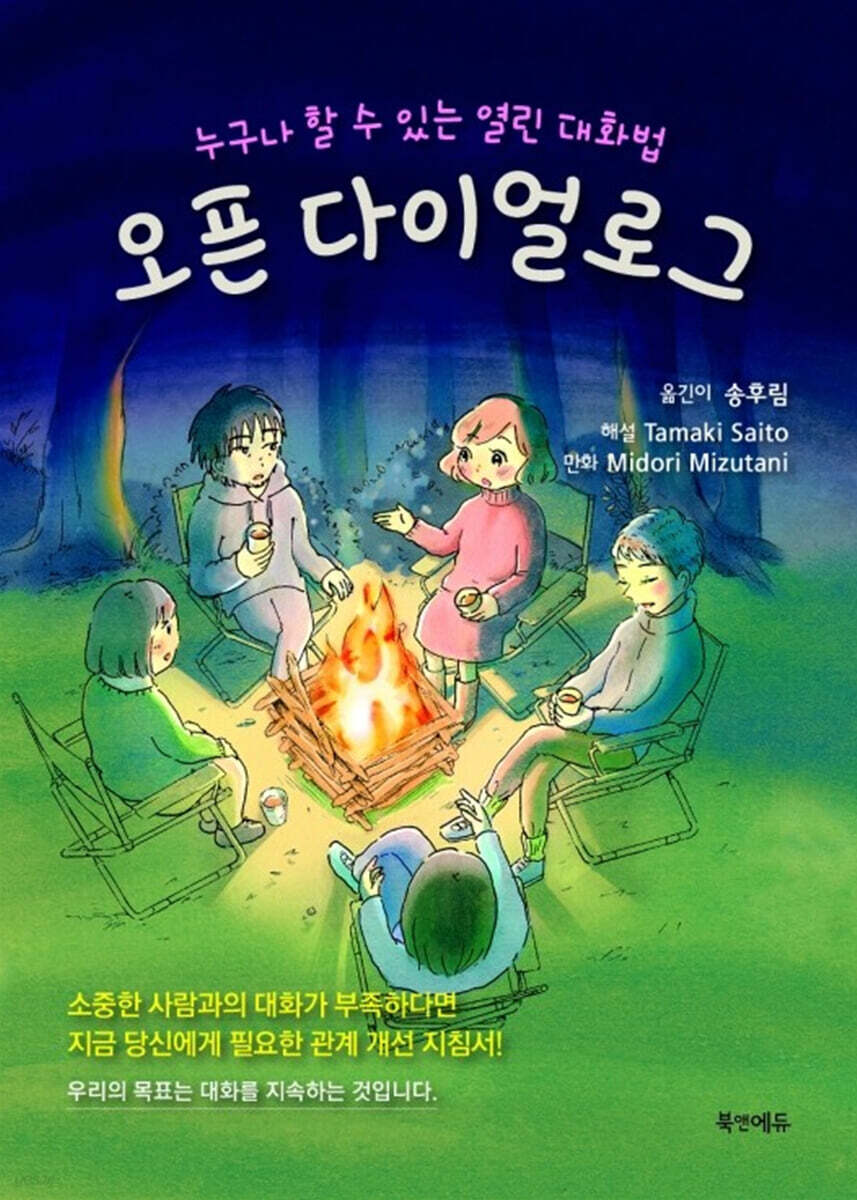
『Open Dialogue』 is well-organized so that even those who are new to Open Dialogue can understand the overall concepts and technologies of Open Dialogue at a glance.
The author, a specialist who has patiently counseled reclusive loners for a long time, has richly incorporated original theories into his own experiences, and, in a Japanese way, has reorganized the cases into easy-to-understand comics.
Observing the author's process of adapting Western theories and formats to Japanese reality provides valuable hints on how open dialogue can be applied in Korea.
index
Contents
Chapter 1: The Reclusive Loner Son Who Refuses to Converse 12
Chapter 2 Cartoonist Mizutani, Open Dialogue
Experience it for yourself! 26
Chapter 3: My Husband Is Cheating! 38
Chapter 4: The Five Pillars of Open Dialogue 63
The first axis is sufficient for continuous dialogue 65
No second axis plan 67
Third Axis: Teams, Not Individuals 69
The Fourth Axis: Reflection: The Patient Observes the Therapist 71
Polyphony 73, not the fifth axis harmony
Chapter 5: Preparing for Open Dialogue 75
1.
Getting Started 76
2.
Listening and Speaking 79
3.
Reflection 82
4.
Finishing 90
Chapter 6: The Reality of Open Dialogue 93
1.
No persuasion, discussion, explanation, questioning, or advice 94
2.
Don't deny the experience 95
3.
Don't judge easily as if you know everything 96
Chapter 7: Open Dialogue: I'm Curious About This 103
Chapter 8: Proposal from a Ghost! 118
Chapter 9: Mr. Tamaki's Story 128
Chapter 10: Visiting Finland, the Home of Open Dialogue 150
Conclusion 174
Column | Open Dialogue 7 Principles 64
98 Easy Mistakes to Make
Open Dialogue Experiences Through Home Care 102
Publisher's Review
Translator's Preface
This book is the first introductory book on open dialogue to be introduced in Korea.
There has been interest in open dialogue in Korea as well.
Although some books have briefly introduced Open Dialogue, this is surprisingly the first book to be published entirely on the topic.
This may mean that Korea's health and social system is maintained with a focus on 'management' of 'pathology'.
Among them, medical institutions say, 'The disease is wrong, so treat it.'
Operating under the pressures of paradigms and 'cost-effectiveness' and 'speed', open dialogue presents us with a radical image.
This is especially true given that Open Dialogue was initially created to address the most extreme forms of communication, particularly in psychiatric crisis situations.
Because talking to patients in a psychotic state such as acute schizophrenia is not effective, the common approach is to quickly relieve symptoms through medication.
In particular, a significant number of people working in the mental health field in Korea are working excessively hard.
I get the feeling that there's a kind of 'learned helplessness' being shared subtly, due to the practical reasons of having to maintain the service with minimal time and cost.
There were those who attempted open dialogue out of a sense of personal mission, but I think this background may have played a role in their failure to achieve sustainability and widespread adoption.
However, there is no particular disagreement that the philosophy implied by Open Dialogue is valid and provides us with direction.
Although some structure and technical aspects have been added for use in therapeutic settings, the essence of Open Dialogue is 'conversation' rather than 'therapy'.
Even if you don't follow the formality, it will be a useful conversation method that can be applied to various conflict situations that arise in everyday life.
The book's emphasis that open dialogue can be applied to anyone and any situation is also based on the universal dialogism inherent in open dialogue.
This is what Russian philosopher Mikhail Bakhtin said: “Life is essentially a conversation.
To live means to engage in conversation.
This is well expressed in the proposition, “Asking, listening, and answering is the nature of life.”
And Bakhtin said, “One voice does not end anything, it does not solve anything.
“There must be at least two voices,” he said.
This shows that our way of life, which was full of 'monologues', must move to 'conversations'.
In countless situations in life, whether in daily life or in the medical field, regardless of right or wrong, monologue delays resolution, while dialogue promotes it.
Open Dialogue provides even the specifics on how to initiate and sustain conversations, which naturally arise as questions.
This book is well-organized so that even those new to Open Dialog can understand the overall concepts and technologies of Open Dialog at a glance.
The author, Tamaki Saito, is an expert who has patiently counseled reclusive loners for a long time and has richly incorporated the original theory into his own experience.
In a Japanese way, it is characterized by the fact that the examples are reorganized in an easy-to-understand way through comics.
As we watch the author adapt Western theories and formats to fit Japanese reality,
You can also get some good hints on how to apply open dialogue in Korea.
I would like to thank Book & Edu CEO Shin Eun-ju and Manager Shin Gyu-cheol for always publishing good books, and Assistant Manager Hwang In-ae for her thorough editing.
I sincerely hope that this book will serve as an opportunity to sow the seeds of open dialogue in Korea.
March 2022
Song Hu-rim
GOODS SPECIFICS
- Publication date: March 30, 2022
- Page count, weight, size: 176 pages | 180*230*20mm
- ISBN13: 9791155902158
- ISBN10: 1155902157

You may also like
카테고리
korean


korean


