

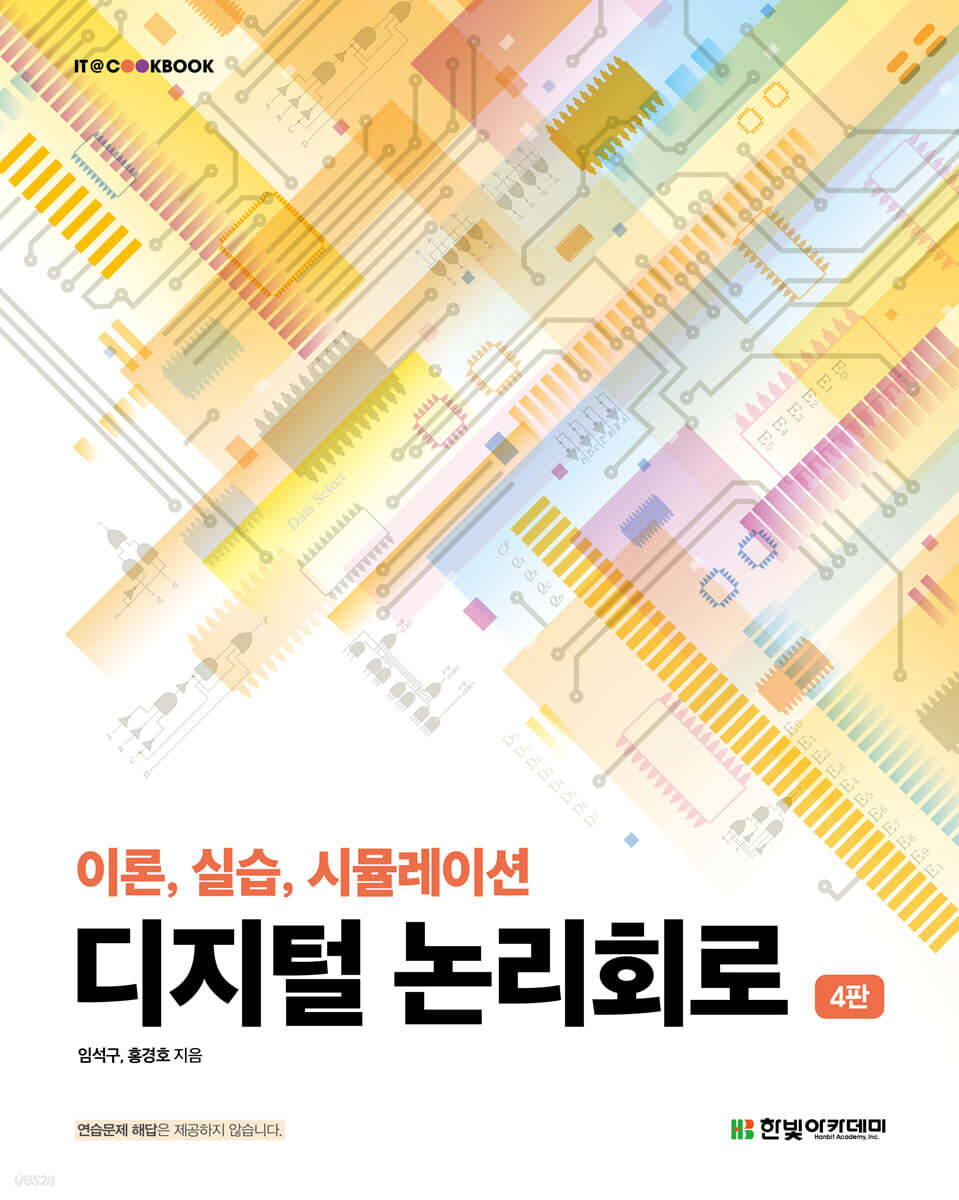
digital logic circuits
 |
Description
Book Introduction
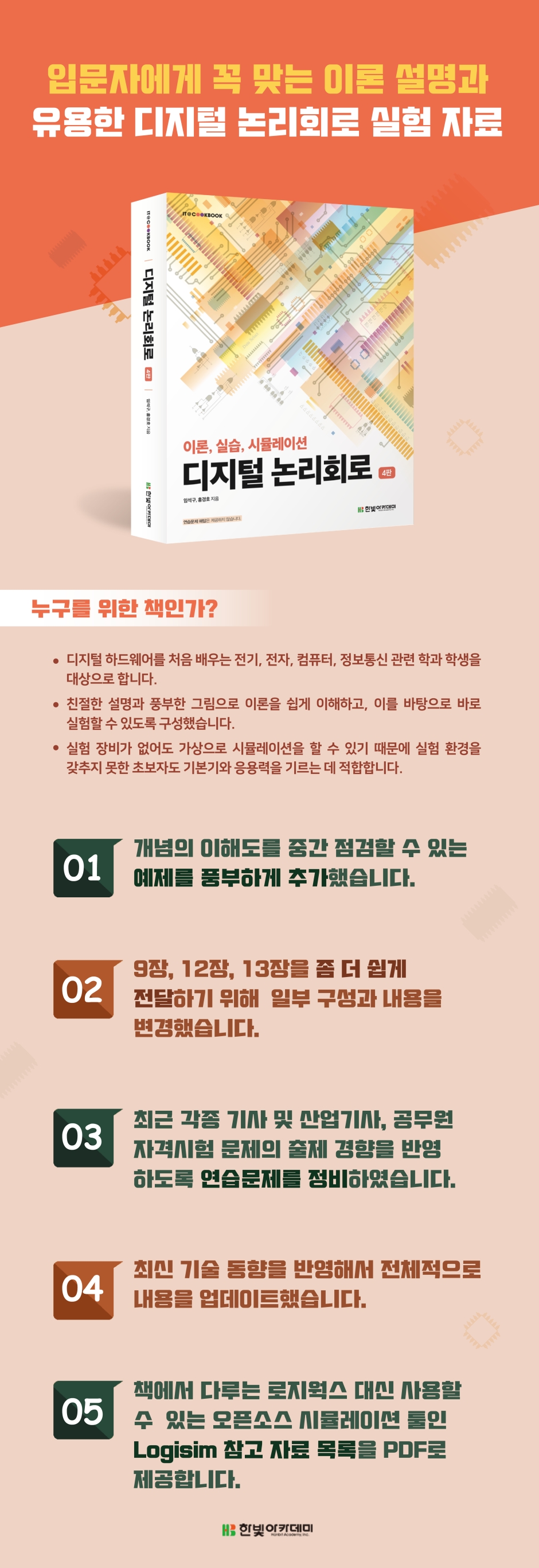
Theory explanations and useful digital logic circuit experiment materials perfect for beginners.
It is intended for students in electrical, electronic, computer, and information and communication departments who are learning digital hardware for the first time.
It is designed to help you easily understand the theory with friendly explanations and abundant illustrations, and to enable you to conduct experiments based on it right away.
Because it allows for virtual simulations without experimental equipment, it is suitable for beginners who do not have an experimental environment to develop basic and applied skills.
*This book was developed as a textbook for university lectures, so it does not provide answers to practice problems.
It is intended for students in electrical, electronic, computer, and information and communication departments who are learning digital hardware for the first time.
It is designed to help you easily understand the theory with friendly explanations and abundant illustrations, and to enable you to conduct experiments based on it right away.
Because it allows for virtual simulations without experimental equipment, it is suitable for beginners who do not have an experimental environment to develop basic and applied skills.
*This book was developed as a textbook for university lectures, so it does not provide answers to practice problems.
- You can preview some of the book's contents.
Preview
index
Chapter 01 Introduction
01 Digital and Analog
02 Representation of digital information
03 Logic levels and pulse waveforms
04 Digital Integrated Circuit
05 ADC and DAC
Practice problems
Past exam questions
Chapter 02 Number System
01 decimal
02 Base Conversion
03 Binary integer operations and complements
04 Representation of binary floating-point numbers
Practice problems
Past exam questions
Chapter 03 Digital Code
01 BCD code and 3+ code
02 Various binary codes
03 Gray Code
04 Error Detection Code
05 Alphanumeric code
Practice problems
Past exam questions
Chapter 04 Logic Gates
01 Logic Level
02 NOT gate and buffer gate
03 AND gate
04 OR Gate
05 NAND gate
06 NOR gate
07 XOR gate
08 XNOR gate
09 Positive and Negative Logic
Electrical characteristics of the 10-gate
Practice problems
Past exam questions
Chapter 05 Boolean Algebra
01 Expression of basic logical expressions
02 Boolean Algebra Law
03 Conversion of logic formulas in logic circuits
04 Circuit configuration of logic formula
05 Expression form of Boolean algebra
06 Simplification of logical expressions using Boolean algebraic laws
Practice problems
Past exam questions
Chapter 06 Simplifying Logical Expressions
01 Two-variable Karnaugh map
02 3-variable Karnaugh map
03 4-variable Karnaugh map
04 Optional Karnaugh Map
05 Creating a Karnaugh map of a logical expression
06 5-variable, 6-variable Karnaugh map
07 Quinn-McCluskey Simplification Algorithm
08 Multiple output functions
09 Conversion to NAND and NOR gates
10 XOR and XNOR gates
Practice problems
Past exam questions
Chapter 07 Combinational Logic Circuits
01 Adder
02 Comparator
03 Decoder
04 Encoder
05 Multiplexer
06 Demultiplexer
07 Code Converter
08 Parity Generator/Detector
Practice problems
Past exam questions
Chapter 08 Flip-flops
01 Basic Flip-Flop
02 SR flip-flop
03 D flip-flop
04 JK Flip-Flop
05 T flip-flop
06 Asynchronous Input
07 Flip-flop operating characteristics
08 Multivibrator
Practice problems
Past exam questions
Chapter 09 Synchronous Sequential Logic Circuits
01 Synchronous Sequential Logic Circuit Overview
02 Analysis process of synchronous sequential logic circuits
03 Flip-flop excitation
04 Design process of synchronous sequential logic circuits
05 Design example of synchronous sequential logic circuit
06 Design in unused condition
07 Counter Design
08 Design using state equations
09 Design using decoders and flip-flops
Practice problems
Past exam questions
Chapter 10 Counter
01 Asynchronous Counter
02 Synchronous Counter
03 Other Counters
04 IC Counter
05 Application of Counter
Practice problems
Past exam questions
Chapter 11 Register
01 Classification of registers
02 Serial input-serial output register
03 Serial input-parallel output register
04 Parallel Input-Serial Output Register
05 Parallel Input-Parallel Output Register
06 Bidirectional Shift Register
07 General purpose shift register
08 Applications of Shift Registers
Practice problems
Past exam questions
Chapter 12 Memory and Programmable Logic Units
01 Memory Overview
02 ROM
03 RAM
04 Flash memory
05 Programmable Logic Device (PLD)
Practice problems
Past exam questions
Chapter 13 Logic Circuit Experiment
01 Experiment Overview
02 Basic logic gates
03 Boolean Algebra and De Morgan's Theorem
04 XOR gate
05 Adder and Subtractor
06 Decoder and Encoder
07 Multiplexers and Demultiplexers
08 Code Converter
09 Flip-flop
10 Asynchronous Counters
11 Synchronous counters
12 registers
13 Multivibrator
Chapter 14 Term Project
01 How to Use Hardware Manufacturing Tools
02 8-bit parallel adder/subtractor
03 Traffic light control
04 Digital Clock
Search
01 Digital and Analog
02 Representation of digital information
03 Logic levels and pulse waveforms
04 Digital Integrated Circuit
05 ADC and DAC
Practice problems
Past exam questions
Chapter 02 Number System
01 decimal
02 Base Conversion
03 Binary integer operations and complements
04 Representation of binary floating-point numbers
Practice problems
Past exam questions
Chapter 03 Digital Code
01 BCD code and 3+ code
02 Various binary codes
03 Gray Code
04 Error Detection Code
05 Alphanumeric code
Practice problems
Past exam questions
Chapter 04 Logic Gates
01 Logic Level
02 NOT gate and buffer gate
03 AND gate
04 OR Gate
05 NAND gate
06 NOR gate
07 XOR gate
08 XNOR gate
09 Positive and Negative Logic
Electrical characteristics of the 10-gate
Practice problems
Past exam questions
Chapter 05 Boolean Algebra
01 Expression of basic logical expressions
02 Boolean Algebra Law
03 Conversion of logic formulas in logic circuits
04 Circuit configuration of logic formula
05 Expression form of Boolean algebra
06 Simplification of logical expressions using Boolean algebraic laws
Practice problems
Past exam questions
Chapter 06 Simplifying Logical Expressions
01 Two-variable Karnaugh map
02 3-variable Karnaugh map
03 4-variable Karnaugh map
04 Optional Karnaugh Map
05 Creating a Karnaugh map of a logical expression
06 5-variable, 6-variable Karnaugh map
07 Quinn-McCluskey Simplification Algorithm
08 Multiple output functions
09 Conversion to NAND and NOR gates
10 XOR and XNOR gates
Practice problems
Past exam questions
Chapter 07 Combinational Logic Circuits
01 Adder
02 Comparator
03 Decoder
04 Encoder
05 Multiplexer
06 Demultiplexer
07 Code Converter
08 Parity Generator/Detector
Practice problems
Past exam questions
Chapter 08 Flip-flops
01 Basic Flip-Flop
02 SR flip-flop
03 D flip-flop
04 JK Flip-Flop
05 T flip-flop
06 Asynchronous Input
07 Flip-flop operating characteristics
08 Multivibrator
Practice problems
Past exam questions
Chapter 09 Synchronous Sequential Logic Circuits
01 Synchronous Sequential Logic Circuit Overview
02 Analysis process of synchronous sequential logic circuits
03 Flip-flop excitation
04 Design process of synchronous sequential logic circuits
05 Design example of synchronous sequential logic circuit
06 Design in unused condition
07 Counter Design
08 Design using state equations
09 Design using decoders and flip-flops
Practice problems
Past exam questions
Chapter 10 Counter
01 Asynchronous Counter
02 Synchronous Counter
03 Other Counters
04 IC Counter
05 Application of Counter
Practice problems
Past exam questions
Chapter 11 Register
01 Classification of registers
02 Serial input-serial output register
03 Serial input-parallel output register
04 Parallel Input-Serial Output Register
05 Parallel Input-Parallel Output Register
06 Bidirectional Shift Register
07 General purpose shift register
08 Applications of Shift Registers
Practice problems
Past exam questions
Chapter 12 Memory and Programmable Logic Units
01 Memory Overview
02 ROM
03 RAM
04 Flash memory
05 Programmable Logic Device (PLD)
Practice problems
Past exam questions
Chapter 13 Logic Circuit Experiment
01 Experiment Overview
02 Basic logic gates
03 Boolean Algebra and De Morgan's Theorem
04 XOR gate
05 Adder and Subtractor
06 Decoder and Encoder
07 Multiplexers and Demultiplexers
08 Code Converter
09 Flip-flop
10 Asynchronous Counters
11 Synchronous counters
12 registers
13 Multivibrator
Chapter 14 Term Project
01 How to Use Hardware Manufacturing Tools
02 8-bit parallel adder/subtractor
03 Traffic light control
04 Digital Clock
Search
Detailed image
Publisher's Review
Starting with number systems and digital codes, we explore logic gates, Boolean algebra, and how to simplify logic expressions, before exploring various combinational logic circuits.
Additionally, through understanding flip-flops, you will learn how to design synchronous sequential logic circuits, and learn about their applications such as design methods for counters and registers.
Finally, we look at memory and programmable logic devices (PLDs).
1.
Introduction, Number System, Digital Code (Chapters 1-3)
We will examine the concepts and general contents of digital and analog, and take a detailed look at various numbers and base conversions such as binary, octal, and hexadecimal, which are the most basic in logic circuits, as well as complementary representations.
In addition, we will lay the foundation for studying digital logic circuits by examining various digital codes such as BCD code, excess-3 code, and Gray code.
2.
Logic gates, Boolean algebra, and simplification of logical expressions (Chapters 4–6)
We will learn about basic logic gates such as NOT, AND, and OR gates with diagrams, and look at how to express basic logic expressions, the laws of Boolean algebra, and how to construct logic expressions into logic circuits.
We will also learn how to simplify complex logical expressions using Karnaugh maps, QM algorithms, etc.
3.
Combinational logic circuits, flip-flops, synchronous sequential logic circuits, counters, registers, memory, and programmable logic devices (Chapters 7–12)
Learn about combinational logic circuits such as adders, decoders, and encoders, as well as various flip-flops, with illustrations.
We will learn about the overview, interpretation, and design process of synchronous sequential logic circuits in order, and also take a close look at various counters and registers.
Finally, we look at ROM, RAM, flash memory, PLD, etc.
4.
Digital Logic Circuit Experiment, Term Project (Chapters 13-14)
We've included a variety of exercises based on what you've learned in each chapter.
You can learn the content more thoroughly by practicing it directly along with the theory.
If you do not have training equipment, you can also conduct virtual training through simulation using the Logic Works tool introduced in the appendix.
The Term Project details the entire process of building an 8-bit parallel adder/subtractor, a traffic light controller, and a digital clock.
Additionally, through understanding flip-flops, you will learn how to design synchronous sequential logic circuits, and learn about their applications such as design methods for counters and registers.
Finally, we look at memory and programmable logic devices (PLDs).
1.
Introduction, Number System, Digital Code (Chapters 1-3)
We will examine the concepts and general contents of digital and analog, and take a detailed look at various numbers and base conversions such as binary, octal, and hexadecimal, which are the most basic in logic circuits, as well as complementary representations.
In addition, we will lay the foundation for studying digital logic circuits by examining various digital codes such as BCD code, excess-3 code, and Gray code.
2.
Logic gates, Boolean algebra, and simplification of logical expressions (Chapters 4–6)
We will learn about basic logic gates such as NOT, AND, and OR gates with diagrams, and look at how to express basic logic expressions, the laws of Boolean algebra, and how to construct logic expressions into logic circuits.
We will also learn how to simplify complex logical expressions using Karnaugh maps, QM algorithms, etc.
3.
Combinational logic circuits, flip-flops, synchronous sequential logic circuits, counters, registers, memory, and programmable logic devices (Chapters 7–12)
Learn about combinational logic circuits such as adders, decoders, and encoders, as well as various flip-flops, with illustrations.
We will learn about the overview, interpretation, and design process of synchronous sequential logic circuits in order, and also take a close look at various counters and registers.
Finally, we look at ROM, RAM, flash memory, PLD, etc.
4.
Digital Logic Circuit Experiment, Term Project (Chapters 13-14)
We've included a variety of exercises based on what you've learned in each chapter.
You can learn the content more thoroughly by practicing it directly along with the theory.
If you do not have training equipment, you can also conduct virtual training through simulation using the Logic Works tool introduced in the appendix.
The Term Project details the entire process of building an 8-bit parallel adder/subtractor, a traffic light controller, and a digital clock.
GOODS SPECIFICS
- Date of issue: January 15, 2022
- Page count, weight, size: 816 pages | 188*235*40mm
- ISBN13: 9791156645689
- ISBN10: 1156645689
You may also like
카테고리
korean


korean

![ELLE 엘르 스페셜 에디션 A형 : 12월 [2025]](http://librairie.coreenne.fr/cdn/shop/files/b8e27a3de6c9538896439686c6b0e8fb.jpg?v=1766436872&width=3840)


