

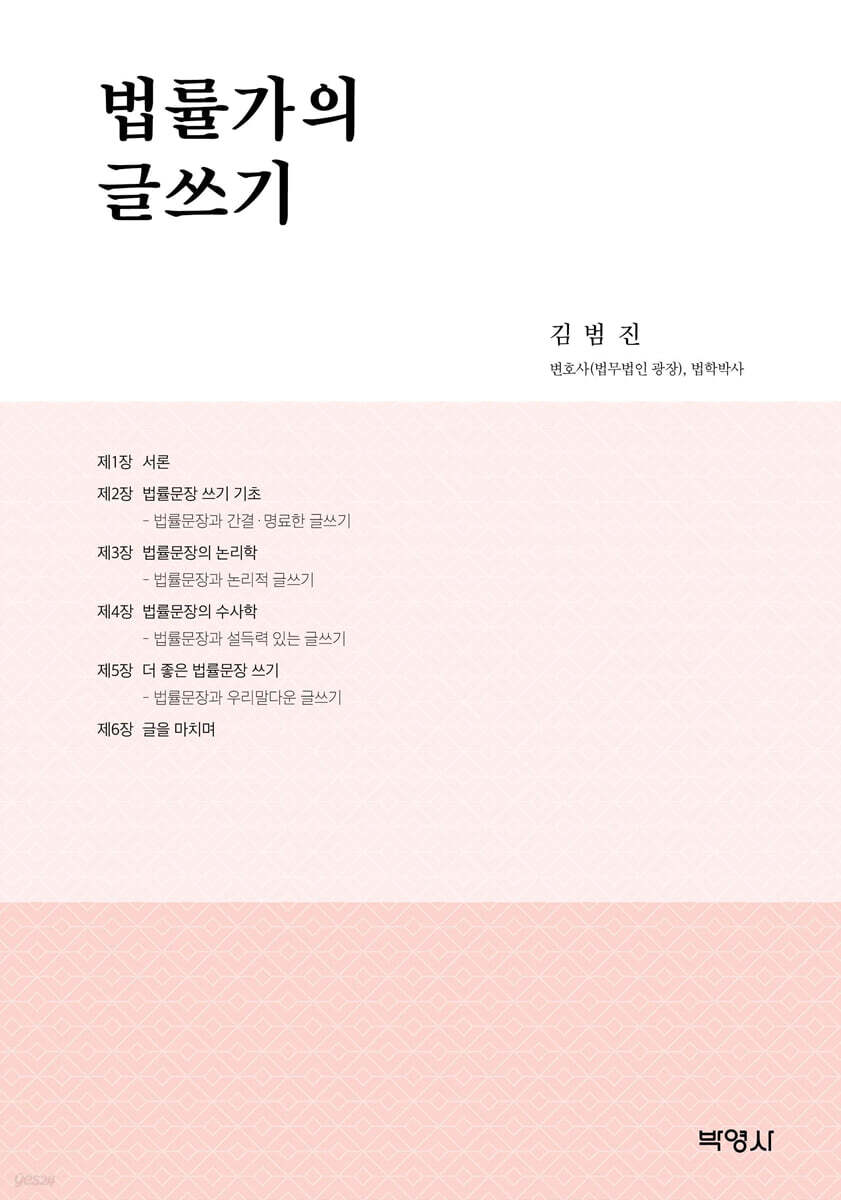
A lawyer's writing
 |
Description
Book Introduction
『Lawyer's Writing』 is a study of writing.
This is a theoretical study that applies the theories of argumentation and rhetoric from general writing books to practical legal writing.
This research is not simply a matter of writing.
The process of completing a legal document is very complex and three-dimensional.
It is not something that can be solved with legal knowledge alone.
In addition to law, it is intricately intertwined with language, logic, rhetoric, and various humanities and social sciences.
In practice, there are many issues that cannot be resolved through schematic legal application, as shown in cases in law textbooks.
In such cases, the trial is much more complex and is the product of a fierce confrontation or debate between three-dimensional thinking and its outcomes.
This is a completely new area that is not covered in the legal curriculum.
The author attempted to unravel even a little of that vast and complex maze.
This is a theoretical study that applies the theories of argumentation and rhetoric from general writing books to practical legal writing.
This research is not simply a matter of writing.
The process of completing a legal document is very complex and three-dimensional.
It is not something that can be solved with legal knowledge alone.
In addition to law, it is intricately intertwined with language, logic, rhetoric, and various humanities and social sciences.
In practice, there are many issues that cannot be resolved through schematic legal application, as shown in cases in law textbooks.
In such cases, the trial is much more complex and is the product of a fierce confrontation or debate between three-dimensional thinking and its outcomes.
This is a completely new area that is not covered in the legal curriculum.
The author attempted to unravel even a little of that vast and complex maze.
index
Chapter 1 Introduction
Chapter 2: Basics of Writing Legal Sentences: Legal Sentences and Concise, Clear Writing
Section 1 Introduction
Section 2: Five Principles for Concise and Clear Writing
Ⅰ.
The First Principle of Concise and Clear Writing: Breaking Sentences
Ⅱ.
The Second Rule of Concise, Clear Writing: Eliminate Frills
Ⅲ.
The Third Principle of Concise and Clear Writing: Parentheses and Their Applications
Ⅳ.
The Fourth Principle of Concise and Clear Writing: Use Clear Expression
V.
The 5th Principle of Concise and Clear Writing: Visualizing Your Writing
Ⅵ.
finish
Chapter 3: The Logic of Legal Sentences: Legal Sentences and Logical Writing
Section 1 What is an argument?
Section 2 Legal Argumentation and Legal Writing
Section 3: Six Principles of Legal Writing and Logical Writing
Ⅰ.
The First Principle of Logical Writing: Establishing the Basic Form of Argumentation
Ⅱ.
The Second Principle of Logical Writing: Distinguishing between Core and Supporting Arguments
Ⅲ.
The Third Principle of Logical Writing: Revealing Logical Structure in Complex Arguments
Ⅳ.
The Fourth Principle of Logical Writing: Logical Writing at the Individual Sentence Level
V.
The Fifth Principle of Logical Writing: Inclusive Argumentation and Factual Writing
Ⅵ.
The Sixth Principle of Logical Writing: Inclusive Arguments and Presenting Rich Arguments
Ⅶ.
finish
Chapter 4: The Rhetoric of Legal Sentences: Legal Sentences and Persuasive Writing
Section 1 Introduction
Section 2: Five Principles of Persuasive Writing
Ⅰ.
The First Principle of Persuasive Writing: Appropriate Redundancy and Variation
Ⅱ.
The Second Principle of Persuasive Writing: Detailed Description, Eliminating Questions
Ⅲ.
The Third Principle of Persuasive Writing: Use Analogies and Examples
Ⅳ.
The Fourth Principle of Persuasive Writing: Using Sophisticated Conceptual Language
V.
The 5 Principles of Persuasive Writing: Ethos and Pathos
Ⅵ.
finish
Chapter 5: Writing Better Legal Sentences: Legal Sentences and Korean Writing
Section 1: Why is writing in our language a problem?
Section 2: Three Principles for Legal Text and Korean Writing
Chapter 6: Conclusion
Chapter 2: Basics of Writing Legal Sentences: Legal Sentences and Concise, Clear Writing
Section 1 Introduction
Section 2: Five Principles for Concise and Clear Writing
Ⅰ.
The First Principle of Concise and Clear Writing: Breaking Sentences
Ⅱ.
The Second Rule of Concise, Clear Writing: Eliminate Frills
Ⅲ.
The Third Principle of Concise and Clear Writing: Parentheses and Their Applications
Ⅳ.
The Fourth Principle of Concise and Clear Writing: Use Clear Expression
V.
The 5th Principle of Concise and Clear Writing: Visualizing Your Writing
Ⅵ.
finish
Chapter 3: The Logic of Legal Sentences: Legal Sentences and Logical Writing
Section 1 What is an argument?
Section 2 Legal Argumentation and Legal Writing
Section 3: Six Principles of Legal Writing and Logical Writing
Ⅰ.
The First Principle of Logical Writing: Establishing the Basic Form of Argumentation
Ⅱ.
The Second Principle of Logical Writing: Distinguishing between Core and Supporting Arguments
Ⅲ.
The Third Principle of Logical Writing: Revealing Logical Structure in Complex Arguments
Ⅳ.
The Fourth Principle of Logical Writing: Logical Writing at the Individual Sentence Level
V.
The Fifth Principle of Logical Writing: Inclusive Argumentation and Factual Writing
Ⅵ.
The Sixth Principle of Logical Writing: Inclusive Arguments and Presenting Rich Arguments
Ⅶ.
finish
Chapter 4: The Rhetoric of Legal Sentences: Legal Sentences and Persuasive Writing
Section 1 Introduction
Section 2: Five Principles of Persuasive Writing
Ⅰ.
The First Principle of Persuasive Writing: Appropriate Redundancy and Variation
Ⅱ.
The Second Principle of Persuasive Writing: Detailed Description, Eliminating Questions
Ⅲ.
The Third Principle of Persuasive Writing: Use Analogies and Examples
Ⅳ.
The Fourth Principle of Persuasive Writing: Using Sophisticated Conceptual Language
V.
The 5 Principles of Persuasive Writing: Ethos and Pathos
Ⅵ.
finish
Chapter 5: Writing Better Legal Sentences: Legal Sentences and Korean Writing
Section 1: Why is writing in our language a problem?
Section 2: Three Principles for Legal Text and Korean Writing
Chapter 6: Conclusion
Publisher's Review
It was about 7 or 8 years ago that I vaguely conceived the idea of writing something like this.
It was on the bus ride home after having a drink with colleagues after finishing a few days of hard work on a written document.
Maybe it was because I was drunk, but I had a strange thought.
How about documenting the intense, complex thought process and the days of exhausting thought that went into perfecting a written piece? How about systematically explaining the intense and complex process of thinking that goes into a single piece of writing, from draft to completion? Afterwards, I made notes comparing the before and after revisions to the writing.
I also bought books on writing one by one.
Then, by chance, I was given the opportunity to teach a course on legal document writing at Hanyang University Law School.
In 2020, I gave a special lecture on writing at Korea Cyber University.
This book is a compilation and revision of lecture notes I have prepared over the years.
I'm not very good at writing.
Ironically, that is precisely what led me to publish this book on writing.
There are so many writing books on the market.
These are books in which writing experts share their writing secrets.
I don't have that ability.
Instead, I organized the teachings of writing experts one by one and applied them to legal texts.
I also worked on organizing the writing revisions by type.
For this task, in addition to writing books, I also read a few books on argument theory and logic theory.
The books I bought one by one like that soon became about 40 to 50.
Simply put, this book is a study of writing.
This is a theoretical study that applies the theories of argumentation and rhetoric from general writing books to practical legal writing.
This research is not simply a matter of writing.
The process of completing a legal document is very complex and three-dimensional.
It is not something that can be solved with legal knowledge alone.
In addition to law, it is intricately intertwined with language, logic, rhetoric, and various humanities and social sciences.
In practice, there are many issues that cannot be resolved through schematic legal application, as shown in cases in law textbooks.
In such cases, the trial is much more complex and is the product of a fierce confrontation or debate between three-dimensional thinking and its outcomes.
This is a completely new area that is not covered in the legal curriculum.
I wanted to try to unravel even a little of that huge, complex maze.
I would like to express my gratitude to Park Young-sa, who permitted the publication of this book; to Team Leader Lee Seung-hyeon, who completed the difficult editing process with great skill; to the senior and junior lawyers and professors at Gwangjang Law Firm, who taught me much, and to my loving family.
2021.
7. 20.
Kim Beom-jin
It was on the bus ride home after having a drink with colleagues after finishing a few days of hard work on a written document.
Maybe it was because I was drunk, but I had a strange thought.
How about documenting the intense, complex thought process and the days of exhausting thought that went into perfecting a written piece? How about systematically explaining the intense and complex process of thinking that goes into a single piece of writing, from draft to completion? Afterwards, I made notes comparing the before and after revisions to the writing.
I also bought books on writing one by one.
Then, by chance, I was given the opportunity to teach a course on legal document writing at Hanyang University Law School.
In 2020, I gave a special lecture on writing at Korea Cyber University.
This book is a compilation and revision of lecture notes I have prepared over the years.
I'm not very good at writing.
Ironically, that is precisely what led me to publish this book on writing.
There are so many writing books on the market.
These are books in which writing experts share their writing secrets.
I don't have that ability.
Instead, I organized the teachings of writing experts one by one and applied them to legal texts.
I also worked on organizing the writing revisions by type.
For this task, in addition to writing books, I also read a few books on argument theory and logic theory.
The books I bought one by one like that soon became about 40 to 50.
Simply put, this book is a study of writing.
This is a theoretical study that applies the theories of argumentation and rhetoric from general writing books to practical legal writing.
This research is not simply a matter of writing.
The process of completing a legal document is very complex and three-dimensional.
It is not something that can be solved with legal knowledge alone.
In addition to law, it is intricately intertwined with language, logic, rhetoric, and various humanities and social sciences.
In practice, there are many issues that cannot be resolved through schematic legal application, as shown in cases in law textbooks.
In such cases, the trial is much more complex and is the product of a fierce confrontation or debate between three-dimensional thinking and its outcomes.
This is a completely new area that is not covered in the legal curriculum.
I wanted to try to unravel even a little of that huge, complex maze.
I would like to express my gratitude to Park Young-sa, who permitted the publication of this book; to Team Leader Lee Seung-hyeon, who completed the difficult editing process with great skill; to the senior and junior lawyers and professors at Gwangjang Law Firm, who taught me much, and to my loving family.
2021.
7. 20.
Kim Beom-jin
GOODS SPECIFICS
- Publication date: August 10, 2021
- Page count, weight, size: 314 pages | 566g | 173*244*15mm
- ISBN13: 9791130338965
- ISBN10: 1130338967
You may also like
카테고리
korean


korean

![ELLE 엘르 스페셜 에디션 A형 : 12월 [2025]](http://librairie.coreenne.fr/cdn/shop/files/b8e27a3de6c9538896439686c6b0e8fb.jpg?v=1766436872&width=3840)


