

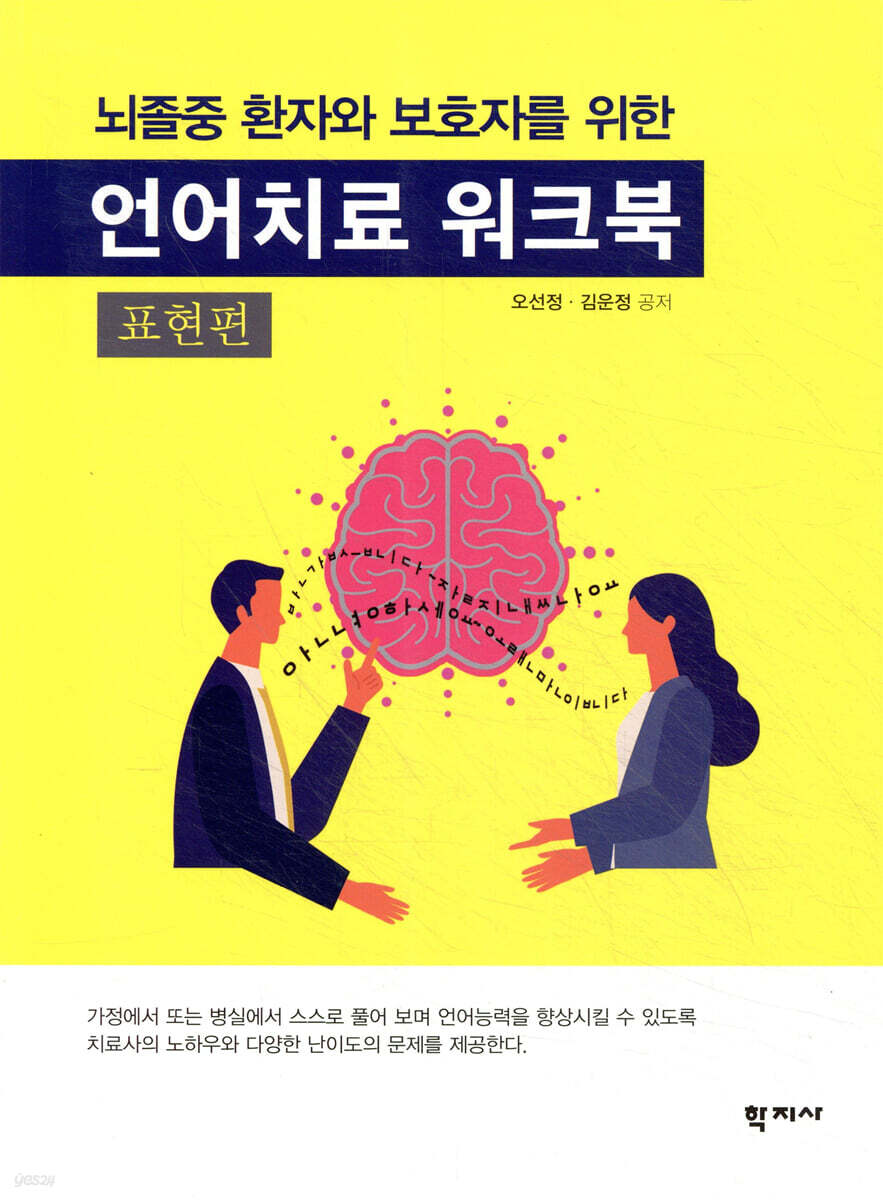
Speech Therapy Workbook (Expressions)
 |
Description
Book Introduction
The 『Speech Therapy Workbook (Expression Edition)』 was created with the concept of a 'friendly speech therapy guide' to help patients engage in more active speech therapy outside of therapy or at home.
Based on many years of experience in speech therapy, it has been organized so that patients and their guardians can easily use it.
Based on many years of experience in speech therapy, it has been organized so that patients and their guardians can easily use it.
index
preface
Recommended articles
Book Introduction
How to use the book
How to talk to patients
Chapter 1: Augmentative and Alternative Communication
1.
Yes/No
2.
Basic expressions
3.
body parts
4.
Expression of various emotions and states
Chapter 2: Endurance & Memory
1.
Time, Place, and People
2.
Calculate
Chapter 3 Automatic Speech
1.
number
2.
Day of the week/season
3.
etc
4.
sing
Chapter 4: Naming
1.
Name body parts
2.
Naming objects by category
3.
Wait for the job name
4.
Wait for the place name
Chapter 5 Word Retrieval
1.
Listen to the questions and guess the words (word quiz)
2.
opposite
3.
mind map
4.
Complete the word
Chapter 6: Vocabulary Fluency
1.
Wait for creation name by category
2.
Beginning word/ending word
3.
Words starting with consonants
Chapter 7 Sentence Completion
1.
Sentence Completion (Basic)
2.
Complete the matching sentences
3.
Complete sentences with different words
4.
Creating sentences connected by connective endings
5.
Creating sentences connected by conjunctive adverbs
Chapter 8: Describing Pictures
Chapter 9 Sentence Production
1.
Create sentences using onomatopoeia and mimetic words
2.
Make sentences with the given words
3.
Explaining similarities and differences
4.
Define a word
5.
Proverb Completion and Meaning
Chapter 10: Speaking Your Mind
1.
Answering personal questions
2.
Imagine and answer
3.
Explaining the order
4.
Creating the latter part of the story
Recommended articles
Book Introduction
How to use the book
How to talk to patients
Chapter 1: Augmentative and Alternative Communication
1.
Yes/No
2.
Basic expressions
3.
body parts
4.
Expression of various emotions and states
Chapter 2: Endurance & Memory
1.
Time, Place, and People
2.
Calculate
Chapter 3 Automatic Speech
1.
number
2.
Day of the week/season
3.
etc
4.
sing
Chapter 4: Naming
1.
Name body parts
2.
Naming objects by category
3.
Wait for the job name
4.
Wait for the place name
Chapter 5 Word Retrieval
1.
Listen to the questions and guess the words (word quiz)
2.
opposite
3.
mind map
4.
Complete the word
Chapter 6: Vocabulary Fluency
1.
Wait for creation name by category
2.
Beginning word/ending word
3.
Words starting with consonants
Chapter 7 Sentence Completion
1.
Sentence Completion (Basic)
2.
Complete the matching sentences
3.
Complete sentences with different words
4.
Creating sentences connected by connective endings
5.
Creating sentences connected by conjunctive adverbs
Chapter 8: Describing Pictures
Chapter 9 Sentence Production
1.
Create sentences using onomatopoeia and mimetic words
2.
Make sentences with the given words
3.
Explaining similarities and differences
4.
Define a word
5.
Proverb Completion and Meaning
Chapter 10: Speaking Your Mind
1.
Answering personal questions
2.
Imagine and answer
3.
Explaining the order
4.
Creating the latter part of the story
Detailed image
Publisher's Review
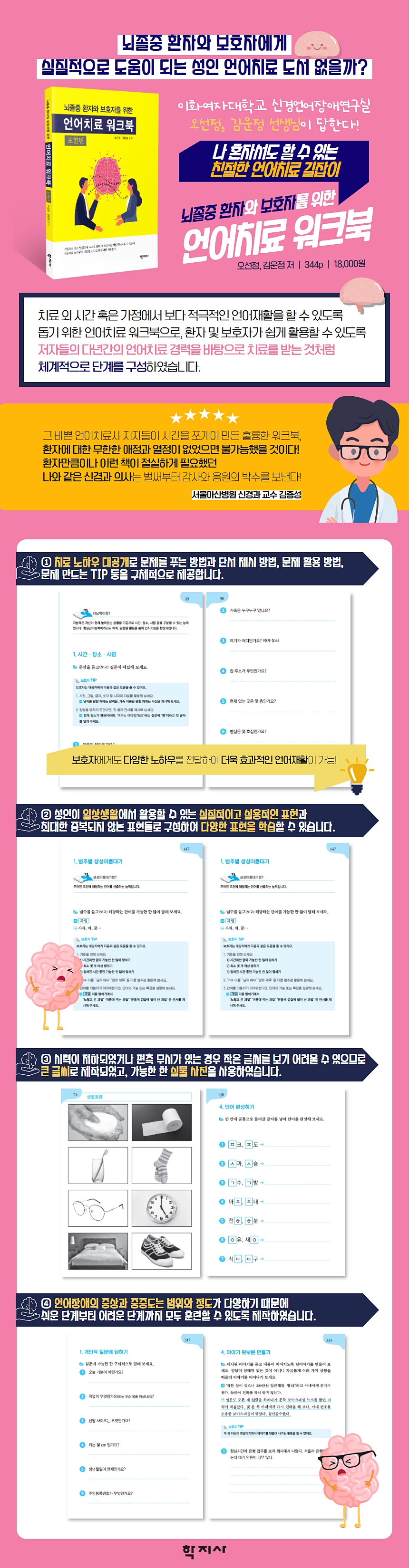
This book was created with the concept of a 'friendly language therapy guide' to help patients engage in more active language rehabilitation outside of treatment or at home.
To ensure ease of use for patients and their caregivers, we have taken into consideration the following points based on our many years of experience in speech therapy:
1.
Treatment know-how revealed
It provides specific tips on how to solve problems, how to present clues, how to utilize problems, and how to create problems.
By providing various know-hows not only to patients but also to their guardians, we can provide more effective language rehabilitation.
2.
A large number of questions
Provide as many questions as possible to ensure sufficient training.
3.
Consists of expressions commonly used in daily life
You can learn practical and useful expressions that adults can use in their daily lives.
4.
Composed of various expressions
You can learn a variety of expressions by composing them with as few repetitions as possible.
5.
Made in large letters
If you have impaired vision or unilateral neglect, you may have difficulty reading small letters, so we made them in large letters.
6.
Answers are provided after each activity.
You can check the answer to the question quickly and easily.
7.
Use actual photos (if possible)
We used real photographs whenever possible, as it may be difficult to perceive pictures if you have cognitive impairment or poor eyesight.
8.
Various difficulty levels
Because the symptoms and severity of language disorders vary widely, we have designed training programs that can be used for all levels, from easy to difficult.
To ensure ease of use for patients and their caregivers, we have taken into consideration the following points based on our many years of experience in speech therapy:
1.
Treatment know-how revealed
It provides specific tips on how to solve problems, how to present clues, how to utilize problems, and how to create problems.
By providing various know-hows not only to patients but also to their guardians, we can provide more effective language rehabilitation.
2.
A large number of questions
Provide as many questions as possible to ensure sufficient training.
3.
Consists of expressions commonly used in daily life
You can learn practical and useful expressions that adults can use in their daily lives.
4.
Composed of various expressions
You can learn a variety of expressions by composing them with as few repetitions as possible.
5.
Made in large letters
If you have impaired vision or unilateral neglect, you may have difficulty reading small letters, so we made them in large letters.
6.
Answers are provided after each activity.
You can check the answer to the question quickly and easily.
7.
Use actual photos (if possible)
We used real photographs whenever possible, as it may be difficult to perceive pictures if you have cognitive impairment or poor eyesight.
8.
Various difficulty levels
Because the symptoms and severity of language disorders vary widely, we have designed training programs that can be used for all levels, from easy to difficult.
GOODS SPECIFICS
- Publication date: June 30, 2021
- Format: Paperback book binding method guide
- Page count, weight, size: 344 pages | 720g | 188*257*18mm
- ISBN13: 9788999724428
- ISBN10: 8999724425
You may also like
카테고리
korean


korean

![ELLE 엘르 스페셜 에디션 A형 : 12월 [2025]](http://librairie.coreenne.fr/cdn/shop/files/b8e27a3de6c9538896439686c6b0e8fb.jpg?v=1766436872&width=3840)


