

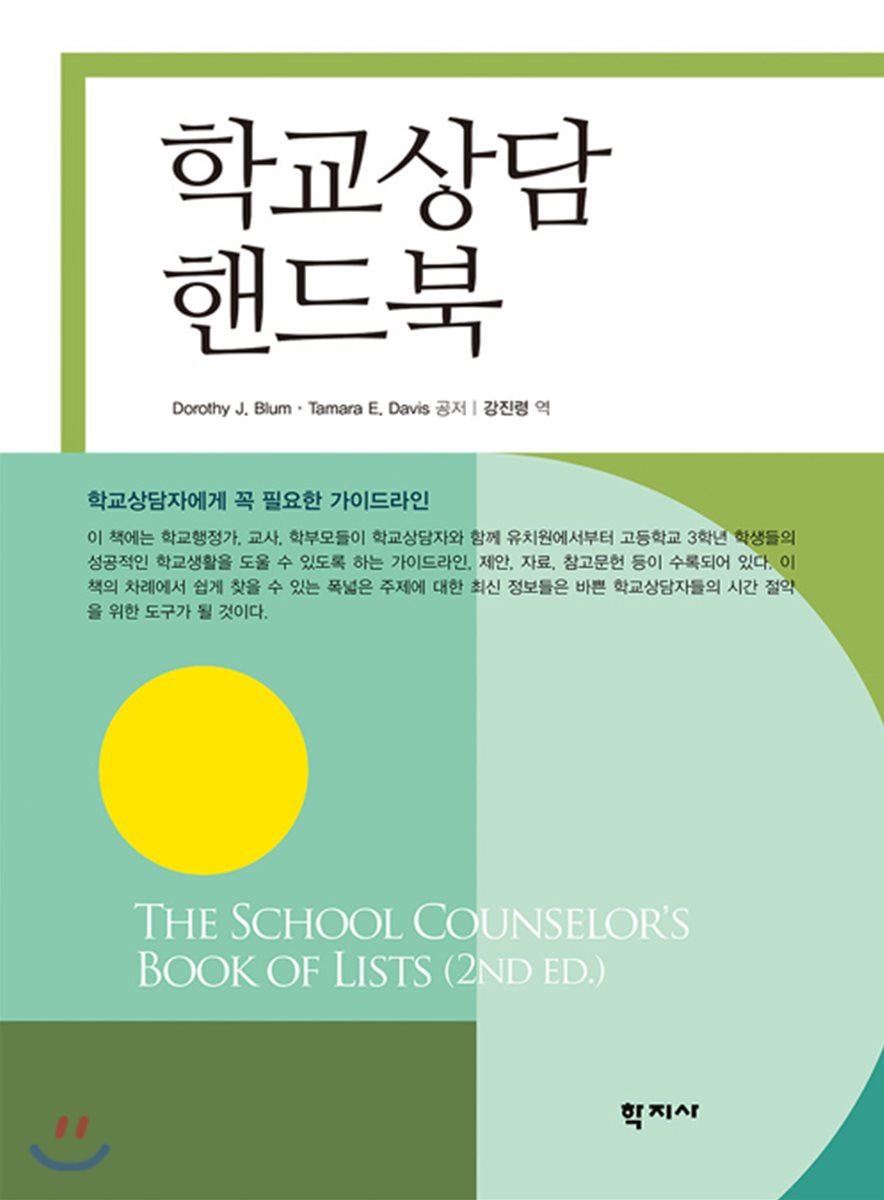
School Counseling Handbook
 |
Description
index
Translator's Preface
introduction
survey
Acknowledgements
Part 1: School Counseling Programs: The ASCA National Model
basic
1.1.
Beliefs and Philosophy of the School Counseling Program
1.2.
Components of a School Counseling Program Mission Statement
1.3. ASCA National Standards for School Counseling Programs
Delivery system
1.4.
Comprehensive School Counseling Program
1.5.
School Counseling and Life Education Curriculum
1.6.
Individual Student Plan
1.7.
Responsive service
1.8.
System support
Management system
1.9.
Components of a management system
1.10.
Management rules
1.11.
School Counseling Advisory Committee
1.12.
Using data to monitor student progress
1.13.
Action plan
1.14.
Time usage
1.15.
Schedule
Accountability
1.16.
Components of accountability
1.17.
Results Report
1.18.
School Counselor Performance Standards
1.19.
School Counseling Program Audit
ASCA National Model Topics
1.20.
advocacy
1.21.
Leadership
1.22.
cooperation
1.23.
System change
Part 2: School Counselor: Preparation, Roles, and Responsibilities
School Counselor Preparation
2.1.
Preparation, Certification, Qualification, and Licensing of School Counselor
The Role of School Counselor
2.2.
Traditional and Modified Roles of School Counselor
2.3.
American School Counselor Association Role Statement
2.4.
School counselor vs.
Life education counselor
Competent school counselor
2.5.
School Counselor Competencies
2.6.
General multicultural competencies
Ethical and Legal Counselors
2.7.
Ethical Standards for School Counseling Programs
2.8.
Confidentiality
2.9.
Ethical decision-making
2.10.
Legal Standards and Enforcement
Theoretical orientation of school counselors
2.11.
Counseling theory
2.12.
General Strategies for Student Counseling
2.13.
Adlerian therapy
2.14.
existential therapy
2.15.
Humanistic Counseling
2.16.
Gestalt therapy
2.17.
behavioral therapy
2.18.
cognitive behavioral therapy
2.19.
rational emotive behavior therapy
2.20.
reality therapy (choice theory)
2.21.
Solution-Focused Short-Term Counseling
2.22.
Integrated Counseling
Supervisor
2.23.
Supervisor of other school counselors, interns, and trainees
change agent
2.24.
School environment change agent
competent school counselor
2.25.
Skills and Characteristics of a Competent School Counselor
2.26.
Effective School Counseling: A Data Focus
Individuals and Professionals: Self-Care Strategies for School Counselors
2.27.
Professional Burnout and Stress in Schools
2.28.
Self-care of the helper
2.29.
Professional identity
Part 3: School Counseling Implementation and Programs
Personal counseling
3.1.
Personal counseling at school
3.2.
Process, skills, and techniques of personal counseling
3.3.
Problem-solving model
3.4.
Using Play in Counseling
3.5.
Effective Individual Counseling in Schools
small group counseling
3.6.
Small group counseling at school
3.7.
Benefits of small group counseling
3.8.
Group counseling topics
3.9.
Preliminary group plan
3.10.
small group counseling sessions
3.11.
Group Counseling Leadership
3.12.
Effective small group counseling
Classroom Life Education
3.13.
Overview of Classroom Life Education
3.14.
Developmentally Appropriate Classroom Life Education Lesson Topics
3.15.
Classroom Management Strategies
3.16.
Class president
Parent/Guardian Advisory
3.17.
Individual counseling for parents/guardians
3.18.
Parent/Guardian Group Advisory
3.19.
Participation of parents/guardians with difficult access
Teacher Advisory
3.20.
Faculty development and teacher self-training
3.21.
Faculty and staff meetings and team meetings
3.22.
Teacher-led individual counseling
3.23.
Teacher Advisory: Classroom Management and Discipline Skills
3.24.
Student learning style
3.25.
Parent/Guardian/Teacher/Student/Counselor Meeting
Program development and participation for the entire school
3.26.
Creating a positive environment throughout the school
3.27.
Counseling Services: School-wide responsibility coordinated by the school counselor.
3.28.
Differentiated/Diverse Personnel Composition of School Counseling Programs
3.29.
Materials for School Counseling Programs
3.30.
Violence Prevention Program
3.31.
Conflict Resolution and Peer Mediation Programs
3.32.
Peer Helper Program
3.33.
Character education program
3.34.
Tutoring and mentoring programs in schools and communities
3.35.
Coordination activities for school counseling program volunteers
3.36.
Child Research Team or Local Eligibility Review Committee
3.37.
Crisis or Major Incident Response Team
Part 4: Academic Counseling at School
Academic goals
4.1.
Academic Goals for All Students
4.2.
Response to intervention
4.3.
Standardized and/or high-stakes testing
Academic development of all students
4.4.
Goal setting skills
4.5.
study skills
4.6.
Test preparation and test-taking skills
4.7.
Time management skills
4.8.
Stress management
4.9.
Choosing subjects for future opportunities
4.10.
Exploring Postsecondary Education
4.11.
College application
4.12.
College Application Essay
4.13.
University Recommendation
4.14.
Choosing a University
4.15.
Financial aid
4.16.
Preparing for college
Academic Counseling
4.17.
Counseling for students with academic problems
4.18.
Collaboration with teachers of students with academic problems
4.19.
Counseling students with learning or physical problems
4.20.
Working with teachers of students with learning or physical challenges
4.21.
Counseling for students with special needs
4.22.
Counseling English as a Second Language Users and English Learners
4.23.
Counseling Students with Attention Deficit Hyperactivity Disorder
4.24.
Counseling Students with Obsessive-Compulsive Disorder
4.25.
Counseling Students with Tourette Syndrome
4.26.
Counseling for students at risk of dropping out
4.27.
Counseling Students Afraid of Failure
4.28.
Counseling Students with Fear or Avoidance of Success
4.29.
Counseling Perfectionist Students
4.30.
Gifted Student Counseling
4.31.
Counseling for students who procrastinate
4.32.
Helping Students Learn from Failure
4.33.
Helping students overcome barriers to success
Part 5: Career Counseling at School
Career Development Theory and Evaluation
5.1.
Career development theory
5.2.
Career evaluation
National Career Competencies and Skills for Students
5.3.
National Career Capacity and Technology
5.4.
Career goals for all students
Career counseling for all students
5.5.
Career development program planning
5.6.
Elementary school students' career development
5.7.
Middle school student career development
5.8.
High school student career development
5.9.
Implementation of career development program
5.10.
Career and College Center
5.11.
Post-secondary plans (1st year of middle school to 3rd year of high school)
5.12.
Academic or career portfolio
5.13.
Career values
5.14.
Career Decision-Making Skills
5.15.
Job Interview Skills
5.16.
marketable technology
5.17.
Career stereotypes, prejudice, and discrimination
5.18.
Structured job experience
5.19.
Career Information Interview
5.20.
Career exploration and life planning
5.21.
Career counseling
5.22.
Career counseling for minority and underprivileged students
5.23.
Career Counseling for Students with Special Needs
Part 6: Personal/Social Counseling in Schools: Student Development and Life Skills
Personal/Social Development
6.1.
Personal/Social Goals for All Students
6.2.
The needs of all students
6.3.
Issues related to child and adolescent development
6.4.
Students' fears or stressors
6.5.
Ethnic diversity of students
6.6.
cultural diversity
6.7.
Culturally Responsive School Counselor
6.8.
students with special needs
6.9.
at-risk students
6.10.
family relationships
Personal/Social Counseling: Life Skills for All Students
6.11.
Life skills
6.12.
Life Skills Education Program
6.13.
communication skills
6.14.
Student Behaviors That Affect Communication
6.15.
nonverbal communication
6.16.
Recognize verbal invitations that facilitate communication
6.17.
Recognize language that degrades others
6.18.
Me message
6.19.
Comparing people's ways of expressing themselves
6.20.
Active listening skills
6.21.
Helping students understand their own and others' emotions
6.22.
Emotion vocabulary
6.23.
Assertiveness skills
6.24.
Peer pressure rejection techniques
6.25.
Teaching students how to respect others
6.26.
Developing Students' Self-Confidence
6.27.
Anger management skills
6.28.
Conflict management and resolution skills
6.29.
Coping and Resilience Skills
6.30.
Relationship skills
6.31.
social skills
6.32.
Stress Management Techniques
Part 7: Personal/Social Counseling in Schools: Prevention and Effective Intervention
7.1.
Programs to promote student safety
7.2.
Information about students' rights to safety
7.3.
child abuse
7.4.
physical neglect
7.5.
Child Abuse and Neglect: School Counselor Intervention
7.6.
Acquaintance sexual assault and date sexual assault
7.7.
Student bullying and harassment
7.8.
School administrators and teachers' measures to prevent and combat student bullying and harassment.
7.9.
School counselors' actions to prevent and combat bullying and harassment
7.10.
sexual harassment
7.11.
cyberbullying
7.12.
gender equality
7.13.
eating disorders
7.14.
Bad circle
7.15.
substance abuse
7.16. HIV/AIDS
7.17.
Childhood and Adolescent Depression
7.18.
Dealing with Grief and Loss
7.19.
Death of a loved one
7.20.
Death of a classmate
7.21.
tragic event or national disaster
7.22.
student suicide
7.23.
sexual minority youth
7.24.
Self-harm and self-mutilation
7.25.
Unauthorized absence
7.26.
School phobia and school refusal
7.27.
teenage pregnancy
7.28.
students without support
7.29.
High-Risk Student Behavior
7.30.
Parental separation and divorce
7.31.
children of alcoholics
7.32.
Students with parents/guardians deployed in the military
7.33.
Meeting the mental health needs of all students
Search
introduction
survey
Acknowledgements
Part 1: School Counseling Programs: The ASCA National Model
basic
1.1.
Beliefs and Philosophy of the School Counseling Program
1.2.
Components of a School Counseling Program Mission Statement
1.3. ASCA National Standards for School Counseling Programs
Delivery system
1.4.
Comprehensive School Counseling Program
1.5.
School Counseling and Life Education Curriculum
1.6.
Individual Student Plan
1.7.
Responsive service
1.8.
System support
Management system
1.9.
Components of a management system
1.10.
Management rules
1.11.
School Counseling Advisory Committee
1.12.
Using data to monitor student progress
1.13.
Action plan
1.14.
Time usage
1.15.
Schedule
Accountability
1.16.
Components of accountability
1.17.
Results Report
1.18.
School Counselor Performance Standards
1.19.
School Counseling Program Audit
ASCA National Model Topics
1.20.
advocacy
1.21.
Leadership
1.22.
cooperation
1.23.
System change
Part 2: School Counselor: Preparation, Roles, and Responsibilities
School Counselor Preparation
2.1.
Preparation, Certification, Qualification, and Licensing of School Counselor
The Role of School Counselor
2.2.
Traditional and Modified Roles of School Counselor
2.3.
American School Counselor Association Role Statement
2.4.
School counselor vs.
Life education counselor
Competent school counselor
2.5.
School Counselor Competencies
2.6.
General multicultural competencies
Ethical and Legal Counselors
2.7.
Ethical Standards for School Counseling Programs
2.8.
Confidentiality
2.9.
Ethical decision-making
2.10.
Legal Standards and Enforcement
Theoretical orientation of school counselors
2.11.
Counseling theory
2.12.
General Strategies for Student Counseling
2.13.
Adlerian therapy
2.14.
existential therapy
2.15.
Humanistic Counseling
2.16.
Gestalt therapy
2.17.
behavioral therapy
2.18.
cognitive behavioral therapy
2.19.
rational emotive behavior therapy
2.20.
reality therapy (choice theory)
2.21.
Solution-Focused Short-Term Counseling
2.22.
Integrated Counseling
Supervisor
2.23.
Supervisor of other school counselors, interns, and trainees
change agent
2.24.
School environment change agent
competent school counselor
2.25.
Skills and Characteristics of a Competent School Counselor
2.26.
Effective School Counseling: A Data Focus
Individuals and Professionals: Self-Care Strategies for School Counselors
2.27.
Professional Burnout and Stress in Schools
2.28.
Self-care of the helper
2.29.
Professional identity
Part 3: School Counseling Implementation and Programs
Personal counseling
3.1.
Personal counseling at school
3.2.
Process, skills, and techniques of personal counseling
3.3.
Problem-solving model
3.4.
Using Play in Counseling
3.5.
Effective Individual Counseling in Schools
small group counseling
3.6.
Small group counseling at school
3.7.
Benefits of small group counseling
3.8.
Group counseling topics
3.9.
Preliminary group plan
3.10.
small group counseling sessions
3.11.
Group Counseling Leadership
3.12.
Effective small group counseling
Classroom Life Education
3.13.
Overview of Classroom Life Education
3.14.
Developmentally Appropriate Classroom Life Education Lesson Topics
3.15.
Classroom Management Strategies
3.16.
Class president
Parent/Guardian Advisory
3.17.
Individual counseling for parents/guardians
3.18.
Parent/Guardian Group Advisory
3.19.
Participation of parents/guardians with difficult access
Teacher Advisory
3.20.
Faculty development and teacher self-training
3.21.
Faculty and staff meetings and team meetings
3.22.
Teacher-led individual counseling
3.23.
Teacher Advisory: Classroom Management and Discipline Skills
3.24.
Student learning style
3.25.
Parent/Guardian/Teacher/Student/Counselor Meeting
Program development and participation for the entire school
3.26.
Creating a positive environment throughout the school
3.27.
Counseling Services: School-wide responsibility coordinated by the school counselor.
3.28.
Differentiated/Diverse Personnel Composition of School Counseling Programs
3.29.
Materials for School Counseling Programs
3.30.
Violence Prevention Program
3.31.
Conflict Resolution and Peer Mediation Programs
3.32.
Peer Helper Program
3.33.
Character education program
3.34.
Tutoring and mentoring programs in schools and communities
3.35.
Coordination activities for school counseling program volunteers
3.36.
Child Research Team or Local Eligibility Review Committee
3.37.
Crisis or Major Incident Response Team
Part 4: Academic Counseling at School
Academic goals
4.1.
Academic Goals for All Students
4.2.
Response to intervention
4.3.
Standardized and/or high-stakes testing
Academic development of all students
4.4.
Goal setting skills
4.5.
study skills
4.6.
Test preparation and test-taking skills
4.7.
Time management skills
4.8.
Stress management
4.9.
Choosing subjects for future opportunities
4.10.
Exploring Postsecondary Education
4.11.
College application
4.12.
College Application Essay
4.13.
University Recommendation
4.14.
Choosing a University
4.15.
Financial aid
4.16.
Preparing for college
Academic Counseling
4.17.
Counseling for students with academic problems
4.18.
Collaboration with teachers of students with academic problems
4.19.
Counseling students with learning or physical problems
4.20.
Working with teachers of students with learning or physical challenges
4.21.
Counseling for students with special needs
4.22.
Counseling English as a Second Language Users and English Learners
4.23.
Counseling Students with Attention Deficit Hyperactivity Disorder
4.24.
Counseling Students with Obsessive-Compulsive Disorder
4.25.
Counseling Students with Tourette Syndrome
4.26.
Counseling for students at risk of dropping out
4.27.
Counseling Students Afraid of Failure
4.28.
Counseling Students with Fear or Avoidance of Success
4.29.
Counseling Perfectionist Students
4.30.
Gifted Student Counseling
4.31.
Counseling for students who procrastinate
4.32.
Helping Students Learn from Failure
4.33.
Helping students overcome barriers to success
Part 5: Career Counseling at School
Career Development Theory and Evaluation
5.1.
Career development theory
5.2.
Career evaluation
National Career Competencies and Skills for Students
5.3.
National Career Capacity and Technology
5.4.
Career goals for all students
Career counseling for all students
5.5.
Career development program planning
5.6.
Elementary school students' career development
5.7.
Middle school student career development
5.8.
High school student career development
5.9.
Implementation of career development program
5.10.
Career and College Center
5.11.
Post-secondary plans (1st year of middle school to 3rd year of high school)
5.12.
Academic or career portfolio
5.13.
Career values
5.14.
Career Decision-Making Skills
5.15.
Job Interview Skills
5.16.
marketable technology
5.17.
Career stereotypes, prejudice, and discrimination
5.18.
Structured job experience
5.19.
Career Information Interview
5.20.
Career exploration and life planning
5.21.
Career counseling
5.22.
Career counseling for minority and underprivileged students
5.23.
Career Counseling for Students with Special Needs
Part 6: Personal/Social Counseling in Schools: Student Development and Life Skills
Personal/Social Development
6.1.
Personal/Social Goals for All Students
6.2.
The needs of all students
6.3.
Issues related to child and adolescent development
6.4.
Students' fears or stressors
6.5.
Ethnic diversity of students
6.6.
cultural diversity
6.7.
Culturally Responsive School Counselor
6.8.
students with special needs
6.9.
at-risk students
6.10.
family relationships
Personal/Social Counseling: Life Skills for All Students
6.11.
Life skills
6.12.
Life Skills Education Program
6.13.
communication skills
6.14.
Student Behaviors That Affect Communication
6.15.
nonverbal communication
6.16.
Recognize verbal invitations that facilitate communication
6.17.
Recognize language that degrades others
6.18.
Me message
6.19.
Comparing people's ways of expressing themselves
6.20.
Active listening skills
6.21.
Helping students understand their own and others' emotions
6.22.
Emotion vocabulary
6.23.
Assertiveness skills
6.24.
Peer pressure rejection techniques
6.25.
Teaching students how to respect others
6.26.
Developing Students' Self-Confidence
6.27.
Anger management skills
6.28.
Conflict management and resolution skills
6.29.
Coping and Resilience Skills
6.30.
Relationship skills
6.31.
social skills
6.32.
Stress Management Techniques
Part 7: Personal/Social Counseling in Schools: Prevention and Effective Intervention
7.1.
Programs to promote student safety
7.2.
Information about students' rights to safety
7.3.
child abuse
7.4.
physical neglect
7.5.
Child Abuse and Neglect: School Counselor Intervention
7.6.
Acquaintance sexual assault and date sexual assault
7.7.
Student bullying and harassment
7.8.
School administrators and teachers' measures to prevent and combat student bullying and harassment.
7.9.
School counselors' actions to prevent and combat bullying and harassment
7.10.
sexual harassment
7.11.
cyberbullying
7.12.
gender equality
7.13.
eating disorders
7.14.
Bad circle
7.15.
substance abuse
7.16. HIV/AIDS
7.17.
Childhood and Adolescent Depression
7.18.
Dealing with Grief and Loss
7.19.
Death of a loved one
7.20.
Death of a classmate
7.21.
tragic event or national disaster
7.22.
student suicide
7.23.
sexual minority youth
7.24.
Self-harm and self-mutilation
7.25.
Unauthorized absence
7.26.
School phobia and school refusal
7.27.
teenage pregnancy
7.28.
students without support
7.29.
High-Risk Student Behavior
7.30.
Parental separation and divorce
7.31.
children of alcoholics
7.32.
Students with parents/guardians deployed in the military
7.33.
Meeting the mental health needs of all students
Search
GOODS SPECIFICS
- Date of publication: August 30, 2017
- Page count, weight, size: 509 pages | 1,046g | 188*257*35mm
- ISBN13: 9788999713521
- ISBN10: 8999713520
You may also like
카테고리
korean


korean

![GQ KOREA Mark (Monthly): December [2025]](http://librairie.coreenne.fr/cdn/shop/files/8ef265dbbfbf186523ed75ba7319009d.jpg?v=1765340328&width=3840)


