

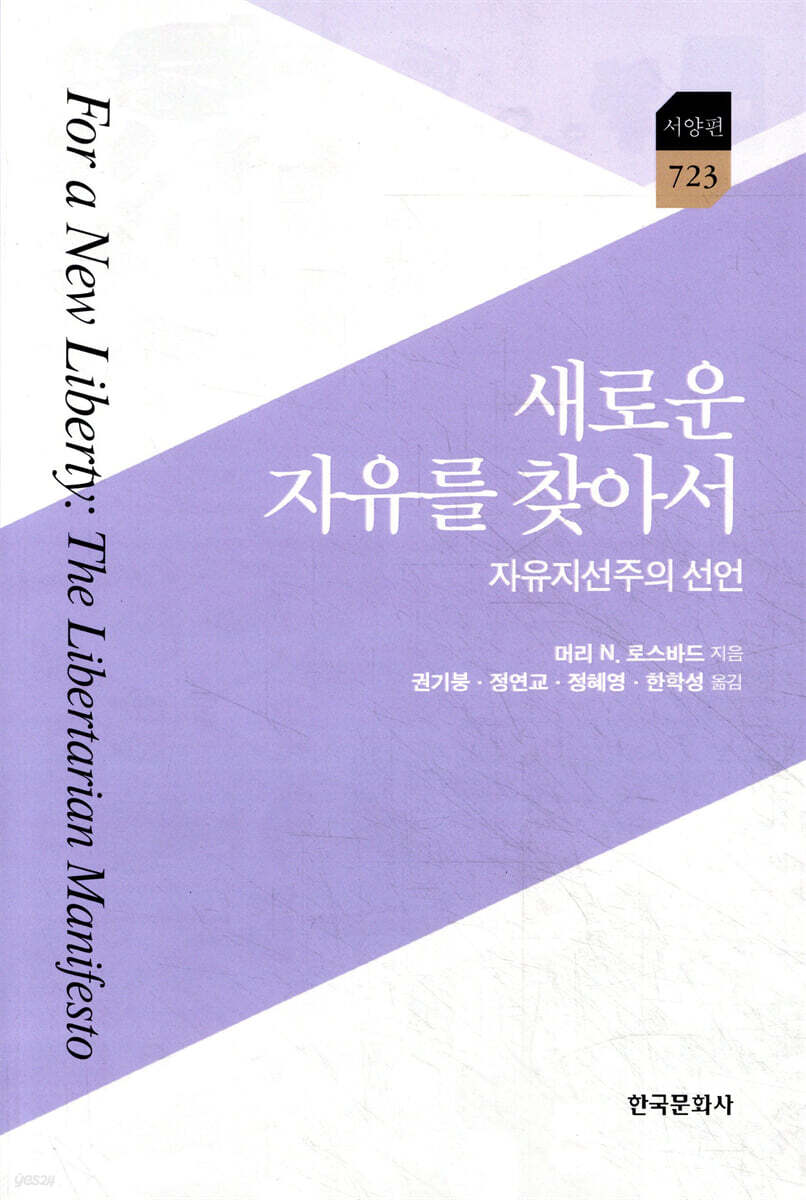
In search of new freedom
 |
Description
Book Introduction
This book is an introduction to libertarianism, and is written from the perspective of “pro-market anarchism” within libertarianism.
The author, who is called a champion of modern libertarianism by the liberal camp, faithfully explains the principles of libertarianism while showing their implications in a straightforward manner.
And throughout the book, one axiom is repeatedly emphasized: the axiom of non-infringement: “No one may infringe upon another person or upon what he owns.”
The author, who is called a champion of modern libertarianism by the liberal camp, faithfully explains the principles of libertarianism while showing their implications in a straightforward manner.
And throughout the book, one axiom is repeatedly emphasized: the axiom of non-infringement: “No one may infringe upon another person or upon what he owns.”
Into the book
There are many different libertarian ideologies in the world today, but Rothbardianism, even when not mentioned by name, has maintained a central position and been a focus of debate because of its intellectual weight, its core ideas, its conscience, its strategy, and its moral core.
That's because Murray Rothbard is the founder of modern libertarianism.
The modern libertarianism he advocated was a political-ideological system that proposed an immediate departure from the ideological frameworks of the left and the right, as well as from their centralized plans for the exercise of state power.
Libertarianism is a radical alternative ideology that argues that state power is dysfunctional and immoral.
Rothbard is 'Mr. Libertarian'.
He was called a Libertarian and could be called a 'living enemy of the government'.
He still is.
In fact, he thoroughly studied the ideas of many senior thinkers, especially the classical liberal tradition, the Austrian school of liberal economics, the American anti-war tradition, and the natural law tradition, and incorporated them into his own thinking.
But it was Rothbard who put all these pieces together into one unified system.
His system may seem unrealistic at first, but once he defines and explains it, it becomes something our society must accept.
The individual pieces of his system are simple (self-ownership, strict property rights, free markets, anti-government in almost every way imaginable), but the implications are earth-shattering.
Once readers have encountered the full picture of libertarianism (Rothbard's For a New Liberty has been their primary source of contact for more than a quarter of a century), they are unlikely to forget it.
It becomes an indispensable lens that allows us to see real-world events with the greatest clarity.
More than any other book, this one explains why Rothbard's reputation has grown over time (his influence has grown significantly since his death) and why Rothbardism has so many enemies on the left, right, and centrist alike.
In short, Rothbard's successful scientific quest for freedom is inspiring in that it offers hope for the creation of a world that is as completely free as it is incapable of error.
Its logical and moral consistency, coupled with its empirically grounded persuasiveness, poses a threat to any intellectual vision that seeks to use the state to remake the world according to a pre-arranged plan.
It also gives readers a deeply hopeful vision of how the world could be different.
Rothbard began writing this book after Tom Mandel, then an editor at Macmillan, contacted him after seeing his article in the New York Times' opinion section in the spring of 1971.
It was the only time Rothbard had been commissioned by a commercial publisher.
Looking at the original manuscript, which was very consistent in typing and almost perfect in its first draft, you can see how effortlessly and joyfully he worked.
The manuscript looks sleek, ruthless, and powerful.
A look at the historical context reveals something that is easily overlooked.
Modern libertarianism, although anti-leftist (as those terms are generally understood) and anti-socialist, did not arise as a reaction against socialism or leftism.
Rather, in the American historical context, libertarianism arose as a counter to conservatism's tendency toward statism and its selective celebration of conservative-style national planning.
American conservatives may not praise the welfare state or excessive economic regulation, but they do have a positive view of power exercised in the name of nationalism, war, "pro-family" policies, and the infringement of individual liberty and privacy.
Lyndon B. Johnson
In American history since President Johnson, Republican presidents have been more responsible for the serious expansion of executive and judicial power than Democratic presidents.
The inspiration for Rothbard's political and economic system was his desire to defend pure freedom against the corruption and compromise of conservatism that continued from President Nixon through President Reagan and President Bush.
It's also surprising how little caution Rothbard shows when making his case.
Other intellectuals who are on the receiving end of such provocations tend to water down the argument so as not to offend.
For example, why do you advocate for the complete abolition of the state or anarchism when a more moderate argument for limiting government power might attract more people? Why do you vehemently condemn American imperialism, limiting your audience to anti-Soviet conservatives who might otherwise embrace free-market sentiments? Why do you go so specific about privatizing courts, roads, and waterways, even though it risks alienating people? Why do you tackle thorny issues like regulating individual consumption and morality with uncomfortably consistent treatment, when leaving it alone might attract a wider audience? Why do you go so specific about monetary issues and central banking, when a more moderate argument for free enterprise would have pleased countless Chamber of Commerce-type conservatives?
But it was not Rothbard's style to refine and compromise to suit the times and readers.
He knew that this was a once-in-a-lifetime opportunity to fully display libertarianism in all its glory, and he did not want to miss it.
So here we read:
We encounter arguments not just for reducing government but for eliminating it entirely; not just for granting property rights but for leaving even contract enforcement to the market; and not just for reducing welfare but for eliminating the entire welfare-war state.
While other attempts to promote libertarianism, both before and after the publication of this book, have generally called for transitional and stopgap measures, and have shown a willingness to make concessions to statists whenever possible, we do not see any of this in Rothbard.
Without him, initiatives like school vouchers and the privatization of government programs would not have existed.
Instead, he presents a complete and comprehensive vision of what freedom can look like, and he sees it through to completion.
For that reason, while numerous similar attempts to write a libertarian manifesto have failed to stand the test of time, Rothbard's book remains in demand.
Likewise, while there have been many books on libertarianism in the meantime, most of them deal with only one aspect of philosophy, one aspect of politics, one aspect of economics, or one aspect of history.
Books that covered all these topics together were often collections of works by several authors.
Only Rothbard could master all these disciplines and write a unified manifesto that is absolutely irreplaceable.
But his approach was largely self-effacing.
He always referred to other authors or intellectuals of the past or his contemporaries.
Not only that, but writing this kind of introduction can also give readers an easier path into a difficult book, but that's not the case here.
Rothbard never explains things to his readers in an easy-to-understand way, but he always explains things clearly.
Rothbard put it in his own words.
I want to free the reader from the task of listing my favorite parts of the book or speculating about which sentences Rothbard might have clarified if he had the opportunity to produce a revised edition.
Readers will sense his energy and passion on each page, the logic of his arguments irresistibly compelling, and the intellectual fire that inspired this work burns as brightly today as ever.
This book is still considered 'dangerous'.
The reason is that once you've encountered Rothbardism, no other book on political science, economics, or sociology will ever be read the same way again.
What was once a commercial phenomenon has now become a truly classic statement that can be expected to be read for generations to come.
Llewellyn H. Rockwell Jr.
Rockwell, Jr.)
Auburn, Alabama
July 6, 2005
That's because Murray Rothbard is the founder of modern libertarianism.
The modern libertarianism he advocated was a political-ideological system that proposed an immediate departure from the ideological frameworks of the left and the right, as well as from their centralized plans for the exercise of state power.
Libertarianism is a radical alternative ideology that argues that state power is dysfunctional and immoral.
Rothbard is 'Mr. Libertarian'.
He was called a Libertarian and could be called a 'living enemy of the government'.
He still is.
In fact, he thoroughly studied the ideas of many senior thinkers, especially the classical liberal tradition, the Austrian school of liberal economics, the American anti-war tradition, and the natural law tradition, and incorporated them into his own thinking.
But it was Rothbard who put all these pieces together into one unified system.
His system may seem unrealistic at first, but once he defines and explains it, it becomes something our society must accept.
The individual pieces of his system are simple (self-ownership, strict property rights, free markets, anti-government in almost every way imaginable), but the implications are earth-shattering.
Once readers have encountered the full picture of libertarianism (Rothbard's For a New Liberty has been their primary source of contact for more than a quarter of a century), they are unlikely to forget it.
It becomes an indispensable lens that allows us to see real-world events with the greatest clarity.
More than any other book, this one explains why Rothbard's reputation has grown over time (his influence has grown significantly since his death) and why Rothbardism has so many enemies on the left, right, and centrist alike.
In short, Rothbard's successful scientific quest for freedom is inspiring in that it offers hope for the creation of a world that is as completely free as it is incapable of error.
Its logical and moral consistency, coupled with its empirically grounded persuasiveness, poses a threat to any intellectual vision that seeks to use the state to remake the world according to a pre-arranged plan.
It also gives readers a deeply hopeful vision of how the world could be different.
Rothbard began writing this book after Tom Mandel, then an editor at Macmillan, contacted him after seeing his article in the New York Times' opinion section in the spring of 1971.
It was the only time Rothbard had been commissioned by a commercial publisher.
Looking at the original manuscript, which was very consistent in typing and almost perfect in its first draft, you can see how effortlessly and joyfully he worked.
The manuscript looks sleek, ruthless, and powerful.
A look at the historical context reveals something that is easily overlooked.
Modern libertarianism, although anti-leftist (as those terms are generally understood) and anti-socialist, did not arise as a reaction against socialism or leftism.
Rather, in the American historical context, libertarianism arose as a counter to conservatism's tendency toward statism and its selective celebration of conservative-style national planning.
American conservatives may not praise the welfare state or excessive economic regulation, but they do have a positive view of power exercised in the name of nationalism, war, "pro-family" policies, and the infringement of individual liberty and privacy.
Lyndon B. Johnson
In American history since President Johnson, Republican presidents have been more responsible for the serious expansion of executive and judicial power than Democratic presidents.
The inspiration for Rothbard's political and economic system was his desire to defend pure freedom against the corruption and compromise of conservatism that continued from President Nixon through President Reagan and President Bush.
It's also surprising how little caution Rothbard shows when making his case.
Other intellectuals who are on the receiving end of such provocations tend to water down the argument so as not to offend.
For example, why do you advocate for the complete abolition of the state or anarchism when a more moderate argument for limiting government power might attract more people? Why do you vehemently condemn American imperialism, limiting your audience to anti-Soviet conservatives who might otherwise embrace free-market sentiments? Why do you go so specific about privatizing courts, roads, and waterways, even though it risks alienating people? Why do you tackle thorny issues like regulating individual consumption and morality with uncomfortably consistent treatment, when leaving it alone might attract a wider audience? Why do you go so specific about monetary issues and central banking, when a more moderate argument for free enterprise would have pleased countless Chamber of Commerce-type conservatives?
But it was not Rothbard's style to refine and compromise to suit the times and readers.
He knew that this was a once-in-a-lifetime opportunity to fully display libertarianism in all its glory, and he did not want to miss it.
So here we read:
We encounter arguments not just for reducing government but for eliminating it entirely; not just for granting property rights but for leaving even contract enforcement to the market; and not just for reducing welfare but for eliminating the entire welfare-war state.
While other attempts to promote libertarianism, both before and after the publication of this book, have generally called for transitional and stopgap measures, and have shown a willingness to make concessions to statists whenever possible, we do not see any of this in Rothbard.
Without him, initiatives like school vouchers and the privatization of government programs would not have existed.
Instead, he presents a complete and comprehensive vision of what freedom can look like, and he sees it through to completion.
For that reason, while numerous similar attempts to write a libertarian manifesto have failed to stand the test of time, Rothbard's book remains in demand.
Likewise, while there have been many books on libertarianism in the meantime, most of them deal with only one aspect of philosophy, one aspect of politics, one aspect of economics, or one aspect of history.
Books that covered all these topics together were often collections of works by several authors.
Only Rothbard could master all these disciplines and write a unified manifesto that is absolutely irreplaceable.
But his approach was largely self-effacing.
He always referred to other authors or intellectuals of the past or his contemporaries.
Not only that, but writing this kind of introduction can also give readers an easier path into a difficult book, but that's not the case here.
Rothbard never explains things to his readers in an easy-to-understand way, but he always explains things clearly.
Rothbard put it in his own words.
I want to free the reader from the task of listing my favorite parts of the book or speculating about which sentences Rothbard might have clarified if he had the opportunity to produce a revised edition.
Readers will sense his energy and passion on each page, the logic of his arguments irresistibly compelling, and the intellectual fire that inspired this work burns as brightly today as ever.
This book is still considered 'dangerous'.
The reason is that once you've encountered Rothbardism, no other book on political science, economics, or sociology will ever be read the same way again.
What was once a commercial phenomenon has now become a truly classic statement that can be expected to be read for generations to come.
Llewellyn H. Rockwell Jr.
Rockwell, Jr.)
Auburn, Alabama
July 6, 2005
---From the text
Publisher's Review
What kind of system does the political community of the Republic of Korea strive for? Is it a statist welfare system or a liberal democratic market economy?
“No one can infringe upon another person or what he owns.”
“Freedom will triumph, and as time goes on, there will be no other alternative.”
Murray Rothbard's classic, The Libertarian Manifesto
Libertarianism is a political and social philosophy that seeks to maximize individual freedom and fundamental rights, and argues that state power cannot be free from corruption and inefficiency.
This book is an introductory text written by author Murray Rothbard to widely publicize the history, characteristics, and legitimacy of libertarianism, and is written from the perspective of “pro-market anarchism” within libertarianism.
The author faithfully explains the libertarian principle while showing its implications directly, and repeatedly emphasizes one self-evident axiom throughout the book: the axiom of non-infringement: “No one may infringe upon another person or what he owns.”
In this book, the author draws on natural law thought, classical liberalism, the liberal economics tradition, and traditional American anti-war sentiment to propose a unified theory based on the absolute value of freedom, called the "science of liberty."
He proposed specific strategies and alternatives to realize a libertarian society by breaking away from the ideological framework of the left and right and uniting all social fields, including politics, society, economy, education, and environmental protection, into a unified system, and called the implementation plan the "Declaration of Libertarianism."
In this respect, the liberal camp calls Rothbard the champion of modern libertarianism.
“No one can infringe upon another person or what he owns.”
“Freedom will triumph, and as time goes on, there will be no other alternative.”
Murray Rothbard's classic, The Libertarian Manifesto
Libertarianism is a political and social philosophy that seeks to maximize individual freedom and fundamental rights, and argues that state power cannot be free from corruption and inefficiency.
This book is an introductory text written by author Murray Rothbard to widely publicize the history, characteristics, and legitimacy of libertarianism, and is written from the perspective of “pro-market anarchism” within libertarianism.
The author faithfully explains the libertarian principle while showing its implications directly, and repeatedly emphasizes one self-evident axiom throughout the book: the axiom of non-infringement: “No one may infringe upon another person or what he owns.”
In this book, the author draws on natural law thought, classical liberalism, the liberal economics tradition, and traditional American anti-war sentiment to propose a unified theory based on the absolute value of freedom, called the "science of liberty."
He proposed specific strategies and alternatives to realize a libertarian society by breaking away from the ideological framework of the left and right and uniting all social fields, including politics, society, economy, education, and environmental protection, into a unified system, and called the implementation plan the "Declaration of Libertarianism."
In this respect, the liberal camp calls Rothbard the champion of modern libertarianism.
GOODS SPECIFICS
- Date of publication: December 10, 2013
- Format: Hardcover book binding method guide
- Page count, weight, size: 570 pages | 932g | 153*225*35mm
- ISBN13: 9788968170782
- ISBN10: 8968170789
You may also like
카테고리
korean


korean

![GQ KOREA Mark (Monthly): December [2025]](http://librairie.coreenne.fr/cdn/shop/files/8ef265dbbfbf186523ed75ba7319009d.jpg?v=1765340328&width=3840)


