

cultural anthropology
 |
Description
Book Introduction
Over the past 50 years, cultural anthropology in Korea has grown significantly.
The number of cultural anthropologists increased, and numerous university anthropology departments and research institutes were established.
Even at universities without anthropology departments, most offer anthropology or cultural anthropology courses as liberal arts subjects, which is gradually increasing interest and awareness of anthropology among college students and the general public across the country.
Research in the field of anthropology has improved both quantitatively and qualitatively.
There are dozens of books and translations introducing anthropology in Korean.
This book attempts to introduce a perspective that helps us understand the characteristics of Korean society and culture, along with an explanation of the universality and diversity of culture.
Even when dealing with simple and uncivilized societies or traditional cultures, they were linked to a perspective on cultural phenomena and social problems in modern society.
And it is not simply a transfer of knowledge, but an introduction to anthropological thinking.
It avoids encyclopedic instructions and lists of theories and sticks to the basic elements that anyone beginning to study anthropology should have.
The number of cultural anthropologists increased, and numerous university anthropology departments and research institutes were established.
Even at universities without anthropology departments, most offer anthropology or cultural anthropology courses as liberal arts subjects, which is gradually increasing interest and awareness of anthropology among college students and the general public across the country.
Research in the field of anthropology has improved both quantitatively and qualitatively.
There are dozens of books and translations introducing anthropology in Korean.
This book attempts to introduce a perspective that helps us understand the characteristics of Korean society and culture, along with an explanation of the universality and diversity of culture.
Even when dealing with simple and uncivilized societies or traditional cultures, they were linked to a perspective on cultural phenomena and social problems in modern society.
And it is not simply a transfer of knowledge, but an introduction to anthropological thinking.
It avoids encyclopedic instructions and lists of theories and sticks to the basic elements that anyone beginning to study anthropology should have.
index
In the revised edition v
Preface to the First Edition viii
Chapter 1: Overview of Cultural Anthropology
1.
General characteristics of anthropology
1) The discipline of anthropology
2) Fields and research methods of anthropology
2.
Research tasks and social contributions of cultural anthropology
1) Central tasks of cultural anthropology
2) Cultural anthropology and modern society
3) Major and career path in cultural anthropology
3.
Methods of cultural anthropology
1) Cultural anthropology perspective
2) Field investigation and data collection
3) Data analysis and theory formation
Chapter 2: The Development of Anthropology
1.
The changing nature of anthropology
1) Freedom from intellectual illusions and prejudices
2) Primitive society and modern society
3) Study of other cultures and one's own culture
4) Study of the system and its meaning
2.
Development of anthropological theory and methods
1) 19th-century anthropology and evolutionism
2) The concept and criticism of evolutionism
3.
Early 20th Century: The Diversification of Anthropology
1) Boaz and historical particularism
2) Propagationism
3) Durkheim and the foundations of social anthropology
4.
Mid-20th century: Systematization of theory and establishment of empirical methodology
1) Malinovsky and functionalism
2) Radcliffe-Brown and structural functionalism
3) Criticism of structural functionalism
5.
Modern anthropology
1) Levi-Strauss and structuralism
2) Neo-evolutionism
3) Symbolism
4) Marxist anthropology
Chapter 3: The Concept of Culture
1.
The meaning of culture
1) Culture as a lifestyle
2) Holistic view
3) Idealistic view
2.
Attributes of culture
1) Culture is shared.
2) Culture is learned.
3) Culture is accumulated.
4) Culture is a whole
5) Culture is always changing.
3.
The composition of culture
1) Culture as a system
2) Cultural characteristics
3) Cultural complex
4) Subculture
4.
Humans and Culture
1) Cultural diversity
2) Superorganism of culture
Chapter 4: Human Evolution and Cultural Development
1.
The principles of human and cultural evolution
1) The principle of human evolution
2) Principles of cultural evolution
2.
The emergence of mankind
1) Evolution of Dryopithecus
2) Australopithecus and tool use
3.
Early humans and Paleolithic culture
1) Evolution of Homo erectus and the Early Paleolithic culture
2) Neanderthal Middle Paleolithic culture
3) Late Paleolithic culture of Homo sapiens sapiens
4.
The Neolithic Revolution and the Emergence of Ancient Civilization
1) Revolution of the Neolithic Age
2) Emergence of ancient civilizations
Chapter 5 Marriage and Family
1.
Marriage and performance
1) Regulation of sex
2) Incest prohibition
3) Definition of marriage
4) Functions of marriage
2.
Marriage regulations
1) Choice of spouse
2) Exogamy and endogamy
3) Secondary marriage
3.
Marital status
1) Monogamy
2) Polygamy
3) Polyandry
4.
family
1) The concept of family
2) Family type
3) Occupancy rate
Chapter 6 Relatives
1.
The concept and scope of kinship
1) Blood relatives and in-laws
2) Meaning of kinship
3) Scope of kinship
2.
kinship system
1) Departure rate
2) Steps and stages
3) Subordinate rate
4) Maternal rate
5) Precept rate
6) Double exit rate
3.
Organization and function of kinship groups
1) Marriage and descent groups
2) Half-legged
3) Various types of step groups
4) Function of the stage group
4.
Kinship terms
1) Hawaiian-style kinship terms
2) Irokoi-type kinship terms
3) Eskimo-type kinship terms
4) Korean kinship terms
Chapter 7 Social Organization
1.
Classification by sex
1) Division of roles by gender
2) Organization by gender
3) Gender and culture
2.
Classification by age
1) Cultural perceptions of age
2) Coming-of-age ceremonies and age groups
3) Age groups in a complex society
3.
rank, hierarchy, class
1) Grade
2) Hierarchy
3) Hierarchy
4.
caste
1) Caste and Culture
2) Modern society and caste
5.
binary differentiation
6.
combination
1) Social change and associations
2) Secret society
Chapter 8 Economic System
1.
Anthropological interest in economics
1) Economic research by anthropologists
2) Realism and Formalism Approach
2.
production
1) Meaning of production
2) Production decision
3) Factors of production
3.
Distribution and Exchange
1) Distribution and exchange within society
2) Trade between societies
4.
Use and consumption
1) Use and savings of resources
2) Use of property and wealth
3) Types and norms of consumption
Chapter 9 Politics and Law
1.
The concept of politics
1) Politics at the institutional level
2) Politics at the level of action
3) Power, authority, and inequality
2.
The many dimensions of politics
1) Political system and organization
2) Political sphere
3) Political process
3.
Political aspects of the non-political sphere
1) Kinship system and politics
2) Economy and politics
3) Religion and politics
4.
Law and Social Control
1) Concept and types of law
2) Subject to legal sanctions
3) Types of social control
4) Form and process of sanctions
Chapter 10 Culture and Religion
1.
Anthropological Approach to Religion
1) The concept of religion
2) Diversity and universality of religion
2.
The great study of religion?
1) The concept of supernatural beings
2) Sorcery, magic, and witchcraft
3) The process and content of the ceremony
4) Mediator between God and man
3.
Various Perspectives on Religious Studies
1) Evolutionary perspective
2) Psychological interpretation
3) Sociological perspective
4) Ecological approach
5) Systematization of knowledge
6) Understanding the symbolic system
4.
religious movement
1) Millennium Movement
2) Ghost Dance
3) Consciousness of the load
4) Cultural change and religion
Chapter 11 Culture and Character
1.
Determinants of personality
1) Biological factors
2) Natural environment
3) Personal unique experiences
4) Cultural factors
2.
The process of forming character
1) Parenting style
2) Culturalization
3) Education
3.
Social character and national character
1) Basic humanity
2) Most common personality
3) Social personality
4) National character
5) Ideal personality type
Chapter 12 Culture and Language
1.
Humans, Language, and Culture
1) Study of language
2) Linguistic diversity
2.
Communication transmission
1) Animal communication
2) Origin of language
3) The process of language acquisition
3.
The structure of language
1) Phonemes and phonetics
2) Morpheme, morphology, syntax
3) Transformational grammar
4.
Change and variation in language
1) Historical linguistics
2) Sociolinguistics
3) Title system
5.
Language and Thought
1) The binding force of language
2) Sapir-Whorf hypothesis
Chapter 13 Culture and Arts
1.
The concept of art
2.
The meaning of art
3.
Various fields of art
1) Body decoration
2) Conversation
3) Music
4) Dance
5) Doubles
6) Literature
7) Cultural change and art
Chapter 14 Culture and Environment
1.
Concepts of environment and ecology
1) Various aspects of the environment
2) Ecology and ecosystems
3) Comparison of ecological theories in biology and social sciences
2.
Ecological Approaches to Anthropology
1) Deterministic approach
2) Cultural-ecological approach
3) Implementation model of cultural ecology
4) Ecological comparison between rural and fishing villages
3.
Resources, population, and war
1) Technology, environment, and food resources
2) Population pressure and competition for resources
3) Population and war
4.
Challenges and Limitations of Human Ecology
1) The challenges of human ecology
2) Limitations and Prospects of Human Ecology
Chapter 15 Cultural Change
1.
Cultural Process and Cultural Change
2.
The process of cultural change
1) Invention and discovery
2) Radio waves
3) Cultural adaptation
3.
Cultural evolution
1) Early evolutionary theory
2) Single-line evolution and multi-line evolution
3) Special evolution and general evolution
4) Energy theory of cultural evolution
Chapter 16 Applied Anthropology
1.
The nature of applied anthropology
1) Background of the establishment of applied anthropology
2) Applied anthropology in the capitalist system
3) Planned changes in the socialist system
2.
Development Issues and Anthropology
1) Regional development and culture
2) Development policies and business implementation
3) Modernization and the Third World
4) Rural development and culture
3.
Health and Medical Issues and Anthropology
1) Health, Disease, Death, and Culture
2) Diagnosis and Culture
3) Classification and treatment of diseases
4) Relationship between the therapist and the patient
5) Lifestyle and endemic diseases
4.
Urban Issues and Anthropology
1) The perspective of urban anthropology
2) Urbanization and migration issues
3) Urban adaptation strategies
4) Urban poverty problem
5.
Anthropological issues related to development projects
References
Search
Preface to the First Edition viii
Chapter 1: Overview of Cultural Anthropology
1.
General characteristics of anthropology
1) The discipline of anthropology
2) Fields and research methods of anthropology
2.
Research tasks and social contributions of cultural anthropology
1) Central tasks of cultural anthropology
2) Cultural anthropology and modern society
3) Major and career path in cultural anthropology
3.
Methods of cultural anthropology
1) Cultural anthropology perspective
2) Field investigation and data collection
3) Data analysis and theory formation
Chapter 2: The Development of Anthropology
1.
The changing nature of anthropology
1) Freedom from intellectual illusions and prejudices
2) Primitive society and modern society
3) Study of other cultures and one's own culture
4) Study of the system and its meaning
2.
Development of anthropological theory and methods
1) 19th-century anthropology and evolutionism
2) The concept and criticism of evolutionism
3.
Early 20th Century: The Diversification of Anthropology
1) Boaz and historical particularism
2) Propagationism
3) Durkheim and the foundations of social anthropology
4.
Mid-20th century: Systematization of theory and establishment of empirical methodology
1) Malinovsky and functionalism
2) Radcliffe-Brown and structural functionalism
3) Criticism of structural functionalism
5.
Modern anthropology
1) Levi-Strauss and structuralism
2) Neo-evolutionism
3) Symbolism
4) Marxist anthropology
Chapter 3: The Concept of Culture
1.
The meaning of culture
1) Culture as a lifestyle
2) Holistic view
3) Idealistic view
2.
Attributes of culture
1) Culture is shared.
2) Culture is learned.
3) Culture is accumulated.
4) Culture is a whole
5) Culture is always changing.
3.
The composition of culture
1) Culture as a system
2) Cultural characteristics
3) Cultural complex
4) Subculture
4.
Humans and Culture
1) Cultural diversity
2) Superorganism of culture
Chapter 4: Human Evolution and Cultural Development
1.
The principles of human and cultural evolution
1) The principle of human evolution
2) Principles of cultural evolution
2.
The emergence of mankind
1) Evolution of Dryopithecus
2) Australopithecus and tool use
3.
Early humans and Paleolithic culture
1) Evolution of Homo erectus and the Early Paleolithic culture
2) Neanderthal Middle Paleolithic culture
3) Late Paleolithic culture of Homo sapiens sapiens
4.
The Neolithic Revolution and the Emergence of Ancient Civilization
1) Revolution of the Neolithic Age
2) Emergence of ancient civilizations
Chapter 5 Marriage and Family
1.
Marriage and performance
1) Regulation of sex
2) Incest prohibition
3) Definition of marriage
4) Functions of marriage
2.
Marriage regulations
1) Choice of spouse
2) Exogamy and endogamy
3) Secondary marriage
3.
Marital status
1) Monogamy
2) Polygamy
3) Polyandry
4.
family
1) The concept of family
2) Family type
3) Occupancy rate
Chapter 6 Relatives
1.
The concept and scope of kinship
1) Blood relatives and in-laws
2) Meaning of kinship
3) Scope of kinship
2.
kinship system
1) Departure rate
2) Steps and stages
3) Subordinate rate
4) Maternal rate
5) Precept rate
6) Double exit rate
3.
Organization and function of kinship groups
1) Marriage and descent groups
2) Half-legged
3) Various types of step groups
4) Function of the stage group
4.
Kinship terms
1) Hawaiian-style kinship terms
2) Irokoi-type kinship terms
3) Eskimo-type kinship terms
4) Korean kinship terms
Chapter 7 Social Organization
1.
Classification by sex
1) Division of roles by gender
2) Organization by gender
3) Gender and culture
2.
Classification by age
1) Cultural perceptions of age
2) Coming-of-age ceremonies and age groups
3) Age groups in a complex society
3.
rank, hierarchy, class
1) Grade
2) Hierarchy
3) Hierarchy
4.
caste
1) Caste and Culture
2) Modern society and caste
5.
binary differentiation
6.
combination
1) Social change and associations
2) Secret society
Chapter 8 Economic System
1.
Anthropological interest in economics
1) Economic research by anthropologists
2) Realism and Formalism Approach
2.
production
1) Meaning of production
2) Production decision
3) Factors of production
3.
Distribution and Exchange
1) Distribution and exchange within society
2) Trade between societies
4.
Use and consumption
1) Use and savings of resources
2) Use of property and wealth
3) Types and norms of consumption
Chapter 9 Politics and Law
1.
The concept of politics
1) Politics at the institutional level
2) Politics at the level of action
3) Power, authority, and inequality
2.
The many dimensions of politics
1) Political system and organization
2) Political sphere
3) Political process
3.
Political aspects of the non-political sphere
1) Kinship system and politics
2) Economy and politics
3) Religion and politics
4.
Law and Social Control
1) Concept and types of law
2) Subject to legal sanctions
3) Types of social control
4) Form and process of sanctions
Chapter 10 Culture and Religion
1.
Anthropological Approach to Religion
1) The concept of religion
2) Diversity and universality of religion
2.
The great study of religion?
1) The concept of supernatural beings
2) Sorcery, magic, and witchcraft
3) The process and content of the ceremony
4) Mediator between God and man
3.
Various Perspectives on Religious Studies
1) Evolutionary perspective
2) Psychological interpretation
3) Sociological perspective
4) Ecological approach
5) Systematization of knowledge
6) Understanding the symbolic system
4.
religious movement
1) Millennium Movement
2) Ghost Dance
3) Consciousness of the load
4) Cultural change and religion
Chapter 11 Culture and Character
1.
Determinants of personality
1) Biological factors
2) Natural environment
3) Personal unique experiences
4) Cultural factors
2.
The process of forming character
1) Parenting style
2) Culturalization
3) Education
3.
Social character and national character
1) Basic humanity
2) Most common personality
3) Social personality
4) National character
5) Ideal personality type
Chapter 12 Culture and Language
1.
Humans, Language, and Culture
1) Study of language
2) Linguistic diversity
2.
Communication transmission
1) Animal communication
2) Origin of language
3) The process of language acquisition
3.
The structure of language
1) Phonemes and phonetics
2) Morpheme, morphology, syntax
3) Transformational grammar
4.
Change and variation in language
1) Historical linguistics
2) Sociolinguistics
3) Title system
5.
Language and Thought
1) The binding force of language
2) Sapir-Whorf hypothesis
Chapter 13 Culture and Arts
1.
The concept of art
2.
The meaning of art
3.
Various fields of art
1) Body decoration
2) Conversation
3) Music
4) Dance
5) Doubles
6) Literature
7) Cultural change and art
Chapter 14 Culture and Environment
1.
Concepts of environment and ecology
1) Various aspects of the environment
2) Ecology and ecosystems
3) Comparison of ecological theories in biology and social sciences
2.
Ecological Approaches to Anthropology
1) Deterministic approach
2) Cultural-ecological approach
3) Implementation model of cultural ecology
4) Ecological comparison between rural and fishing villages
3.
Resources, population, and war
1) Technology, environment, and food resources
2) Population pressure and competition for resources
3) Population and war
4.
Challenges and Limitations of Human Ecology
1) The challenges of human ecology
2) Limitations and Prospects of Human Ecology
Chapter 15 Cultural Change
1.
Cultural Process and Cultural Change
2.
The process of cultural change
1) Invention and discovery
2) Radio waves
3) Cultural adaptation
3.
Cultural evolution
1) Early evolutionary theory
2) Single-line evolution and multi-line evolution
3) Special evolution and general evolution
4) Energy theory of cultural evolution
Chapter 16 Applied Anthropology
1.
The nature of applied anthropology
1) Background of the establishment of applied anthropology
2) Applied anthropology in the capitalist system
3) Planned changes in the socialist system
2.
Development Issues and Anthropology
1) Regional development and culture
2) Development policies and business implementation
3) Modernization and the Third World
4) Rural development and culture
3.
Health and Medical Issues and Anthropology
1) Health, Disease, Death, and Culture
2) Diagnosis and Culture
3) Classification and treatment of diseases
4) Relationship between the therapist and the patient
5) Lifestyle and endemic diseases
4.
Urban Issues and Anthropology
1) The perspective of urban anthropology
2) Urbanization and migration issues
3) Urban adaptation strategies
4) Urban poverty problem
5.
Anthropological issues related to development projects
References
Search
Publisher's Review
The Korean Society of Cultural Anthropology was founded in 1958 by several folklorists who were interested in cultural anthropology.
At that time, there were no anthropology departments in Korean universities, and anthropology lectures as a liberal arts subject were very limited.
It was even more difficult to find textbooks on anthropology or cultural anthropology written in Korean.
However, in 2011, the 'World East Asian Anthropology Conference', jointly organized by the Korean Cultural Anthropology Association and the East Asian Anthropology Association, was held in Jeonju, Korea for five days.
It is said that there were about 200 participants in the academic conference from Korea and about 100 participants from about 20 countries.
In addition to two keynote speeches representing the two academic societies and a joint plenary session on Korean cultural studies by Korean, American, and Japanese anthropologists, 30 conferences featured paper presentations and discussions on a variety of topics. Field research visits were conducted in four cities and counties in North Jeolla Province, and Korean and foreign visual anthropology films were screened.
Such phenomena can be seen as an indicator of the considerable growth that the Korean anthropological community has achieved over the past 50 years.
The number of anthropologists has increased significantly, and numerous university anthropology departments or cultural anthropology departments and anthropology-related research institutes have been established.
Even in universities without anthropology departments, most offer anthropology or cultural anthropology courses as liberal arts subjects, which is gradually increasing interest and awareness of anthropology among university students and the general public across the country.
Research in the field of anthropology has also improved significantly, both quantitatively and qualitatively.
In the editors' preface, Lee Hae-young and Ahn Jeong-mo, who first co-published Introduction to Anthropology (Jeongyeonsa) in 1958, stated, "I don't know if it's because anthropology is an unfamiliar discipline, but as far as I know, there hasn't been any publishing activity in this field in Korea."
However, there are now dozens of books and translations introducing anthropology in Korean.
This book was originally first published in 1985 as 『Introduction to Cultural Anthropology』 (Seoul National University Press), and was later revised and published in 1992 with some of the book's contents revised.
After that, they were unable to produce a revised edition, but when they decided that they could no longer use the book's structure and content as is, the authors began work on a revised edition, albeit an incomplete one.
First of all, the most urgent need for a revised edition was to write Chinese characters in Hangul and to rewrite sentences for easier reading.
When I wrote this book and published the revised edition, the practice of using Korean and Chinese characters together continued in university textbooks, especially professional books.
This book was no exception.
However, nowadays, Chinese characters are rarely used, and only in special cases are Chinese characters used in parentheses around Korean expressions to help readers understand.
It is common knowledge among college students these days that books written in Chinese characters are not easy to read and are not fun.
Moreover, difficult technical terms and sentences written in Chinese characters not only reduce the reader's comprehension but also become a stumbling block that makes them lose interest.
In addition, we recognized the need for each chapter of this book to provide further reading on the topic, including recent general books, articles, and other references.
So, in this revised edition, we first wrote all Chinese characters in Hangul, corrected typos and misspellings, and rewrote sentences to make them easier to read.
The 'Further Reading' section at the end of each chapter is supplemented by recent papers, books, and translations related to the topic of that chapter.
Accordingly, the references presented at the very end of the book have also been supplemented with new information.
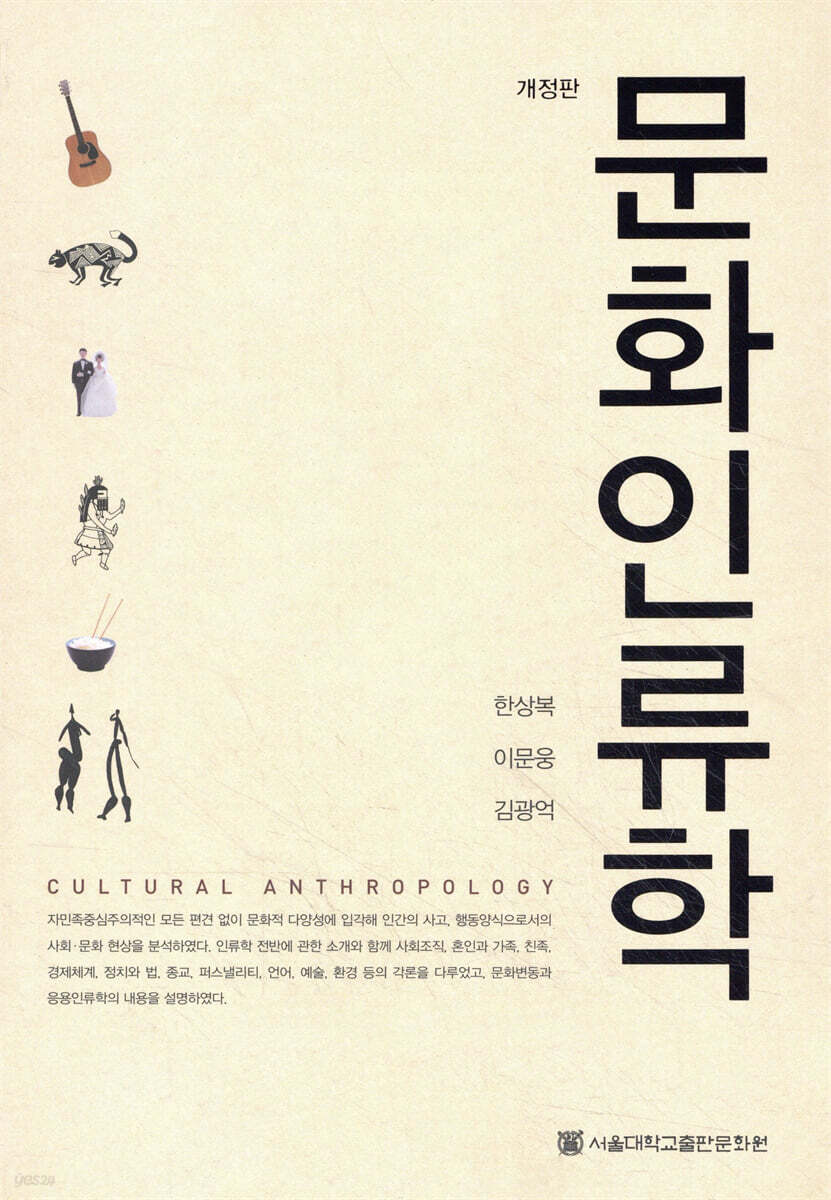
The title of the revised edition was also changed to ‘Cultural Anthropology’, and the cover design was also redesigned.
However, the task of rewriting the entire book remains a task that must be undertaken from now on, based on recent research papers and books that have been searched and supplemented, as well as criticism and advice from students and anthropology professors who have used the book as a textbook.
At that time, there were no anthropology departments in Korean universities, and anthropology lectures as a liberal arts subject were very limited.
It was even more difficult to find textbooks on anthropology or cultural anthropology written in Korean.
However, in 2011, the 'World East Asian Anthropology Conference', jointly organized by the Korean Cultural Anthropology Association and the East Asian Anthropology Association, was held in Jeonju, Korea for five days.
It is said that there were about 200 participants in the academic conference from Korea and about 100 participants from about 20 countries.
In addition to two keynote speeches representing the two academic societies and a joint plenary session on Korean cultural studies by Korean, American, and Japanese anthropologists, 30 conferences featured paper presentations and discussions on a variety of topics. Field research visits were conducted in four cities and counties in North Jeolla Province, and Korean and foreign visual anthropology films were screened.
Such phenomena can be seen as an indicator of the considerable growth that the Korean anthropological community has achieved over the past 50 years.
The number of anthropologists has increased significantly, and numerous university anthropology departments or cultural anthropology departments and anthropology-related research institutes have been established.
Even in universities without anthropology departments, most offer anthropology or cultural anthropology courses as liberal arts subjects, which is gradually increasing interest and awareness of anthropology among university students and the general public across the country.
Research in the field of anthropology has also improved significantly, both quantitatively and qualitatively.
In the editors' preface, Lee Hae-young and Ahn Jeong-mo, who first co-published Introduction to Anthropology (Jeongyeonsa) in 1958, stated, "I don't know if it's because anthropology is an unfamiliar discipline, but as far as I know, there hasn't been any publishing activity in this field in Korea."
However, there are now dozens of books and translations introducing anthropology in Korean.
This book was originally first published in 1985 as 『Introduction to Cultural Anthropology』 (Seoul National University Press), and was later revised and published in 1992 with some of the book's contents revised.
After that, they were unable to produce a revised edition, but when they decided that they could no longer use the book's structure and content as is, the authors began work on a revised edition, albeit an incomplete one.
First of all, the most urgent need for a revised edition was to write Chinese characters in Hangul and to rewrite sentences for easier reading.
When I wrote this book and published the revised edition, the practice of using Korean and Chinese characters together continued in university textbooks, especially professional books.
This book was no exception.
However, nowadays, Chinese characters are rarely used, and only in special cases are Chinese characters used in parentheses around Korean expressions to help readers understand.
It is common knowledge among college students these days that books written in Chinese characters are not easy to read and are not fun.
Moreover, difficult technical terms and sentences written in Chinese characters not only reduce the reader's comprehension but also become a stumbling block that makes them lose interest.
In addition, we recognized the need for each chapter of this book to provide further reading on the topic, including recent general books, articles, and other references.
So, in this revised edition, we first wrote all Chinese characters in Hangul, corrected typos and misspellings, and rewrote sentences to make them easier to read.
The 'Further Reading' section at the end of each chapter is supplemented by recent papers, books, and translations related to the topic of that chapter.
Accordingly, the references presented at the very end of the book have also been supplemented with new information.
The title of the revised edition was also changed to ‘Cultural Anthropology’, and the cover design was also redesigned.
However, the task of rewriting the entire book remains a task that must be undertaken from now on, based on recent research papers and books that have been searched and supplemented, as well as criticism and advice from students and anthropology professors who have used the book as a textbook.
GOODS SPECIFICS
- Date of publication: September 20, 2011
- Page count, weight, size: 596 pages | 847g | 153*224*35mm
- ISBN13: 9788952112408
- ISBN10: 8952112407
You may also like
카테고리
korean


korean

![GQ KOREA Mark (Monthly): December [2025]](http://librairie.coreenne.fr/cdn/shop/files/8ef265dbbfbf186523ed75ba7319009d.jpg?v=1765340328&width=3840)


