

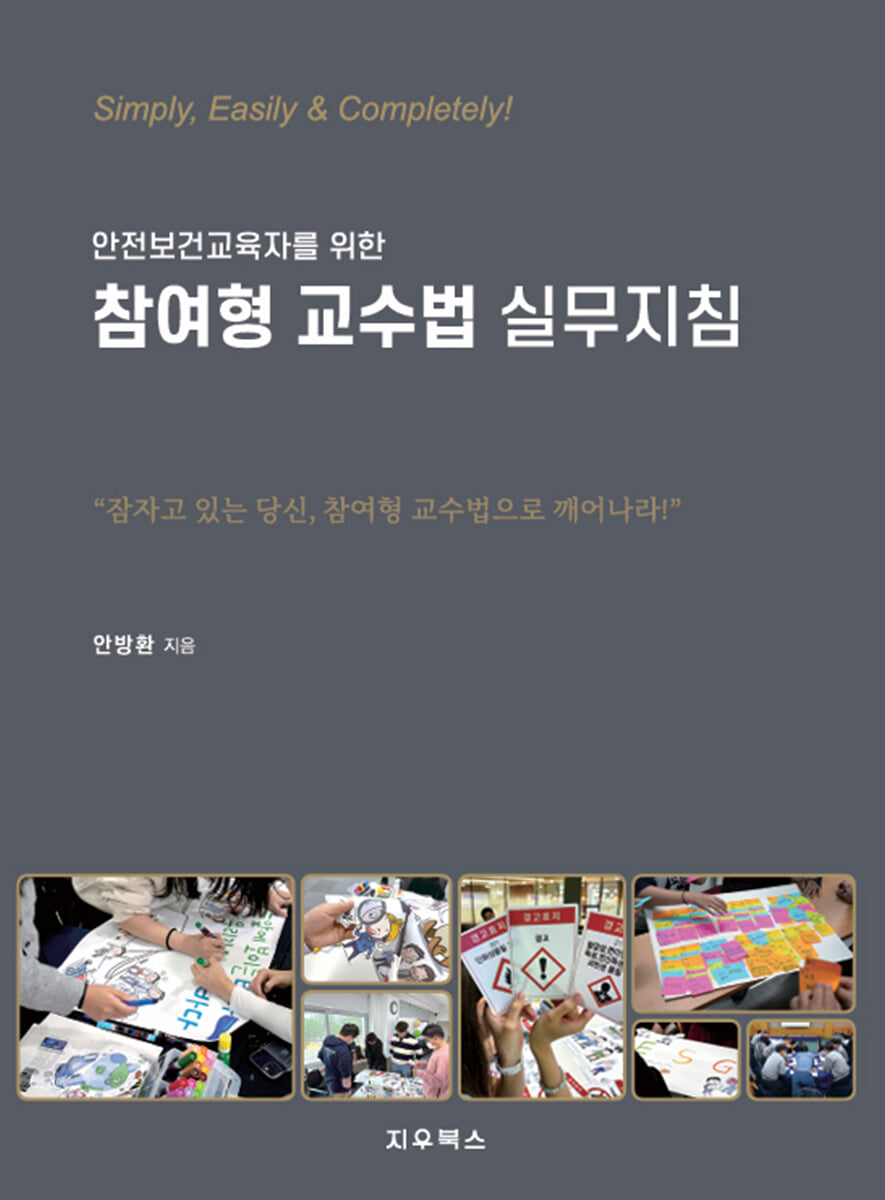
Practical Guidelines for Participatory Teaching Methods for Occupational Safety and Health Educators
 |
Description
Book Introduction
Over the past 25 years, I've been providing safety and health training, consulting, and working on numerous projects in industrial settings. One regret has always lingered in my heart. In the HR field, various teaching methods, such as facilitation, action learning, coaching, and creative teaching methods, are widely adopted both domestically and internationally.
However, despite the numerous statutory training programs in the field of occupational safety and health, it has been difficult to find materials on effective teaching techniques.
To bridge that gap, we have been attempting to bring about change in the educational field for the past 10 years under the name of “participatory teaching method.”
Over time, I've felt a growing urgency for a method that doesn't simply transmit rules, but rather one that fosters genuine learning and behavioral change.
Participatory teaching is a teaching method that transforms learners from passive listeners to active practitioners. It is also a practical solution that integrates educational technology, safety psychology, and the needs of the field.
This book is the fruition of a long-cherished wish, and I am deeply grateful that it has been presented to the world as a book, transcending the traditional classroom textbook.
This book is not just about one person's experiences.
It is the result of the voices from the field, the essence of education, and a sincere desire for safety.
We sincerely hope that this book will serve as a practical tool for safety and health educators, managers, and all those interested in safety and health education, contributing to the protection of more lives and workplace safety.
However, despite the numerous statutory training programs in the field of occupational safety and health, it has been difficult to find materials on effective teaching techniques.
To bridge that gap, we have been attempting to bring about change in the educational field for the past 10 years under the name of “participatory teaching method.”
Over time, I've felt a growing urgency for a method that doesn't simply transmit rules, but rather one that fosters genuine learning and behavioral change.
Participatory teaching is a teaching method that transforms learners from passive listeners to active practitioners. It is also a practical solution that integrates educational technology, safety psychology, and the needs of the field.
This book is the fruition of a long-cherished wish, and I am deeply grateful that it has been presented to the world as a book, transcending the traditional classroom textbook.
This book is not just about one person's experiences.
It is the result of the voices from the field, the essence of education, and a sincere desire for safety.
We sincerely hope that this book will serve as a practical tool for safety and health educators, managers, and all those interested in safety and health education, contributing to the protection of more lives and workplace safety.
index
Chapter 1: Understanding Participatory Teaching
Understanding the Basics of Participatory Teaching / Why Participatory Teaching? / The Learning Pyramid and Participatory Teaching /
Havruta Learning Method / Facilitation Techniques / Deep Insights from the Sages
Chapter 2: The Intersection of Educational Technology and Participatory Teaching
What is Instructional Technology? / Mechanical Engineering-Based Instructional Technology / Behavioral Science-Based Instructional Technology
Chapter 3: Using Participatory Teaching Methods in Safety and Health Education
The Importance of Occupational Safety and Health Education / The Reality and Challenges of Mandatory Occupational Safety and Health Act Education /
Design and Application of Participatory Teaching Methods Using the ADDIE Model / Utilizing National Competency Standards
Chapter 4: Preparing for Participatory Teaching
Creating the Optimal Study Space / A to Z Guide to Successful Lectures
Chapter 5: Participatory Teaching Methodology
5.1 Icebreaking Techniques
Creating a positive image through smile training / Creating a positive learning environment with praise stickers /
Fist stacking relieves tension and builds intimacy / Balloon games strengthen teamwork
5.2 Guide to Participatory Teaching Practice
Emergency Preparedness and Response / Our Team Identity / Ground Rules that Unite the Classroom /
Role cards to strengthen teamwork / Crossword puzzle to stimulate the brain / Initial consonant quiz to stimulate the brain / Multiple choice quiz to improve concentration / Traffic light cards to visualize communication / Brainwriting to let ideas flow / Video story to capture attention / Beyond theory to the field / Walk & Talk to share conversations while walking / Techniques for determining order to proceed without conflict / Small talk for small but important conversations / Mini megaphone to use for time to concentrate / Mandala technique to use 9×9 thinking technique / Mind map strategy to connect creativity and logic / Rich pictures to change perception and behavior / Safety observation to be the first step to safety / Creative poster to deliver a strong message / Safety and health signs to read hazards / Safety messages delivered with magic / Smart utilization skills in the digital age / Safety messages delivered with music / How to use Padlet, a space for collaboration and creativity / Kakao Open Chat to have efficient group conversations / How to use artificial intelligence (AI), a technology that changes the future / Video production techniques from story to editing / Secrets to storytelling that leaves a lasting impression / Writing Safety Line to trace my safety footprints
5.3 Lecture Effectiveness Evaluation
Learning check-up through quizzes using Kahoot / Effectiveness evaluation using Google Forms / Classroom enthusiasm thermometer / Lecture performance evaluation KEEP/STOP/BEGIN
Appendix: Safety and Health Education Plan Reflecting Participatory Teaching Methods
1.
Worker safety and health training
2.
Safety and Health Training for Managers and Supervisors
3.
Safety and Health Workshop
4.
Participatory Teaching Method Instructor (Level 1, Level 2) Training Course
Understanding the Basics of Participatory Teaching / Why Participatory Teaching? / The Learning Pyramid and Participatory Teaching /
Havruta Learning Method / Facilitation Techniques / Deep Insights from the Sages
Chapter 2: The Intersection of Educational Technology and Participatory Teaching
What is Instructional Technology? / Mechanical Engineering-Based Instructional Technology / Behavioral Science-Based Instructional Technology
Chapter 3: Using Participatory Teaching Methods in Safety and Health Education
The Importance of Occupational Safety and Health Education / The Reality and Challenges of Mandatory Occupational Safety and Health Act Education /
Design and Application of Participatory Teaching Methods Using the ADDIE Model / Utilizing National Competency Standards
Chapter 4: Preparing for Participatory Teaching
Creating the Optimal Study Space / A to Z Guide to Successful Lectures
Chapter 5: Participatory Teaching Methodology
5.1 Icebreaking Techniques
Creating a positive image through smile training / Creating a positive learning environment with praise stickers /
Fist stacking relieves tension and builds intimacy / Balloon games strengthen teamwork
5.2 Guide to Participatory Teaching Practice
Emergency Preparedness and Response / Our Team Identity / Ground Rules that Unite the Classroom /
Role cards to strengthen teamwork / Crossword puzzle to stimulate the brain / Initial consonant quiz to stimulate the brain / Multiple choice quiz to improve concentration / Traffic light cards to visualize communication / Brainwriting to let ideas flow / Video story to capture attention / Beyond theory to the field / Walk & Talk to share conversations while walking / Techniques for determining order to proceed without conflict / Small talk for small but important conversations / Mini megaphone to use for time to concentrate / Mandala technique to use 9×9 thinking technique / Mind map strategy to connect creativity and logic / Rich pictures to change perception and behavior / Safety observation to be the first step to safety / Creative poster to deliver a strong message / Safety and health signs to read hazards / Safety messages delivered with magic / Smart utilization skills in the digital age / Safety messages delivered with music / How to use Padlet, a space for collaboration and creativity / Kakao Open Chat to have efficient group conversations / How to use artificial intelligence (AI), a technology that changes the future / Video production techniques from story to editing / Secrets to storytelling that leaves a lasting impression / Writing Safety Line to trace my safety footprints
5.3 Lecture Effectiveness Evaluation
Learning check-up through quizzes using Kahoot / Effectiveness evaluation using Google Forms / Classroom enthusiasm thermometer / Lecture performance evaluation KEEP/STOP/BEGIN
Appendix: Safety and Health Education Plan Reflecting Participatory Teaching Methods
1.
Worker safety and health training
2.
Safety and Health Training for Managers and Supervisors
3.
Safety and Health Workshop
4.
Participatory Teaching Method Instructor (Level 1, Level 2) Training Course
GOODS SPECIFICS
- Date of issue: October 1, 2025
- Page count, weight, size: 248 pages | 188*257*20mm
- ISBN13: 9791192639383
- ISBN10: 1192639383
You may also like
카테고리
korean


korean

![ELLE 엘르 스페셜 에디션 A형 : 12월 [2025]](http://librairie.coreenne.fr/cdn/shop/files/b8e27a3de6c9538896439686c6b0e8fb.jpg?v=1766436872&width=3840)


