

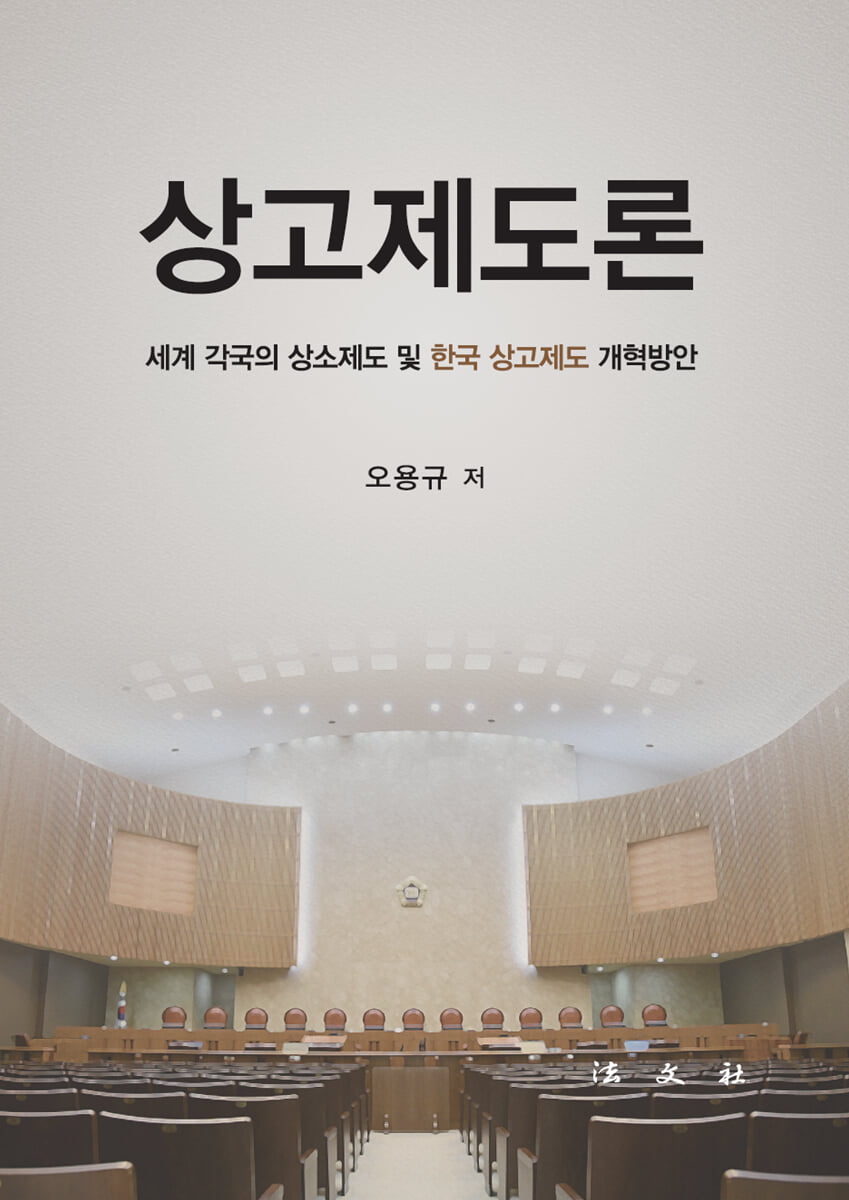
Theory of the Supreme Court System
 |
Description
index
theory
Chapter 1: Comparison of Judicial and Appellate Systems Around the World
Section 1 The United States
Section 2 Britain
Section 3 Germany
Section 4 France
Section 5 Japan
Chapter 2: Korea's arbitration system and its evolution
Section 1. Korea's arbitration and appeal system
Section 2: Evolution of the Korean Appeals System
Chapter 3: Korean Civil Litigation Appellate System and Issues in Application
Section 1. Main contents of the Korean civil litigation appellate system
Section 2 Problems with the Second Trial (Appellate) System in Korean Civil Litigation
Section 3 Problems with the Third Trial (Appeal) System in Korean Civil Litigation
Chapter 4: Discussion and Evaluation of Improvement of the Korean Appeals System
Section 1: Discussion on improving the appeal system during the 2002 revision of the Civil Procedure Act
Section 2: Discussion on improving the appeal system and appeal review methods in Korea
Chapter 5: Seeking Feasible Appellate Court Reform Measures
Section 1. Relationship between the reform of the first trial and the reform of the appellate court
Section 2 Changes in the Korean Judicial Environment
Section 3: Institutional Improvement Measures to Strengthen the First Trial
Section 4. Measures to improve the structure of the appellate and supreme courts
theory
Appendix: Factors to Consider in the Discussion of Appellate Court Reform (Law Times Contribution)
Chapter 1: Comparison of Judicial and Appellate Systems Around the World
Section 1 The United States
Section 2 Britain
Section 3 Germany
Section 4 France
Section 5 Japan
Chapter 2: Korea's arbitration system and its evolution
Section 1. Korea's arbitration and appeal system
Section 2: Evolution of the Korean Appeals System
Chapter 3: Korean Civil Litigation Appellate System and Issues in Application
Section 1. Main contents of the Korean civil litigation appellate system
Section 2 Problems with the Second Trial (Appellate) System in Korean Civil Litigation
Section 3 Problems with the Third Trial (Appeal) System in Korean Civil Litigation
Chapter 4: Discussion and Evaluation of Improvement of the Korean Appeals System
Section 1: Discussion on improving the appeal system during the 2002 revision of the Civil Procedure Act
Section 2: Discussion on improving the appeal system and appeal review methods in Korea
Chapter 5: Seeking Feasible Appellate Court Reform Measures
Section 1. Relationship between the reform of the first trial and the reform of the appellate court
Section 2 Changes in the Korean Judicial Environment
Section 3: Institutional Improvement Measures to Strengthen the First Trial
Section 4. Measures to improve the structure of the appellate and supreme courts
theory
Appendix: Factors to Consider in the Discussion of Appellate Court Reform (Law Times Contribution)
Publisher's Review
preface
In December 2014, 168 ruling and opposition party lawmakers suddenly proposed a bill to amend the law to introduce a supreme court.
As a former chief judge at Changwon District Court, I assumed that the National Assembly and the Court Administration Office would have gone through extensive discussions before proposing a bill to amend the law.
I had some doubts about how such a big change could be proposed so suddenly, but I let it be.
When I was working in Changwon, judges from the Court Administration Office came down to explain the implementation of the Supreme Court system.
Despite the fact that more than half of the National Assembly members proposed a bill to introduce a Supreme Court, the introduction of a Supreme Court has been slow, and the Court Administration Office appears to be making every effort in various ways.
Although most lawsuits seem to have clear facts, in fiercely contested cases it is extremely difficult to uncover the substantive truth.
It would be nice if you could tell the truth just by looking at the plaintiff and defendant's faces, but that kind of interest law doesn't work in a lawsuit, and in the end, you have no choice but to judge by comparing the evidence submitted by the plaintiff and defendant.
The first and second trials are conducted by judges who can at least see the faces of the plaintiff, defendant, or their representatives and personally experience the progress of the lawsuit, but the third trial is conducted solely based on a review of documents.
Therefore, there has always been a doubt as to whether it is desirable for the third trial to correct the facts other than correcting the clear errors of the original trial and making a legal judgment.
Personally, I thought that if the Supreme Court is introduced, the appellate court will make substantive judgments rather than dismissals, and that lawyers will play a big role in taking on cases not only in the first or second trials but also in the third trial. However, I was worried that the innocent citizens would now have to worry about the burden of attorney fees for the third trial and remand trial and the prolonged litigation.
Then, in 2017, allegations surfaced that undue pressure had been applied to former Judge Lee Tan-hee, a member of the International Human Rights Law Association within the court, and an investigation into the matter was launched.
At that time, I was preparing my doctoral dissertation at China University of Political Science and Law. Since there was a considerable amount of research papers, public hearing materials, and internal court research materials that had been conducted in Korea up to that point, I discussed with my advisor that using these materials to comparatively analyze the appellate systems of the Anglo-American and Continental law systems and write a thesis on the history and revision of the Korean appellate system could be useful material for Chinese scholars as well.
At the time, there were many preparations within the court for reforming the appeal system. There were research books on first-instance, appellate, and supreme court trials around the world written by the court's Foreign Judicial System Research Group, various papers researched by the Seoul National University Industry-Academic Cooperation Foundation, books published by the Judicial Policy Research Institute, and various papers on the appeal system written by academics and practitioners.
In particular, the books of the Foreign Judicial System Research Group of the Court were not published externally, making them difficult for the general public to access. I thought that compiling these research materials would serve as good basic data for research on the appellate system.
Our country's legal system was greatly influenced by the continental legal system, but under the influence of the US military government, the principle of separation of powers was firmly established in the Constitution, and the Constitution granted the judiciary a very large role and responsibility as one axis of the separation of powers.
Afterwards, the American legal system had a great influence on Korean litigation and substantive law, and eventually, the American-style law school system was introduced.
Reforming the appeals system is not a problem that can be solved with a one-point legal amendment to address a visible problem.
The appeals system is also a part of the judicial system, and the judicial system is made up of various systems that are intertwined like a large organism.
Based on this understanding, consideration should be given to how the reform of the appellate system influences and is influenced by other judicial systems.
Therefore, in order to study the legal system of our country, which can be said to be a representative example of a mixture of continental and common law systems, I thought it was necessary to conduct a comparative study of the appellate and trial systems of the continental and common law systems, and also investigated the training system for legal professionals who operate the trial system.
Changing a country's judicial system, especially its appellate system, can have a significant impact on the status, role, and responsibilities of the courts, which ultimately has a significant impact on the lives of its citizens.
I hope that this book can serve as a foundation for reforming the appeals and trial systems, drawing a bigger picture rather than piecemeal reforms. It would be a great achievement.
A lot of time has passed since I wrote my doctoral dissertation in 2018, and the systems of the various countries I mentioned in the dissertation have changed significantly, and our country's system has also changed considerably.
And since the intended direction was different from that of the thesis, the content was significantly modified and added to.
By the way, there may be some mistakes in the text of the book, so I would appreciate it if you could point them out.
Many people helped and encouraged me to create this book.
I would like to express my gratitude to Professor Xiao Jianhua (肖建?) of the China University of Political Science and Law, who took me in as a student despite my shortcomings and secretly encouraged me every year when I could not start my doctoral dissertation due to my busy judicial work, for his warm consideration and support; to former Supreme Court Justice Lee In-bok, who readily agreed to write a letter of recommendation without a single second of hesitation when I asked him to do so; and to the professors in my lecture room during my time as a professor at the Judicial Research and Training Institute, who were always my companions in discussing our judicial system and who diligently researched case law and agreed to lecture.
I would also like to express my gratitude to my former fellow judges who supported me when I was hesitant to publish this book. Although this is a very inadequate piece of writing, I look forward to your words of encouragement and guidance.
I would also like to express my deep gratitude to my students, who always provide the driving force behind my new challenges.
I also extend my gratitude to Kwon Hyuk-gi, Vice President of Beopmunsa, for his active support of the publication of this book, and to Kim Yong-seok, Vice President, for his impeccable editing and proofreading, which resulted in such a neat and well-written book.
Lastly, I would like to dedicate this book to my parents, family, and fellow lawyers at Dongin Law Firm who have always believed in and supported me.
In December 2014, 168 ruling and opposition party lawmakers suddenly proposed a bill to amend the law to introduce a supreme court.
As a former chief judge at Changwon District Court, I assumed that the National Assembly and the Court Administration Office would have gone through extensive discussions before proposing a bill to amend the law.
I had some doubts about how such a big change could be proposed so suddenly, but I let it be.
When I was working in Changwon, judges from the Court Administration Office came down to explain the implementation of the Supreme Court system.
Despite the fact that more than half of the National Assembly members proposed a bill to introduce a Supreme Court, the introduction of a Supreme Court has been slow, and the Court Administration Office appears to be making every effort in various ways.
Although most lawsuits seem to have clear facts, in fiercely contested cases it is extremely difficult to uncover the substantive truth.
It would be nice if you could tell the truth just by looking at the plaintiff and defendant's faces, but that kind of interest law doesn't work in a lawsuit, and in the end, you have no choice but to judge by comparing the evidence submitted by the plaintiff and defendant.
The first and second trials are conducted by judges who can at least see the faces of the plaintiff, defendant, or their representatives and personally experience the progress of the lawsuit, but the third trial is conducted solely based on a review of documents.
Therefore, there has always been a doubt as to whether it is desirable for the third trial to correct the facts other than correcting the clear errors of the original trial and making a legal judgment.
Personally, I thought that if the Supreme Court is introduced, the appellate court will make substantive judgments rather than dismissals, and that lawyers will play a big role in taking on cases not only in the first or second trials but also in the third trial. However, I was worried that the innocent citizens would now have to worry about the burden of attorney fees for the third trial and remand trial and the prolonged litigation.
Then, in 2017, allegations surfaced that undue pressure had been applied to former Judge Lee Tan-hee, a member of the International Human Rights Law Association within the court, and an investigation into the matter was launched.
At that time, I was preparing my doctoral dissertation at China University of Political Science and Law. Since there was a considerable amount of research papers, public hearing materials, and internal court research materials that had been conducted in Korea up to that point, I discussed with my advisor that using these materials to comparatively analyze the appellate systems of the Anglo-American and Continental law systems and write a thesis on the history and revision of the Korean appellate system could be useful material for Chinese scholars as well.
At the time, there were many preparations within the court for reforming the appeal system. There were research books on first-instance, appellate, and supreme court trials around the world written by the court's Foreign Judicial System Research Group, various papers researched by the Seoul National University Industry-Academic Cooperation Foundation, books published by the Judicial Policy Research Institute, and various papers on the appeal system written by academics and practitioners.
In particular, the books of the Foreign Judicial System Research Group of the Court were not published externally, making them difficult for the general public to access. I thought that compiling these research materials would serve as good basic data for research on the appellate system.
Our country's legal system was greatly influenced by the continental legal system, but under the influence of the US military government, the principle of separation of powers was firmly established in the Constitution, and the Constitution granted the judiciary a very large role and responsibility as one axis of the separation of powers.
Afterwards, the American legal system had a great influence on Korean litigation and substantive law, and eventually, the American-style law school system was introduced.
Reforming the appeals system is not a problem that can be solved with a one-point legal amendment to address a visible problem.
The appeals system is also a part of the judicial system, and the judicial system is made up of various systems that are intertwined like a large organism.
Based on this understanding, consideration should be given to how the reform of the appellate system influences and is influenced by other judicial systems.
Therefore, in order to study the legal system of our country, which can be said to be a representative example of a mixture of continental and common law systems, I thought it was necessary to conduct a comparative study of the appellate and trial systems of the continental and common law systems, and also investigated the training system for legal professionals who operate the trial system.
Changing a country's judicial system, especially its appellate system, can have a significant impact on the status, role, and responsibilities of the courts, which ultimately has a significant impact on the lives of its citizens.
I hope that this book can serve as a foundation for reforming the appeals and trial systems, drawing a bigger picture rather than piecemeal reforms. It would be a great achievement.
A lot of time has passed since I wrote my doctoral dissertation in 2018, and the systems of the various countries I mentioned in the dissertation have changed significantly, and our country's system has also changed considerably.
And since the intended direction was different from that of the thesis, the content was significantly modified and added to.
By the way, there may be some mistakes in the text of the book, so I would appreciate it if you could point them out.
Many people helped and encouraged me to create this book.
I would like to express my gratitude to Professor Xiao Jianhua (肖建?) of the China University of Political Science and Law, who took me in as a student despite my shortcomings and secretly encouraged me every year when I could not start my doctoral dissertation due to my busy judicial work, for his warm consideration and support; to former Supreme Court Justice Lee In-bok, who readily agreed to write a letter of recommendation without a single second of hesitation when I asked him to do so; and to the professors in my lecture room during my time as a professor at the Judicial Research and Training Institute, who were always my companions in discussing our judicial system and who diligently researched case law and agreed to lecture.
I would also like to express my gratitude to my former fellow judges who supported me when I was hesitant to publish this book. Although this is a very inadequate piece of writing, I look forward to your words of encouragement and guidance.
I would also like to express my deep gratitude to my students, who always provide the driving force behind my new challenges.
I also extend my gratitude to Kwon Hyuk-gi, Vice President of Beopmunsa, for his active support of the publication of this book, and to Kim Yong-seok, Vice President, for his impeccable editing and proofreading, which resulted in such a neat and well-written book.
Lastly, I would like to dedicate this book to my parents, family, and fellow lawyers at Dongin Law Firm who have always believed in and supported me.
GOODS SPECIFICS
- Date of issue: October 15, 2025
- Format: Paperback book binding method guide
- Page count, weight, size: 358 pages | 176*248*30mm
- ISBN13: 9788918916361
- ISBN10: 8918916361
You may also like
카테고리
korean


korean

![ELLE 엘르 스페셜 에디션 A형 : 12월 [2025]](http://librairie.coreenne.fr/cdn/shop/files/b8e27a3de6c9538896439686c6b0e8fb.jpg?v=1766436872&width=3840)


