

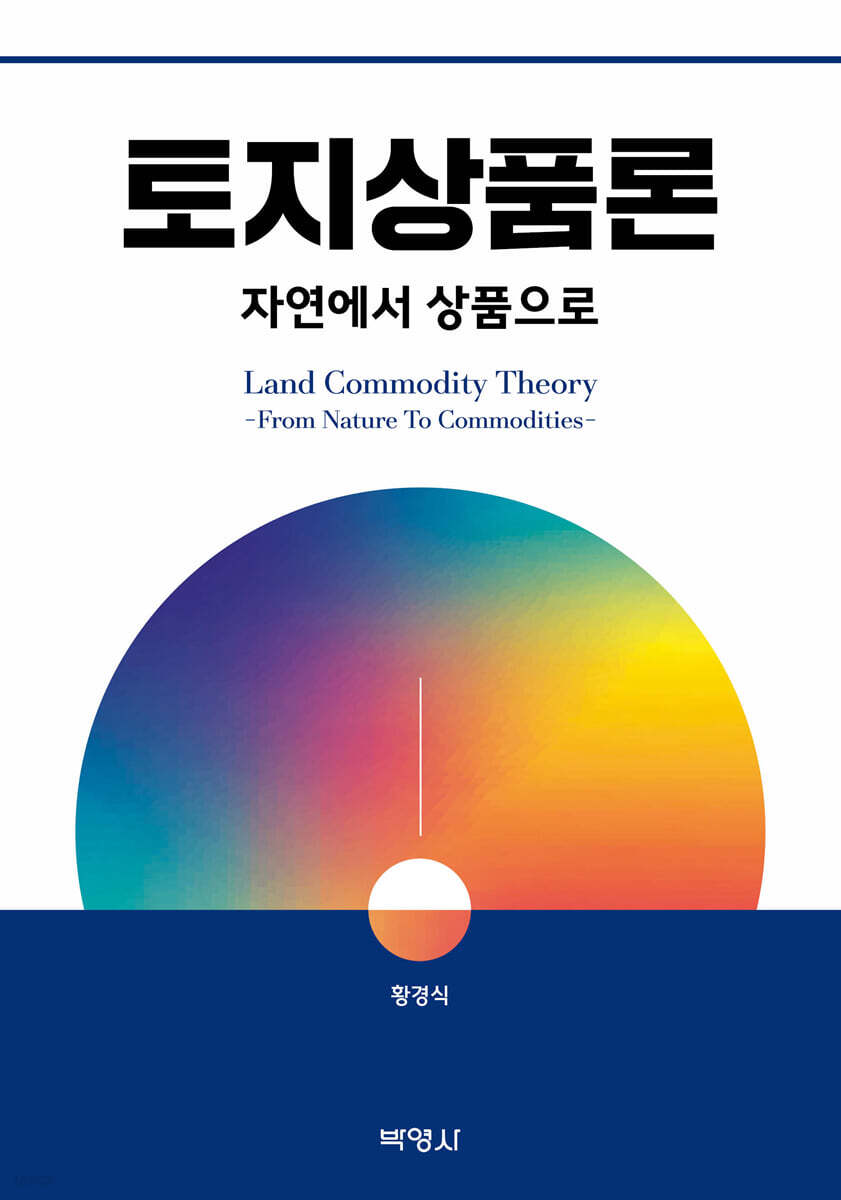
Land commodity theory
 |
Description
Book Introduction
This book is the first theoretical and practical book to examine the factors that give land its economic value as a commodity by integrating research results from various disciplines through insight into the history of human land use, and to systematically explain actual cases according to Korea's land use system based on this.
index
1 · Economic value of land · 1
1.1 From Natural to Economic Goods 3
1.1.1 History of Land Use 4
1.1.2 Land Theory 9
1.1.3 Location and Spatial Structure Theory 27
1.2 Land Use and Urban Planning Theory 60
1.2.1 Theoretical Concepts of Land Use 61
1.2.2 Urban and Non-Urban Land Use 62
1.2.3 Development of Urban Planning Theory 62
1.2.4 Modern Urban Development Techniques - Focusing on Major Paradigms 68
1.2.5 The Role and Importance of Urban Planning 73
2 · Korea's Land Use System and Land Use Plan · 75
2.1 Korea's Land Use System 77
2.2 Means of implementing land use plans 79
2.2.1 Regulatory measures for land use planning 79
2.2.2 Planning Tools for Land Use Planning 91
2.2.3 Land Use Planning Development Tools 109
2.2.4 Means of Guiding Land Use Planning 110
2.3 Changes in Regional Planning and Land Use Through the History of Seoul's Urban Planning 113
2.3.1 The Evolution of Regional Planning in Seoul: From a Single-Centered City to a Multi-Centered City 114
2.3.2 The Impact of Urban Planning on Land Use and Values 124
3 · Valuation of Land Products · 129
3.1 Land Supply and Demand, Equilibrium Price 131
3.2 Land commodity pricing methods 135
3.2.1 Emotional Assessment 135
3.2.2 Competitive Bidding 136
3.2.3 Sale and Purchase Agreement 138
3.3 Methods for Estimating the Value of Land Products 139
3.3.1 Real Estate Asset Pricing Model 139
3.3.2 Hedonic Price Model 141
4 · Basic Concepts and Classification of Land Commodities · 145
4.1 Definition and Characteristics of Land Commodities 147
4.1.1 Physical Characteristics of Land Commodities 150
4.1.2 Social and Institutional Characteristics of Land Commodities 157
4.1.3 Economic Characteristics of Land Commodities 165
4.1.4 Marketing Characteristics of Land Products 169
4.2 Classification of Land Commodities 173
4.2.1 Individually Located Land Products 174
4.2.2 Planned Land Product 177
4.3 Segmentation of Land Products 183
5 · Individually Located Land Products · 185
5.1 Classification of Individually Located Land Products 187
5.1.1 Residential Land 188
5.1.2 Commercial and Business Land 199
5.1.3 Industrial and Warehouse Land 225
5.1.4 Land Related to Agriculture, Forestry, and the Natural Environment 231
5.1.5 Individually located land for other purposes 238
6 · Planned Land Products · 271
6.1 Classification and Sales Methods of Planned Land Products 273
6.1.1 Planned Site Development Project 273
6.1.2 Supply price of land products 277
6.1.3 Method of Supplying Land Products 280
6.1.4 Land Sale Notice 285
6.1.5 Application of Earth Unit Plan 287
6.2 Classification of residential land products 288
6.2.1 Residential Land for Single-Family Housing: Single-Family and Multi-Family Housing 289
6.2.2 300 units of land for single-family homes and shops
6.2.3 Block-type single-family home site 317
6.2.4 Townhouse land 324
6.2.5 Apartment land 332
6.2.6 Residential complex paper 350
6.2.7 Semi-residential land 366
6.3 Classification of Commercial Paper Products 372
6.3.1 Neighborhood Living Facility Site 374
6.3.2 Neighborhood Commercial Land 382
6.3.3 General Commercial Paper 386
6.3.4 Central Commercial Area 396
6.4 Classification and Characteristics of Urban "Self-Sufficiency" Land Products 407
6.4.1 Business Facility Land 413
6.4.2 Urban Support Facility Land 418
6.5 Infrastructure land 422
6.5.1 Religious Facility Land 423
6.5.2 Parking Lot Paper 426
6.5.3 Gas Station Land 428
6.5.4 Liquefied Petroleum Gas Filling Station Site 431
6.5.5 Distribution Business Equipment Paper 434
6.5.6 School Paper 436
6.5.7 Public Business Facility Land 439
6.5.8 Cultural Facility Land 444
6.5.9 Sports Facility Land 448
6.5.10 Welfare facility land 451
6.5.11 Medical Facility Land 453
6.5.12 Supply facility paper 455
6.5.13 Road Paper 459
6.5.14 Park land 474
6.5.15 Green Paper 477
6.6 Classification of land products such as industrial complexes 479
6.6.1 Industrial Facility Site 484
6.6.2 Support facility land 488
6.7 The value of planned land products 490
7 · Changes in the Value of Land Commodities and the Future · 493
7.1 Shifts in the Land Commodity Paradigm 495
7.2 Land Commodity Value and the Future 496
In conclusion 499
Reference 501
1.1 From Natural to Economic Goods 3
1.1.1 History of Land Use 4
1.1.2 Land Theory 9
1.1.3 Location and Spatial Structure Theory 27
1.2 Land Use and Urban Planning Theory 60
1.2.1 Theoretical Concepts of Land Use 61
1.2.2 Urban and Non-Urban Land Use 62
1.2.3 Development of Urban Planning Theory 62
1.2.4 Modern Urban Development Techniques - Focusing on Major Paradigms 68
1.2.5 The Role and Importance of Urban Planning 73
2 · Korea's Land Use System and Land Use Plan · 75
2.1 Korea's Land Use System 77
2.2 Means of implementing land use plans 79
2.2.1 Regulatory measures for land use planning 79
2.2.2 Planning Tools for Land Use Planning 91
2.2.3 Land Use Planning Development Tools 109
2.2.4 Means of Guiding Land Use Planning 110
2.3 Changes in Regional Planning and Land Use Through the History of Seoul's Urban Planning 113
2.3.1 The Evolution of Regional Planning in Seoul: From a Single-Centered City to a Multi-Centered City 114
2.3.2 The Impact of Urban Planning on Land Use and Values 124
3 · Valuation of Land Products · 129
3.1 Land Supply and Demand, Equilibrium Price 131
3.2 Land commodity pricing methods 135
3.2.1 Emotional Assessment 135
3.2.2 Competitive Bidding 136
3.2.3 Sale and Purchase Agreement 138
3.3 Methods for Estimating the Value of Land Products 139
3.3.1 Real Estate Asset Pricing Model 139
3.3.2 Hedonic Price Model 141
4 · Basic Concepts and Classification of Land Commodities · 145
4.1 Definition and Characteristics of Land Commodities 147
4.1.1 Physical Characteristics of Land Commodities 150
4.1.2 Social and Institutional Characteristics of Land Commodities 157
4.1.3 Economic Characteristics of Land Commodities 165
4.1.4 Marketing Characteristics of Land Products 169
4.2 Classification of Land Commodities 173
4.2.1 Individually Located Land Products 174
4.2.2 Planned Land Product 177
4.3 Segmentation of Land Products 183
5 · Individually Located Land Products · 185
5.1 Classification of Individually Located Land Products 187
5.1.1 Residential Land 188
5.1.2 Commercial and Business Land 199
5.1.3 Industrial and Warehouse Land 225
5.1.4 Land Related to Agriculture, Forestry, and the Natural Environment 231
5.1.5 Individually located land for other purposes 238
6 · Planned Land Products · 271
6.1 Classification and Sales Methods of Planned Land Products 273
6.1.1 Planned Site Development Project 273
6.1.2 Supply price of land products 277
6.1.3 Method of Supplying Land Products 280
6.1.4 Land Sale Notice 285
6.1.5 Application of Earth Unit Plan 287
6.2 Classification of residential land products 288
6.2.1 Residential Land for Single-Family Housing: Single-Family and Multi-Family Housing 289
6.2.2 300 units of land for single-family homes and shops
6.2.3 Block-type single-family home site 317
6.2.4 Townhouse land 324
6.2.5 Apartment land 332
6.2.6 Residential complex paper 350
6.2.7 Semi-residential land 366
6.3 Classification of Commercial Paper Products 372
6.3.1 Neighborhood Living Facility Site 374
6.3.2 Neighborhood Commercial Land 382
6.3.3 General Commercial Paper 386
6.3.4 Central Commercial Area 396
6.4 Classification and Characteristics of Urban "Self-Sufficiency" Land Products 407
6.4.1 Business Facility Land 413
6.4.2 Urban Support Facility Land 418
6.5 Infrastructure land 422
6.5.1 Religious Facility Land 423
6.5.2 Parking Lot Paper 426
6.5.3 Gas Station Land 428
6.5.4 Liquefied Petroleum Gas Filling Station Site 431
6.5.5 Distribution Business Equipment Paper 434
6.5.6 School Paper 436
6.5.7 Public Business Facility Land 439
6.5.8 Cultural Facility Land 444
6.5.9 Sports Facility Land 448
6.5.10 Welfare facility land 451
6.5.11 Medical Facility Land 453
6.5.12 Supply facility paper 455
6.5.13 Road Paper 459
6.5.14 Park land 474
6.5.15 Green Paper 477
6.6 Classification of land products such as industrial complexes 479
6.6.1 Industrial Facility Site 484
6.6.2 Support facility land 488
6.7 The value of planned land products 490
7 · Changes in the Value of Land Commodities and the Future · 493
7.1 Shifts in the Land Commodity Paradigm 495
7.2 Land Commodity Value and the Future 496
In conclusion 499
Reference 501
Detailed image

Publisher's Review
Entering
The word 'land' has a special emotional meaning for our people in addition to its dictionary meaning and physical characteristics.
Our country has been an agricultural society from ancient times to modern times.
Therefore, land was not only a means of spatial value for construction, but also a means of producing food and a means of survival.
Furthermore, land ownership and use are the cause of the gap between the rich and the poor, and they are objects of economic value as a means for forming, maintaining, and developing a nation and its power.
Land is an object of economic value that goes beyond its physical characteristics and serves as a means of survival and power formation.
However, in modern times, the use and value of land have undergone rapid changes compared to before industrialization.
With the industrialization of the West, land use changed from agricultural production areas to industrial production areas and centers of commercial transactions.
In our country, too, during the industrialization process, agricultural land decreased and the area of land for industrial and business facilities and cities rapidly increased.
Due to so-called 'urbanization', the meaning and value of land have become more complex and diverse.
In modern times, land has been divided into natural land, agricultural production land, urban residential land, commercial land, industrial land, and green space, and has come to have various economic values.
These classifications were further subdivided into complex classification systems based on national and regional humanities and social characteristics and natural environments.
We categorize the objects traded in human society as goods and services, and collectively call them commodities.
Additionally, the economic characteristics that a product has are called marketability.
The commercial value of land as an economic good is complexly differentiated, but it is difficult to find a theoretical book that provides an academic and practical system for classifying commodities and explaining their value.
The factors that give land various economic values are determined by the physical characteristics of the land, the price of land use, the location of the land, the different human and social characteristics and natural environment of each country and region, and the land use plan regulated by law.
Explaining these factors requires a deep understanding of various academic disciplines.
This is because real estate, such as land, has as many fields of study as the history of mankind, and its complex and integrated characteristics make it difficult to explain it in a single academic field.
In other words, to explain the value of land commodities, an integrated understanding of research conducted in various academic fields such as economics, urban planning, architecture, law, geography, business administration, and policy studies is necessary.
Real Estate Study is the central field of study that studies real estate, including land, based on this integrated understanding.
Moreover, as the value of real estate assets becomes more important, the academic and practical importance and role of real estate studies are also increasing.
For this reason, it is the mission of real estate studies to integrate the research results of various disciplines from the perspective of real estate studies to systematically and practically organize how 'land, a part of nature' became 'a commodity as an economic good.'
In this respect, attempts to systematize and classify land as a commodity and explain its marketability are of great research value as a field of real estate studies.
Land is the habitat for life on the surface of the earth, and it is the cradle where life sprouts in the ecosystem of plants and animals.
Therefore, since prehistoric times, humans have had no choice but to use land.
As human society was formed and advanced, the need to exclusively use land for housing, farming, livestock raising, hunting and gathering, etc., i.e., 'demand', arose.
However, land is limited to a 'supply' limited to the surface space of the Earth.
Therefore, the owner who first occupied the land for whatever reason had the right to use and profit from the land, as well as to dispose of it.
On this basis, a 'market' was formed where transactions such as exchange, rental, and sale took place between land demanders and land owners targeting specific surfaces.
A 'commodity' traded in the 'market' is an economic good that is used in itself or traded as a means to another purpose.
Land also has commodity value as an economic good.
The marketability of land is ‘the value generated through the use of land’ or ‘the value increased by converting the existing use of land to another purpose.’
These appear individually or in combination.
In order to understand land as a commodity, we must first understand the principles by which land value is formed.
The commercial value of land is composed of natural factors and factors formed socially and culturally in human society.
Therefore, we will examine natural factors and humanities and social factors across various academic disciplines and, based on this, attempt to explain the value factors of land commodities.
Meanwhile, humanities and social factors are formed differently in each country or region, so we will explain the classification and marketability of land products and factors influencing value based on the historical records of our country since the modern era.
Even in our country, it is difficult to find data that classifies land as a commodity traded in the market, organizes its characteristics, and explains them with examples.
In other words, it is difficult to find materials that organize and explain theoretical and practical research on ‘land commodities.’
This book is intended to serve as a stepping stone for both research and practice for researchers seeking to advance real estate product research as a field of real estate studies, as well as for business owners and practitioners working with real estate products.
I would like to await readers with the attitude of a scholar who is open to the diverse opinions of readers and studies them, so that any additions, subtractions, or corrections in this book can be reflected in a revised edition in the future.
The word 'land' has a special emotional meaning for our people in addition to its dictionary meaning and physical characteristics.
Our country has been an agricultural society from ancient times to modern times.
Therefore, land was not only a means of spatial value for construction, but also a means of producing food and a means of survival.
Furthermore, land ownership and use are the cause of the gap between the rich and the poor, and they are objects of economic value as a means for forming, maintaining, and developing a nation and its power.
Land is an object of economic value that goes beyond its physical characteristics and serves as a means of survival and power formation.
However, in modern times, the use and value of land have undergone rapid changes compared to before industrialization.
With the industrialization of the West, land use changed from agricultural production areas to industrial production areas and centers of commercial transactions.
In our country, too, during the industrialization process, agricultural land decreased and the area of land for industrial and business facilities and cities rapidly increased.
Due to so-called 'urbanization', the meaning and value of land have become more complex and diverse.
In modern times, land has been divided into natural land, agricultural production land, urban residential land, commercial land, industrial land, and green space, and has come to have various economic values.
These classifications were further subdivided into complex classification systems based on national and regional humanities and social characteristics and natural environments.
We categorize the objects traded in human society as goods and services, and collectively call them commodities.
Additionally, the economic characteristics that a product has are called marketability.
The commercial value of land as an economic good is complexly differentiated, but it is difficult to find a theoretical book that provides an academic and practical system for classifying commodities and explaining their value.
The factors that give land various economic values are determined by the physical characteristics of the land, the price of land use, the location of the land, the different human and social characteristics and natural environment of each country and region, and the land use plan regulated by law.
Explaining these factors requires a deep understanding of various academic disciplines.
This is because real estate, such as land, has as many fields of study as the history of mankind, and its complex and integrated characteristics make it difficult to explain it in a single academic field.
In other words, to explain the value of land commodities, an integrated understanding of research conducted in various academic fields such as economics, urban planning, architecture, law, geography, business administration, and policy studies is necessary.
Real Estate Study is the central field of study that studies real estate, including land, based on this integrated understanding.
Moreover, as the value of real estate assets becomes more important, the academic and practical importance and role of real estate studies are also increasing.
For this reason, it is the mission of real estate studies to integrate the research results of various disciplines from the perspective of real estate studies to systematically and practically organize how 'land, a part of nature' became 'a commodity as an economic good.'
In this respect, attempts to systematize and classify land as a commodity and explain its marketability are of great research value as a field of real estate studies.
Land is the habitat for life on the surface of the earth, and it is the cradle where life sprouts in the ecosystem of plants and animals.
Therefore, since prehistoric times, humans have had no choice but to use land.
As human society was formed and advanced, the need to exclusively use land for housing, farming, livestock raising, hunting and gathering, etc., i.e., 'demand', arose.
However, land is limited to a 'supply' limited to the surface space of the Earth.
Therefore, the owner who first occupied the land for whatever reason had the right to use and profit from the land, as well as to dispose of it.
On this basis, a 'market' was formed where transactions such as exchange, rental, and sale took place between land demanders and land owners targeting specific surfaces.
A 'commodity' traded in the 'market' is an economic good that is used in itself or traded as a means to another purpose.
Land also has commodity value as an economic good.
The marketability of land is ‘the value generated through the use of land’ or ‘the value increased by converting the existing use of land to another purpose.’
These appear individually or in combination.
In order to understand land as a commodity, we must first understand the principles by which land value is formed.
The commercial value of land is composed of natural factors and factors formed socially and culturally in human society.
Therefore, we will examine natural factors and humanities and social factors across various academic disciplines and, based on this, attempt to explain the value factors of land commodities.
Meanwhile, humanities and social factors are formed differently in each country or region, so we will explain the classification and marketability of land products and factors influencing value based on the historical records of our country since the modern era.
Even in our country, it is difficult to find data that classifies land as a commodity traded in the market, organizes its characteristics, and explains them with examples.
In other words, it is difficult to find materials that organize and explain theoretical and practical research on ‘land commodities.’
This book is intended to serve as a stepping stone for both research and practice for researchers seeking to advance real estate product research as a field of real estate studies, as well as for business owners and practitioners working with real estate products.
I would like to await readers with the attitude of a scholar who is open to the diverse opinions of readers and studies them, so that any additions, subtractions, or corrections in this book can be reflected in a revised edition in the future.
GOODS SPECIFICS
- Date of issue: September 30, 2025
- Page count, weight, size: 524 pages | 171*244*35mm
- ISBN13: 9791130324067
- ISBN10: 1130324060
You may also like
카테고리
korean


korean

![ELLE 엘르 스페셜 에디션 A형 : 12월 [2025]](http://librairie.coreenne.fr/cdn/shop/files/b8e27a3de6c9538896439686c6b0e8fb.jpg?v=1766436872&width=3840)


