

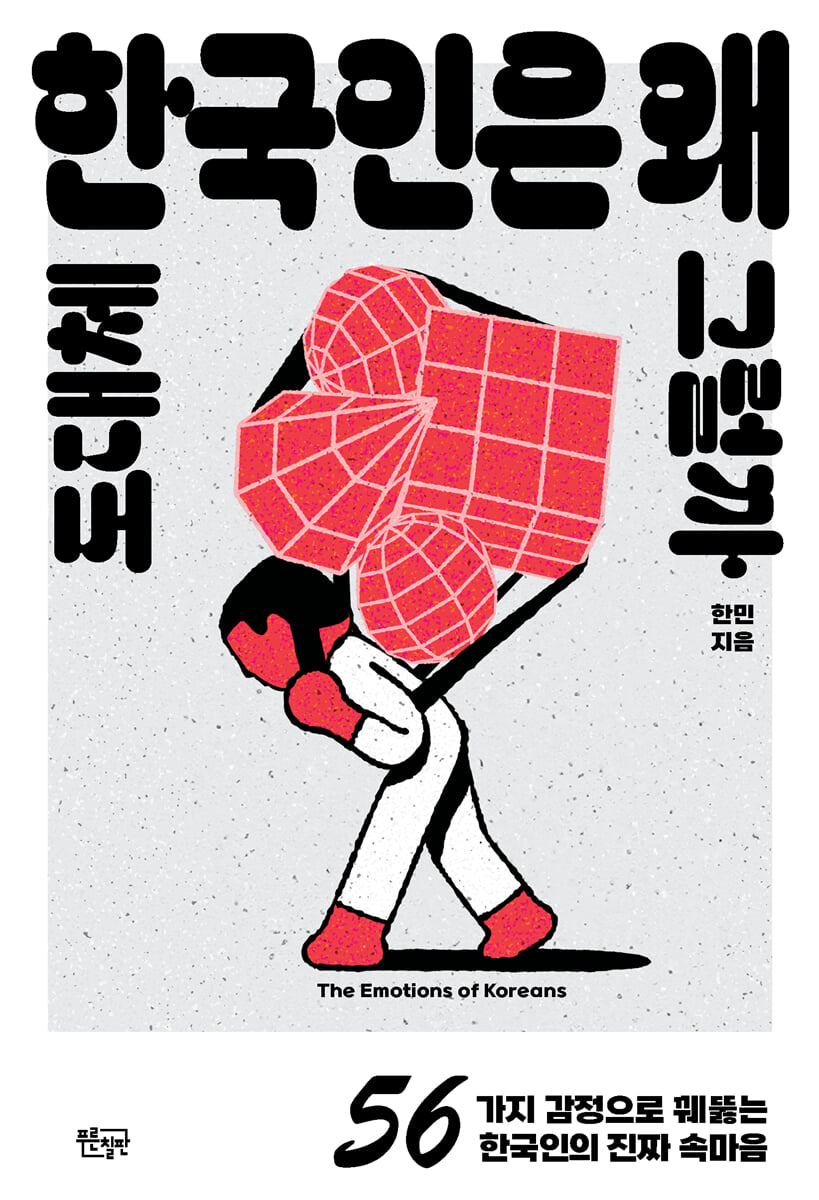
Why on earth are Koreans like that?
 |
Description
Book Introduction
“Emotions are the most powerful tool and protective shield for human survival as social beings!”
A dictionary of Korean emotions that accurately reads the minds of Koreans using 56 keywords.
With the rise in the number of people suffering from mental illness and growing interest in mental health, more and more people are seeking psychiatric care and counseling. While we often talk about the importance of emotions, how well do we actually understand our own? In fact, understanding our emotions is crucial not only for understanding ourselves, but also for understanding others and living as social beings.
In particular, beyond the universal human emotions that apply across all cultures, each culture has emotions that apply within its social context. For Koreans, there are emotions that can be understood within a unique Korean temperament and sociocultural context, so understanding them is essential to living as a Korean.
Many Koreans, even psychiatrists who treat people's mental health, say that because of the culture's repression of emotional expression, Koreans are unaware of their own emotional state and are vulnerable to emotional recognition.
Because of the collectivist culture that suppresses individual autonomy and expression, people are oppressed by the organization and superiors at work, and in society, they are unable to speak up or express their emotions properly because they are concerned about what others think.
But if we actually look around us, there are many people who express their emotions quite intensely.
People who display so-called 'anger management issues', professional inconveniencers and bullies who cannot tolerate even the smallest inconvenience, people who cross the line by meddling and meddlesomeness in others, and even people who vent their frustrations about unfairness.
If Korean culture is so repressive of individual expression and Koreans are truly emotionally insensitive, how can these phenomena be explained?
This book, written by a cultural psychologist, meticulously unravels the emotional system and characteristics of Koreans based on their unique cultural foundations, clearly resolving many misunderstandings about Korean emotions.
This book first examines the basic theories of emotion itself and the way Koreans experience emotions, and then delves into the various Korean emotions categorized into "basic emotions," "social emotions," and "self-conscious emotions."
It covers 56 emotional keywords in detail, including basic concepts, properties and functions, meanings according to cultural context, and tips for expression and understanding, like an encyclopedia, and mentions a total of 133 emotional words.
The emotional vocabulary contained in this book will serve as a compass for understanding the direction of emotions for those studying psychology, counselors, writers, parents, teachers, and others whose work requires a close understanding of the human mind, as well as for anyone seeking personal growth.
A dictionary of Korean emotions that accurately reads the minds of Koreans using 56 keywords.
With the rise in the number of people suffering from mental illness and growing interest in mental health, more and more people are seeking psychiatric care and counseling. While we often talk about the importance of emotions, how well do we actually understand our own? In fact, understanding our emotions is crucial not only for understanding ourselves, but also for understanding others and living as social beings.
In particular, beyond the universal human emotions that apply across all cultures, each culture has emotions that apply within its social context. For Koreans, there are emotions that can be understood within a unique Korean temperament and sociocultural context, so understanding them is essential to living as a Korean.
Many Koreans, even psychiatrists who treat people's mental health, say that because of the culture's repression of emotional expression, Koreans are unaware of their own emotional state and are vulnerable to emotional recognition.
Because of the collectivist culture that suppresses individual autonomy and expression, people are oppressed by the organization and superiors at work, and in society, they are unable to speak up or express their emotions properly because they are concerned about what others think.
But if we actually look around us, there are many people who express their emotions quite intensely.
People who display so-called 'anger management issues', professional inconveniencers and bullies who cannot tolerate even the smallest inconvenience, people who cross the line by meddling and meddlesomeness in others, and even people who vent their frustrations about unfairness.
If Korean culture is so repressive of individual expression and Koreans are truly emotionally insensitive, how can these phenomena be explained?
This book, written by a cultural psychologist, meticulously unravels the emotional system and characteristics of Koreans based on their unique cultural foundations, clearly resolving many misunderstandings about Korean emotions.
This book first examines the basic theories of emotion itself and the way Koreans experience emotions, and then delves into the various Korean emotions categorized into "basic emotions," "social emotions," and "self-conscious emotions."
It covers 56 emotional keywords in detail, including basic concepts, properties and functions, meanings according to cultural context, and tips for expression and understanding, like an encyclopedia, and mentions a total of 133 emotional words.
The emotional vocabulary contained in this book will serve as a compass for understanding the direction of emotions for those studying psychology, counselors, writers, parents, teachers, and others whose work requires a close understanding of the human mind, as well as for anyone seeking personal growth.
- You can preview some of the book's contents.
Preview
index
Prologue Are Koreans Really So Vulnerable to Emotional Recognition?
Chapter 1.
Understanding the Meaning of Emotions and the Korean Mind
'Emotions' in terms
Elements and composition of emotions
Classification of emotions
Characteristics of the Korean mind
Cultural sentiment and the Korean mind
Chapter 2.
Universal human experiences, basic emotions
If the most terrifying moment in your life comes_horror
Joy is a nutrient for our mental health.
Heartbreaking sadness protects me_Sadness
Why are Koreans always angry?_Anger
When the desire to distinguish between oneself and others becomes excessive, it becomes disgust.
Why You Should Calm Yourself When You're Startled_Surprise
When life feels hard_suffering
Why do I feel like I have to do something when my teeth hurt? _Boredom
What's Important for the Mental Health of Anxious Koreans: Reassurance
The things I wish for bring up many emotions_Wind
When you encounter freedom and peace in the state of no-self_ecstasy
Chapter 3.
Social emotions that arise in social relationships
Gratitude: An emotion that must be expressed in every society
When you miss someone but can't, your heart aches_longing
If a joyful moment comes that makes your eyes sparkle_Happiness
With a proud heart like looking at my own child_I am proud
The important heart that forms the foundation of social maintenance_emotion
Love is an intensity that is immediately apparent without words.
The comfort of knowing you're not alone_a sense of belonging
If there is no one in the world you can trust_Trust
What you need when you want to get deeper_Intimacy
If you are in front of someone who naturally bows their head, you have respect.
A heart that can be felt without words_Jeong
When it's so heartbreaking to see someone sad_pity
Why Saying "You Offended Me" Is Dangerous_Annoyance
The feeling of wanting to avoid something if possible_burden
If you're not related, there's no need to be disappointed_sad
I hate the sight of you, but I don't want to break up our relationship_Hate
Don't let envy turn into hatred_Envy
Enjoying solitude too much can be harmful_loneliness
When you feel like crawling into a hole_embarrassment
A strangely uneasy and uncomfortable state of mind_a sense of discomfort
Chapter 4.
Self-conscious emotions interpreted from one's own perspective
When my leisurely pace makes you anxious_leisurely
If excessive expression of joy is a problem_gratification
Finding fun in life also requires balance_fun
What it takes to fight fear: courage
The exhilarating feeling of relief from 10 years of chronic pain all at once
The emotion of wisdom to restore self-worth_Shinmyeong
Appropriate pride is the lifeblood of life_Pride
A presence that is revealed only after being wounded_self-esteem
Objectification is essential when you feel unfairness and injustice_Injustice
Let the desire to not lose to others help me grow.
When something unexpected happens and you don't know what to do_bewilderment
Shame creates a better 'me'_Shame
When Guilt Becomes an Opportunity to Right a Wrong_Guilt
So as not to fall into a greater sense of loss_sadness
When the arrows of injustice are pointed at me and I become powerless_sorrow
Today's regrets become tomorrow's new strength_Regret
If you feel dissatisfied with someone close to you_dissatisfaction
When someone tells me they are disappointed in me_disappointment
If your life goals or expectations lose their purpose, you will feel empty.
I wish you would leave me alone_annoying
When things don't go your way, it's frustrating
When you feel overly impatient, adjust your goals_Impatience
You have to know how to regret to dream of a better future.
Even if it's unfair and sad, life must go on_Han (恨)
A confused person needs enough time_Confusion
Appendix: Korean Emotions Expressed Through Physical Feeling, Taste, and Temperature
Epilogue: Emotion Recognition and Utilization at a Glance
Search
Chapter 1.
Understanding the Meaning of Emotions and the Korean Mind
'Emotions' in terms
Elements and composition of emotions
Classification of emotions
Characteristics of the Korean mind
Cultural sentiment and the Korean mind
Chapter 2.
Universal human experiences, basic emotions
If the most terrifying moment in your life comes_horror
Joy is a nutrient for our mental health.
Heartbreaking sadness protects me_Sadness
Why are Koreans always angry?_Anger
When the desire to distinguish between oneself and others becomes excessive, it becomes disgust.
Why You Should Calm Yourself When You're Startled_Surprise
When life feels hard_suffering
Why do I feel like I have to do something when my teeth hurt? _Boredom
What's Important for the Mental Health of Anxious Koreans: Reassurance
The things I wish for bring up many emotions_Wind
When you encounter freedom and peace in the state of no-self_ecstasy
Chapter 3.
Social emotions that arise in social relationships
Gratitude: An emotion that must be expressed in every society
When you miss someone but can't, your heart aches_longing
If a joyful moment comes that makes your eyes sparkle_Happiness
With a proud heart like looking at my own child_I am proud
The important heart that forms the foundation of social maintenance_emotion
Love is an intensity that is immediately apparent without words.
The comfort of knowing you're not alone_a sense of belonging
If there is no one in the world you can trust_Trust
What you need when you want to get deeper_Intimacy
If you are in front of someone who naturally bows their head, you have respect.
A heart that can be felt without words_Jeong
When it's so heartbreaking to see someone sad_pity
Why Saying "You Offended Me" Is Dangerous_Annoyance
The feeling of wanting to avoid something if possible_burden
If you're not related, there's no need to be disappointed_sad
I hate the sight of you, but I don't want to break up our relationship_Hate
Don't let envy turn into hatred_Envy
Enjoying solitude too much can be harmful_loneliness
When you feel like crawling into a hole_embarrassment
A strangely uneasy and uncomfortable state of mind_a sense of discomfort
Chapter 4.
Self-conscious emotions interpreted from one's own perspective
When my leisurely pace makes you anxious_leisurely
If excessive expression of joy is a problem_gratification
Finding fun in life also requires balance_fun
What it takes to fight fear: courage
The exhilarating feeling of relief from 10 years of chronic pain all at once
The emotion of wisdom to restore self-worth_Shinmyeong
Appropriate pride is the lifeblood of life_Pride
A presence that is revealed only after being wounded_self-esteem
Objectification is essential when you feel unfairness and injustice_Injustice
Let the desire to not lose to others help me grow.
When something unexpected happens and you don't know what to do_bewilderment
Shame creates a better 'me'_Shame
When Guilt Becomes an Opportunity to Right a Wrong_Guilt
So as not to fall into a greater sense of loss_sadness
When the arrows of injustice are pointed at me and I become powerless_sorrow
Today's regrets become tomorrow's new strength_Regret
If you feel dissatisfied with someone close to you_dissatisfaction
When someone tells me they are disappointed in me_disappointment
If your life goals or expectations lose their purpose, you will feel empty.
I wish you would leave me alone_annoying
When things don't go your way, it's frustrating
When you feel overly impatient, adjust your goals_Impatience
You have to know how to regret to dream of a better future.
Even if it's unfair and sad, life must go on_Han (恨)
A confused person needs enough time_Confusion
Appendix: Korean Emotions Expressed Through Physical Feeling, Taste, and Temperature
Epilogue: Emotion Recognition and Utilization at a Glance
Search
Into the book
The term 'agentive mind' refers to the voluntary mind controlled and exercised by an individual who is the owner of the mind. This is well reflected in the expressions about 'mind' that Koreans often use.
As the master of one's mind, an individual 'uses' one's mind, 'uses' one's mind, 'eats' one's mind (makes up one's mind), 'lets go' one's mind (lets go), and 'loads and collects' one's mind.
At this time, the mind has the ‘dominance and arbitrariness’ of observing and controlling the individual’s actions.
Subjectivity means that the mind becomes an agent that controls the individual's actions, while arbitrariness means that the mind's operation is highly subjective and personal.
Koreans value this sense of ownership, that is, the aspect of eating, holding, and using one's mind.
--- 「Chapter 1.
From "Understanding the Meaning of Emotions and the Korean Mind"
Korean culture is also very unique in its perspective on anger.
As foreigners have observed, Koreans are always angry, and anger is a representative emotion used to describe Koreans. In reality, Koreans are particularly sensitive to 'unfair situations.'
In Korean culture, the emotions associated with unfair situations can be understood as a cultural concept called 'injustice.'
--- 「Chapter 2.
From “Universal Human Experience, Basic Emotions”
In Korean culture, when we think of affection, we often think of grandmothers who give everything to their grandchildren. In essence, affection is the feeling of giving because you want to give.
This mind arises from the subjectivity of action and the subjectivity of relationship.
Even if the other person is not my grandchild, and even if the other person does not want it, I have to give it to them if I want to.
This is where the Korean behavioral traits of meddling and meddlesomeness come into play.
People meddle in other people's business because they are 'different from others', 'feel sorry and sad', and 'can't stay still'.
Of course, this definition of subjectivity and identity has its pros and cons.
Another important property that can be seen in the form of the act of justice is that the expression of justice is done nonverbally.
It's like telepathy, 'I know even if you don't say it.'
--- 「Chapter 3.
From “Social Emotions Arising in Social Relationships”
Shinmyeong becomes an opportunity to release the negative emotions accumulated in daily life and recharge with new energy.
Just like extreme sadness or fear, extreme pleasure and excitement have a cathartic effect, and in the process of releasing repressed desires through various expressive behaviors to express such joy and excitement, one discovers an inner energy that one was not aware of.
In fact, Korean culture is ingrained with the idea that if you have the spirit, you can do anything, and because of this, spirit has been known as the source of Koreans' "mysterious energy."
--- 「Chapter 4.
From “Self-conscious emotions interpreted from one’s own perspective”
Han (恨) has a cultural function called ‘adaptation.’
The damage to self-worth is serious, but it is not easy to immediately restore it.
Still, life must go on, so people blame themselves for the injustice they have suffered and try to console themselves by saying that this is just how the world is.
These psychological processes also serve as wisdom for life, just as a oyster that holds a stone creates a pearl.
Meanwhile, Han goes through three stages to become a static and detached emotion, but not all Han ends up in a static state.
Han (恨) also acts as a powerful motive for releasing resentment, that is, venting one's anger.
As the master of one's mind, an individual 'uses' one's mind, 'uses' one's mind, 'eats' one's mind (makes up one's mind), 'lets go' one's mind (lets go), and 'loads and collects' one's mind.
At this time, the mind has the ‘dominance and arbitrariness’ of observing and controlling the individual’s actions.
Subjectivity means that the mind becomes an agent that controls the individual's actions, while arbitrariness means that the mind's operation is highly subjective and personal.
Koreans value this sense of ownership, that is, the aspect of eating, holding, and using one's mind.
--- 「Chapter 1.
From "Understanding the Meaning of Emotions and the Korean Mind"
Korean culture is also very unique in its perspective on anger.
As foreigners have observed, Koreans are always angry, and anger is a representative emotion used to describe Koreans. In reality, Koreans are particularly sensitive to 'unfair situations.'
In Korean culture, the emotions associated with unfair situations can be understood as a cultural concept called 'injustice.'
--- 「Chapter 2.
From “Universal Human Experience, Basic Emotions”
In Korean culture, when we think of affection, we often think of grandmothers who give everything to their grandchildren. In essence, affection is the feeling of giving because you want to give.
This mind arises from the subjectivity of action and the subjectivity of relationship.
Even if the other person is not my grandchild, and even if the other person does not want it, I have to give it to them if I want to.
This is where the Korean behavioral traits of meddling and meddlesomeness come into play.
People meddle in other people's business because they are 'different from others', 'feel sorry and sad', and 'can't stay still'.
Of course, this definition of subjectivity and identity has its pros and cons.
Another important property that can be seen in the form of the act of justice is that the expression of justice is done nonverbally.
It's like telepathy, 'I know even if you don't say it.'
--- 「Chapter 3.
From “Social Emotions Arising in Social Relationships”
Shinmyeong becomes an opportunity to release the negative emotions accumulated in daily life and recharge with new energy.
Just like extreme sadness or fear, extreme pleasure and excitement have a cathartic effect, and in the process of releasing repressed desires through various expressive behaviors to express such joy and excitement, one discovers an inner energy that one was not aware of.
In fact, Korean culture is ingrained with the idea that if you have the spirit, you can do anything, and because of this, spirit has been known as the source of Koreans' "mysterious energy."
--- 「Chapter 4.
From “Self-conscious emotions interpreted from one’s own perspective”
Han (恨) has a cultural function called ‘adaptation.’
The damage to self-worth is serious, but it is not easy to immediately restore it.
Still, life must go on, so people blame themselves for the injustice they have suffered and try to console themselves by saying that this is just how the world is.
These psychological processes also serve as wisdom for life, just as a oyster that holds a stone creates a pearl.
Meanwhile, Han goes through three stages to become a static and detached emotion, but not all Han ends up in a static state.
Han (恨) also acts as a powerful motive for releasing resentment, that is, venting one's anger.
--- 「Chapter 4.
From “Self-conscious emotions that think from one’s own perspective”
From “Self-conscious emotions that think from one’s own perspective”
Publisher's Review
Are Koreans vulnerable to emotional recognition?
We uncover the secrets of the Korean heart that even Koreans don't know about!
“Koreans have a strong desire for expression.
This is related to the desire to exert influence as an 'I' that emerges from the subjectivity of the self, and can be summarized in one word: "Do you know who I am?!"
Koreans are a people who constantly strive to make their presence known.
Therefore, the expression of emotions is also very delicate and active.
Even when compared to Japan, which is classified as a collectivist cultural sphere similar to Korea, the difference is clear.
Therefore, Koreans most dislike situations where ‘my expression is restricted/suppressed.’
If you suffer injustice, you will not be able to go to the afterlife even after you die and will become a ghost.
When a person's expression is restricted, he or she becomes ill.
Hwa-byung is a representative cultural dependence syndrome in Korea.
(……)
Emotions evoke changes in my body and mind, and people in the culture I live in have created and used words to define them.
In these times when social change and technological advancements are making communication between people more difficult, understanding our own emotions and those of others will become the foundation for social interaction and emotional support.
Above all, precisely sensing and expressing my state of mind is a way of self-understanding and self-realization.
- From the prologue
We uncover the secrets of the Korean heart that even Koreans don't know about!
“Koreans have a strong desire for expression.
This is related to the desire to exert influence as an 'I' that emerges from the subjectivity of the self, and can be summarized in one word: "Do you know who I am?!"
Koreans are a people who constantly strive to make their presence known.
Therefore, the expression of emotions is also very delicate and active.
Even when compared to Japan, which is classified as a collectivist cultural sphere similar to Korea, the difference is clear.
Therefore, Koreans most dislike situations where ‘my expression is restricted/suppressed.’
If you suffer injustice, you will not be able to go to the afterlife even after you die and will become a ghost.
When a person's expression is restricted, he or she becomes ill.
Hwa-byung is a representative cultural dependence syndrome in Korea.
(……)
Emotions evoke changes in my body and mind, and people in the culture I live in have created and used words to define them.
In these times when social change and technological advancements are making communication between people more difficult, understanding our own emotions and those of others will become the foundation for social interaction and emotional support.
Above all, precisely sensing and expressing my state of mind is a way of self-understanding and self-realization.
- From the prologue
GOODS SPECIFICS
- Date of issue: August 30, 2025
- Page count, weight, size: 284 pages | 446g | 140*205*20mm
- ISBN13: 9791191638288
- ISBN10: 1191638286
You may also like
카테고리
korean


korean

![ELLE 엘르 스페셜 에디션 A형 : 12월 [2025]](http://librairie.coreenne.fr/cdn/shop/files/b8e27a3de6c9538896439686c6b0e8fb.jpg?v=1766436872&width=3840)


