

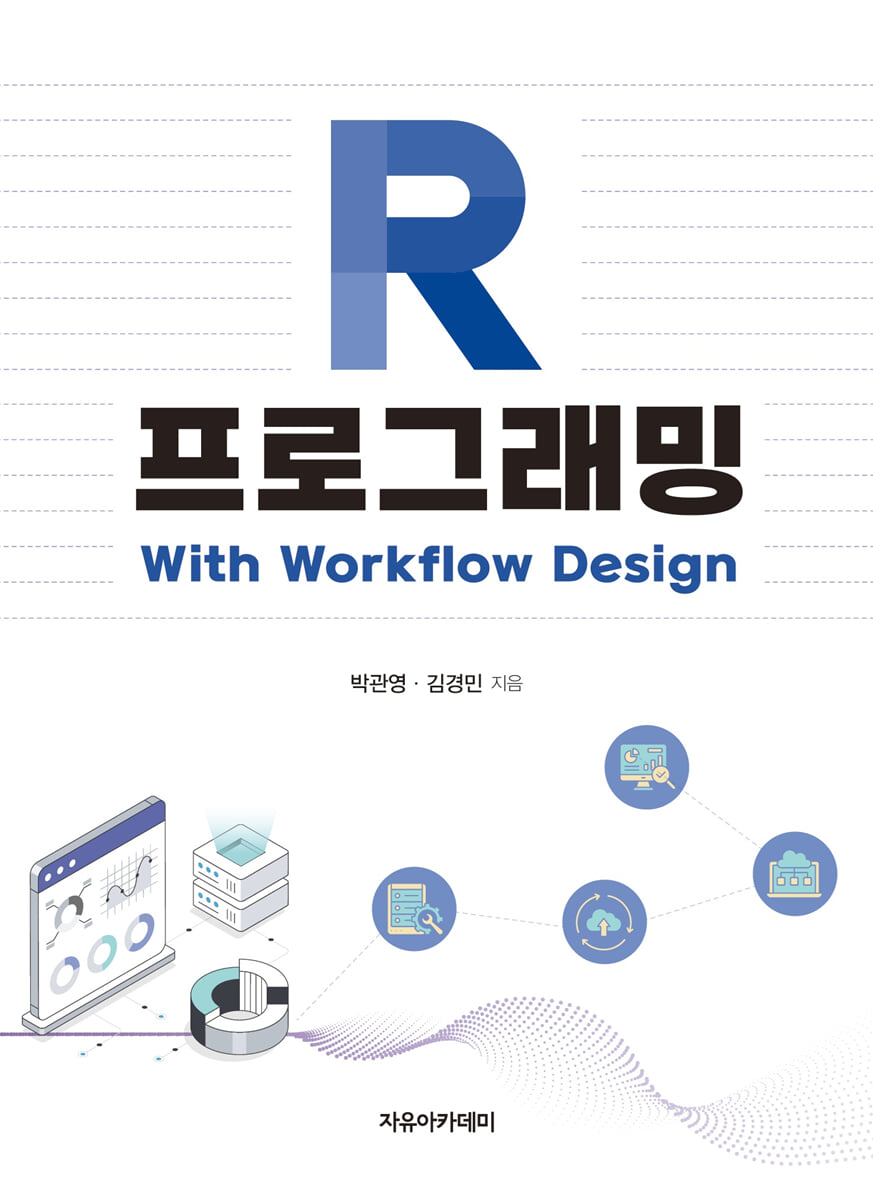
R Programming: with Workflow Design
 |
Description
Book Introduction
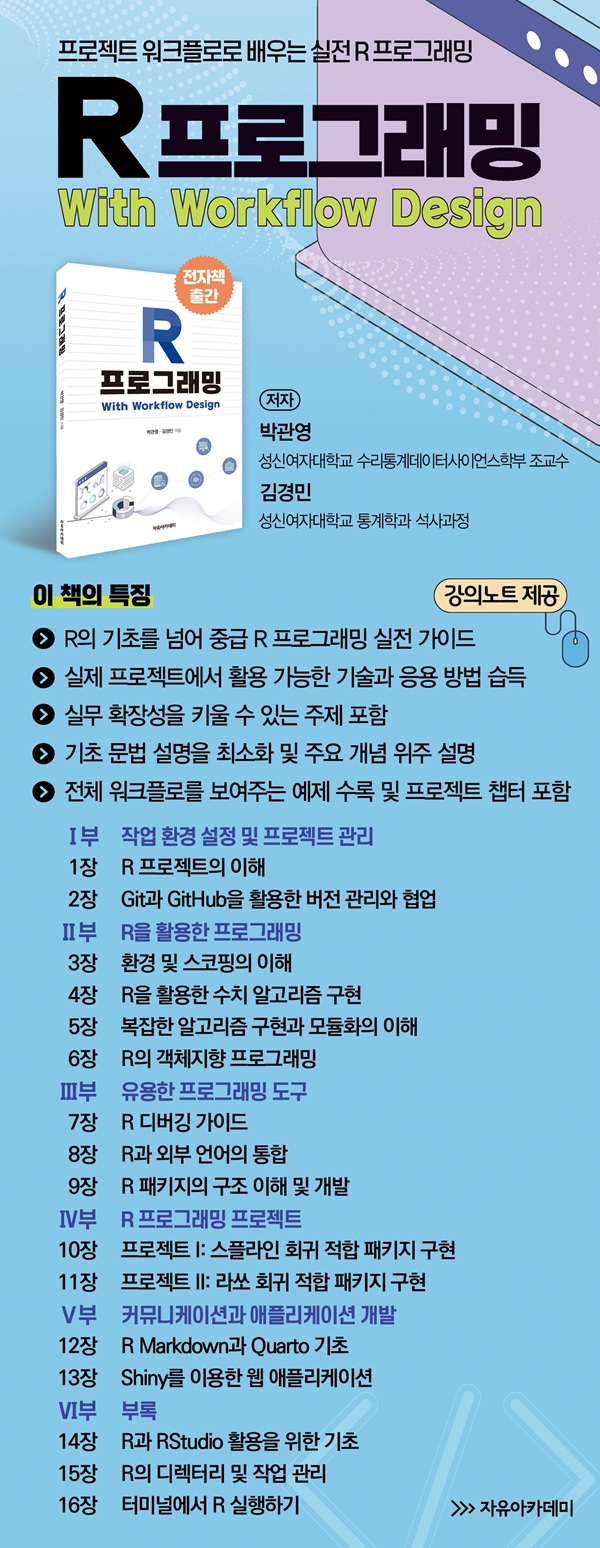
This book covers intermediate programming knowledge for practical application from a project workflow perspective.
This course is designed for students, researchers, and practitioners who have already mastered the basics of R, and aims to provide techniques and application methods that can be immediately applied in actual projects.
This will help readers either implement the functionality they need for their own projects or understand and adapt it to other tools.
This course is designed for students, researchers, and practitioners who have already mastered the basics of R, and aims to provide techniques and application methods that can be immediately applied in actual projects.
This will help readers either implement the functionality they need for their own projects or understand and adapt it to other tools.
index
Part I: Setting Up Your Work Environment and Managing Your Projects
Chapter 1 Understanding R Projects 1.1 Creating an R Project 1.2 Advantages of R Projects 1.3 When Should You Use an R Project?
Chapter 2 Version control and collaboration using Git and GitHub 2.1 Understanding Git and GitHub 2.2 Installation and project setup process 2.3 Features of Git 2.4 Basic functions of Git 2.5 Collaboration process using GitHub
Part II: Programming with R
Chapter 3 Understanding Environments and Scoping 3.1 Basics of Environments and Search Paths 3.2 Scoping Rules and the Structure of Environments 3.3 Understanding the Operating Environment and Function Calls
Chapter 4: Implementing Numerical Algorithms Using R 4.1 Understanding Numerical Algorithms 4.2 Programming Guidelines for Algorithm Implementation 4.3 Understanding the Implementation Process through Sorting Algorithms 4.4 Numerical Linear Algebra: Gaussian Elimination
Chapter 5: Understanding Complex Algorithm Implementation and Modularization 5.1 The Need for Algorithm Design and Modularization 5.2 Understanding Spline Regression Models 5.3 Modular Design for Implementing Spline Regression Model Fitting 5.4 Implementing Spline Regression Model Fitting Using R 5.5 Managing and Executing Modularized Code
Chapter 6 Object-Oriented Programming in R 6.1 Fundamentals of Object-Oriented Programming in R 6.2 Classes and Attributes 6.3 Generic Functions 6.4 Implementing Generic Functions and Methods 6.5 Example: Spline Basis Function Plot Method
Part III Useful Programming Tools
Chapter 7 R Debugging Guide 7.1 Example Functions 7.2 Debugging Using Traceback() 7.3 Debugging Using Browser() 7.4 Debugging Using Debug() and Debugonce()
Chapter 8 Integration of R and External Languages 8.1 Reasons for Integration with External Languages 8.2 Integration of R and C++ using Rcpp 8.3 Integration of R and Python using reticulate
Chapter 9 Understanding and Developing R Packages 9.1 Why You Should Study R Package Development 9.2 Package Structure and Metadata 9.3 Documentation and Namespace Management Using Roxygen2 9.4 Package Development Using Rcpp 9.5 Understanding the Package Distribution Process
Part IV R Programming Project
Chapter 10 Project I: Implementing a Spline Regression Fit Package 10.1 Package Functionality and Structure 10.2 Implementing a Spline Regression Fit 10.3 Managing Metadata 10.4 Adding Example Data 10.5 Writing and Distributing a Manual
Chapter 11 Project II: Implementing the Lasso Regression Fit Package 11.1 Understanding the Lasso Regression Model 11.2 Understanding the Coordinate Descent Algorithm 11.3 Implementation Using R 11.4 Implementation Using Rcpp 11.5 Deployment and Scalability
Part V Communication and Application Development
Chapter 12 R Markdown and Quarto Basics 12.1 Understanding R Markdown and Quarto 12.2 Getting Started with R Markdown and Quarto 12.3 R Markdown Basics 12.4 Changes When Using Quarto
Chapter 13 Web Applications with Shiny 13.1 Application Deployment and Understanding Shiny 13.2 Getting Started with Shiny 13.3 Structure and Basic Code of a Shiny Application 13.4 Project: Data Analysis and Results Summary Application Development
Part VI Appendix
Chapter 14: Basics for Using R and RStudio 14.1 Installing R and RStudio and Installing Packages 14.2 Path Management 14.3 R Objects 14.4 Loops and Conditional Statements 14.5 Defining and Calling Functions
Chapter 15: Managing directories and tasks in R 15.1 Basic functions related to files and directories 15.2 Creating and managing directories 15.3 Handling paths and files 15.4 Executing scripts and managing tasks
Chapter 16 Running R in the Terminal 16.1 Running R in the Terminal 16.2 Frequently Used Commands in a Server Environment 16.3 Installing Packages and Setting Library Paths 16.4 Summary
?References
Chapter 1 Understanding R Projects 1.1 Creating an R Project 1.2 Advantages of R Projects 1.3 When Should You Use an R Project?
Chapter 2 Version control and collaboration using Git and GitHub 2.1 Understanding Git and GitHub 2.2 Installation and project setup process 2.3 Features of Git 2.4 Basic functions of Git 2.5 Collaboration process using GitHub
Part II: Programming with R
Chapter 3 Understanding Environments and Scoping 3.1 Basics of Environments and Search Paths 3.2 Scoping Rules and the Structure of Environments 3.3 Understanding the Operating Environment and Function Calls
Chapter 4: Implementing Numerical Algorithms Using R 4.1 Understanding Numerical Algorithms 4.2 Programming Guidelines for Algorithm Implementation 4.3 Understanding the Implementation Process through Sorting Algorithms 4.4 Numerical Linear Algebra: Gaussian Elimination
Chapter 5: Understanding Complex Algorithm Implementation and Modularization 5.1 The Need for Algorithm Design and Modularization 5.2 Understanding Spline Regression Models 5.3 Modular Design for Implementing Spline Regression Model Fitting 5.4 Implementing Spline Regression Model Fitting Using R 5.5 Managing and Executing Modularized Code
Chapter 6 Object-Oriented Programming in R 6.1 Fundamentals of Object-Oriented Programming in R 6.2 Classes and Attributes 6.3 Generic Functions 6.4 Implementing Generic Functions and Methods 6.5 Example: Spline Basis Function Plot Method
Part III Useful Programming Tools
Chapter 7 R Debugging Guide 7.1 Example Functions 7.2 Debugging Using Traceback() 7.3 Debugging Using Browser() 7.4 Debugging Using Debug() and Debugonce()
Chapter 8 Integration of R and External Languages 8.1 Reasons for Integration with External Languages 8.2 Integration of R and C++ using Rcpp 8.3 Integration of R and Python using reticulate
Chapter 9 Understanding and Developing R Packages 9.1 Why You Should Study R Package Development 9.2 Package Structure and Metadata 9.3 Documentation and Namespace Management Using Roxygen2 9.4 Package Development Using Rcpp 9.5 Understanding the Package Distribution Process
Part IV R Programming Project
Chapter 10 Project I: Implementing a Spline Regression Fit Package 10.1 Package Functionality and Structure 10.2 Implementing a Spline Regression Fit 10.3 Managing Metadata 10.4 Adding Example Data 10.5 Writing and Distributing a Manual
Chapter 11 Project II: Implementing the Lasso Regression Fit Package 11.1 Understanding the Lasso Regression Model 11.2 Understanding the Coordinate Descent Algorithm 11.3 Implementation Using R 11.4 Implementation Using Rcpp 11.5 Deployment and Scalability
Part V Communication and Application Development
Chapter 12 R Markdown and Quarto Basics 12.1 Understanding R Markdown and Quarto 12.2 Getting Started with R Markdown and Quarto 12.3 R Markdown Basics 12.4 Changes When Using Quarto
Chapter 13 Web Applications with Shiny 13.1 Application Deployment and Understanding Shiny 13.2 Getting Started with Shiny 13.3 Structure and Basic Code of a Shiny Application 13.4 Project: Data Analysis and Results Summary Application Development
Part VI Appendix
Chapter 14: Basics for Using R and RStudio 14.1 Installing R and RStudio and Installing Packages 14.2 Path Management 14.3 R Objects 14.4 Loops and Conditional Statements 14.5 Defining and Calling Functions
Chapter 15: Managing directories and tasks in R 15.1 Basic functions related to files and directories 15.2 Creating and managing directories 15.3 Handling paths and files 15.4 Executing scripts and managing tasks
Chapter 16 Running R in the Terminal 16.1 Running R in the Terminal 16.2 Frequently Used Commands in a Server Environment 16.3 Installing Packages and Setting Library Paths 16.4 Summary
?References
Detailed image
Publisher's Review
preface
R is a powerful tool with a long history in statistical analysis and data science.
R is a widely used tool for learning data analysis, and related basic materials and introductory books are easily available in bookstores or on the Internet.
Many people take their first steps by learning the basic syntax and basic data analysis methods of R through these materials.
However, there is a relative lack of materials that cover the intermediate-level programming skills and knowledge required to solve real-world problems beyond the basics of R.
There's a reason why there are so few books for intermediate users.
Users at this stage are able to independently acquire the necessary knowledge from specialized materials such as official documents, papers, and original books, and are often capable of solving problems in a desired direction by obtaining sources from the Internet and conducting a little research.
However, this process does not come naturally to all learners.
It is also common to see people lose their direction or interest and fail to overcome the traps of intermediate players.
If you fail to acquire skills and insights beyond the basics, you will face limitations in increasing productivity when conducting data analysis or research in the field.
If you understand basic grammar, you can understand other people's simple code or analysis results, but you don't have the practice of producing something yourself.
This is also related to the linguistic nature of R.
Since a programming language is, after all, a language, you can only become familiar with it after going beyond basic grammar and going through the process of actually using it.
This book covers intermediate programming knowledge for practical application from a project workflow perspective.
This course is designed for students, researchers, and practitioners who have already mastered the basics of R, and aims to provide techniques and application methods that can be immediately applied in actual projects.
This will help readers either implement the functionality they need for their own projects or understand and adapt it to other tools.
The text consists of five parts.
In Part I, you will learn the basics of setting up a work environment and managing projects.
Part II through Part IV are the core of this book.
The content of the book is based on R lectures given to graduate students, undergraduate researchers, and developer groups.
One area where many learners struggle as they progress to the intermediate level is understanding and utilizing the capabilities of R as a programming language.
Unlike statistical software such as SPSS, R is a programming language that allows you to directly implement and manage various functions and features.
These topics are covered in detail in Parts II and III.
In Part IV, we will directly code a package for statistical inference.
Part V covers communication and distribution of analysis and programming results.
Part VI contains appendices that may be helpful in understanding the text.
To share practical knowledge, this book intentionally avoids a dictionary-style structure.
Listing the basic grammar and major packages of R could create a thick dictionary-like manual, but learning programming through this method is like studying English conversation using an English dictionary.
To avoid this approach, this book minimizes explanations of basic grammar, focuses on key concepts, and provides references where necessary.
Instead, we've included examples that demonstrate the entire workflow, with project chapters placed after the core parts to help you learn how the content is actually used.
The main example codes included in the book can be found in the GitHub repository (https://github.com/kybak90/R_programming_workflow_book), and will be helpful for learning by practicing or following the code flow.
Please note that any revisions made after publication will be posted in the data room of the Free Academy website (www.freeaca.com).
I hope this book will help you move beyond simply using R and begin your journey to expanding your capabilities as a data scientist by using it to solve various challenges you face in the field.
R is a powerful tool with a long history in statistical analysis and data science.
R is a widely used tool for learning data analysis, and related basic materials and introductory books are easily available in bookstores or on the Internet.
Many people take their first steps by learning the basic syntax and basic data analysis methods of R through these materials.
However, there is a relative lack of materials that cover the intermediate-level programming skills and knowledge required to solve real-world problems beyond the basics of R.
There's a reason why there are so few books for intermediate users.
Users at this stage are able to independently acquire the necessary knowledge from specialized materials such as official documents, papers, and original books, and are often capable of solving problems in a desired direction by obtaining sources from the Internet and conducting a little research.
However, this process does not come naturally to all learners.
It is also common to see people lose their direction or interest and fail to overcome the traps of intermediate players.
If you fail to acquire skills and insights beyond the basics, you will face limitations in increasing productivity when conducting data analysis or research in the field.
If you understand basic grammar, you can understand other people's simple code or analysis results, but you don't have the practice of producing something yourself.
This is also related to the linguistic nature of R.
Since a programming language is, after all, a language, you can only become familiar with it after going beyond basic grammar and going through the process of actually using it.
This book covers intermediate programming knowledge for practical application from a project workflow perspective.
This course is designed for students, researchers, and practitioners who have already mastered the basics of R, and aims to provide techniques and application methods that can be immediately applied in actual projects.
This will help readers either implement the functionality they need for their own projects or understand and adapt it to other tools.
The text consists of five parts.
In Part I, you will learn the basics of setting up a work environment and managing projects.
Part II through Part IV are the core of this book.
The content of the book is based on R lectures given to graduate students, undergraduate researchers, and developer groups.
One area where many learners struggle as they progress to the intermediate level is understanding and utilizing the capabilities of R as a programming language.
Unlike statistical software such as SPSS, R is a programming language that allows you to directly implement and manage various functions and features.
These topics are covered in detail in Parts II and III.
In Part IV, we will directly code a package for statistical inference.
Part V covers communication and distribution of analysis and programming results.
Part VI contains appendices that may be helpful in understanding the text.
To share practical knowledge, this book intentionally avoids a dictionary-style structure.
Listing the basic grammar and major packages of R could create a thick dictionary-like manual, but learning programming through this method is like studying English conversation using an English dictionary.
To avoid this approach, this book minimizes explanations of basic grammar, focuses on key concepts, and provides references where necessary.
Instead, we've included examples that demonstrate the entire workflow, with project chapters placed after the core parts to help you learn how the content is actually used.
The main example codes included in the book can be found in the GitHub repository (https://github.com/kybak90/R_programming_workflow_book), and will be helpful for learning by practicing or following the code flow.
Please note that any revisions made after publication will be posted in the data room of the Free Academy website (www.freeaca.com).
I hope this book will help you move beyond simply using R and begin your journey to expanding your capabilities as a data scientist by using it to solve various challenges you face in the field.
GOODS SPECIFICS
- Date of issue: August 18, 2025
- Page count, weight, size: 232 pages | 188*257*10mm
- ISBN13: 9791158087449
- ISBN10: 1158087446
You may also like
카테고리
korean


korean

![ELLE 엘르 스페셜 에디션 A형 : 12월 [2025]](http://librairie.coreenne.fr/cdn/shop/files/b8e27a3de6c9538896439686c6b0e8fb.jpg?v=1766436872&width=3840)


