

Functional anatomy
 |
Description
Book Introduction
『Functional Anatomy』 consists of a total of 8 chapters.
Chapter 1 is an introduction designed to help you learn basic terminology related to functional movement, and Chapter 2 is a general introduction to the skeleton, muscles, and nervous system designed to help you briefly recall what you learned in anatomy.
Chapters 3 through 8 are the main body of this book and are organized to help readers understand the outline of each part, skeletal structure, bone palpation, joint and supporting tissue structure, nerve structure, muscle structure, and movement.
In relation to the location of the muscles that attach to the bone, the places where they attach are indicated in red and the places where they touch are indicated in blue. In order to enable a three-dimensional understanding of the muscles in the relevant areas, they are presented as shallow, middle, and deep. In addition, the parts for palpating each muscle are organized so that students can easily follow along according to the content.
Chapter 1 is an introduction designed to help you learn basic terminology related to functional movement, and Chapter 2 is a general introduction to the skeleton, muscles, and nervous system designed to help you briefly recall what you learned in anatomy.
Chapters 3 through 8 are the main body of this book and are organized to help readers understand the outline of each part, skeletal structure, bone palpation, joint and supporting tissue structure, nerve structure, muscle structure, and movement.
In relation to the location of the muscles that attach to the bone, the places where they attach are indicated in red and the places where they touch are indicated in blue. In order to enable a three-dimensional understanding of the muscles in the relevant areas, they are presented as shallow, middle, and deep. In addition, the parts for palpating each muscle are organized so that students can easily follow along according to the content.
index
Chapter 1 Understanding Movement
Chapter 2 Body Systems (Skeleton, Muscles, Nervous System General Theory)
Chapter 3 Shoulder Joint and Upper Arm
Chapter 4 Forearm and Hand
Chapter 5 The Spine and Thoracic Cage
Chapter 6 Pelvis, Hip, and Knee Joints
Chapter 7 Calves and Feet
Chapter 8 Head and Face
Chapter 2 Body Systems (Skeleton, Muscles, Nervous System General Theory)
Chapter 3 Shoulder Joint and Upper Arm
Chapter 4 Forearm and Hand
Chapter 5 The Spine and Thoracic Cage
Chapter 6 Pelvis, Hip, and Knee Joints
Chapter 7 Calves and Feet
Chapter 8 Head and Face
Publisher's Review
A guide to understanding proper functional body movement and facilitating accurate muscles.
Functional anatomy is a discipline that understands human movement and its principles based on human anatomy, and aims to understand the functions of the body's joints and muscles.
Functional anatomy is very important because it involves functional movements and stimulation of the subjects, which leads to related examinations and evaluations, and ultimately to interventions.
Learning about proper functional movement and precise muscle stimulation is essential not only for professionals treating patients with musculoskeletal and neurological disorders, but also for professionals teaching sports, massage, yoga, and Pilates.
This book consists of a total of 8 chapters.
Chapter 1 is an introduction designed to help you learn basic terminology related to functional movement, and Chapter 2 is a general introduction to the skeleton, muscles, and nervous system designed to help you briefly recall what you learned in anatomy.
Chapters 3 through 8 are the main body of this book and are organized to help readers understand the outline of each part, skeletal structure, bone palpation, joint and supporting tissue structure, nerve structure, muscle structure, and movement.
In relation to the location of the muscles that attach to the bone, the places where they attach are indicated in red and the places where they touch are indicated in blue. In order to enable a three-dimensional understanding of the muscles in the relevant areas, they are presented as shallow, middle, and deep. In addition, the parts for palpating each muscle are organized so that students can easily follow along according to the content.
Additionally, the content is organized to assist in decision-making through descriptions of each muscle characteristic, examples of damage and symptoms, and related diseases.
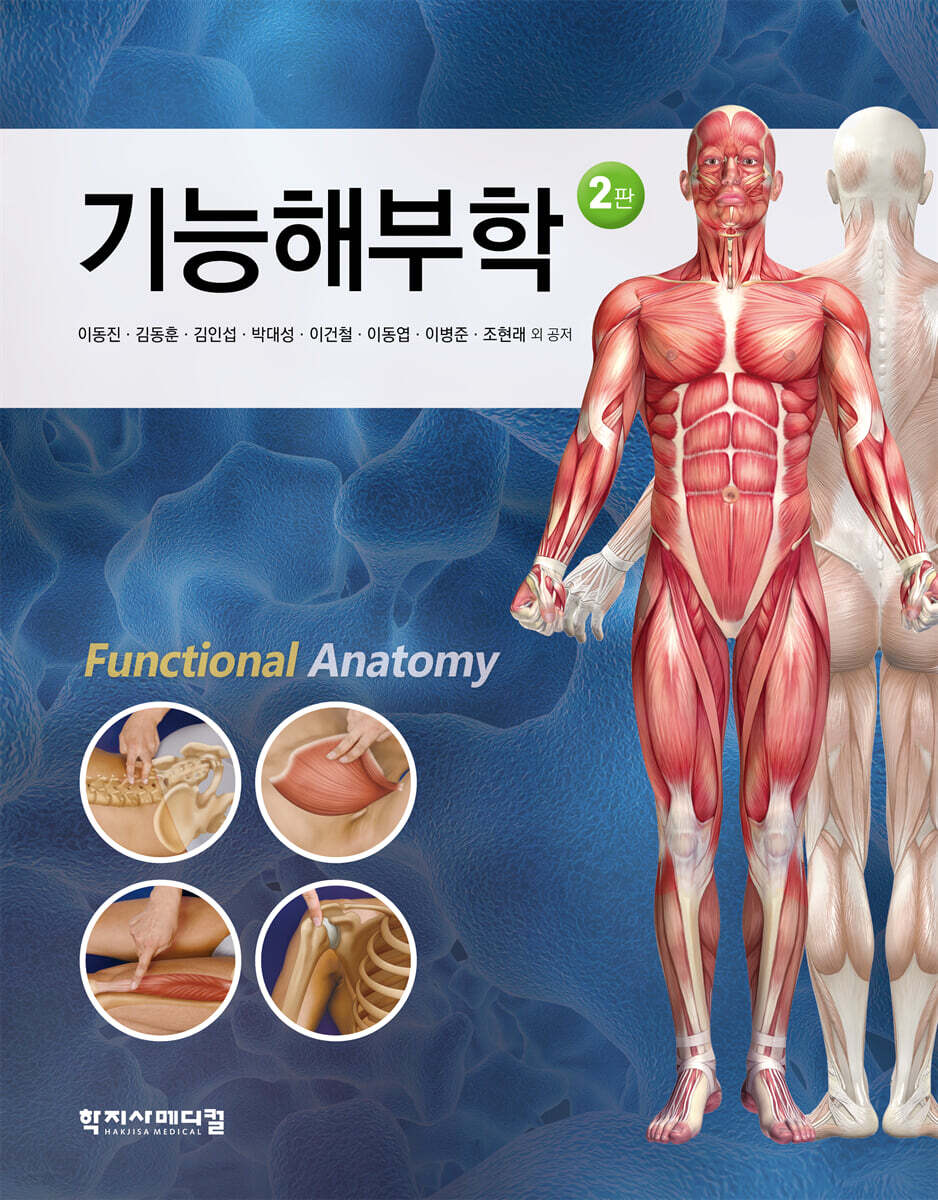
In particular, to help students learning with this textbook, muscles and bones were synthesized onto an actual photographed human body model to enhance the three-dimensional effect.
The second edition was revised to reflect the 6th edition of medical terminology to ensure that there are no problems in preparing for the national examination, and some errors in the first edition were corrected and duplicated parts were boldly deleted.
Functional anatomy is a discipline that understands human movement and its principles based on human anatomy, and aims to understand the functions of the body's joints and muscles.
Functional anatomy is very important because it involves functional movements and stimulation of the subjects, which leads to related examinations and evaluations, and ultimately to interventions.
Learning about proper functional movement and precise muscle stimulation is essential not only for professionals treating patients with musculoskeletal and neurological disorders, but also for professionals teaching sports, massage, yoga, and Pilates.
This book consists of a total of 8 chapters.
Chapter 1 is an introduction designed to help you learn basic terminology related to functional movement, and Chapter 2 is a general introduction to the skeleton, muscles, and nervous system designed to help you briefly recall what you learned in anatomy.
Chapters 3 through 8 are the main body of this book and are organized to help readers understand the outline of each part, skeletal structure, bone palpation, joint and supporting tissue structure, nerve structure, muscle structure, and movement.
In relation to the location of the muscles that attach to the bone, the places where they attach are indicated in red and the places where they touch are indicated in blue. In order to enable a three-dimensional understanding of the muscles in the relevant areas, they are presented as shallow, middle, and deep. In addition, the parts for palpating each muscle are organized so that students can easily follow along according to the content.
Additionally, the content is organized to assist in decision-making through descriptions of each muscle characteristic, examples of damage and symptoms, and related diseases.
In particular, to help students learning with this textbook, muscles and bones were synthesized onto an actual photographed human body model to enhance the three-dimensional effect.
The second edition was revised to reflect the 6th edition of medical terminology to ensure that there are no problems in preparing for the national examination, and some errors in the first edition were corrected and duplicated parts were boldly deleted.
GOODS SPECIFICS
- Date of issue: July 20, 2025
- Format: Hardcover book binding method guide
- Page count, weight, size: 528 pages | 188*257*29mm
- ISBN13: 9791194219965
You may also like
카테고리
korean


korean

![ELLE 엘르 스페셜 에디션 A형 : 12월 [2025]](http://librairie.coreenne.fr/cdn/shop/files/b8e27a3de6c9538896439686c6b0e8fb.jpg?v=1766436872&width=3840)


