

Augmentative and alternative communication
 |
Description
Book Introduction
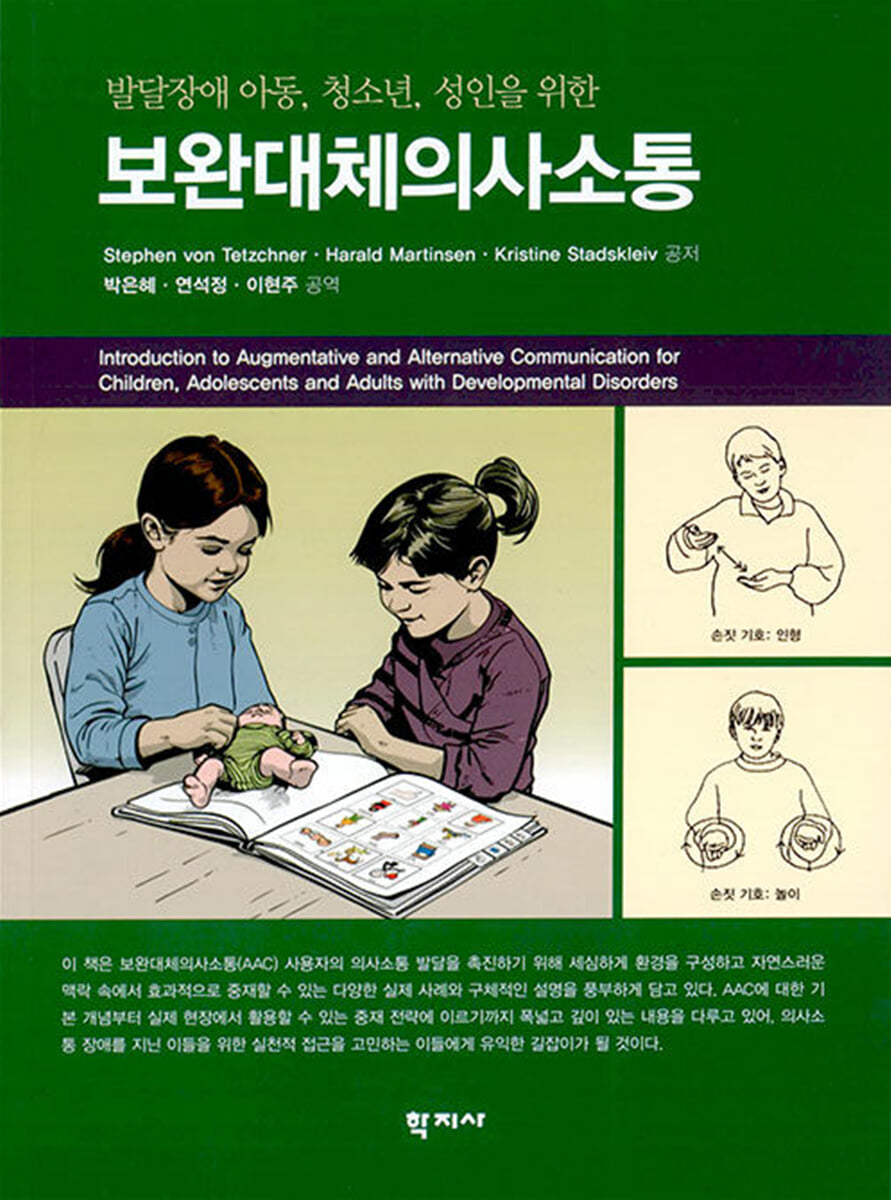
This book is rich in practical examples and detailed explanations, demonstrating how to carefully design environments and effectively implement interventions within natural contexts to foster the communication development of augmentative and alternative communication (AAC) users. Covering a wide range of topics, from basic AAC concepts to practical intervention strategies, this book will serve as a valuable guide for those considering practical approaches for those with communication disabilities.
index
Translator's Preface
Author's Preface
Note: List of Figures, Hand Gestures, and Graphic Symbols, List of Illustrations, Information
Introduction: Introduction
About language and speech
History of Augmentative and Alternative Communication
The diversity of people who need non-verbal communication systems
Overview of each chapter
Terminology
Chapter 1: Augmentative and Alternative Communication
hand gestures
Graphic communication symbols
painting
Spelling
Type and tactile symbols
Choose from hand gestures and graphic communication symbols.
Use in everyday life
Chapter 2 Communication Tools
Types and subtypes of communication tools
Other areas of assistive technology
access
Choosing a Communication Tool
Characteristics of instrumental communication
Chapter 3 Children, Adolescents, and Adults Who Need AAC
Three functional groups
Disability groups that use AAC heavily
Issues Related to Communication Intervention for People with Severe Communication Disorders
Chapter 4 Evaluation
Evaluation and Forecasting
AAC Pyramid: A Framework for Assessment and Follow-up
Evaluation method
Start with the basics
Common problems
motor skills
Visual and auditory
Communication and Language
challenging behavior
Communication partner and environment assessment
Language intervention evaluation
Communicating information when there are changes at school, work, home, etc.
Putting Your Plan into Action: Defining Areas of Responsibility
Chapter 5 Arbitration Situation
Communication situation
Integration
Configuring the teaching situation
Planning for generalization, maintenance, and transfer of skills to new situations
Structuring
Structured or unstructured mediation situations
Planned and unplanned language use
Chapter 6 Mediation Strategies
Evidence-based practice
Getting Started with AAC Intervention
common interest
Implicit and Explicit Learning and Teaching
Use of hand gestures and graphic symbols
Early Intervention Strategies to Promote AAC Understanding
Initial Strategies to Promote AAC Use
General AAC teaching strategies
preparatory training
Formal training in AAC
The problem of technology facilitation
AAC in bilingual environments
The Impact of AAC on Speech Development
Ending AAC Mediation
Chapter 7: Early Gestures and Graphic Symbols
Communication currently in use
Quick Word Match
Overextension and underextension
General and specific vocabulary
Communication success
repeat
motor skills
perception
Iconicity
Simple and complex concepts
What to Expect Early on
Chapter 8: Continuous Vocabulary Development
Measuring vocabulary size
Systematic vocabulary selection
Alternative language group
Supported Language Groups
Expressive language group
Expanding vocabulary with combinations and polysemy
Pre-made vocabulary
24 Principles for a Developmental and Balanced Vocabulary
personal dictionary
From graphic symbols to text
Chapter 9: Sentence Composition with Gestures or Graphic Symbols
Symbol or symbolic sentence support strategy
Order of signs or symbols
Inflection, grammatical signs and symbols
Pre-made sentences
cognitive effort
Language experience
Sentences that serve as a framework for understanding
Diversity of language use
Chapter 10: AAC, Participation, and Activity
Routine activities and variety
play
Dialogue planning as part of the activity
From role-playing to the real world
Interactive Picture Book Reading
AAC and Social Media Engagement
AAC in challenging situations
Chapter 11: Conversational Skills and Narrative
Start, change, and end conversations
Alternative language group
Supported Language Groups
Expressive language group
narrative
Chapter 12 Language Environment
Adapting to Early and Late Language Environments
Simultaneous use of words and hand gestures or graphic symbols
AAC within the family
AAC and Peer Environment
Adult AAC Users as Role Models
Support for teachers and related staff
In conclusion
Glossary of Terms
References
References
Search
Author's Preface
Note: List of Figures, Hand Gestures, and Graphic Symbols, List of Illustrations, Information
Introduction: Introduction
About language and speech
History of Augmentative and Alternative Communication
The diversity of people who need non-verbal communication systems
Overview of each chapter
Terminology
Chapter 1: Augmentative and Alternative Communication
hand gestures
Graphic communication symbols
painting
Spelling
Type and tactile symbols
Choose from hand gestures and graphic communication symbols.
Use in everyday life
Chapter 2 Communication Tools
Types and subtypes of communication tools
Other areas of assistive technology
access
Choosing a Communication Tool
Characteristics of instrumental communication
Chapter 3 Children, Adolescents, and Adults Who Need AAC
Three functional groups
Disability groups that use AAC heavily
Issues Related to Communication Intervention for People with Severe Communication Disorders
Chapter 4 Evaluation
Evaluation and Forecasting
AAC Pyramid: A Framework for Assessment and Follow-up
Evaluation method
Start with the basics
Common problems
motor skills
Visual and auditory
Communication and Language
challenging behavior
Communication partner and environment assessment
Language intervention evaluation
Communicating information when there are changes at school, work, home, etc.
Putting Your Plan into Action: Defining Areas of Responsibility
Chapter 5 Arbitration Situation
Communication situation
Integration
Configuring the teaching situation
Planning for generalization, maintenance, and transfer of skills to new situations
Structuring
Structured or unstructured mediation situations
Planned and unplanned language use
Chapter 6 Mediation Strategies
Evidence-based practice
Getting Started with AAC Intervention
common interest
Implicit and Explicit Learning and Teaching
Use of hand gestures and graphic symbols
Early Intervention Strategies to Promote AAC Understanding
Initial Strategies to Promote AAC Use
General AAC teaching strategies
preparatory training
Formal training in AAC
The problem of technology facilitation
AAC in bilingual environments
The Impact of AAC on Speech Development
Ending AAC Mediation
Chapter 7: Early Gestures and Graphic Symbols
Communication currently in use
Quick Word Match
Overextension and underextension
General and specific vocabulary
Communication success
repeat
motor skills
perception
Iconicity
Simple and complex concepts
What to Expect Early on
Chapter 8: Continuous Vocabulary Development
Measuring vocabulary size
Systematic vocabulary selection
Alternative language group
Supported Language Groups
Expressive language group
Expanding vocabulary with combinations and polysemy
Pre-made vocabulary
24 Principles for a Developmental and Balanced Vocabulary
personal dictionary
From graphic symbols to text
Chapter 9: Sentence Composition with Gestures or Graphic Symbols
Symbol or symbolic sentence support strategy
Order of signs or symbols
Inflection, grammatical signs and symbols
Pre-made sentences
cognitive effort
Language experience
Sentences that serve as a framework for understanding
Diversity of language use
Chapter 10: AAC, Participation, and Activity
Routine activities and variety
play
Dialogue planning as part of the activity
From role-playing to the real world
Interactive Picture Book Reading
AAC and Social Media Engagement
AAC in challenging situations
Chapter 11: Conversational Skills and Narrative
Start, change, and end conversations
Alternative language group
Supported Language Groups
Expressive language group
narrative
Chapter 12 Language Environment
Adapting to Early and Late Language Environments
Simultaneous use of words and hand gestures or graphic symbols
AAC within the family
AAC and Peer Environment
Adult AAC Users as Role Models
Support for teachers and related staff
In conclusion
Glossary of Terms
References
References
Search
GOODS SPECIFICS
- Date of issue: August 10, 2025
- Page count, weight, size: 592 pages | 1,210g | 189*255*35mm
- ISBN13: 9788999734670
- ISBN10: 8999734676
You may also like
카테고리
korean


korean

![ELLE 엘르 스페셜 에디션 A형 : 12월 [2025]](http://librairie.coreenne.fr/cdn/shop/files/b8e27a3de6c9538896439686c6b0e8fb.jpg?v=1766436872&width=3840)


