

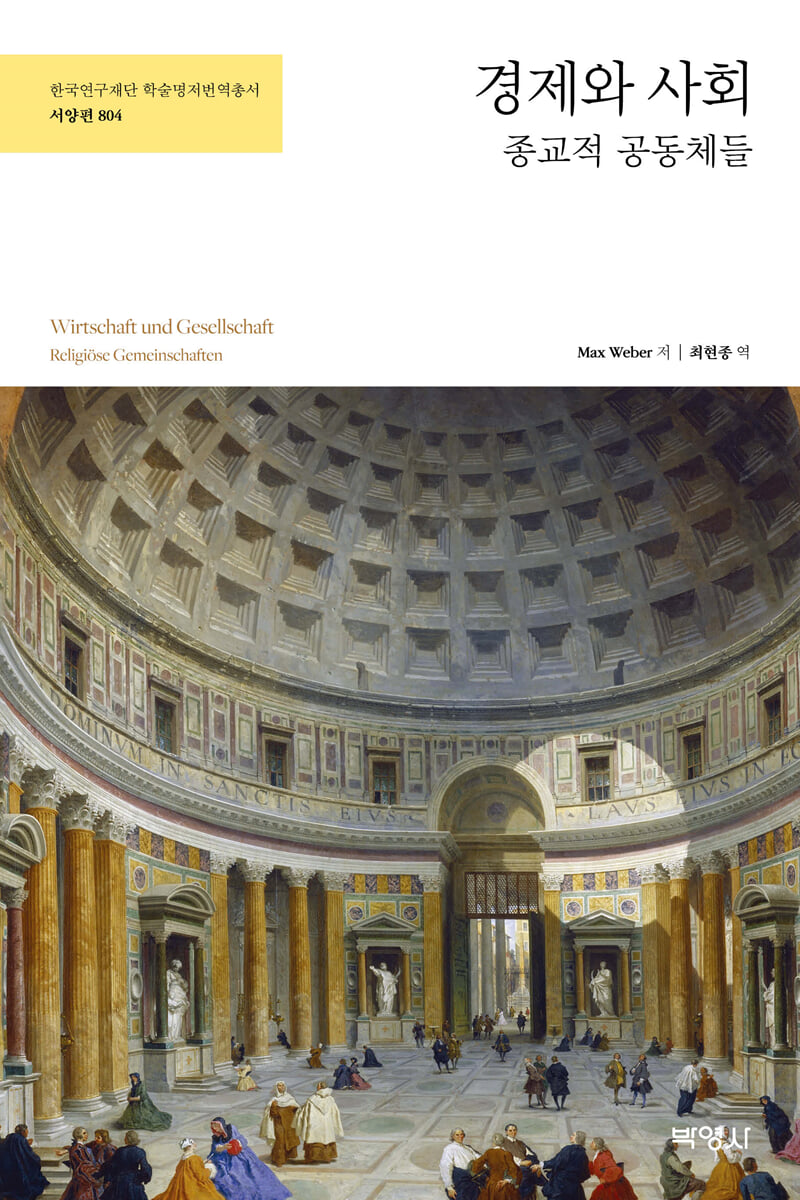
Economy and Society: Religious Communities
 |
Description
Book Introduction
Economy and Society: Religious Communities by Hans G.
The Complete Works of Max Weber, Part 1, Volume 22, Economy and Society, edited by Kippenberg with Petra Schilm in collaboration with Jutta Niemeier.
Economic and social order and power.
Max Weber-Gesamtausgabe, Abt. 2, Religious Communities
1, Bd.
22: Wirtschaft and Gesellschaft.
Die Wirtschaft und die gesellschaftlichen Ordnungen und Machte.
Nachlaß.
This is a complete translation of Teilband 2: Religiose Gemeinschaften, Tubingen 2001).
The Complete Works of Max Weber, Part 1, Volume 22, Economy and Society, edited by Kippenberg with Petra Schilm in collaboration with Jutta Niemeier.
Economic and social order and power.
Max Weber-Gesamtausgabe, Abt. 2, Religious Communities
1, Bd.
22: Wirtschaft and Gesellschaft.
Die Wirtschaft und die gesellschaftlichen Ordnungen und Machte.
Nachlaß.
This is a complete translation of Teilband 2: Religiose Gemeinschaften, Tubingen 2001).
index
01 Origins of Religion 1
02 Shaman-Priest 33
03 New Concepts, Religious Ethics, and Taboos 39
04 'The Prophet' 55
05 Community 73
06 Sacred Knowledge, Preaching, and Ministry 83
07 Status, Class, and Religion 99
08 The Problem of Theodicy 171
09 Salvation and Reincarnation 183
10 The Way of Salvation and Its Impact on Lifestyle 189
11 Religious Ethics and the 'World' 243
12 Culture, Religion, and the 'World' 287
Postscript 319
Appendix 411
Translator's Note 439
Search 445
02 Shaman-Priest 33
03 New Concepts, Religious Ethics, and Taboos 39
04 'The Prophet' 55
05 Community 73
06 Sacred Knowledge, Preaching, and Ministry 83
07 Status, Class, and Religion 99
08 The Problem of Theodicy 171
09 Salvation and Reincarnation 183
10 The Way of Salvation and Its Impact on Lifestyle 189
11 Religious Ethics and the 'World' 243
12 Culture, Religion, and the 'World' 287
Postscript 319
Appendix 411
Translator's Note 439
Search 445
Publisher's Review
Translator's Note
This book is by Hans G.
The Complete Works of Max Weber, Part 1, Volume 22, Economy and Society, edited by Kippenberg with Petra Schilm in collaboration with Jutta Niemeier.
Economic and social order and power.
Max Weber-Gesamtausgabe, Abt. 2, Religious Communities
1, Bd.
22: Wirtschaft and Gesellschaft.
Die Wirtschaft und die gesellschaftlichen Ordnungen und Machte.
Nachlaß.
This is a complete translation of Teilband 2: Religiose Gemeinschaften, Tubingen 2001).
Chapter 7, “Status Groups, Classes, and Religion (Stande, Klassen und Religion)” of this book was included in 『Selected Works of Max Weber’s Sociology of Religion』 (Nanam, 2008) by Jeon Seong-woo, and Chapter 10, “The Way of Salvation and Its Influence on Attitudes to Life (Die Erlosungewege und ihr Einfluß auf die Lebensfuhrung)” was included in 『In Search of Classics of German Sociology of Religion: Weber, Troeltsch, Simmel』 (Korea Academic Information, 2020) by this translator, but this book is the first complete translation of the entire book.
This book is part of Max Weber's posthumous work, commonly called Economy and Society.
Economy and Society consists of the 'old' manuscript written between 1909 and 1914, and the unfinished 'new' manuscript from 1918-1920, which was completely rewritten by Weber himself after reconceiving it. It was first published in 1921 and 1922 after Weber's death, and has been continuously edited to this day.
The importance of this book can be confirmed by the fact that it was selected as number one in the list of the 10 most important sociological books of the 20th century by the International Sociological Association in 1998.
Other parts of this book were translated and published by Park Seong-hwan under the titles “Economy and Society I” (Munhak-gwa-Jiseongsa, 1997), the part corresponding to the new manuscript, and “Economy and Society: Communities” (Nanam, 2009), the part corresponding to Volume 1 of the old manuscript.
This book corresponds to the second volume of the old manuscript, and the remaining volumes 3-5, which deal with 'Law (Recht)', 'Government (Herrschaft)', and 'The City (Die Stadt)', have not yet been translated.
Weber's Economy and Society was originally planned as part of a new Handbook of Political Economy (Handbuchs der Politischen Okonomie) in early 1909.
The original handbook was edited by Gustav von Schonberg from 1882 to 1896 and published in four editions.
The 'Subject Distribution Plan' drafted by Weber, sent out in May 1910, listed the planned chapters of Economy and Society as "a) Economy and Law (1.
Basic relationship, 2.
(periods of development to today's state).
b) Economic and social groups (family and local associations, status and class, nation).
c) Economy and Culture (Criticism of Historical Materialism)” is divided into three sub-areas.
In the process, the new handbook was retitled "Outline of Social Economics" (Grundriß der Sozialokonomik) to distinguish it from previous works.
The “Preface” to Volume 1 of 『Outlines of Social Economics』, published in 1914, contains information on the “Organization of the Collected Works,” according to which Weber’s own contribution is in Section C of Part III of Volume 1 of 『Outlines of Social Economics』 [“Foundations of the Economy” (Grundlage der Wirtschaft)], Chapter 5 “Religious Communities.
“Class Determinants of Religion; Cultural Religion and Economic Attitudes” including “Economy and Society”.
I. Economic and Social Order and Power” is presented (for a more detailed account of the publication and editing process of Economy and Society, see the “Editor’s Introduction” and “Translator’s Note” included in Economy and Society: Communities).
The work on this work probably began in 1911, and was mainly completed in 1913 (for details, see the appendix of this book, “Establishment and Transmission of the Text”).
However, this became impossible due to the outbreak of World War I in 1914 and Max Weber's subsequent military service.
Meanwhile, Max Weber published a series of works on the Economic Ethics of World Religions (Wirtschaftsethik der Weltreligion) in 1915, which he stated would serve as “a preparatory work and commentary for the systematic sociology of religion of the Outlines of Social Economics” (see ‘Plan of Revision’ in the “Appendix” of this book).
A series of writings on the "Economic Ethics of World Religions" were revised and republished in 1919 as the "Gesammelte Aufsatze zur Religionssoziologie" (Essays on the Sociology of Religion), but the planned systematic revision of the sociology of religion was not completed due to his sudden death in 1920.
Since this work was not published in its complete form, it does not have a systematic structure.
For example, the longest chapter in this book, Chapter 7, “Status, Class, and Religion,” is 35 pages long in the German edition, while the shortest two chapters are only two pages long.
However, the German editor of this book writes in his “Afterword” that, despite the text’s unsystematic state, it “contains a pervasive and, in that sense, systematic meaning.”
And it interprets its meaning as “rejecting materialism, which measures human actions of all times and cultures according to calculable ends and interests, [...] and restoring the subject to human actions and the interpretation of the world presupposed by them.”
And along with this, under the title of ‘Reproduction of Text’, the main contents of the text are divided into ‘Religious Community’, ‘Class Nature of Religion’, and ‘Cultural Religion and Economic Attitude’ (for more details, refer to the relevant section of the “Postscript”, and for the connection between each chapter, refer to ‘Subheadings, Overview of Contents, and Credibility Issues of Text Division’ in the “Appendix”).
In particular, the section on 'Cultural Religion and Economic Attitude' is developed in more detail in a series of writings on 'Economic Ethics of World Religions', including 'Protestant Ethic and the Spirit of Capitalism', and this is particularly evident in the fact that part of Chapter 11 of this book is directly quoted in the "Interim Review" section of 'Economic Ethics of World Religions'.
On the other hand, the content related to 'religious community' started from the proposition that "rationality is a special form of product of religious community formation and social action, and therefore a special case of community action" ('Plan of revision' in the 'Appendix' of this book), but in the subsequent revision of the entire 『Economy and Society』 (Complete Works of Max Weber I/23), the concept of advanced rationalization of all social relations came to the forefront, and 'community formation' became a special type of social action distinct from this, and its importance was weakened.
In the “Editor’s Introduction” to “Economy and Society: Communities,” it is stated that “Weber now used the term ‘social action’ as the central category in his ‘sociology of understanding’ and no longer used the term ‘community action.’
The concept of ‘community’ has now tended to recede behind the concept of ‘society’” (p. 99).
That is, “the view of the gradual rationalization of all social relations, which until then had been only one of many, now came to the forefront in texts on religion, law, and domination.
[...] Max Weber still maintained that 'community action' could occur under the conditions of a purposive rational order.
But now [...] the general principle of the rational and purposive shaping of all social relations is increasingly coming to the forefront” (p. 102).
In addition to these main contents, this book is also very important for understanding various concepts and topics that were dealt with in Weber's (religious) sociology.
These include 'charisma', 'theodicy', 'disenchantment', the distinction between 'priestly' and 'prophetic' religion, a comparison between 'asceticism' and 'mysticism', 'practical' religion and ethics, the distinction between 'world rejection', 'world flight', 'world conformity' and 'world overcoming' religious types, and 'cultural religion'.
For a more detailed explanation of this book, please refer to the “Postscript” and “Appendix” of the German edition.
When the translator returned to Korea after studying the sociology of religion, one of the things that surprised him was that so many important related classics had not yet been translated into Korean.
Among them, this book can be said to be the most representative book.
Afterwards, I searched for a translation through various channels and finally published this result as part of the National Research Foundation of Korea's Masterpiece Translation Project.
Although it is lacking in many ways, and I am particularly concerned that it might not be as good as the excellent translation by Professor Park Seong-hwan, who has already translated other parts of Economy and Society, I hope to find meaning in the fact that it can introduce important parts of Max Weber's sociology of religion to various researchers and readers who have difficulty accessing the original text.
Furthermore, I hope that the remaining parts of 『Economy and Society』, which have not yet been translated, will be translated as soon as possible by scholars specializing in the relevant fields.
This book is by Hans G.
The Complete Works of Max Weber, Part 1, Volume 22, Economy and Society, edited by Kippenberg with Petra Schilm in collaboration with Jutta Niemeier.
Economic and social order and power.
Max Weber-Gesamtausgabe, Abt. 2, Religious Communities
1, Bd.
22: Wirtschaft and Gesellschaft.
Die Wirtschaft und die gesellschaftlichen Ordnungen und Machte.
Nachlaß.
This is a complete translation of Teilband 2: Religiose Gemeinschaften, Tubingen 2001).
Chapter 7, “Status Groups, Classes, and Religion (Stande, Klassen und Religion)” of this book was included in 『Selected Works of Max Weber’s Sociology of Religion』 (Nanam, 2008) by Jeon Seong-woo, and Chapter 10, “The Way of Salvation and Its Influence on Attitudes to Life (Die Erlosungewege und ihr Einfluß auf die Lebensfuhrung)” was included in 『In Search of Classics of German Sociology of Religion: Weber, Troeltsch, Simmel』 (Korea Academic Information, 2020) by this translator, but this book is the first complete translation of the entire book.
This book is part of Max Weber's posthumous work, commonly called Economy and Society.
Economy and Society consists of the 'old' manuscript written between 1909 and 1914, and the unfinished 'new' manuscript from 1918-1920, which was completely rewritten by Weber himself after reconceiving it. It was first published in 1921 and 1922 after Weber's death, and has been continuously edited to this day.
The importance of this book can be confirmed by the fact that it was selected as number one in the list of the 10 most important sociological books of the 20th century by the International Sociological Association in 1998.
Other parts of this book were translated and published by Park Seong-hwan under the titles “Economy and Society I” (Munhak-gwa-Jiseongsa, 1997), the part corresponding to the new manuscript, and “Economy and Society: Communities” (Nanam, 2009), the part corresponding to Volume 1 of the old manuscript.
This book corresponds to the second volume of the old manuscript, and the remaining volumes 3-5, which deal with 'Law (Recht)', 'Government (Herrschaft)', and 'The City (Die Stadt)', have not yet been translated.
Weber's Economy and Society was originally planned as part of a new Handbook of Political Economy (Handbuchs der Politischen Okonomie) in early 1909.
The original handbook was edited by Gustav von Schonberg from 1882 to 1896 and published in four editions.
The 'Subject Distribution Plan' drafted by Weber, sent out in May 1910, listed the planned chapters of Economy and Society as "a) Economy and Law (1.
Basic relationship, 2.
(periods of development to today's state).
b) Economic and social groups (family and local associations, status and class, nation).
c) Economy and Culture (Criticism of Historical Materialism)” is divided into three sub-areas.
In the process, the new handbook was retitled "Outline of Social Economics" (Grundriß der Sozialokonomik) to distinguish it from previous works.
The “Preface” to Volume 1 of 『Outlines of Social Economics』, published in 1914, contains information on the “Organization of the Collected Works,” according to which Weber’s own contribution is in Section C of Part III of Volume 1 of 『Outlines of Social Economics』 [“Foundations of the Economy” (Grundlage der Wirtschaft)], Chapter 5 “Religious Communities.
“Class Determinants of Religion; Cultural Religion and Economic Attitudes” including “Economy and Society”.
I. Economic and Social Order and Power” is presented (for a more detailed account of the publication and editing process of Economy and Society, see the “Editor’s Introduction” and “Translator’s Note” included in Economy and Society: Communities).
The work on this work probably began in 1911, and was mainly completed in 1913 (for details, see the appendix of this book, “Establishment and Transmission of the Text”).
However, this became impossible due to the outbreak of World War I in 1914 and Max Weber's subsequent military service.
Meanwhile, Max Weber published a series of works on the Economic Ethics of World Religions (Wirtschaftsethik der Weltreligion) in 1915, which he stated would serve as “a preparatory work and commentary for the systematic sociology of religion of the Outlines of Social Economics” (see ‘Plan of Revision’ in the “Appendix” of this book).
A series of writings on the "Economic Ethics of World Religions" were revised and republished in 1919 as the "Gesammelte Aufsatze zur Religionssoziologie" (Essays on the Sociology of Religion), but the planned systematic revision of the sociology of religion was not completed due to his sudden death in 1920.
Since this work was not published in its complete form, it does not have a systematic structure.
For example, the longest chapter in this book, Chapter 7, “Status, Class, and Religion,” is 35 pages long in the German edition, while the shortest two chapters are only two pages long.
However, the German editor of this book writes in his “Afterword” that, despite the text’s unsystematic state, it “contains a pervasive and, in that sense, systematic meaning.”
And it interprets its meaning as “rejecting materialism, which measures human actions of all times and cultures according to calculable ends and interests, [...] and restoring the subject to human actions and the interpretation of the world presupposed by them.”
And along with this, under the title of ‘Reproduction of Text’, the main contents of the text are divided into ‘Religious Community’, ‘Class Nature of Religion’, and ‘Cultural Religion and Economic Attitude’ (for more details, refer to the relevant section of the “Postscript”, and for the connection between each chapter, refer to ‘Subheadings, Overview of Contents, and Credibility Issues of Text Division’ in the “Appendix”).
In particular, the section on 'Cultural Religion and Economic Attitude' is developed in more detail in a series of writings on 'Economic Ethics of World Religions', including 'Protestant Ethic and the Spirit of Capitalism', and this is particularly evident in the fact that part of Chapter 11 of this book is directly quoted in the "Interim Review" section of 'Economic Ethics of World Religions'.
On the other hand, the content related to 'religious community' started from the proposition that "rationality is a special form of product of religious community formation and social action, and therefore a special case of community action" ('Plan of revision' in the 'Appendix' of this book), but in the subsequent revision of the entire 『Economy and Society』 (Complete Works of Max Weber I/23), the concept of advanced rationalization of all social relations came to the forefront, and 'community formation' became a special type of social action distinct from this, and its importance was weakened.
In the “Editor’s Introduction” to “Economy and Society: Communities,” it is stated that “Weber now used the term ‘social action’ as the central category in his ‘sociology of understanding’ and no longer used the term ‘community action.’
The concept of ‘community’ has now tended to recede behind the concept of ‘society’” (p. 99).
That is, “the view of the gradual rationalization of all social relations, which until then had been only one of many, now came to the forefront in texts on religion, law, and domination.
[...] Max Weber still maintained that 'community action' could occur under the conditions of a purposive rational order.
But now [...] the general principle of the rational and purposive shaping of all social relations is increasingly coming to the forefront” (p. 102).
In addition to these main contents, this book is also very important for understanding various concepts and topics that were dealt with in Weber's (religious) sociology.
These include 'charisma', 'theodicy', 'disenchantment', the distinction between 'priestly' and 'prophetic' religion, a comparison between 'asceticism' and 'mysticism', 'practical' religion and ethics, the distinction between 'world rejection', 'world flight', 'world conformity' and 'world overcoming' religious types, and 'cultural religion'.
For a more detailed explanation of this book, please refer to the “Postscript” and “Appendix” of the German edition.
When the translator returned to Korea after studying the sociology of religion, one of the things that surprised him was that so many important related classics had not yet been translated into Korean.
Among them, this book can be said to be the most representative book.
Afterwards, I searched for a translation through various channels and finally published this result as part of the National Research Foundation of Korea's Masterpiece Translation Project.
Although it is lacking in many ways, and I am particularly concerned that it might not be as good as the excellent translation by Professor Park Seong-hwan, who has already translated other parts of Economy and Society, I hope to find meaning in the fact that it can introduce important parts of Max Weber's sociology of religion to various researchers and readers who have difficulty accessing the original text.
Furthermore, I hope that the remaining parts of 『Economy and Society』, which have not yet been translated, will be translated as soon as possible by scholars specializing in the relevant fields.
GOODS SPECIFICS
- Date of issue: July 31, 2025
- Format: Hardcover book binding method guide
- Page count, weight, size: 536 pages | 153*224*35mm
- ISBN13: 9791130321448
- ISBN10: 1130321444
You may also like
카테고리
korean


korean

![GQ KOREA Mark (Monthly): December [2025]](http://librairie.coreenne.fr/cdn/shop/files/8ef265dbbfbf186523ed75ba7319009d.jpg?v=1765340328&width=3840)


