

Labor Law 2
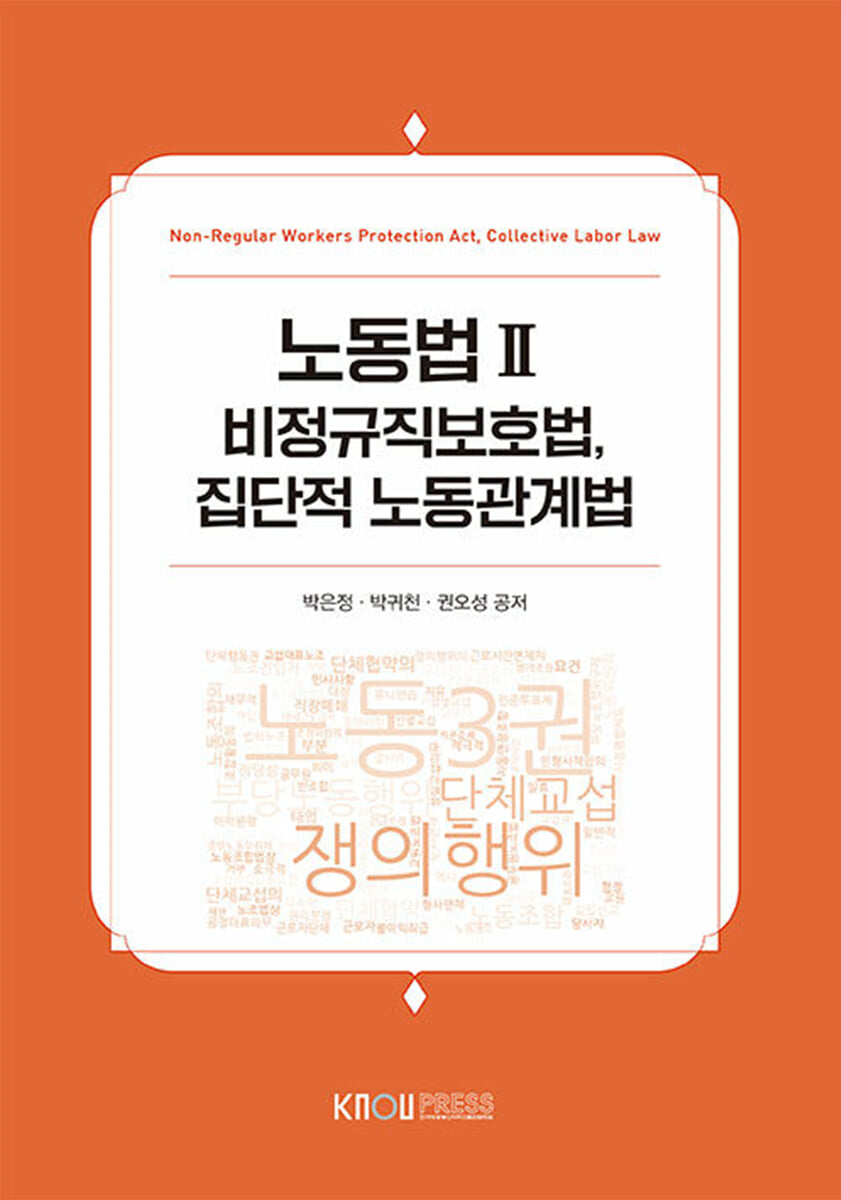 |
Description
Book Introduction
“Labor is not a commodity.” This is a sentence from the ILO Philadelphia Declaration (1944).
The Philadelphia Declaration, issued in preparation for the reconstruction of a society devastated by World War II and based on the recognition that sustained peace was impossible without social justice, rejected the commodification of labor that denies human dignity and declared that freedom of expression and freedom of association are the foundation of a democratic society and sustainable development.
This kind of thinking underlies modern labor law.
To borrow a phrase from Martin Luther King, “Where inequality exists, justice is at stake,” we could say that equal and dignified labor is a necessary condition for social justice.
This book, consisting of 15 chapters, covers the laws protecting irregular workers and labor unions, which were created to ensure equal and dignified labor for social justice.
Part 1 covers the Act on the Protection of Fixed-Term and Part-Time Workers, which was enacted in 2007, and the Act on the Protection of Dispatched Workers, which was enacted in 1998, based on the principle of equality under Article 11 of the Constitution and the principle of the right to work and the principle of legality of working conditions under Article 32 of the Constitution.
This article provides an in-depth look at the principles and content of the law protecting irregular workers, providing an overview of Korea's relevant legislation and highlighting specific issues to aid understanding.
We also included specific examples to help readers understand the irregular worker protection law in a three-dimensional way.
Part 2 covers labor union laws, such as the Trade Union and Labor Relations Adjustment Act, the Act on the Establishment and Operation of Public Officials' Labor Unions, and the Act on the Establishment and Operation of Teachers' Labor Unions, which reflect (albeit insufficiently) the basic principles of ILO Convention No. 87 on Freedom of Association and Protection of the Right to Organize (1948), which Korea reached after a long period of social struggle, based on Article 33 of the Constitution.
It is important to understand the history of the rights of trade unions contained in Part II.
If we fully understand why these rights were guaranteed, the significance and limitations of our country's current labor union laws will become more apparent.
Therefore, in Part 2, we have tried to fully capture the history of the emergence and recognition of general labor unions, as well as the history of teachers' and public servants' unions that have endured hardships and adversities under the special political circumstances of our country.
The Philadelphia Declaration, issued in preparation for the reconstruction of a society devastated by World War II and based on the recognition that sustained peace was impossible without social justice, rejected the commodification of labor that denies human dignity and declared that freedom of expression and freedom of association are the foundation of a democratic society and sustainable development.
This kind of thinking underlies modern labor law.
To borrow a phrase from Martin Luther King, “Where inequality exists, justice is at stake,” we could say that equal and dignified labor is a necessary condition for social justice.
This book, consisting of 15 chapters, covers the laws protecting irregular workers and labor unions, which were created to ensure equal and dignified labor for social justice.
Part 1 covers the Act on the Protection of Fixed-Term and Part-Time Workers, which was enacted in 2007, and the Act on the Protection of Dispatched Workers, which was enacted in 1998, based on the principle of equality under Article 11 of the Constitution and the principle of the right to work and the principle of legality of working conditions under Article 32 of the Constitution.
This article provides an in-depth look at the principles and content of the law protecting irregular workers, providing an overview of Korea's relevant legislation and highlighting specific issues to aid understanding.
We also included specific examples to help readers understand the irregular worker protection law in a three-dimensional way.
Part 2 covers labor union laws, such as the Trade Union and Labor Relations Adjustment Act, the Act on the Establishment and Operation of Public Officials' Labor Unions, and the Act on the Establishment and Operation of Teachers' Labor Unions, which reflect (albeit insufficiently) the basic principles of ILO Convention No. 87 on Freedom of Association and Protection of the Right to Organize (1948), which Korea reached after a long period of social struggle, based on Article 33 of the Constitution.
It is important to understand the history of the rights of trade unions contained in Part II.
If we fully understand why these rights were guaranteed, the significance and limitations of our country's current labor union laws will become more apparent.
Therefore, in Part 2, we have tried to fully capture the history of the emergence and recognition of general labor unions, as well as the history of teachers' and public servants' unions that have endured hardships and adversities under the special political circumstances of our country.
index
Part 1 Non-regular Workers Protection Act
Lecture 1: Understanding the Non-Regular Workers Protection Act
Lecture 2: Temporary and Part-Time Workers
Lecture 3: Dispatched Workers
Lecture 4 Special Issues: Renewal Expectations, Short-Term Workers, and Illegal Dispatch
Lecture 5: Non-regular Worker Discrimination Correction System
Part 2 Labor Union Act
Lecture 6: General Introduction to Labor Union Law
Lesson 7 Labor Unions
Lesson 8: Collective Bargaining (1)
Lesson 9: Collective Bargaining (2)
Lesson 10: Collective Agreements
Lesson 11: Dispute Action (1)
Lesson 12: Dispute Action (2)
Lecture 13: Prohibition and Remedies for Unfair Labor Practices
Lesson 14: Civil Servant and Teacher Labor Unions (1)
Lesson 15: Civil Servant and Teacher Labor Unions (2)
Lecture 1: Understanding the Non-Regular Workers Protection Act
Lecture 2: Temporary and Part-Time Workers
Lecture 3: Dispatched Workers
Lecture 4 Special Issues: Renewal Expectations, Short-Term Workers, and Illegal Dispatch
Lecture 5: Non-regular Worker Discrimination Correction System
Part 2 Labor Union Act
Lecture 6: General Introduction to Labor Union Law
Lesson 7 Labor Unions
Lesson 8: Collective Bargaining (1)
Lesson 9: Collective Bargaining (2)
Lesson 10: Collective Agreements
Lesson 11: Dispute Action (1)
Lesson 12: Dispute Action (2)
Lecture 13: Prohibition and Remedies for Unfair Labor Practices
Lesson 14: Civil Servant and Teacher Labor Unions (1)
Lesson 15: Civil Servant and Teacher Labor Unions (2)
GOODS SPECIFICS
- Date of issue: July 25, 2025
- Page count, weight, size: 552 pages | Checking size
- ISBN13: 9788920052729
- ISBN10: 8920052727
You may also like
카테고리
korean


korean

![GQ KOREA Mark (Monthly): December [2025]](http://librairie.coreenne.fr/cdn/shop/files/8ef265dbbfbf186523ed75ba7319009d.jpg?v=1765340328&width=3840)


