

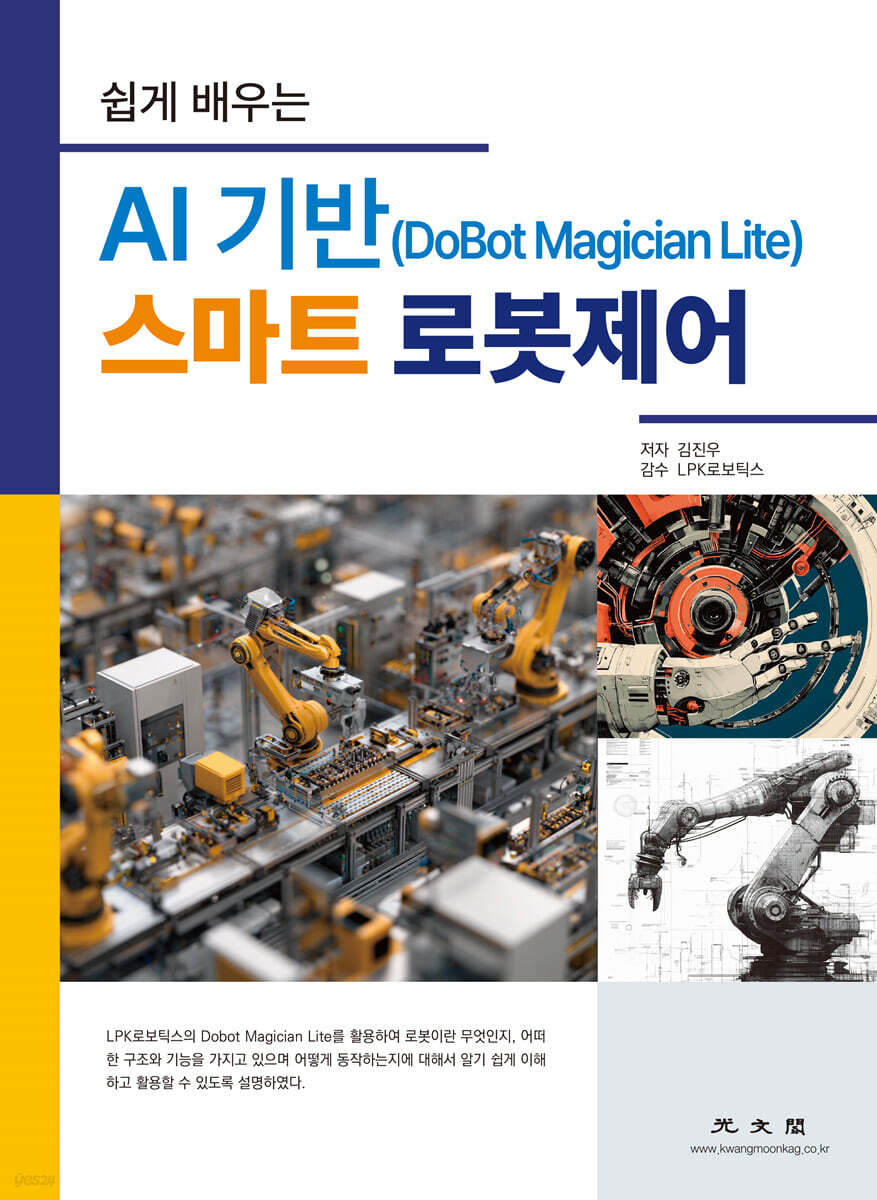
Easy-to-learn AI-based smart robot control (DoBot Magician Lite)
 |
Description
Book Introduction
The Fourth Industrial Revolution and artificial intelligence craze that has been sweeping the globe since the early 21st century show no signs of cooling down, and are being widely applied not only in manufacturing but also in various fields of society.
In particular, with the rapid development of the Fourth Industrial Revolution, the robotics industry is expected to develop into a key industry leading the 21st century. Accordingly, the national government has selected the robotics industry as one of the top 10 next-generation growth engines and is prioritizing its development.
However, if you want to understand the structure of the robot and use it directly, you need to be sufficiently prepared.
For example, in order for a robot to quickly and accurately move and position an object to a desired location, it requires various engineering knowledge and experience in kinematics, dynamics, motors, sensors, pneumatics, S/W, and control and measurement.
Therefore, this book uses LPK Robotics' Dobot Magician Lite to explain what a robot is, what its structure and function are, and how it operates, so that it can be easily understood and utilized.
In particular, with the rapid development of the Fourth Industrial Revolution, the robotics industry is expected to develop into a key industry leading the 21st century. Accordingly, the national government has selected the robotics industry as one of the top 10 next-generation growth engines and is prioritizing its development.
However, if you want to understand the structure of the robot and use it directly, you need to be sufficiently prepared.
For example, in order for a robot to quickly and accurately move and position an object to a desired location, it requires various engineering knowledge and experience in kinematics, dynamics, motors, sensors, pneumatics, S/W, and control and measurement.
Therefore, this book uses LPK Robotics' Dobot Magician Lite to explain what a robot is, what its structure and function are, and how it operates, so that it can be easily understood and utilized.
index
Chapter 1: Robot Overview
1.
Etymology of robot
2.
Types of robots
3.
power transmission device
4.
Robot control system
5.
Robotics
Chapter 2 H/W and Development Platform
1.
Magician Lite
2.
Magic Box
3.
Development Platform
4.
Setting up a development environment
Chapter 3: Understanding Block Coding and Python
1.
Block coding characteristics and development environment
2.
Dobot block coding settings
3.
Python functions
Chapter 4 Block Coding-Based Control
1.
Understanding Robot Control Blocks
2. Control PTP & Home
3.
Using the Robot Suction Cup
4. Using the Robot Gripper
5.
Controlling robot movement sequence and coordinates
6.
Controlling a robot using a suction cup
7.
Controlling robots based on first-in, first-out
8.
Controlling robots based on last-in, first-out (LIFO)
9.
Recognize images
10.
Recognize faces
11.
Recognize text
12.
Controlling a robot using text recognition
13.
Controlling Sequences Using Text Recognition
Chapter 5 Python-Based Control
1.
Understanding the Python Development Environment
2.
Understanding Robot Control Statements
3.
Controlling P&P Home
4.
Using the Robot Suction Cup
5.
Using the Robot Gripper
6.
Controlling robot movement sequence and coordinates
7.
Controlling a robot using a suction cup
8.
Controlling a robot using a for loop
9.
Controlling robots based on first-in, first-out
10.
Controlling robots based on last-in, first-out (LIFO)
11.
Aligning the Camera
12.
Collecting data
13.
Recognize data
14.
Data Learning and Robot Work Classification
1.
Etymology of robot
2.
Types of robots
3.
power transmission device
4.
Robot control system
5.
Robotics
Chapter 2 H/W and Development Platform
1.
Magician Lite
2.
Magic Box
3.
Development Platform
4.
Setting up a development environment
Chapter 3: Understanding Block Coding and Python
1.
Block coding characteristics and development environment
2.
Dobot block coding settings
3.
Python functions
Chapter 4 Block Coding-Based Control
1.
Understanding Robot Control Blocks
2. Control PTP & Home
3.
Using the Robot Suction Cup
4. Using the Robot Gripper
5.
Controlling robot movement sequence and coordinates
6.
Controlling a robot using a suction cup
7.
Controlling robots based on first-in, first-out
8.
Controlling robots based on last-in, first-out (LIFO)
9.
Recognize images
10.
Recognize faces
11.
Recognize text
12.
Controlling a robot using text recognition
13.
Controlling Sequences Using Text Recognition
Chapter 5 Python-Based Control
1.
Understanding the Python Development Environment
2.
Understanding Robot Control Statements
3.
Controlling P&P Home
4.
Using the Robot Suction Cup
5.
Using the Robot Gripper
6.
Controlling robot movement sequence and coordinates
7.
Controlling a robot using a suction cup
8.
Controlling a robot using a for loop
9.
Controlling robots based on first-in, first-out
10.
Controlling robots based on last-in, first-out (LIFO)
11.
Aligning the Camera
12.
Collecting data
13.
Recognize data
14.
Data Learning and Robot Work Classification
Publisher's Review
The Fourth Industrial Revolution and artificial intelligence craze that has been sweeping the globe since the early 21st century show no signs of cooling down, and are being widely applied not only in manufacturing but also in various fields of society.
In particular, with the rapid development of the Fourth Industrial Revolution, the robotics industry is expected to develop into a key industry leading the 21st century. Accordingly, the national government has selected the robotics industry as one of the top 10 next-generation growth engines and is prioritizing its development.
Such robotics technologies are becoming essential aids in improving the quality of life by enriching and freeing human life in almost all fields, including industry and home. Various types of robots are continuously appearing and being utilized in various fields.
And even people who have no connection to robotics are naturally curious and interested in moving robots that are being used in such a wide range of fields, and they naturally develop a desire to learn about them.
Robots, which were once mainly used in manufacturing sites and felt somewhat distant, have now come closer to us, and we have entered an era where we can enjoy just watching their movements and even using them.
However, if you want to understand the structure of the robot and use it directly, you need to be sufficiently prepared.
For example, in order for a robot to quickly and accurately move and position an object to a desired location, it requires various engineering knowledge and experience in kinematics, dynamics, motors, sensors, pneumatics, S/W, and control and measurement.
Therefore, this book uses LPK Robotics' Dobot Magician Lite to explain what a robot is, what its structure and function are, and how it operates, so that it can be easily understood and utilized.
LPK Robotics, referenced in this book, is an industrial robot solution company founded in 2004. Based on continuous research and development and accumulated technology, it is constantly innovating and challenging itself. It is a robot solution company that is expanding its business into the field of robot solutions such as orthogonal robots, linear robots, and precision stages for cutting-edge industries such as displays, semiconductors, secondary batteries, and automobiles, as well as AI collaborative robots and multi-joint robots.
The book, which utilizes LPK Robotics' Dobot Magician Lite, is structured as follows.
Chapter 1, 'Robot Overview', covers the origins and types of robots, power transmission devices, control systems, and robotics, and is written for beginners who are new to robots.
Chapter 2, 'H/W and Development Platform', describes the hardware configuration and features of Magician Lite and the configuration and features of Magic Box, and provides detailed descriptions of the development platform and development environment construction methods.
Chapter 3, 'Understanding Block Coding and Python', describes the characteristics of block coding, development environment, block coding settings, and Python functions in a conceptual manner.
Chapter 4, 'Block Coding-Based Control', consists of 15 practical tasks, including understanding robot control blocks and controlling PTP & Home, so that you can practice controlling Magician Lite.
Chapter 5, 'Python-based Control', describes 14 practical exercises to help you practice controlling Magician Lite using Python, including understanding the Python development environment and robot control statements.
We have put in a lot of effort to make this book easier for readers to understand, but if there are any shortcomings, we promise to continue to research and revise and supplement it.
I would like to express my deepest gratitude to LPK CEO Sim Tae-ho, FM Solution CEO Oh Jae-jun, Yedam, Ye-jun, Chae-rin, Ian, Ji-in, and the staff of Gwangmungak Publishing for their meticulous attention, consideration, and assistance in completing this book.
In particular, with the rapid development of the Fourth Industrial Revolution, the robotics industry is expected to develop into a key industry leading the 21st century. Accordingly, the national government has selected the robotics industry as one of the top 10 next-generation growth engines and is prioritizing its development.
Such robotics technologies are becoming essential aids in improving the quality of life by enriching and freeing human life in almost all fields, including industry and home. Various types of robots are continuously appearing and being utilized in various fields.
And even people who have no connection to robotics are naturally curious and interested in moving robots that are being used in such a wide range of fields, and they naturally develop a desire to learn about them.
Robots, which were once mainly used in manufacturing sites and felt somewhat distant, have now come closer to us, and we have entered an era where we can enjoy just watching their movements and even using them.
However, if you want to understand the structure of the robot and use it directly, you need to be sufficiently prepared.
For example, in order for a robot to quickly and accurately move and position an object to a desired location, it requires various engineering knowledge and experience in kinematics, dynamics, motors, sensors, pneumatics, S/W, and control and measurement.
Therefore, this book uses LPK Robotics' Dobot Magician Lite to explain what a robot is, what its structure and function are, and how it operates, so that it can be easily understood and utilized.
LPK Robotics, referenced in this book, is an industrial robot solution company founded in 2004. Based on continuous research and development and accumulated technology, it is constantly innovating and challenging itself. It is a robot solution company that is expanding its business into the field of robot solutions such as orthogonal robots, linear robots, and precision stages for cutting-edge industries such as displays, semiconductors, secondary batteries, and automobiles, as well as AI collaborative robots and multi-joint robots.
The book, which utilizes LPK Robotics' Dobot Magician Lite, is structured as follows.
Chapter 1, 'Robot Overview', covers the origins and types of robots, power transmission devices, control systems, and robotics, and is written for beginners who are new to robots.
Chapter 2, 'H/W and Development Platform', describes the hardware configuration and features of Magician Lite and the configuration and features of Magic Box, and provides detailed descriptions of the development platform and development environment construction methods.
Chapter 3, 'Understanding Block Coding and Python', describes the characteristics of block coding, development environment, block coding settings, and Python functions in a conceptual manner.
Chapter 4, 'Block Coding-Based Control', consists of 15 practical tasks, including understanding robot control blocks and controlling PTP & Home, so that you can practice controlling Magician Lite.
Chapter 5, 'Python-based Control', describes 14 practical exercises to help you practice controlling Magician Lite using Python, including understanding the Python development environment and robot control statements.
We have put in a lot of effort to make this book easier for readers to understand, but if there are any shortcomings, we promise to continue to research and revise and supplement it.
I would like to express my deepest gratitude to LPK CEO Sim Tae-ho, FM Solution CEO Oh Jae-jun, Yedam, Ye-jun, Chae-rin, Ian, Ji-in, and the staff of Gwangmungak Publishing for their meticulous attention, consideration, and assistance in completing this book.
GOODS SPECIFICS
- Date of issue: June 15, 2025
- Page count, weight, size: 272 pages | 576g | 188*257*20mm
- ISBN13: 9791193965153
- ISBN10: 1193965152
You may also like
카테고리
korean


korean

![ELLE 엘르 스페셜 에디션 A형 : 12월 [2025]](http://librairie.coreenne.fr/cdn/shop/files/b8e27a3de6c9538896439686c6b0e8fb.jpg?v=1766436872&width=3840)


