

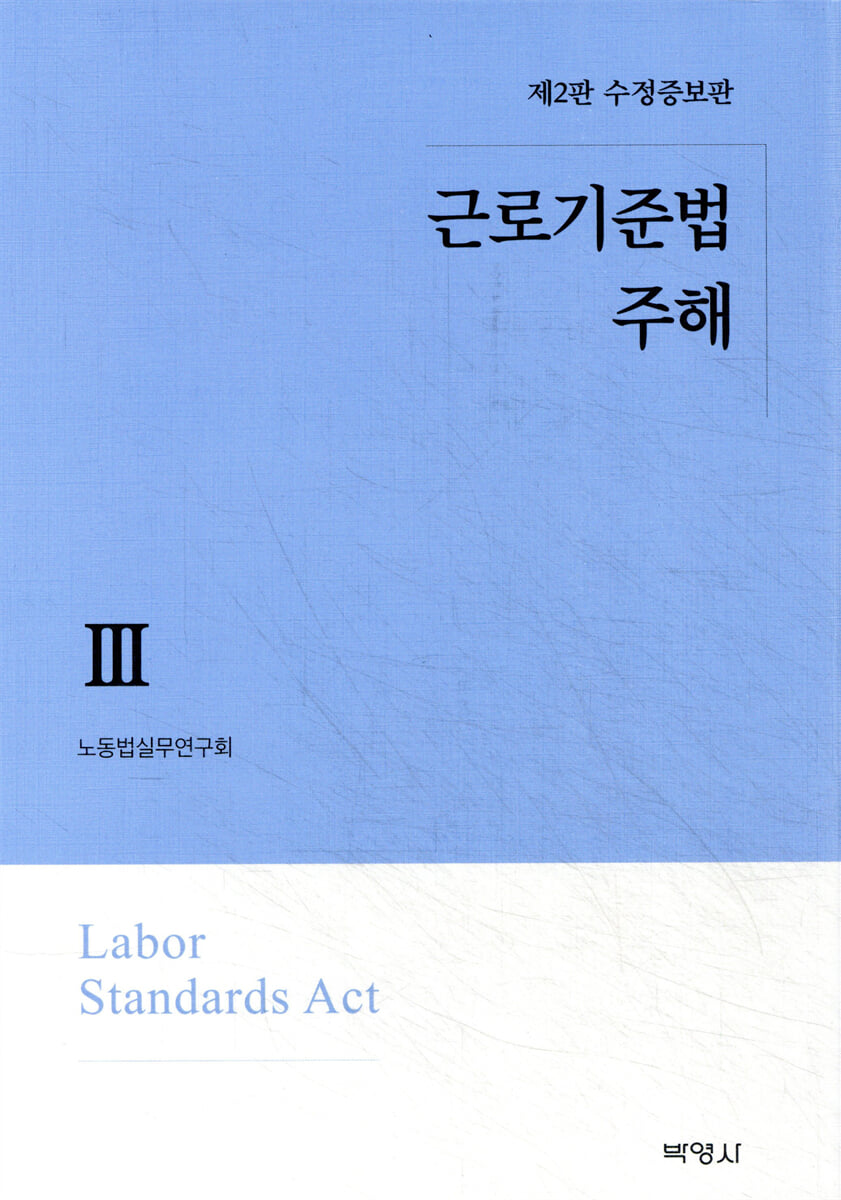
Labor Standards Act Commentary 3
 |
Description
Book Introduction
The Labor Standards Act has been revised five times, excluding revisions to other laws.
New provisions were established to promote the use of annual paid leave by workers with less than one year of continuous employment, a flexible working hour system was established where the unit period exceeds three months and is within six months, and provisions were established to impose an objective investigation obligation on employers in relation to the system prohibiting workplace bullying and to impose fines on employers who commit workplace bullying.
Even in cases where reinstatement to the original position is impossible in the event of an unfair dismissal, a basis for receiving monetary compensation through the unfair dismissal relief procedure has been established, the limit on enforcement fines for non-compliance with relief orders has been raised, and pregnant female workers are permitted to apply for changes to their work start and end times.
The scope of application of delayed interest payment for unpaid wages has been expanded to include employed workers, and the basis for expanding and strengthening sanctions against habitual non-paying employers has been established.
In line with the revision of the Labor Standards Act, laws concerning individual employment relationships, such as the Equal Employment Opportunity Act, the Workers' Retirement Benefits Security Act, and the Wage Claims Security Act, were also revised.
New provisions were established to promote the use of annual paid leave by workers with less than one year of continuous employment, a flexible working hour system was established where the unit period exceeds three months and is within six months, and provisions were established to impose an objective investigation obligation on employers in relation to the system prohibiting workplace bullying and to impose fines on employers who commit workplace bullying.
Even in cases where reinstatement to the original position is impossible in the event of an unfair dismissal, a basis for receiving monetary compensation through the unfair dismissal relief procedure has been established, the limit on enforcement fines for non-compliance with relief orders has been raised, and pregnant female workers are permitted to apply for changes to their work start and end times.
The scope of application of delayed interest payment for unpaid wages has been expanded to include employed workers, and the basis for expanding and strengthening sanctions against habitual non-paying employers has been established.
In line with the revision of the Labor Standards Act, laws concerning individual employment relationships, such as the Equal Employment Opportunity Act, the Workers' Retirement Benefits Security Act, and the Wage Claims Security Act, were also revised.
index
Chapter 3 Wages
Wage Preamble: Minimum Wage [Lee Mi-seon] 3
Article 43 (Payment of Wages) [Jeong Jae-heon and Lee Jeong-ah] 83
Article 43-2 (Disclosure of List of Business Owners in Default) [Jeong Jae-heon and Lee Jeong-ah] 104
Article 43-3 (Provision of Information on Unpaid Wages, etc.) [Jeong Jae-heon and Lee Jeong-ah] 109
Article 43-4 (Restrictions on Subsidies and Support for Habitually Defaulting Business Owners) [Jeong Jae-heon, Lee Jeong-ah] 115
Article 43-5 (Delegation of Work, etc.) [Jeong Jae-heon, Lee Jeong-ah] 119
Article 43-6 (Request for Provision of Data, etc. for Disclosure of List of Business Owners in Default, etc.) [Jeong Jae-heon, Lee Jeong-ah] 120
Article 43-7 (Prohibition on Departure) [Jeong Jae-heon and Lee Jeong-ah] 123
Article 43-8 (Claim for Damages for Unpaid Wages, etc.) [Jeong Jae-heon and Lee Jeong-ah] 126
Article 44 (Payment of Wages for Subcontracted Work) [Jeong Jae-heon and Lee Jeong-ah] 128
Article 44-2 (Joint Liability for Wage Payment in the Construction Industry) [Jeong Jae-heon and Lee Jeong-ah] 133
Article 44-3 (Special Provisions Regarding Wages in Construction Contracts) [Jeong Jae-heon, Lee Jeong-ah] 137
Article 45 (Emergency Payment) [Jeong Jae-heon and Lee Jeong-ah] 139
Article 46 (Severance Pay) [Kim Jin-seok] 141
Article 47 (Contracted Workers) [Jeong Jae-heon and Lee Jeong-ah] 148
Article 48 (Wage Register and Wage Statement) [Jeong Jae-heon and Lee Jeong-ah] 149
Article 49 (Statute of Limitations on Wages) [Jeong Jae-heon and Lee Jeong-ah] 152
Post-Wage Theory 1: Sanctions and Remedies for Wage Arrears [Jeong Jae-heon and Lee Jeong-ah] 155
Post-Wage Theory 2: Industrial Actions and the Principle of No Work, No Pay [Jeong Jae-heon and Lee Jeong-ah] 172
Chapter 4 Working Hours and Rest
Article 50 (Working Hours) [Lee Jeong-han, Kim Jin, and Go Jong-wan] 185
Article 51 (Flexible Working Hours for Up to 3 Months) [Lee Jeong-han, Kim Jin, and Go Jong-wan] 203
Article 51-2 (Flexible Working Hours for Exceeding 3 Months) [Lee Jeong-han, Kim Jin, and Go Jong-wan] 204
Article 51-3 (Wage Settlement When the Period of Work is Shorter than the Unit Period) [Lee Jeong-han, Kim Jin, and Go Jong-wan] 205
Article 52 (Optional Working Hours) [Lee Jeong-han, Kim Jin, and Go Jong-wan] 221
Article 53 (Restrictions on Overtime Work) [Lee Jeong-han, Kim Jin, and Go Jong-wan] 227
Article 54 (Rest) [Lee Jeong-han, Kim Jin, Yeo Yeon-sim] 247
Article 55 (Holidays) [Lee Jeong-han, Kim Jin, Yeo Yeon-sim] 256
Article 56 (Overtime, Night, and Holiday Work) [Kim Jin-seok] 281
Article 57 (Compensatory Leave System) [Kim Jin-seok] 335
Article 58 (Special Cases Regarding Calculation of Working Hours) [Lee Jeong-han, Kim Jin, and Go Jong-wan] 336
Article 59 (Special Provisions for Working Hours and Rest Periods) [Lee Jeong-han, Kim Jin, and Go Jong-wan] 347
Article 60 (Annual Paid Leave) [Lee Jeong-han, Kim Jin, Yeo Yeon-sim] 353
Article 61 (Promotion of Use of Annual Paid Leave) [Lee Jeong-han, Kim Jin, Yeo Yeon-sim] 379
Article 62 (Substitution of Paid Leave) [Lee Jeong-han, Kim Jin, and Yeo Yeon-sim] 384
Article 63 (Exceptions to Application) [Lee Jeong-han, Kim Jin, and Yeo Yeon-sim] 386
Chapter 5 Women and Boys
Women and Boys: A Preface [Kim Min-gi and Oh Seung-i] 397
Article 64 (Minimum Age and Employment Permit) [Kim Min-ki, Oh Seung-i] 402
Article 65 (Prohibition of Use) [Kim Min-ki, Oh Seung-i] 405
Article 66 (Certificate of Minority) [Kim Min-gi, Oh Seung-i] 410
Article 67 (Employment Contract) [Kim Min-ki and Oh Seung-i] 413
Article 68 (Claim for Wages) [Kim Min-gi and Oh Seung-i] 418
Article 69 (Working Hours) [Kim Min-ki, Oh Seung-i] 419
Article 70 (Restrictions on Night and Holiday Work) [Kim Min-gi, Oh Seung-i] 422
Article 71 (Overtime Work) [Kim Min-ki and Oh Seung-i] 428
Article 72 (Prohibition of Mining Work) [Kim Min-gi, Oh Seung-i] 431
Article 73 (Menstrual Leave) [Kim Min-ki, Oh Seung-i] 433
Article 74 (Protection of Pregnant Women) [Kim Min-gi, Oh Seung-i] 437
Article 74-2 (Permission for Prenatal Examination Time, etc.) [Kim Min-ki, Oh Seung-i] 455
Article 75 (Childcare Time) [Kim Min-ki and Oh Seung-i] 457
Women and Boys: Maternity Protection and Work-Family Balance Support under the Equal Employment Opportunity Act [Oh Seung-i] 459
Chapter 6 Safety and Health
Article 76 (Safety and Health) [Kwon Chang-young] 475
Chapter 6, Section 2: Prohibition of Workplace Bullying
Article 76-2 (Prohibition of Workplace Bullying) [Kwon Chang-yeong, Shin Kwon-cheol] 589
Article 76-3 (Measures to be taken in the event of workplace bullying) [Shin Kwon-cheol] 611
Chapter 7: Skill Acquisition
Article 77 (Protection of Skilled Workers) [Kwon Chang-young] 635
Chapter 8 Disaster Compensation
Preface to Disaster Compensation [Kang Moon-dae and Im Ja-un] 643
Article 78 (Nursing Care Compensation) [Kang Moon Dae-im Ja-un] 688
Article 79 (Compensation for Suspension of Business) [Kang Moon Dae-im Ja-un] 691
Article 80 (Compensation for Disability) [Kang Moon Dae-im Ja-un] 694
Article 81 (Exceptions to Compensation for Suspension of Work and Compensation for Disability) [Kang Moon Dae-im Ja-un] 698
Article 82 (Compensation for Surviving Family) [Kang Moon Dae-im Ja-un] 701
Article 83 (Funeral Expenses) [Kang Moon-dae and Im Ja-un] 705
Article 84 (Lump-Sum Compensation) [Kang Moon Dae-im Ja-un] 707
Article 85 (Installed Compensation) [Kang Moon Dae-im Ja-un] 709
Article 86 (Claim for Compensation) [Kang Moon Dae-im Ja-un] 710
Article 87 (Relationship with Other Damages) [Kang Moon Dae-im Ja-un] 712
Article 88 (Review and Arbitration by the Minister of Employment and Labor) [Kang Moon-dae and Im Ja-un] 714
Article 89 (Review and Arbitration by the Labor Relations Commission) [Kang Moon-dae and Im Ja-un] 715
Article 90 (Exceptions to Contracted Work) [Kang Moon Dae-im Ja-un] 716
Article 91 (Preservation of Documents) [Kang Moon-dae and Im Ja-un] 717
Article 92 (Statute of Limitations) [Kang Moon Dae-im Ja-un] 719
Chapter 9 Employment Rules
Preface to Employment Rules [Ma Eun-hyeok] 723
Article 93 (Preparation and Reporting of Employment Rules) [Ma Eun-hyeok] 765
Article 94 (Procedures for Drafting and Amending Rules) [Ma Eun-hyeok] 781
Article 95 (Restrictions on Sanctions) [Ma Eun-hyeok] 901
Article 96 (Compliance with Collective Agreements) [Ma Eun-hyeok] 910
Article 97 (Effect of Violation) [Ma Eun-hyeok] 944
Chapter 10 Dormitory
Article 98 (Guarantee of Dormitory Life) [Kim Jin] 981
Article 99 (Preparation and Amendment of Rules) [Kim Jin] 985
Article 100 (Standards for the Establishment and Operation of Dormitories) [Kim Jin] 989
Article 100-2 (Duty to Maintain and Manage Dormitory Facilities) [Kim Jin] 992
Chapter 11 Labor Inspectors, etc.
Article 101 (Supervisory Authority) [Lee Byeong-hee] 995
Article 102 (Authority of Labor Inspectors) [Lee Byeong-hee] 998
Article 102-2 (Request for Provision of Data) [Lee Byeong-hee] 1004
Article 103 (Duties of Labor Inspectors) [Lee Byeong-hee] 1005
Article 104 (Reporting to Supervisory Agencies) [Lee Byeong-hee] 1006
Article 105 (Restrictions on the Exercise of Judicial Police Powers) [Lee Byeong-hee] 1008
Article 106 (Delegation of Authority) [Lee Byeong-hee] 1009
Item Index 1011
Wage Preamble: Minimum Wage [Lee Mi-seon] 3
Article 43 (Payment of Wages) [Jeong Jae-heon and Lee Jeong-ah] 83
Article 43-2 (Disclosure of List of Business Owners in Default) [Jeong Jae-heon and Lee Jeong-ah] 104
Article 43-3 (Provision of Information on Unpaid Wages, etc.) [Jeong Jae-heon and Lee Jeong-ah] 109
Article 43-4 (Restrictions on Subsidies and Support for Habitually Defaulting Business Owners) [Jeong Jae-heon, Lee Jeong-ah] 115
Article 43-5 (Delegation of Work, etc.) [Jeong Jae-heon, Lee Jeong-ah] 119
Article 43-6 (Request for Provision of Data, etc. for Disclosure of List of Business Owners in Default, etc.) [Jeong Jae-heon, Lee Jeong-ah] 120
Article 43-7 (Prohibition on Departure) [Jeong Jae-heon and Lee Jeong-ah] 123
Article 43-8 (Claim for Damages for Unpaid Wages, etc.) [Jeong Jae-heon and Lee Jeong-ah] 126
Article 44 (Payment of Wages for Subcontracted Work) [Jeong Jae-heon and Lee Jeong-ah] 128
Article 44-2 (Joint Liability for Wage Payment in the Construction Industry) [Jeong Jae-heon and Lee Jeong-ah] 133
Article 44-3 (Special Provisions Regarding Wages in Construction Contracts) [Jeong Jae-heon, Lee Jeong-ah] 137
Article 45 (Emergency Payment) [Jeong Jae-heon and Lee Jeong-ah] 139
Article 46 (Severance Pay) [Kim Jin-seok] 141
Article 47 (Contracted Workers) [Jeong Jae-heon and Lee Jeong-ah] 148
Article 48 (Wage Register and Wage Statement) [Jeong Jae-heon and Lee Jeong-ah] 149
Article 49 (Statute of Limitations on Wages) [Jeong Jae-heon and Lee Jeong-ah] 152
Post-Wage Theory 1: Sanctions and Remedies for Wage Arrears [Jeong Jae-heon and Lee Jeong-ah] 155
Post-Wage Theory 2: Industrial Actions and the Principle of No Work, No Pay [Jeong Jae-heon and Lee Jeong-ah] 172
Chapter 4 Working Hours and Rest
Article 50 (Working Hours) [Lee Jeong-han, Kim Jin, and Go Jong-wan] 185
Article 51 (Flexible Working Hours for Up to 3 Months) [Lee Jeong-han, Kim Jin, and Go Jong-wan] 203
Article 51-2 (Flexible Working Hours for Exceeding 3 Months) [Lee Jeong-han, Kim Jin, and Go Jong-wan] 204
Article 51-3 (Wage Settlement When the Period of Work is Shorter than the Unit Period) [Lee Jeong-han, Kim Jin, and Go Jong-wan] 205
Article 52 (Optional Working Hours) [Lee Jeong-han, Kim Jin, and Go Jong-wan] 221
Article 53 (Restrictions on Overtime Work) [Lee Jeong-han, Kim Jin, and Go Jong-wan] 227
Article 54 (Rest) [Lee Jeong-han, Kim Jin, Yeo Yeon-sim] 247
Article 55 (Holidays) [Lee Jeong-han, Kim Jin, Yeo Yeon-sim] 256
Article 56 (Overtime, Night, and Holiday Work) [Kim Jin-seok] 281
Article 57 (Compensatory Leave System) [Kim Jin-seok] 335
Article 58 (Special Cases Regarding Calculation of Working Hours) [Lee Jeong-han, Kim Jin, and Go Jong-wan] 336
Article 59 (Special Provisions for Working Hours and Rest Periods) [Lee Jeong-han, Kim Jin, and Go Jong-wan] 347
Article 60 (Annual Paid Leave) [Lee Jeong-han, Kim Jin, Yeo Yeon-sim] 353
Article 61 (Promotion of Use of Annual Paid Leave) [Lee Jeong-han, Kim Jin, Yeo Yeon-sim] 379
Article 62 (Substitution of Paid Leave) [Lee Jeong-han, Kim Jin, and Yeo Yeon-sim] 384
Article 63 (Exceptions to Application) [Lee Jeong-han, Kim Jin, and Yeo Yeon-sim] 386
Chapter 5 Women and Boys
Women and Boys: A Preface [Kim Min-gi and Oh Seung-i] 397
Article 64 (Minimum Age and Employment Permit) [Kim Min-ki, Oh Seung-i] 402
Article 65 (Prohibition of Use) [Kim Min-ki, Oh Seung-i] 405
Article 66 (Certificate of Minority) [Kim Min-gi, Oh Seung-i] 410
Article 67 (Employment Contract) [Kim Min-ki and Oh Seung-i] 413
Article 68 (Claim for Wages) [Kim Min-gi and Oh Seung-i] 418
Article 69 (Working Hours) [Kim Min-ki, Oh Seung-i] 419
Article 70 (Restrictions on Night and Holiday Work) [Kim Min-gi, Oh Seung-i] 422
Article 71 (Overtime Work) [Kim Min-ki and Oh Seung-i] 428
Article 72 (Prohibition of Mining Work) [Kim Min-gi, Oh Seung-i] 431
Article 73 (Menstrual Leave) [Kim Min-ki, Oh Seung-i] 433
Article 74 (Protection of Pregnant Women) [Kim Min-gi, Oh Seung-i] 437
Article 74-2 (Permission for Prenatal Examination Time, etc.) [Kim Min-ki, Oh Seung-i] 455
Article 75 (Childcare Time) [Kim Min-ki and Oh Seung-i] 457
Women and Boys: Maternity Protection and Work-Family Balance Support under the Equal Employment Opportunity Act [Oh Seung-i] 459
Chapter 6 Safety and Health
Article 76 (Safety and Health) [Kwon Chang-young] 475
Chapter 6, Section 2: Prohibition of Workplace Bullying
Article 76-2 (Prohibition of Workplace Bullying) [Kwon Chang-yeong, Shin Kwon-cheol] 589
Article 76-3 (Measures to be taken in the event of workplace bullying) [Shin Kwon-cheol] 611
Chapter 7: Skill Acquisition
Article 77 (Protection of Skilled Workers) [Kwon Chang-young] 635
Chapter 8 Disaster Compensation
Preface to Disaster Compensation [Kang Moon-dae and Im Ja-un] 643
Article 78 (Nursing Care Compensation) [Kang Moon Dae-im Ja-un] 688
Article 79 (Compensation for Suspension of Business) [Kang Moon Dae-im Ja-un] 691
Article 80 (Compensation for Disability) [Kang Moon Dae-im Ja-un] 694
Article 81 (Exceptions to Compensation for Suspension of Work and Compensation for Disability) [Kang Moon Dae-im Ja-un] 698
Article 82 (Compensation for Surviving Family) [Kang Moon Dae-im Ja-un] 701
Article 83 (Funeral Expenses) [Kang Moon-dae and Im Ja-un] 705
Article 84 (Lump-Sum Compensation) [Kang Moon Dae-im Ja-un] 707
Article 85 (Installed Compensation) [Kang Moon Dae-im Ja-un] 709
Article 86 (Claim for Compensation) [Kang Moon Dae-im Ja-un] 710
Article 87 (Relationship with Other Damages) [Kang Moon Dae-im Ja-un] 712
Article 88 (Review and Arbitration by the Minister of Employment and Labor) [Kang Moon-dae and Im Ja-un] 714
Article 89 (Review and Arbitration by the Labor Relations Commission) [Kang Moon-dae and Im Ja-un] 715
Article 90 (Exceptions to Contracted Work) [Kang Moon Dae-im Ja-un] 716
Article 91 (Preservation of Documents) [Kang Moon-dae and Im Ja-un] 717
Article 92 (Statute of Limitations) [Kang Moon Dae-im Ja-un] 719
Chapter 9 Employment Rules
Preface to Employment Rules [Ma Eun-hyeok] 723
Article 93 (Preparation and Reporting of Employment Rules) [Ma Eun-hyeok] 765
Article 94 (Procedures for Drafting and Amending Rules) [Ma Eun-hyeok] 781
Article 95 (Restrictions on Sanctions) [Ma Eun-hyeok] 901
Article 96 (Compliance with Collective Agreements) [Ma Eun-hyeok] 910
Article 97 (Effect of Violation) [Ma Eun-hyeok] 944
Chapter 10 Dormitory
Article 98 (Guarantee of Dormitory Life) [Kim Jin] 981
Article 99 (Preparation and Amendment of Rules) [Kim Jin] 985
Article 100 (Standards for the Establishment and Operation of Dormitories) [Kim Jin] 989
Article 100-2 (Duty to Maintain and Manage Dormitory Facilities) [Kim Jin] 992
Chapter 11 Labor Inspectors, etc.
Article 101 (Supervisory Authority) [Lee Byeong-hee] 995
Article 102 (Authority of Labor Inspectors) [Lee Byeong-hee] 998
Article 102-2 (Request for Provision of Data) [Lee Byeong-hee] 1004
Article 103 (Duties of Labor Inspectors) [Lee Byeong-hee] 1005
Article 104 (Reporting to Supervisory Agencies) [Lee Byeong-hee] 1006
Article 105 (Restrictions on the Exercise of Judicial Police Powers) [Lee Byeong-hee] 1008
Article 106 (Delegation of Authority) [Lee Byeong-hee] 1009
Item Index 1011
Publisher's Review
Publisher's Note (2nd Revised and Expanded Edition)
It has already been five years since the second edition of the Labor Standards Act Commentary was published.
In the meantime, laws concerning individual labor relations, such as the Labor Standards Act, have been revised several times, and many notable precedents have been handed down.
First, the Labor Standards Act has been revised five times, excluding revisions to other laws (March 31, 2020).
Law No. 17185, January 5, 2021.
Law No. 17862, April 13, 2021.
Law No. 18037, May 18, 2021.
Law No. 18176, October 22, 2024.
(Law No. 20520).
New regulations were established to promote the use of annual paid leave by workers with less than one year of continuous employment, a flexible working hour system was established for units exceeding three months but within six months, and regulations were established to impose an objective investigation obligation on employers in relation to the system prohibiting workplace bullying and to impose fines on employers who commit workplace bullying.
Even in cases where reinstatement is impossible in the event of an unfair dismissal, a basis for receiving monetary compensation through the unfair dismissal relief procedure has been established, the limit on enforcement fines for non-compliance with relief orders has been raised, and pregnant female workers are now permitted to apply for changes to their work start and end times.
The scope of application of interest on delayed payment of unpaid wages has been expanded to include employed workers, and the basis for expanding and strengthening sanctions against habitual non-paying employers has been established.
In line with the revision of the Labor Standards Act, laws concerning individual employment relationships, such as the Equal Employment Opportunity Act, the Workers' Retirement Benefits Security Act, and the Wage Claims Security Act, were also revised.
Subsequently, several full-court decisions were issued, setting new standards for legal discipline on the issue.
Supreme Court 2020.
1. 22.
The full bench decision in Decision No. 2015da73067 stated that when converting a fixed allowance paid in the form of a monthly salary as wages for agreed working hours exceeding the standard working hours into an hourly wage, unless otherwise specified, the number of hours the worker actually agreed to provide work should be added together, and the number of overtime hours and night work hours that take into account the 'surcharge rate' for calculating the surcharge should not be added together.
Supreme Court 2020.
2. 20.
The full bench decision in case No. 2019du52386 ruled that if a worker who had filed an application for relief from unfair dismissal and was contesting the validity of the dismissal became unable to return to his or her original position due to reasons such as reaching retirement age or the expiration of the employment contract, but needed to receive payment equivalent to the wages during the period of dismissal, there was an interest in appealing the Central Labor Relations Commission's retrial decision that dismissed the application for relief.
Supreme Court 2023.
5. 11.
The full bench decision in cases 2017da35588 and 35595 abolished the so-called “socially reasonable doctrine” of previous precedents, stating that if an employer changes the employment rules to the disadvantage of employees without obtaining the employees’ consent through a collective decision-making method, the validity of the employment rules cannot be recognized simply because the drafting or change of the rules is socially reasonable, unless there are special circumstances that can be seen as an abuse of the labor union or employees’ right to collective consent.
Supreme Court 2024.
12.
19.
The full bench decision of Sentence 2020da247190 redefined the concept of regular wages, excluding the concept of fixedness suggested by previous case law from the conceptual indicators of regular wages.
In addition to the above plenary decisions, there are also decisions on whether platform workers are considered workers under the Labor Standards Act, such as decisions on the criteria for determining whether workers are workers, decisions on the worker status of exclusive contract drivers, decisions on whether retroactive wage increases correspond to regular wages, decisions on the distinction between dispatched and subcontracted work, decisions on working conditions applicable to workers who were dispatched workers and then directly hired, decisions on invalidating the wage peak system for maintaining retirement age due to age discrimination, decisions on expectations such as the right to expect re-employment after retirement, the right to expect employment succession due to a change in service provider, and the right to expect employment conversion to regular employment, decisions on the prescribed working hours of university part-time lecturers, decisions on ordinary dismissal due to poor work performance or work ability, decisions on liability for damages due to violation of the obligation to re-employ after layoff, decisions on the validity of wage deductions provided for in employment rules or employment contracts, decisions on whether waiting time, rest time, and training time correspond to working hours, and decisions on the criteria for determining whether the limit on overtime work per week is exceeded. There were rulings, rulings on whether a holiday is considered a holiday, rulings on the statute of limitations and starting point for claims for unused annual leave, rulings on the worker's right to stop work, rulings on whether an employer has violated the duty of care for a worker raising a child and the criteria for judging it, rulings on the legality of personnel orders for workers who have completed childcare leave, etc.
In this revised and expanded edition of the 2nd edition of the Labor Standards Act, 2024.
12.
It reflects the revised laws and precedents announced up to the 31st.
However, with some exceptions, literature published after the publication of the second edition was not reflected, and we hope to reflect this in the third edition.
The Supreme Court Labor Law Practice Research Association published the second edition of the Labor Standards Act Commentary in 2023.
2. The second edition of the Trade Union and Labor Relations Adjustment Act has been published.
I would also like to express my sincere gratitude to the authors and editors who worked with me on the revised and expanded second edition of the Labor Standards Act Commentary.
I would also like to express my gratitude to the staff at Park Young-sa, who have continued to publish this book.
I hope this book will contribute, even if only slightly, to realizing the constitutional vision that human dignity should be guaranteed in individual employment relationships.
thank you
2025.
1.
Co-editor-in-chief
Lee Heung-gu
It has already been five years since the second edition of the Labor Standards Act Commentary was published.
In the meantime, laws concerning individual labor relations, such as the Labor Standards Act, have been revised several times, and many notable precedents have been handed down.
First, the Labor Standards Act has been revised five times, excluding revisions to other laws (March 31, 2020).
Law No. 17185, January 5, 2021.
Law No. 17862, April 13, 2021.
Law No. 18037, May 18, 2021.
Law No. 18176, October 22, 2024.
(Law No. 20520).
New regulations were established to promote the use of annual paid leave by workers with less than one year of continuous employment, a flexible working hour system was established for units exceeding three months but within six months, and regulations were established to impose an objective investigation obligation on employers in relation to the system prohibiting workplace bullying and to impose fines on employers who commit workplace bullying.
Even in cases where reinstatement is impossible in the event of an unfair dismissal, a basis for receiving monetary compensation through the unfair dismissal relief procedure has been established, the limit on enforcement fines for non-compliance with relief orders has been raised, and pregnant female workers are now permitted to apply for changes to their work start and end times.
The scope of application of interest on delayed payment of unpaid wages has been expanded to include employed workers, and the basis for expanding and strengthening sanctions against habitual non-paying employers has been established.
In line with the revision of the Labor Standards Act, laws concerning individual employment relationships, such as the Equal Employment Opportunity Act, the Workers' Retirement Benefits Security Act, and the Wage Claims Security Act, were also revised.
Subsequently, several full-court decisions were issued, setting new standards for legal discipline on the issue.
Supreme Court 2020.
1. 22.
The full bench decision in Decision No. 2015da73067 stated that when converting a fixed allowance paid in the form of a monthly salary as wages for agreed working hours exceeding the standard working hours into an hourly wage, unless otherwise specified, the number of hours the worker actually agreed to provide work should be added together, and the number of overtime hours and night work hours that take into account the 'surcharge rate' for calculating the surcharge should not be added together.
Supreme Court 2020.
2. 20.
The full bench decision in case No. 2019du52386 ruled that if a worker who had filed an application for relief from unfair dismissal and was contesting the validity of the dismissal became unable to return to his or her original position due to reasons such as reaching retirement age or the expiration of the employment contract, but needed to receive payment equivalent to the wages during the period of dismissal, there was an interest in appealing the Central Labor Relations Commission's retrial decision that dismissed the application for relief.
Supreme Court 2023.
5. 11.
The full bench decision in cases 2017da35588 and 35595 abolished the so-called “socially reasonable doctrine” of previous precedents, stating that if an employer changes the employment rules to the disadvantage of employees without obtaining the employees’ consent through a collective decision-making method, the validity of the employment rules cannot be recognized simply because the drafting or change of the rules is socially reasonable, unless there are special circumstances that can be seen as an abuse of the labor union or employees’ right to collective consent.
Supreme Court 2024.
12.
19.
The full bench decision of Sentence 2020da247190 redefined the concept of regular wages, excluding the concept of fixedness suggested by previous case law from the conceptual indicators of regular wages.
In addition to the above plenary decisions, there are also decisions on whether platform workers are considered workers under the Labor Standards Act, such as decisions on the criteria for determining whether workers are workers, decisions on the worker status of exclusive contract drivers, decisions on whether retroactive wage increases correspond to regular wages, decisions on the distinction between dispatched and subcontracted work, decisions on working conditions applicable to workers who were dispatched workers and then directly hired, decisions on invalidating the wage peak system for maintaining retirement age due to age discrimination, decisions on expectations such as the right to expect re-employment after retirement, the right to expect employment succession due to a change in service provider, and the right to expect employment conversion to regular employment, decisions on the prescribed working hours of university part-time lecturers, decisions on ordinary dismissal due to poor work performance or work ability, decisions on liability for damages due to violation of the obligation to re-employ after layoff, decisions on the validity of wage deductions provided for in employment rules or employment contracts, decisions on whether waiting time, rest time, and training time correspond to working hours, and decisions on the criteria for determining whether the limit on overtime work per week is exceeded. There were rulings, rulings on whether a holiday is considered a holiday, rulings on the statute of limitations and starting point for claims for unused annual leave, rulings on the worker's right to stop work, rulings on whether an employer has violated the duty of care for a worker raising a child and the criteria for judging it, rulings on the legality of personnel orders for workers who have completed childcare leave, etc.
In this revised and expanded edition of the 2nd edition of the Labor Standards Act, 2024.
12.
It reflects the revised laws and precedents announced up to the 31st.
However, with some exceptions, literature published after the publication of the second edition was not reflected, and we hope to reflect this in the third edition.
The Supreme Court Labor Law Practice Research Association published the second edition of the Labor Standards Act Commentary in 2023.
2. The second edition of the Trade Union and Labor Relations Adjustment Act has been published.
I would also like to express my sincere gratitude to the authors and editors who worked with me on the revised and expanded second edition of the Labor Standards Act Commentary.
I would also like to express my gratitude to the staff at Park Young-sa, who have continued to publish this book.
I hope this book will contribute, even if only slightly, to realizing the constitutional vision that human dignity should be guaranteed in individual employment relationships.
thank you
2025.
1.
Co-editor-in-chief
Lee Heung-gu
GOODS SPECIFICS
- Date of issue: April 30, 2025
- Format: Hardcover book binding method guide
- Page count, weight, size: 1,056 pages | 176*248*60mm
- ISBN13: 9791130347424
- ISBN10: 1130347427
You may also like
카테고리
korean


korean

![ELLE 엘르 스페셜 에디션 A형 : 12월 [2025]](http://librairie.coreenne.fr/cdn/shop/files/b8e27a3de6c9538896439686c6b0e8fb.jpg?v=1766436872&width=3840)


