

Trigger point that can be held in one hand
 |
Description
Book Introduction
Pain is one of the oldest medical challenges that has accompanied human history.
Despite the remarkable advancements in modern medicine, many patients still suffer from chronic pain.
What I've learned from working in the non-surgical pain management field for over 30 years is that non-surgical approaches to pain management are just as important as surgical approaches.
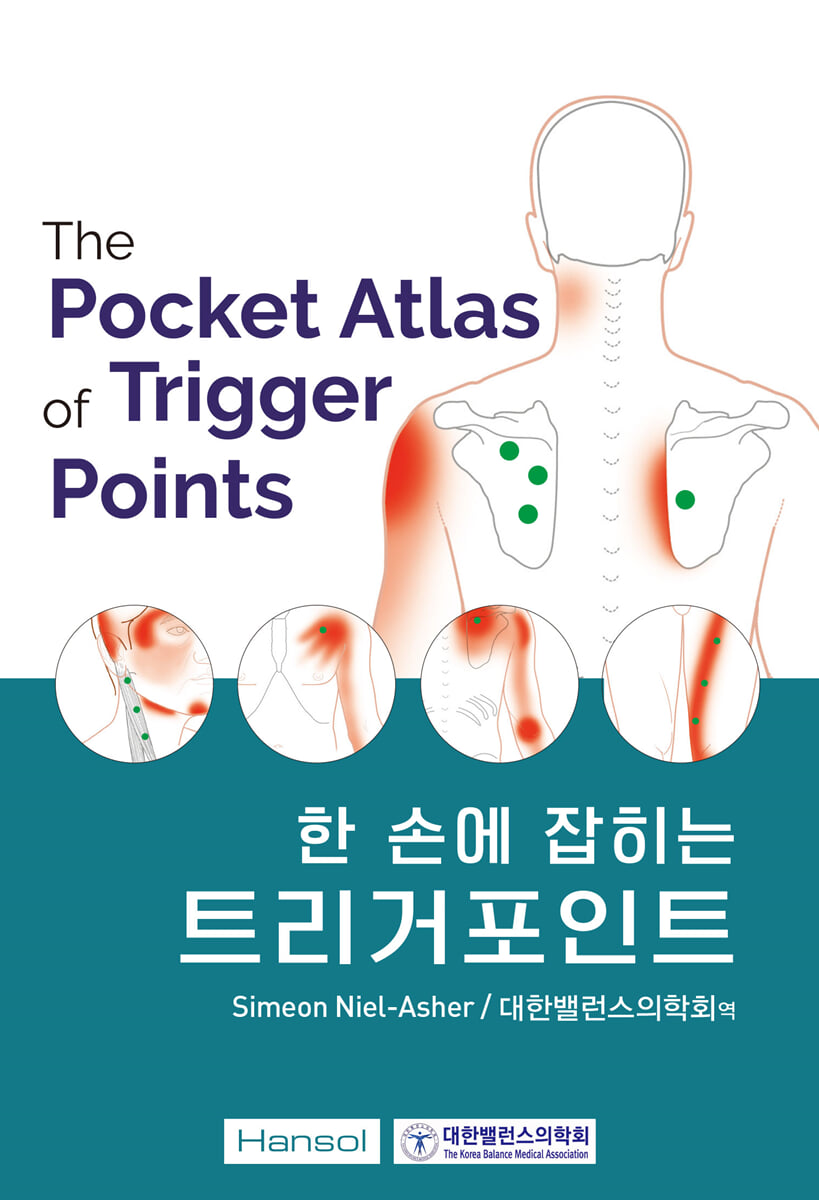
"The Pocket Atlas of Trigger Points," which I recently translated, is a practical and systematic guide to myofascial pain syndrome and trigger points.
This book clearly explains the anatomy and pain patterns, suggests effective treatment strategies, and provides practical guidelines that can be immediately applied in clinical practice.
Despite the remarkable advancements in modern medicine, many patients still suffer from chronic pain.
What I've learned from working in the non-surgical pain management field for over 30 years is that non-surgical approaches to pain management are just as important as surgical approaches.
"The Pocket Atlas of Trigger Points," which I recently translated, is a practical and systematic guide to myofascial pain syndrome and trigger points.
This book clearly explains the anatomy and pain patterns, suggests effective treatment strategies, and provides practical guidelines that can be immediately applied in clinical practice.
- You can preview some of the book's contents.
Preview
index
Introduction to Trigger Points
muscles of the face, head, and neck
Muscles of the trunk and spine
muscles of the shoulders and arms
Forearm and hand
Muscles of the hip joint and thigh
muscles of the calf and foot
Dermatomes and sensory nerves
Super Trigger Point
muscles of the face, head, and neck
Muscles of the trunk and spine
muscles of the shoulders and arms
Forearm and hand
Muscles of the hip joint and thigh
muscles of the calf and foot
Dermatomes and sensory nerves
Super Trigger Point
Publisher's Review
Pain is one of the oldest medical challenges that has accompanied human history.
Despite the remarkable advancements in modern medicine, many patients still suffer from chronic pain.
What I've learned from working in the non-surgical pain management field for over 30 years is that non-surgical approaches to pain management are just as important as surgical approaches.
"The Pocket Atlas of Trigger Points," which I recently translated, is a practical and systematic guide to myofascial pain syndrome and trigger points.
This book clearly explains the anatomy and pain patterns, suggests effective treatment strategies, and provides practical guidelines that can be immediately applied in clinical practice.
Since 1996, I have been lecturing to physicians on non-surgical pain management.
As I introduce various treatment methods, such as chiropractic, proliferative injections, and nerve blocks, I feel that these treatments are not mutually exclusive but rather complementary.
Trigger point therapy is also an important part of this integrative approach.
I decided to translate this book because I wanted to provide Korean medical professionals with more practical and systematic trigger point treatment guidelines.
In particular, I am confident that the detailed anatomical illustrations and clinical application cases in this book will be of great help in actual clinical practice.
As the paradigm of pain treatment gradually expands from surgical to non-surgical and conservative treatments, this book will serve as a very timely guide.
We hope this book will help you understand patients with musculoskeletal pain and develop more effective treatment plans.
Despite the remarkable advancements in modern medicine, many patients still suffer from chronic pain.
What I've learned from working in the non-surgical pain management field for over 30 years is that non-surgical approaches to pain management are just as important as surgical approaches.
"The Pocket Atlas of Trigger Points," which I recently translated, is a practical and systematic guide to myofascial pain syndrome and trigger points.
This book clearly explains the anatomy and pain patterns, suggests effective treatment strategies, and provides practical guidelines that can be immediately applied in clinical practice.
Since 1996, I have been lecturing to physicians on non-surgical pain management.
As I introduce various treatment methods, such as chiropractic, proliferative injections, and nerve blocks, I feel that these treatments are not mutually exclusive but rather complementary.
Trigger point therapy is also an important part of this integrative approach.
I decided to translate this book because I wanted to provide Korean medical professionals with more practical and systematic trigger point treatment guidelines.
In particular, I am confident that the detailed anatomical illustrations and clinical application cases in this book will be of great help in actual clinical practice.
As the paradigm of pain treatment gradually expands from surgical to non-surgical and conservative treatments, this book will serve as a very timely guide.
We hope this book will help you understand patients with musculoskeletal pain and develop more effective treatment plans.
GOODS SPECIFICS
- Date of issue: March 10, 2025
- Page count, weight, size: 226 pages | 130*190*20mm
- ISBN13: 9791189657642
- ISBN10: 1189657643
You may also like
카테고리
korean


korean

![ELLE 엘르 스페셜 에디션 A형 : 12월 [2025]](http://librairie.coreenne.fr/cdn/shop/files/b8e27a3de6c9538896439686c6b0e8fb.jpg?v=1766436872&width=3840)


