

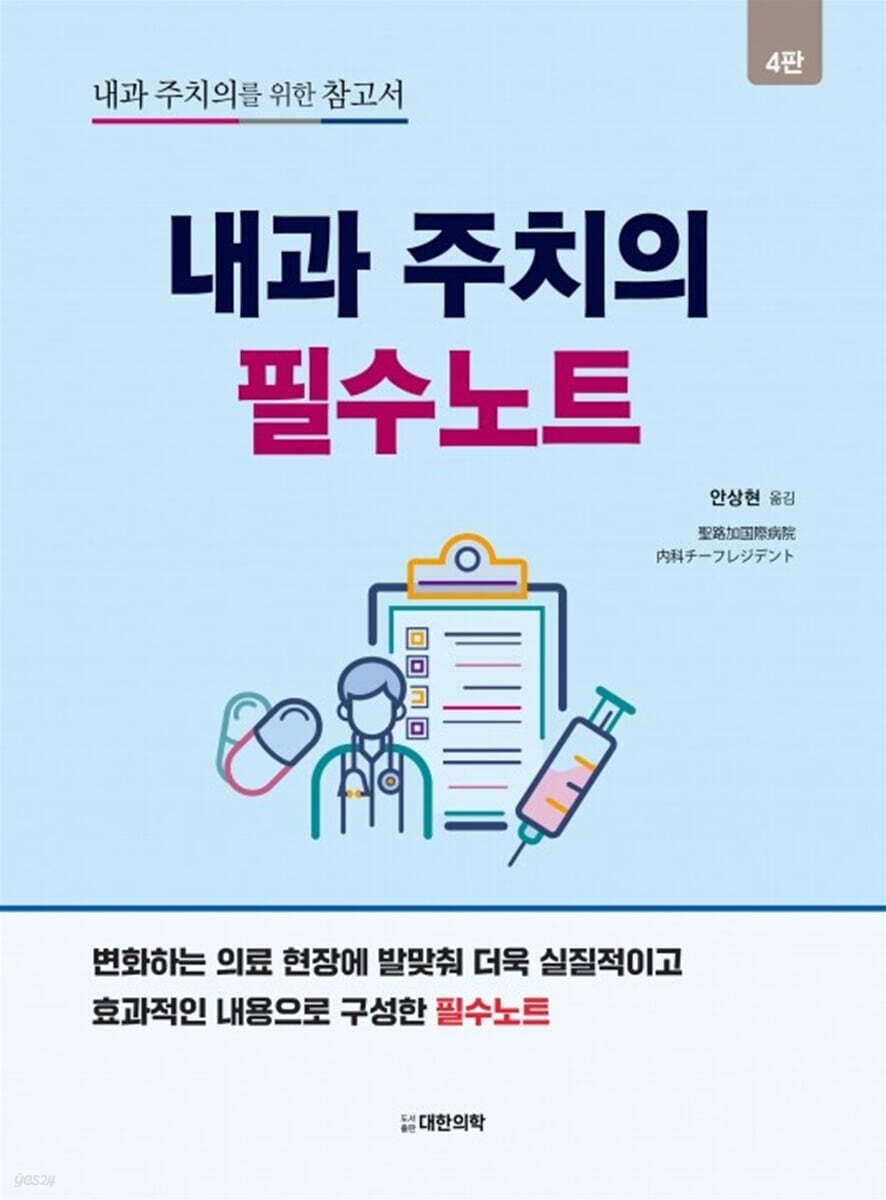
Essential Notes for Internal Medicine Physicians
 |
Description
Book Introduction
"Essential Notes for Internal Medicine Physicians" is not a simple manual; it focuses on the application of medical knowledge and practical responses in emergency situations.
St. Luke's International Hospital, the most popular internal medicine training hospital in Japan, is renowned for its systematic education.
In particular, this fourth edition aims to be more revised than the third edition, reflecting the feedback from practitioners through a survey, adding the latest references and in-depth content, and providing a more robust structure.
St. Luke's International Hospital, the most popular internal medicine training hospital in Japan, is renowned for its systematic education.
In particular, this fourth edition aims to be more revised than the third edition, reflecting the feedback from practitioners through a survey, adding the latest references and in-depth content, and providing a more robust structure.
index
I.
Ward Duty - Don't Miss a Critically Ill Patient! Become a Competent Duty Physician!
1.
Fever - Pay attention to your overall condition and check the overall findings!
2.
Shock - Be aware of whether circulation is maintained, not the absolute blood pressure!
3.
Hypoxia - The most frightening of all vital sign abnormalities! Respond quickly!
4.
Impaired consciousness - if not fainting, AIUEOTIPS
5.
Bradycardia and Tachycardia - Identifying Unstable Arrhythmias!
6.
Chest Pain - Don't Miss These 5 Killer Chest Pain Reliefs!
7.
Abdominal pain - Treatment for abdominal pain begins with ruling out acute abdominal pain.
8.
Headaches - Secondary headaches first!
9.
Nausea and Vomiting - Diagnosis with "NAVSEA"
10.
Blood sugar abnormalities - be careful whether it's low or high!
11.
Insomnia and Delirium - Let's Get Away from 'Prescription Sleeping Pills'!
12.
Allergies in the Ward - Type I? Severe?
13.
Others (falls, dislodged intravenous line, nasogastric tube, or gastrostomy tube, intravenous drip leakage) - Never let your guard down on any call!
II.
Hospitalization - Accurate and Fast Diagnosis! Identify Emergency Conditions!
14.
Pneumonia - Treatment considering background and causative organism
15.
Urinary Tract Infection (UTI) - Simple or Complex?
16.
Bacterial Meningitis - Memorize the Initial Response Guidelines! Administer Antibiotics as Soon as Possible!
17.
Asthma attacks, COPD exacerbations - 'wheeze' does not mean asthma attack.
18.
Acute heart failure - prompt diagnosis and prompt treatment intervention
19.
Cerebral infarction - Save your penumbra with various treatments!
20.
Cramps - Don't panic, get your ABCs right first.
21.
Acute Kidney Injury (AKI) - Always Approach It Step by Step!
22.
Hyponatremia - Na is the most osmotic substance in the body
23.
Hyperkalemia - Suspect, Trust, and Respond to Hyperkalemia
24.
Gastrointestinal bleeding - Identify the site of bleeding based on the pattern of bleeding.
25.
Acute pancreatitis - The most important point is fluids, and pay attention to adequate fluids!
26.
Liver dysfunction - liver or biliary tract
27.
Joint pain and arthritis - be careful of infection and get diagnosed!
28.
Thyroid - Learn the basics of hyperthyroidism and hypothyroidism!
29.
Oncologic Emergency - Cancer treatment is a systemic treatment! Let's be prepared to respond to emergencies!
III.
Ward Management - Ward management is the foundation of clinical care! Become a competent ward doctor!
30.
Complete Blood Count (CBC) - To help you address common CBC abnormalities!
31.
Sap - just sap? Still sap!
32.
Nutrition - If you don't calculate it, don't administer it.
33.
Constipation and diarrhea - because they are so common, it is important to diagnose them thoroughly!
34.
Cancer Pain and Narcotic Painkillers - Don't Let the Pain Endure!
35.
Chronic Kidney Disease (CKD) - Creatinine Isn't the Only Kidney Function
36.
Arterial Blood Gas Analysis (ABGA) - Don't Miss Hidden Abnormalities!
37.
How to Use Steroids - Anticipate Side Effects and Respond Preemptively!
38.
General Guide to Antibiotic Use - Don't Overuse Antibiotics!
39.
Antibiotic Usage Applications - Learn about various infections!
In conclusion
index
Ward Duty - Don't Miss a Critically Ill Patient! Become a Competent Duty Physician!
1.
Fever - Pay attention to your overall condition and check the overall findings!
2.
Shock - Be aware of whether circulation is maintained, not the absolute blood pressure!
3.
Hypoxia - The most frightening of all vital sign abnormalities! Respond quickly!
4.
Impaired consciousness - if not fainting, AIUEOTIPS
5.
Bradycardia and Tachycardia - Identifying Unstable Arrhythmias!
6.
Chest Pain - Don't Miss These 5 Killer Chest Pain Reliefs!
7.
Abdominal pain - Treatment for abdominal pain begins with ruling out acute abdominal pain.
8.
Headaches - Secondary headaches first!
9.
Nausea and Vomiting - Diagnosis with "NAVSEA"
10.
Blood sugar abnormalities - be careful whether it's low or high!
11.
Insomnia and Delirium - Let's Get Away from 'Prescription Sleeping Pills'!
12.
Allergies in the Ward - Type I? Severe?
13.
Others (falls, dislodged intravenous line, nasogastric tube, or gastrostomy tube, intravenous drip leakage) - Never let your guard down on any call!
II.
Hospitalization - Accurate and Fast Diagnosis! Identify Emergency Conditions!
14.
Pneumonia - Treatment considering background and causative organism
15.
Urinary Tract Infection (UTI) - Simple or Complex?
16.
Bacterial Meningitis - Memorize the Initial Response Guidelines! Administer Antibiotics as Soon as Possible!
17.
Asthma attacks, COPD exacerbations - 'wheeze' does not mean asthma attack.
18.
Acute heart failure - prompt diagnosis and prompt treatment intervention
19.
Cerebral infarction - Save your penumbra with various treatments!
20.
Cramps - Don't panic, get your ABCs right first.
21.
Acute Kidney Injury (AKI) - Always Approach It Step by Step!
22.
Hyponatremia - Na is the most osmotic substance in the body
23.
Hyperkalemia - Suspect, Trust, and Respond to Hyperkalemia
24.
Gastrointestinal bleeding - Identify the site of bleeding based on the pattern of bleeding.
25.
Acute pancreatitis - The most important point is fluids, and pay attention to adequate fluids!
26.
Liver dysfunction - liver or biliary tract
27.
Joint pain and arthritis - be careful of infection and get diagnosed!
28.
Thyroid - Learn the basics of hyperthyroidism and hypothyroidism!
29.
Oncologic Emergency - Cancer treatment is a systemic treatment! Let's be prepared to respond to emergencies!
III.
Ward Management - Ward management is the foundation of clinical care! Become a competent ward doctor!
30.
Complete Blood Count (CBC) - To help you address common CBC abnormalities!
31.
Sap - just sap? Still sap!
32.
Nutrition - If you don't calculate it, don't administer it.
33.
Constipation and diarrhea - because they are so common, it is important to diagnose them thoroughly!
34.
Cancer Pain and Narcotic Painkillers - Don't Let the Pain Endure!
35.
Chronic Kidney Disease (CKD) - Creatinine Isn't the Only Kidney Function
36.
Arterial Blood Gas Analysis (ABGA) - Don't Miss Hidden Abnormalities!
37.
How to Use Steroids - Anticipate Side Effects and Respond Preemptively!
38.
General Guide to Antibiotic Use - Don't Overuse Antibiotics!
39.
Antibiotic Usage Applications - Learn about various infections!
In conclusion
index
Publisher's Review
Translator's Preface
"Essential Notes for Internal Medicine Physicians" is a book that I first encountered before my internship in 2010 and was greatly inspired by.
So, I translated the first edition with the hope that other teachers would also benefit from this book, and I was able to introduce it to Korea for the first time.
The second edition was not translated into Korean until 2021, but it returned in 2021 after a 10-year hiatus as a third edition, and we are delighted to announce the publication of an even richer fourth edition in 2025.
The medical field evolves and changes every year.
As new treatment guidelines are published and medical approaches become more refined, this fourth edition reflects these changes and is designed to be more practical and effective.
"Essential Notes for Internal Medicine Physicians" is not a simple manual; it focuses on utilizing medical knowledge and practical responses in emergency situations.
St. Luke's International Hospital, the most popular internal medicine training hospital in Japan, is renowned for its systematic education.
In particular, this fourth edition aims to be more revised than the third edition, reflecting the feedback from practitioners through a survey, adding the latest references and in-depth content, and providing a more robust structure.
We are always curious about how other doctors, or doctors from other countries, actually treat patients and solve problems.
Written by the chief residents of St. Luke's International Hospital, this book draws on core conference and educational materials to capture their passion and earnestness, faithfully conveying the essential information needed in clinical settings.
Through this book, you will be able to see the true nature of Japanese internal medicine training and gain various insights into treatment and education.
Translating this book brought back memories of my days of training.
The times I wrestled with the manual while receiving countless calls as an attending physician, the moments I grew while thinking of solutions during my residency, and the experiences I had as a chief resident passing on knowledge to my juniors became the roots of my career as a doctor.
This book is not simply a tool for solving problems; it helps you understand the "why" and learn a systematic approach in the process.
This was also the element I most longed for during my training.
The translation work could not have been done alone.
I would also like to express my gratitude to everyone at Daehan Medical Publishing for their generous support, which enabled this project to proceed smoothly.
Above all, I would like to take this opportunity to express my gratitude to my wife, Myeongjin, and my daughter, Hyeonseo, for their silent support throughout the translation process.
Although the current medical environment is truly challenging, I support the future of many doctors and hope this book will serve as a small stepping stone toward providing better care to the patients you encounter.
February 2025
Ahn Sang-hyun
The translator is a Japanese medical translator who graduated from Gachon University School of Medicine, completed an internship at Seoul Asan Medical Center, and completed a residency in family medicine at Seoul National University Hospital.
He received his Master's degree in Medical Education from Yonsei University Graduate School, served as the director of Seongseong On Family Clinic, and is currently the chief physician at the Chungnam Workers' Health Center, a consignment of Dankook University Hospital, where he is dedicated to providing education for the general public and medical professionals.
Preface to the 4th edition
The "Essential Notes for Internal Medicine Physicians," now a must-read for medical students and residents, was born from the "Internal Medicine Core Conference" initiated by internal medicine residents in 2004-05.
Having joined Sungnuka International Hospital as an internal medicine resident in 2005, I belong to a generation that learned directly from the writing staff. When I was given the grand task of editing the third edition, I felt both honored and burdened.
Fortunately, I've heard that the third edition is receiving better reviews than ever, perhaps thanks to the other excellent writers.
"Essential Notes for Internal Medicine Physicians" is not just a textbook.
It may also be important for medical students, trainees, and residents to be aware of rare diseases and expand their differential diagnosis.
It would also be important to improve clinical reasoning skills.
However, the most important thing in clinical practice is to be able to make the most of the knowledge you have accumulated, determine the urgency and importance, and then take appropriate action.
『Essential Notes for Internal Medicine Physicians』 was composed with this very point in mind.
Based on frequently encountered cases in the field, we have concisely summarized the essential knowledge, while clearly explaining how to work up and respond.
This fourth edition was written by Professor Sho Fukui, who served as a senior resident in internal medicine in 2017, and Professor Takahiro Suzuki and Professor Takahisa Fujino in 2019.
Among the top residents of all time, they are outstanding in medical knowledge and clinical ability, and are also excellent educators.
Each of us was busy with our own specialized fields, but I asked them to write a revision for the third edition or more, and they readily accepted.
For this revision, we conducted an independent survey of our interns to thoroughly understand which aspects of the book they were satisfied with and how they could improve it.
Additionally, the basic parts are written as concisely and easily as possible, while also providing flexibility by covering more in-depth content.
And we put special effort into the bibliography.
We have tried to introduce new knowledge wherever possible, while also providing commentary on which specific literature is important.
By doing so, I hoped that it would not only help me improve my skills but also help me educate my juniors.
After planning the revised edition and countless discussions with the writing staff over the course of a year, we were able to successfully complete the fourth edition.
I was impressed by the passion and earnest attitude of the writers who, without any compromise, tried to make this book, inherited from their predecessors, even better.
I am truly proud of these three writers.
Lastly, the background that made such a good book possible was the fertile ground of Seongnu International Hospital, where people who love teaching and learning have gathered and continued to provide a long-standing, foundational education.
Thank you to all the hospital staff.
I would also like to express my gratitude to the medical school staff who carefully corrected the manuscript.
Director of the Department of Infectious Diseases, Seongnu International Hospital
Mori Nobuyoshi
"Essential Notes for Internal Medicine Physicians" is a book that I first encountered before my internship in 2010 and was greatly inspired by.
So, I translated the first edition with the hope that other teachers would also benefit from this book, and I was able to introduce it to Korea for the first time.
The second edition was not translated into Korean until 2021, but it returned in 2021 after a 10-year hiatus as a third edition, and we are delighted to announce the publication of an even richer fourth edition in 2025.
The medical field evolves and changes every year.
As new treatment guidelines are published and medical approaches become more refined, this fourth edition reflects these changes and is designed to be more practical and effective.
"Essential Notes for Internal Medicine Physicians" is not a simple manual; it focuses on utilizing medical knowledge and practical responses in emergency situations.
St. Luke's International Hospital, the most popular internal medicine training hospital in Japan, is renowned for its systematic education.
In particular, this fourth edition aims to be more revised than the third edition, reflecting the feedback from practitioners through a survey, adding the latest references and in-depth content, and providing a more robust structure.
We are always curious about how other doctors, or doctors from other countries, actually treat patients and solve problems.
Written by the chief residents of St. Luke's International Hospital, this book draws on core conference and educational materials to capture their passion and earnestness, faithfully conveying the essential information needed in clinical settings.
Through this book, you will be able to see the true nature of Japanese internal medicine training and gain various insights into treatment and education.
Translating this book brought back memories of my days of training.
The times I wrestled with the manual while receiving countless calls as an attending physician, the moments I grew while thinking of solutions during my residency, and the experiences I had as a chief resident passing on knowledge to my juniors became the roots of my career as a doctor.
This book is not simply a tool for solving problems; it helps you understand the "why" and learn a systematic approach in the process.
This was also the element I most longed for during my training.
The translation work could not have been done alone.
I would also like to express my gratitude to everyone at Daehan Medical Publishing for their generous support, which enabled this project to proceed smoothly.
Above all, I would like to take this opportunity to express my gratitude to my wife, Myeongjin, and my daughter, Hyeonseo, for their silent support throughout the translation process.
Although the current medical environment is truly challenging, I support the future of many doctors and hope this book will serve as a small stepping stone toward providing better care to the patients you encounter.
February 2025
Ahn Sang-hyun
The translator is a Japanese medical translator who graduated from Gachon University School of Medicine, completed an internship at Seoul Asan Medical Center, and completed a residency in family medicine at Seoul National University Hospital.
He received his Master's degree in Medical Education from Yonsei University Graduate School, served as the director of Seongseong On Family Clinic, and is currently the chief physician at the Chungnam Workers' Health Center, a consignment of Dankook University Hospital, where he is dedicated to providing education for the general public and medical professionals.
Preface to the 4th edition
The "Essential Notes for Internal Medicine Physicians," now a must-read for medical students and residents, was born from the "Internal Medicine Core Conference" initiated by internal medicine residents in 2004-05.
Having joined Sungnuka International Hospital as an internal medicine resident in 2005, I belong to a generation that learned directly from the writing staff. When I was given the grand task of editing the third edition, I felt both honored and burdened.
Fortunately, I've heard that the third edition is receiving better reviews than ever, perhaps thanks to the other excellent writers.
"Essential Notes for Internal Medicine Physicians" is not just a textbook.
It may also be important for medical students, trainees, and residents to be aware of rare diseases and expand their differential diagnosis.
It would also be important to improve clinical reasoning skills.
However, the most important thing in clinical practice is to be able to make the most of the knowledge you have accumulated, determine the urgency and importance, and then take appropriate action.
『Essential Notes for Internal Medicine Physicians』 was composed with this very point in mind.
Based on frequently encountered cases in the field, we have concisely summarized the essential knowledge, while clearly explaining how to work up and respond.
This fourth edition was written by Professor Sho Fukui, who served as a senior resident in internal medicine in 2017, and Professor Takahiro Suzuki and Professor Takahisa Fujino in 2019.
Among the top residents of all time, they are outstanding in medical knowledge and clinical ability, and are also excellent educators.
Each of us was busy with our own specialized fields, but I asked them to write a revision for the third edition or more, and they readily accepted.
For this revision, we conducted an independent survey of our interns to thoroughly understand which aspects of the book they were satisfied with and how they could improve it.
Additionally, the basic parts are written as concisely and easily as possible, while also providing flexibility by covering more in-depth content.
And we put special effort into the bibliography.
We have tried to introduce new knowledge wherever possible, while also providing commentary on which specific literature is important.
By doing so, I hoped that it would not only help me improve my skills but also help me educate my juniors.
After planning the revised edition and countless discussions with the writing staff over the course of a year, we were able to successfully complete the fourth edition.
I was impressed by the passion and earnest attitude of the writers who, without any compromise, tried to make this book, inherited from their predecessors, even better.
I am truly proud of these three writers.
Lastly, the background that made such a good book possible was the fertile ground of Seongnu International Hospital, where people who love teaching and learning have gathered and continued to provide a long-standing, foundational education.
Thank you to all the hospital staff.
I would also like to express my gratitude to the medical school staff who carefully corrected the manuscript.
Director of the Department of Infectious Diseases, Seongnu International Hospital
Mori Nobuyoshi
GOODS SPECIFICS
- Date of issue: March 23, 2025
- Page count, weight, size: 500 pages | 188*257*30mm
- ISBN13: 9791155903032
- ISBN10: 115590303X
You may also like
카테고리
korean


korean

![GQ KOREA Mark (Monthly): December [2025]](http://librairie.coreenne.fr/cdn/shop/files/8ef265dbbfbf186523ed75ba7319009d.jpg?v=1765340328&width=3840)


