

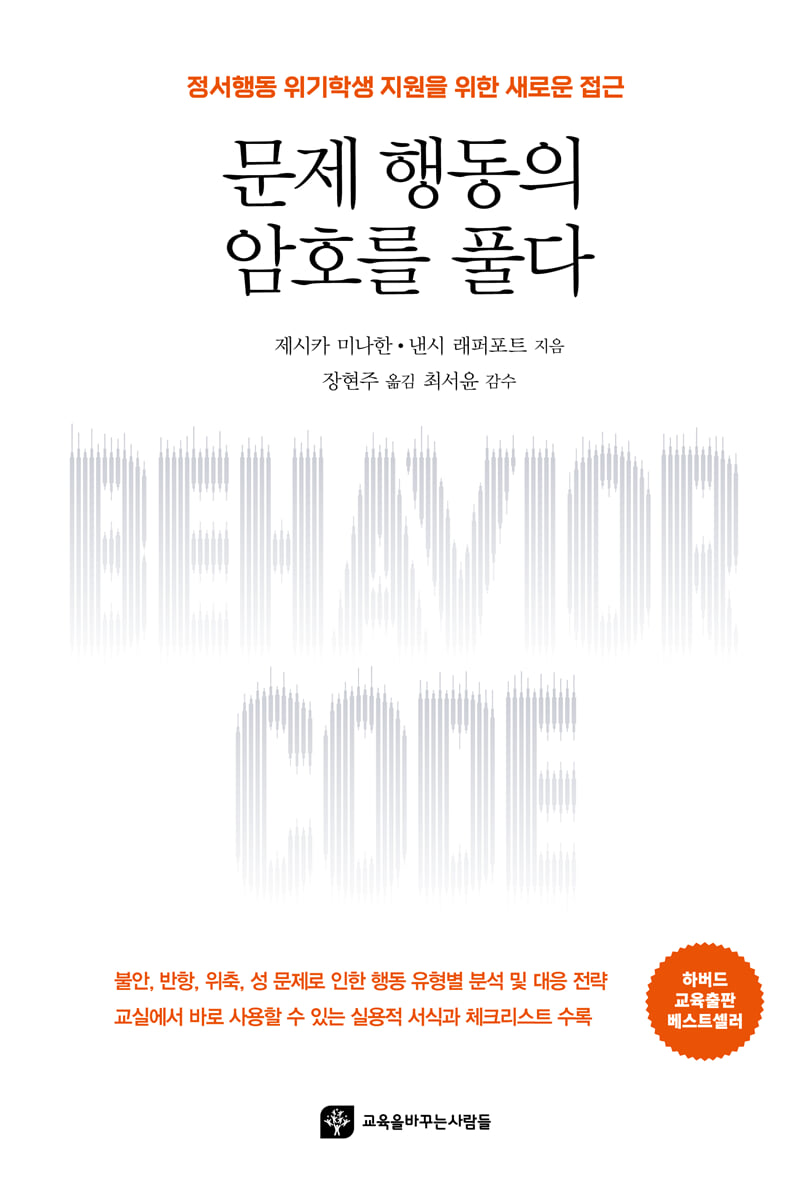
Decoding problem behavior
 |
Description
Book Introduction
Highly recommended by elementary, middle, and high school teachers and counseling experts!
“The Ultimate Guide to Preventing and Responding to Problem Behavior”
The number of "students in emotional and behavioral crisis" is rapidly increasing in the educational field. Students with attention deficit hyperactivity disorder (ADHD), conduct disorder and oppositional defiant disorder, and students consistently depressed and apathetic—these are all examples of students who can be found in schools and classrooms across all regions and ages.
They struggle with learning and social interactions, and some exhibit behavioral problems that negatively impact their interactions with teachers and classmates.
All of this burden falls on the teacher to handle, respond to, and guide.
Although legal and institutional measures to support students experiencing emotional and behavioral crises are being established one after another, and diagnostic, treatment, and counseling support are expanding, the problem still poses a challenge to schools and teachers.
The best way is to prevent and improve problem behavior through preemptive intervention.
To do so, we must identify the difficulties students are experiencing in advance and take appropriate intervention measures.
This is why we need to 'decode the code of problem behavior'.
On the surface, these actions may appear as rebellion, hostility, or stubbornness, but they contain hidden meanings and unexpressed desires.
This book presents a variety of examples and methods to help teachers analyze and interpret students' behavior as if it were a "code," and introduces specific intervention strategies for anxiety, rebellion, withdrawal, and sexual issues.
The strength of this book is that it is very specific and realistic.
The authors are behavioral analysts who have supported teachers in public education for decades and are authorities on mental health research at Harvard Medical School.
It is supported by a solid theoretical basis, including typical behavioral characteristics of students with anxiety, rebellion, withdrawal, and sexual behavior, related psychiatric disorders, and warning signs that teachers can intuitively observe.
A specific strategy called the "FAIR Plan" helps students accurately identify the function of a behavior by recording what factors preceded the behavior and what reactions occurred afterward, and analyzing the patterns.
Then, we can help improve behavior through interactive strategies that adjust the environment, underdeveloped skills, and curriculum, and build trusting relationships between teachers and students.
It also covers teachers' response strategies when inappropriate behavior occurs.
In other words, by identifying the code behind problem behavior and applying appropriate intervention strategies, we can improve behavior and support both teachers and students.
“The Ultimate Guide to Preventing and Responding to Problem Behavior”
The number of "students in emotional and behavioral crisis" is rapidly increasing in the educational field. Students with attention deficit hyperactivity disorder (ADHD), conduct disorder and oppositional defiant disorder, and students consistently depressed and apathetic—these are all examples of students who can be found in schools and classrooms across all regions and ages.
They struggle with learning and social interactions, and some exhibit behavioral problems that negatively impact their interactions with teachers and classmates.
All of this burden falls on the teacher to handle, respond to, and guide.
Although legal and institutional measures to support students experiencing emotional and behavioral crises are being established one after another, and diagnostic, treatment, and counseling support are expanding, the problem still poses a challenge to schools and teachers.
The best way is to prevent and improve problem behavior through preemptive intervention.
To do so, we must identify the difficulties students are experiencing in advance and take appropriate intervention measures.
This is why we need to 'decode the code of problem behavior'.
On the surface, these actions may appear as rebellion, hostility, or stubbornness, but they contain hidden meanings and unexpressed desires.
This book presents a variety of examples and methods to help teachers analyze and interpret students' behavior as if it were a "code," and introduces specific intervention strategies for anxiety, rebellion, withdrawal, and sexual issues.
The strength of this book is that it is very specific and realistic.
The authors are behavioral analysts who have supported teachers in public education for decades and are authorities on mental health research at Harvard Medical School.
It is supported by a solid theoretical basis, including typical behavioral characteristics of students with anxiety, rebellion, withdrawal, and sexual behavior, related psychiatric disorders, and warning signs that teachers can intuitively observe.
A specific strategy called the "FAIR Plan" helps students accurately identify the function of a behavior by recording what factors preceded the behavior and what reactions occurred afterward, and analyzing the patterns.
Then, we can help improve behavior through interactive strategies that adjust the environment, underdeveloped skills, and curriculum, and build trusting relationships between teachers and students.
It also covers teachers' response strategies when inappropriate behavior occurs.
In other words, by identifying the code behind problem behavior and applying appropriate intervention strategies, we can improve behavior and support both teachers and students.
- You can preview some of the book's contents.
Preview
index
Chapter 1: The Code of Action
Why Do They Act That Way?ㆍ030
Basic Concepts for Understanding Behaviorㆍ037
Summaryㆍ057
Chapter 2 FAIR Plan
Basic Frameworkㆍ062
FAIR Plan in Practiceㆍ067
_ F Behavioral Function Hypothesis Establishmentㆍ068
_ A Adjustmentㆍ072
_ I Interaction Strategyㆍ076
_ R Response Strategyㆍ079
Which plan should I use?ㆍ080
Summaryㆍ083
Chapter 3: "Everyone, Go Away!" - Anxiety Issues
Why Anxiety Is a Problemㆍ090
Various anxiety disordersㆍ090
The Importance of Interventionㆍ095
Behavioral Characteristics of Students with Anxiety Disordersㆍ096
Cases where anxiety behavior can be determined through observationㆍ098
Inconsistent behaviorㆍ100
Behavioral Patterns of Students with Anxiety Disordersㆍ101
Avoidance Behavior and Anxietyㆍ104
Transition and Anxietyㆍ106
Support for Students with Anxiety Disordersㆍ111
The Importance of Rest in Anxiety Managementㆍ114
FAIR Plan in Practice_ Anxiety Behaviorㆍ124
_ F Establishment of Behavioral Function Hypothesisㆍ124
_ A Adjustmentㆍ128
_ I Interaction Strategyㆍ147
_ R Response Strategyㆍ149
FAIR Plan for Nellyㆍ151
Summaryㆍ153
FAIR Plan Checklist for Anxiety Issuesㆍ154
Chapter 4: "Don't Tell Me What to Do!" - The Problem of Rebellion
Why Rebellion Occursㆍ164
Typical Characteristics of Students Who Rebelliousㆍ165
Functions of Rebellious Behaviorㆍ168
Warning Signs of Rebellious Behaviorㆍ169
FAIR Plan in Practice_ Rebellion Actionㆍ171
_ F Establishment of Behavioral Function Hypothesisㆍ171
_ A Adjustmentㆍ174
_ I Interaction Strategyㆍ184
_ R Response Strategy (1)ㆍ197 Response Strategy (2)ㆍ200
FAIR Plan for Emilyㆍ205
Summaryㆍ209
FAIR Plan for the Rebellion Problem
FAIR Plan Checklist for Rebellion Issuesㆍ210
Chapter 5: “I’m Not Interested at All” – The Problem of Atrophy
Understanding Depressionㆍ220
Causes of Childhood Depressionㆍ223
Support outside of schoolㆍ224
Cognitive Behavioral Therapyㆍ226
The FAIR Plan in Practice_ Atrophying Behaviorㆍ229
_ F Establishment of Behavioral Function Hypothesisㆍ229
_ A Adjustmentㆍ232
_ I Interaction Strategyㆍ241
_ R Response Strategyㆍ251
FAIR Plan for Jackㆍ252
Summaryㆍ255
FAIR Plan Checklist for Shrinkage Issuesㆍ256
Chapter 6 “I didn’t mean to do that….”_ Sexual Issues
The Concept of Sexual Behaviorㆍ263
Patterns of Childhood Sexual Behaviorㆍ264
Causes of Sexual Behavior and Responsesㆍ266
FAIR Plan in Practice_ Sexual Behaviorㆍ285
_ F Establishment of Behavioral Function Hypothesisㆍ285
_ A Adjustmentㆍ290
_ I Interaction Strategyㆍ297
_ R Response Strategyㆍ299
Summaryㆍ305
FAIR Plan Checklist for Gender Issuesㆍ306
Chapter 7 Problem Behavior FAQs
supplement
A. ABC Record Formㆍ333
B.
Reference Materials for Behavioral Guidanceㆍ334
C.
Lunch Buddy Small Group Permission Request Guideㆍ341
D.
Educational Technical Materialsㆍ342
E.
Self-soothing activity toolsㆍ352
F.
Self-assessment formㆍ354
G.
Responsibility for Choiceㆍ357
H. FAIR Plan Implementation Formㆍ358
Note 359
Searchㆍ384
About the Authorㆍ389
Why Do They Act That Way?ㆍ030
Basic Concepts for Understanding Behaviorㆍ037
Summaryㆍ057
Chapter 2 FAIR Plan
Basic Frameworkㆍ062
FAIR Plan in Practiceㆍ067
_ F Behavioral Function Hypothesis Establishmentㆍ068
_ A Adjustmentㆍ072
_ I Interaction Strategyㆍ076
_ R Response Strategyㆍ079
Which plan should I use?ㆍ080
Summaryㆍ083
Chapter 3: "Everyone, Go Away!" - Anxiety Issues
Why Anxiety Is a Problemㆍ090
Various anxiety disordersㆍ090
The Importance of Interventionㆍ095
Behavioral Characteristics of Students with Anxiety Disordersㆍ096
Cases where anxiety behavior can be determined through observationㆍ098
Inconsistent behaviorㆍ100
Behavioral Patterns of Students with Anxiety Disordersㆍ101
Avoidance Behavior and Anxietyㆍ104
Transition and Anxietyㆍ106
Support for Students with Anxiety Disordersㆍ111
The Importance of Rest in Anxiety Managementㆍ114
FAIR Plan in Practice_ Anxiety Behaviorㆍ124
_ F Establishment of Behavioral Function Hypothesisㆍ124
_ A Adjustmentㆍ128
_ I Interaction Strategyㆍ147
_ R Response Strategyㆍ149
FAIR Plan for Nellyㆍ151
Summaryㆍ153
FAIR Plan Checklist for Anxiety Issuesㆍ154
Chapter 4: "Don't Tell Me What to Do!" - The Problem of Rebellion
Why Rebellion Occursㆍ164
Typical Characteristics of Students Who Rebelliousㆍ165
Functions of Rebellious Behaviorㆍ168
Warning Signs of Rebellious Behaviorㆍ169
FAIR Plan in Practice_ Rebellion Actionㆍ171
_ F Establishment of Behavioral Function Hypothesisㆍ171
_ A Adjustmentㆍ174
_ I Interaction Strategyㆍ184
_ R Response Strategy (1)ㆍ197 Response Strategy (2)ㆍ200
FAIR Plan for Emilyㆍ205
Summaryㆍ209
FAIR Plan for the Rebellion Problem
FAIR Plan Checklist for Rebellion Issuesㆍ210
Chapter 5: “I’m Not Interested at All” – The Problem of Atrophy
Understanding Depressionㆍ220
Causes of Childhood Depressionㆍ223
Support outside of schoolㆍ224
Cognitive Behavioral Therapyㆍ226
The FAIR Plan in Practice_ Atrophying Behaviorㆍ229
_ F Establishment of Behavioral Function Hypothesisㆍ229
_ A Adjustmentㆍ232
_ I Interaction Strategyㆍ241
_ R Response Strategyㆍ251
FAIR Plan for Jackㆍ252
Summaryㆍ255
FAIR Plan Checklist for Shrinkage Issuesㆍ256
Chapter 6 “I didn’t mean to do that….”_ Sexual Issues
The Concept of Sexual Behaviorㆍ263
Patterns of Childhood Sexual Behaviorㆍ264
Causes of Sexual Behavior and Responsesㆍ266
FAIR Plan in Practice_ Sexual Behaviorㆍ285
_ F Establishment of Behavioral Function Hypothesisㆍ285
_ A Adjustmentㆍ290
_ I Interaction Strategyㆍ297
_ R Response Strategyㆍ299
Summaryㆍ305
FAIR Plan Checklist for Gender Issuesㆍ306
Chapter 7 Problem Behavior FAQs
supplement
A. ABC Record Formㆍ333
B.
Reference Materials for Behavioral Guidanceㆍ334
C.
Lunch Buddy Small Group Permission Request Guideㆍ341
D.
Educational Technical Materialsㆍ342
E.
Self-soothing activity toolsㆍ352
F.
Self-assessment formㆍ354
G.
Responsibility for Choiceㆍ357
H. FAIR Plan Implementation Formㆍ358
Note 359
Searchㆍ384
About the Authorㆍ389
Detailed image
.jpg)
Into the book
The challenging behavior of students experiencing emotional and behavioral crises is a serious concern for teachers as well.
They have difficulty controlling their emotions and concentrating on their studies.
They may lack the basic skills needed to regulate their own behavior and may not know what they are doing.
They lack flexibility and tend to explode in anger for no apparent reason, disrupting class activities.
They are unable to form social relationships and are either isolated or overly dependent.
Sitting around blankly or feeling irritated without motivation.
Repeatedly rebel and argue constantly.
Although rare, they may sometimes exhibit inappropriate sexual behavior.
Because of these, teachers stay up all night worrying about them, are afraid to go to class, and are anxious about what they will encounter in the classroom.
Most of their stories are heartbreaking and sad.
--- p.18
Student behavior is often unpredictable and confusing, making it difficult to intuitively discern the reasons for it.
In particular, problem behaviors are often difficult to detect because they are not consistent and often arise from a lack of skills for appropriate behavior.
Even if you accurately judge a student's intentions, you may make incorrect judgments when teaching replacement behaviors.
In other words, when a student behaves inappropriately, we need to teach them appropriate alternative behaviors, such as “don’t push and wait your turn.” If we fail to do so, the intervention is likely to fail.
--- p.32
Actions never occur without meaning or purpose.
Would you repeat a behavior that doesn't yield any results? Even behaviors that seem inappropriate can be effective ways to communicate a specific goal to some students.
Behavior that appears inappropriate is usually related to a specific reaction from others.
Examples include whining to get the teacher's attention, pretending to be sick to avoid class, and swearing to get someone's attention.
When this behavior is repeated, it becomes more difficult to determine what response is truly desired.
Students who repeatedly throw tantrums and storm out of class have already learned that this is effective in getting them out of class.
For teachers trying to address undesirable behaviors and learning experiences, it's important to first understand what students are trying to achieve through their inappropriate behavior.
And we must be careful not to inadvertently reinforce student behavior and find other ways to respond to inappropriate behavior.
--- p.42
A positive relationship between teachers and students has a significant impact on students' behavior.
A study of kindergarten and first grade students found that students who had conflicts with their teachers disliked school, were less compliant, and had lower academic achievement.
Problem behaviors from students like this can push teachers away and increase the likelihood of conflict.
Unfortunately, frequent conflicts with teachers create further resistance in students, and this trend continues.
In our experience, teachers are often ill-prepared to interact with students in emotional and behavioral crisis.
Teachers often respond to students who frequently engage in inappropriate behavior by getting angry or arguing with them.
Or, to avoid negative interactions, they choose to ignore and ignore the person altogether.
Traditional ways of interacting with disobedient students, such as directive or authoritarian communication, are often counterproductive.
--- p.76
The antecedents to the behavior of students experiencing anxiety vary widely.
When I asked Steven to read aloud, some days he did very well, but other days he refused and stormed out of the classroom.
The root cause of this behavior was not the fact that he was 'asked to read aloud', but that Stephen was very anxious at that moment, that it was a specific moment when he was unable to comply with the request.
If this is not understood, interventions may focus on assuming antecedent events, such as Steven disliking to read or having trouble reading.
--- p.100
Advance warning is a strategy that can help anxious students navigate their day more smoothly.
Teachers often worry about the time it takes to provide advance notice and how to fit it into their schedules.
However, advance notice of just five minutes during the first class in the morning is sufficient and can prevent students from avoidant behavior or emotional breakdowns that may occur later.
In addition to previewing the schedule, you can also say, “This is the worksheet we’re going to be solving in math class today.
It's also helpful to show students real-world challenges they'll face later in a subject they don't particularly enjoy, such as, "Let's solve the first problem together."
Since students have previewed the assignment, they will not react negatively when they see the same assignment later.
--- p.139
Most students show signs of escalating behavior before they explode.
Teachers must observe and record each incident.
Each student has a somewhat limited repertoire of warning signs, usually small behavioral changes and other signals that precede explosive behavior.
After a few incidents, the teacher will be able to determine at what point the student is getting close to the explosive point.
Let's make a list of these 'warning signs'.
Common warning signs of rebellious behavior include grunting, clenching fists, clenching teeth, talking loudly, breathing heavily, rocking back and forth, and suddenly getting up and pacing.
--- p.170
Joint activities with teachers can foster students' sense of security and cooperative behavior.
Even if it might seem a bit excessive for some students, engaging in memorable activities that go beyond the everyday can help build relationships.
This is something to consider when you're just starting to build positive relationships, such as at the beginning of the school year or right after the start of the semester.
It's incredibly rewarding to see your students participating more actively in class and thriving in school.
Take a picnic to the school lawn with your students and bring some food to share.
One teacher's spouse even brought her dog from home so she could walk it with her students.
--- p.186
For students who are feeling anxious, it is important to provide a safe and calm space in the classroom.
This space is a place where students can self-regulate when they feel depressed or anxious.
Set up a cozy sofa, comfortable pillows, and activities to distract yourself from negative thoughts.
Some depressed students desperately want attention or someone to talk to, while others just want to be left alone.
For these students, teachers must actively intervene to help them socialize with their friends.
--- p.232
There are some things to be careful about when using humor with shy students.
They are not accustomed to being happy or laughing and are very sensitive.
This means that if you hear the humor as sarcastic, you may misunderstand that you are being made fun of.
Therefore, you should be careful not to feel that the teacher is making fun of you when you hear humorous words.
--- p.244
Students with sexual trauma are more likely to be accustomed to receiving sexual attention from others.
If the abusive adult was the only one who gave the student special attention, it is possible that the student learned something, even if it was painful and harmful.
They are not very good at recognizing boundaries in relationships and are ignorant of how to protect themselves.
Because they have less reflexes for safety than the average child, they are at greater risk of falling into the hands of sex offenders.
--- p.278
When a student makes sexual remarks, it is better to pay little attention to them or ignore them altogether.
However, we should not ignore rule violations.
Let's look at Max's example from the beginning of Chapter 6.
When Max made a sexual remark and the whole class was in an uproar, Mr. Kent responded sternly by ordering him out of the classroom.
But it is better to minimize the reaction and quickly revoke the authority.
Respond with something like, “You did something inappropriate (you just broke a rule), so I’m removing an asterisk.” Or simply say, “That’s inappropriate,” and then write on the board that certain privileges will be revoked in the event of inappropriate behavior, as agreed upon with the student in advance.
--- p.299
One mother's eyes welled up as she reflected on the past year of successful transformations in her fourth-grade son.
“In the past, I felt like I was raising an animal that was completely incomprehensible and sometimes even scary.
I have a son now.
“Thank you so much for giving me my son back.”
They have difficulty controlling their emotions and concentrating on their studies.
They may lack the basic skills needed to regulate their own behavior and may not know what they are doing.
They lack flexibility and tend to explode in anger for no apparent reason, disrupting class activities.
They are unable to form social relationships and are either isolated or overly dependent.
Sitting around blankly or feeling irritated without motivation.
Repeatedly rebel and argue constantly.
Although rare, they may sometimes exhibit inappropriate sexual behavior.
Because of these, teachers stay up all night worrying about them, are afraid to go to class, and are anxious about what they will encounter in the classroom.
Most of their stories are heartbreaking and sad.
--- p.18
Student behavior is often unpredictable and confusing, making it difficult to intuitively discern the reasons for it.
In particular, problem behaviors are often difficult to detect because they are not consistent and often arise from a lack of skills for appropriate behavior.
Even if you accurately judge a student's intentions, you may make incorrect judgments when teaching replacement behaviors.
In other words, when a student behaves inappropriately, we need to teach them appropriate alternative behaviors, such as “don’t push and wait your turn.” If we fail to do so, the intervention is likely to fail.
--- p.32
Actions never occur without meaning or purpose.
Would you repeat a behavior that doesn't yield any results? Even behaviors that seem inappropriate can be effective ways to communicate a specific goal to some students.
Behavior that appears inappropriate is usually related to a specific reaction from others.
Examples include whining to get the teacher's attention, pretending to be sick to avoid class, and swearing to get someone's attention.
When this behavior is repeated, it becomes more difficult to determine what response is truly desired.
Students who repeatedly throw tantrums and storm out of class have already learned that this is effective in getting them out of class.
For teachers trying to address undesirable behaviors and learning experiences, it's important to first understand what students are trying to achieve through their inappropriate behavior.
And we must be careful not to inadvertently reinforce student behavior and find other ways to respond to inappropriate behavior.
--- p.42
A positive relationship between teachers and students has a significant impact on students' behavior.
A study of kindergarten and first grade students found that students who had conflicts with their teachers disliked school, were less compliant, and had lower academic achievement.
Problem behaviors from students like this can push teachers away and increase the likelihood of conflict.
Unfortunately, frequent conflicts with teachers create further resistance in students, and this trend continues.
In our experience, teachers are often ill-prepared to interact with students in emotional and behavioral crisis.
Teachers often respond to students who frequently engage in inappropriate behavior by getting angry or arguing with them.
Or, to avoid negative interactions, they choose to ignore and ignore the person altogether.
Traditional ways of interacting with disobedient students, such as directive or authoritarian communication, are often counterproductive.
--- p.76
The antecedents to the behavior of students experiencing anxiety vary widely.
When I asked Steven to read aloud, some days he did very well, but other days he refused and stormed out of the classroom.
The root cause of this behavior was not the fact that he was 'asked to read aloud', but that Stephen was very anxious at that moment, that it was a specific moment when he was unable to comply with the request.
If this is not understood, interventions may focus on assuming antecedent events, such as Steven disliking to read or having trouble reading.
--- p.100
Advance warning is a strategy that can help anxious students navigate their day more smoothly.
Teachers often worry about the time it takes to provide advance notice and how to fit it into their schedules.
However, advance notice of just five minutes during the first class in the morning is sufficient and can prevent students from avoidant behavior or emotional breakdowns that may occur later.
In addition to previewing the schedule, you can also say, “This is the worksheet we’re going to be solving in math class today.
It's also helpful to show students real-world challenges they'll face later in a subject they don't particularly enjoy, such as, "Let's solve the first problem together."
Since students have previewed the assignment, they will not react negatively when they see the same assignment later.
--- p.139
Most students show signs of escalating behavior before they explode.
Teachers must observe and record each incident.
Each student has a somewhat limited repertoire of warning signs, usually small behavioral changes and other signals that precede explosive behavior.
After a few incidents, the teacher will be able to determine at what point the student is getting close to the explosive point.
Let's make a list of these 'warning signs'.
Common warning signs of rebellious behavior include grunting, clenching fists, clenching teeth, talking loudly, breathing heavily, rocking back and forth, and suddenly getting up and pacing.
--- p.170
Joint activities with teachers can foster students' sense of security and cooperative behavior.
Even if it might seem a bit excessive for some students, engaging in memorable activities that go beyond the everyday can help build relationships.
This is something to consider when you're just starting to build positive relationships, such as at the beginning of the school year or right after the start of the semester.
It's incredibly rewarding to see your students participating more actively in class and thriving in school.
Take a picnic to the school lawn with your students and bring some food to share.
One teacher's spouse even brought her dog from home so she could walk it with her students.
--- p.186
For students who are feeling anxious, it is important to provide a safe and calm space in the classroom.
This space is a place where students can self-regulate when they feel depressed or anxious.
Set up a cozy sofa, comfortable pillows, and activities to distract yourself from negative thoughts.
Some depressed students desperately want attention or someone to talk to, while others just want to be left alone.
For these students, teachers must actively intervene to help them socialize with their friends.
--- p.232
There are some things to be careful about when using humor with shy students.
They are not accustomed to being happy or laughing and are very sensitive.
This means that if you hear the humor as sarcastic, you may misunderstand that you are being made fun of.
Therefore, you should be careful not to feel that the teacher is making fun of you when you hear humorous words.
--- p.244
Students with sexual trauma are more likely to be accustomed to receiving sexual attention from others.
If the abusive adult was the only one who gave the student special attention, it is possible that the student learned something, even if it was painful and harmful.
They are not very good at recognizing boundaries in relationships and are ignorant of how to protect themselves.
Because they have less reflexes for safety than the average child, they are at greater risk of falling into the hands of sex offenders.
--- p.278
When a student makes sexual remarks, it is better to pay little attention to them or ignore them altogether.
However, we should not ignore rule violations.
Let's look at Max's example from the beginning of Chapter 6.
When Max made a sexual remark and the whole class was in an uproar, Mr. Kent responded sternly by ordering him out of the classroom.
But it is better to minimize the reaction and quickly revoke the authority.
Respond with something like, “You did something inappropriate (you just broke a rule), so I’m removing an asterisk.” Or simply say, “That’s inappropriate,” and then write on the board that certain privileges will be revoked in the event of inappropriate behavior, as agreed upon with the student in advance.
--- p.299
One mother's eyes welled up as she reflected on the past year of successful transformations in her fourth-grade son.
“In the past, I felt like I was raising an animal that was completely incomprehensible and sometimes even scary.
I have a son now.
“Thank you so much for giving me my son back.”
--- p.328
Publisher's Review
“It’s not that it’s bad, it’s just broken.
“The child you pushed away with your heart may have been the one who needed you the most.”
I was initially intrigued by the title of this book, 'Behavior Code'.
It seems like common sense that every action has a reason, but I haven't often had the experience of observing someone's actions and thinking about the reason behind their actions.
This seems especially true for young children.
When a child suddenly throws a tantrum while getting ready for school, parents are more likely to get angry than to figure out why.
Your child may be filled with anxiety about the performance evaluation that will be held today and a sense of defeat for not being able to finish the assignment.
With the start of the new school year in March, the Ministry of Education announced a plan to support students at risk of emotional and behavioral difficulties.
Some media outlets reported this with expressions like, "It is now possible to separate disruptive students" and "There is a need to establish a dedicated classroom for students with emotional and behavioral crises." However, I am concerned that the way adults view students at risk may be more focused on "disruption" than "crisis."
The authors say, "The first thing teachers should do is examine their own perceptions of students who are engaging in problem behavior."
Students can easily sense negative emotions in their teachers, which can lead to more problematic behavior.
It's really not easy to be affectionate toward a student who constantly tries to test the teacher's patience.
However, problem behaviors are never improved by punishing them after they occur.
“It’s not that it’s bad, it’s just broken.
“The child you pushed away with your heart may have been the one who needed you the most.” We need a strategy to first identify the psychological and emotional ‘crisis’ the student is experiencing and then approach him or her with your heart.
This book is divided into seven chapters.
Chapter 1 introduces basic concepts for understanding 'behavior'.
Every action is an expression of communication and has an intended function.
The same goes for problem behaviors.
Analyzing the code of behavior is the process of understanding the intention and function that the behavior is trying to express.
Chapter 2 introduces the 'FAIR Plan', a practical intervention plan proposed by the authors.
'FAIR' stands for 'Establishing Behavioral Function Hypothesis', 'Adjustment', 'Interaction', and 'Response' strategies, respectively.
Chapters 3-6 cover anxiety, rebellion, withdrawal, and sexual issues, explaining why students behave this way, how it manifests itself in school, and how teachers should recognize and respond to crises.
We then introduce a specific 'FAIR Plan' to prevent and improve these behaviors, summarized in a checklist.
This will help you decipher the behavioral codes of students who yell at their teachers and throw things at them, students who tear up their math problems, swallow them, and hide under their desks, students who lie face down and fall asleep throughout class, and students who make sexual comments to their teachers. You will also learn what interventions and interactions are needed to improve their behavior, and how to respond.
Chapter 7 contains the most frequently asked questions the authors receive from teachers and their answers.
These twelve questions are ones that any teacher would wonder about.
The answer to this question also feels like it is based on insight and expert knowledge gained from extensive field experience.
This book is for adults who are most closely involved in students' problem behaviors.
Before the book was published, I asked many people, including teachers, counselors, counseling experts, and kindergarten principals, to read it in advance and give me their opinions.
The common opinion was that this was a book that was truly needed in the field.
This book is so practical and specific that it lives up to its name as a "manual for preventing and responding to problem behavior."
I believe it will be a reliable guide for teachers, parents, and counselors working with students in emotional and behavioral crisis.
“The child you pushed away with your heart may have been the one who needed you the most.”
I was initially intrigued by the title of this book, 'Behavior Code'.
It seems like common sense that every action has a reason, but I haven't often had the experience of observing someone's actions and thinking about the reason behind their actions.
This seems especially true for young children.
When a child suddenly throws a tantrum while getting ready for school, parents are more likely to get angry than to figure out why.
Your child may be filled with anxiety about the performance evaluation that will be held today and a sense of defeat for not being able to finish the assignment.
With the start of the new school year in March, the Ministry of Education announced a plan to support students at risk of emotional and behavioral difficulties.
Some media outlets reported this with expressions like, "It is now possible to separate disruptive students" and "There is a need to establish a dedicated classroom for students with emotional and behavioral crises." However, I am concerned that the way adults view students at risk may be more focused on "disruption" than "crisis."
The authors say, "The first thing teachers should do is examine their own perceptions of students who are engaging in problem behavior."
Students can easily sense negative emotions in their teachers, which can lead to more problematic behavior.
It's really not easy to be affectionate toward a student who constantly tries to test the teacher's patience.
However, problem behaviors are never improved by punishing them after they occur.
“It’s not that it’s bad, it’s just broken.
“The child you pushed away with your heart may have been the one who needed you the most.” We need a strategy to first identify the psychological and emotional ‘crisis’ the student is experiencing and then approach him or her with your heart.
This book is divided into seven chapters.
Chapter 1 introduces basic concepts for understanding 'behavior'.
Every action is an expression of communication and has an intended function.
The same goes for problem behaviors.
Analyzing the code of behavior is the process of understanding the intention and function that the behavior is trying to express.
Chapter 2 introduces the 'FAIR Plan', a practical intervention plan proposed by the authors.
'FAIR' stands for 'Establishing Behavioral Function Hypothesis', 'Adjustment', 'Interaction', and 'Response' strategies, respectively.
Chapters 3-6 cover anxiety, rebellion, withdrawal, and sexual issues, explaining why students behave this way, how it manifests itself in school, and how teachers should recognize and respond to crises.
We then introduce a specific 'FAIR Plan' to prevent and improve these behaviors, summarized in a checklist.
This will help you decipher the behavioral codes of students who yell at their teachers and throw things at them, students who tear up their math problems, swallow them, and hide under their desks, students who lie face down and fall asleep throughout class, and students who make sexual comments to their teachers. You will also learn what interventions and interactions are needed to improve their behavior, and how to respond.
Chapter 7 contains the most frequently asked questions the authors receive from teachers and their answers.
These twelve questions are ones that any teacher would wonder about.
The answer to this question also feels like it is based on insight and expert knowledge gained from extensive field experience.
This book is for adults who are most closely involved in students' problem behaviors.
Before the book was published, I asked many people, including teachers, counselors, counseling experts, and kindergarten principals, to read it in advance and give me their opinions.
The common opinion was that this was a book that was truly needed in the field.
This book is so practical and specific that it lives up to its name as a "manual for preventing and responding to problem behavior."
I believe it will be a reliable guide for teachers, parents, and counselors working with students in emotional and behavioral crisis.
GOODS SPECIFICS
- Date of issue: March 20, 2025
- Page count, weight, size: 392 pages | 152*225*30mm
- ISBN13: 9788997724345
- ISBN10: 8997724347
You may also like
카테고리
korean


korean

![ELLE 엘르 스페셜 에디션 A형 : 12월 [2025]](http://librairie.coreenne.fr/cdn/shop/files/b8e27a3de6c9538896439686c6b0e8fb.jpg?v=1766436872&width=3840)


