

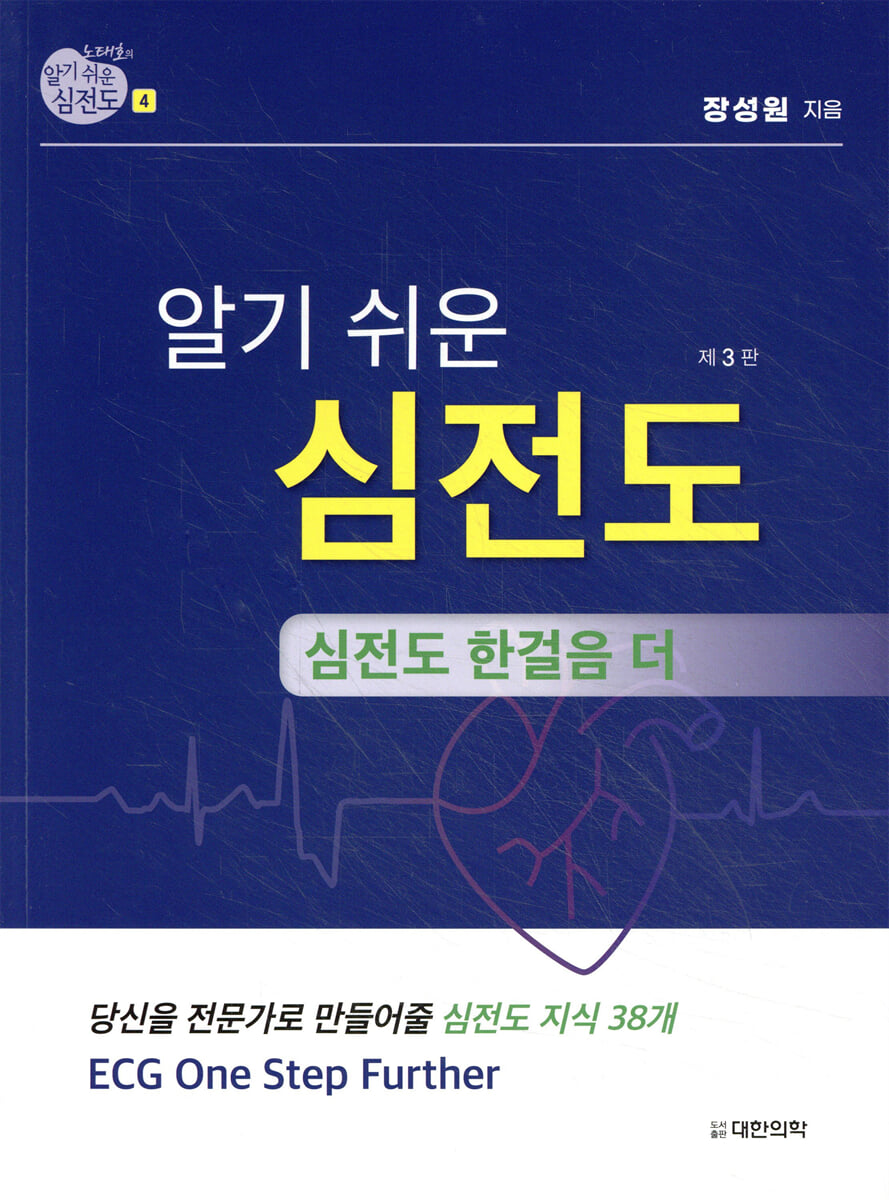
Noh Tae-ho's Easy-to-Understand Electrocardiogram 4
 |
Description
Book Introduction
The revised edition includes all previous material, plus three additional chapters.
Additional findings include De Winter and Wellens signs, conduction block associated with myocardial infarction, and phase 4 block.
De Winter and Wellens electrocardiogram findings suggest critical coronary blood flow obstruction comparable to ST-segment elevation myocardial infarction.
Second, we added the conduction block electrocardiogram accompanying myocardial infarction.
Finally, the fourth phase block is a theory that explains paroxysmal atrioventricular block.
Additional findings include De Winter and Wellens signs, conduction block associated with myocardial infarction, and phase 4 block.
De Winter and Wellens electrocardiogram findings suggest critical coronary blood flow obstruction comparable to ST-segment elevation myocardial infarction.
Second, we added the conduction block electrocardiogram accompanying myocardial infarction.
Finally, the fourth phase block is a theory that explains paroxysmal atrioventricular block.
index
01.
Bundle Branch Block
02.
Premature Beat vs. Premature Excitation?
Pre-excitation)
03. Why is the QRS wide when it's the same APC? - Aberrant Conduction
04. P waves are seen behind the VPC - retrograde P waves
05.
Compensatory Pause
06. Does VPC affect the next PR interval? - Concealed Conduction
07.
Classification of Atrioventricular Block
08.
Distinction between Mobitz Type 1 and Type 2
Type 2 Block)
09.
Differential diagnosis of 2:1 atrioventricular block
10.
Sinus Pause vs.
Sinoatrial Block)
11.
Are you confused between atrial premature beats and atrioventricular block? (APC Bigeminy vs.
2:1 AV Block)
12.
Mobitz type 1 sinoatrial block
13.
Trifascicular Block
14.
Tachycardia: Is it hard to diagnose? - Differential Diagnosis of Tachycardia
15.
Long RP vs.
Short RP Tachycardia
16. Regression mechanism of AVNRT
17. Regression mechanism of AVRT
18.
What happens if you give adenosine for narrow QRS tachycardia?
19. Location of the subductus arteriosus in WPW syndrome
20.
Orthodromic vs. retrograde atrioventricular tachycardia
Antidromic Tachycardia)
21.
Can the location of the accessory pathway be determined in atrioventricular reentrant tachycardia without ventricular pre-excitation?
22.
Why is the QRS wide even though it is not ventricular tachycardia?
23. Is normal QRS tachycardia with irregular RR interval only atrial fibrillation and polysynaptic atrial tachycardia?
24.
Coumel's Law
25.
Where does VPC come from?
26.
Ventricular outflow tract tachycardia vs. left ventricular fasciculus tachycardia (RVOT vs.
Fascicular VT)
27.
Concordance
28.
AV Dissociation
29.
Capture Beat and Fusion Beat
30.
Torsades de Pointes (Torsades de Pointes)
31.
What is the difference between Escape Beat and Escape Rhythm?
32.
Acute myocardial infarction LAD Proximal vs.
Distal
33.
Acute myocardial infarction (LCX) vs. RCA
34.
Acute myocardial infarction RCA Proximal vs.
Distal
35.
Mitral P wave vs. Pulmonary P wave (P Mitrale vs.
P Pulmonale)
36.
De Winter's and Wellens' sign
37.
Conduction block associated with myocardial infarction
38.
Phase 4 block and paroxysmal AV block
Bundle Branch Block
02.
Premature Beat vs. Premature Excitation?
Pre-excitation)
03. Why is the QRS wide when it's the same APC? - Aberrant Conduction
04. P waves are seen behind the VPC - retrograde P waves
05.
Compensatory Pause
06. Does VPC affect the next PR interval? - Concealed Conduction
07.
Classification of Atrioventricular Block
08.
Distinction between Mobitz Type 1 and Type 2
Type 2 Block)
09.
Differential diagnosis of 2:1 atrioventricular block
10.
Sinus Pause vs.
Sinoatrial Block)
11.
Are you confused between atrial premature beats and atrioventricular block? (APC Bigeminy vs.
2:1 AV Block)
12.
Mobitz type 1 sinoatrial block
13.
Trifascicular Block
14.
Tachycardia: Is it hard to diagnose? - Differential Diagnosis of Tachycardia
15.
Long RP vs.
Short RP Tachycardia
16. Regression mechanism of AVNRT
17. Regression mechanism of AVRT
18.
What happens if you give adenosine for narrow QRS tachycardia?
19. Location of the subductus arteriosus in WPW syndrome
20.
Orthodromic vs. retrograde atrioventricular tachycardia
Antidromic Tachycardia)
21.
Can the location of the accessory pathway be determined in atrioventricular reentrant tachycardia without ventricular pre-excitation?
22.
Why is the QRS wide even though it is not ventricular tachycardia?
23. Is normal QRS tachycardia with irregular RR interval only atrial fibrillation and polysynaptic atrial tachycardia?
24.
Coumel's Law
25.
Where does VPC come from?
26.
Ventricular outflow tract tachycardia vs. left ventricular fasciculus tachycardia (RVOT vs.
Fascicular VT)
27.
Concordance
28.
AV Dissociation
29.
Capture Beat and Fusion Beat
30.
Torsades de Pointes (Torsades de Pointes)
31.
What is the difference between Escape Beat and Escape Rhythm?
32.
Acute myocardial infarction LAD Proximal vs.
Distal
33.
Acute myocardial infarction (LCX) vs. RCA
34.
Acute myocardial infarction RCA Proximal vs.
Distal
35.
Mitral P wave vs. Pulmonary P wave (P Mitrale vs.
P Pulmonale)
36.
De Winter's and Wellens' sign
37.
Conduction block associated with myocardial infarction
38.
Phase 4 block and paroxysmal AV block
Publisher's Review
Preface to the 3rd edition
Thanks to the reader's response, we have published a third edition.
The revised edition includes all previous material, plus three additional chapters.
Additional findings include De Winter and Wellens signs, conduction block associated with myocardial infarction, and phase 4 block.
De Winter and Wellens electrocardiogram findings suggest critical coronary blood flow obstruction comparable to ST-segment elevation myocardial infarction.
Second, we added the conduction block electrocardiogram accompanying myocardial infarction.
Finally, the fourth phase block is a theory that explains paroxysmal atrioventricular block.
The format remains the same as before, in the form of questions and answers, and we have tried to make it easy to explain.
I sincerely hope that this book will spark interest in electrocardiography and contribute to improving readers' skills.
I would like to take this opportunity to express my gratitude to everyone who attends the electrocardiography training course every year.
January 2025
Jang Seong-won
Thanks to the reader's response, we have published a third edition.
The revised edition includes all previous material, plus three additional chapters.
Additional findings include De Winter and Wellens signs, conduction block associated with myocardial infarction, and phase 4 block.
De Winter and Wellens electrocardiogram findings suggest critical coronary blood flow obstruction comparable to ST-segment elevation myocardial infarction.
Second, we added the conduction block electrocardiogram accompanying myocardial infarction.
Finally, the fourth phase block is a theory that explains paroxysmal atrioventricular block.
The format remains the same as before, in the form of questions and answers, and we have tried to make it easy to explain.
I sincerely hope that this book will spark interest in electrocardiography and contribute to improving readers' skills.
I would like to take this opportunity to express my gratitude to everyone who attends the electrocardiography training course every year.
January 2025
Jang Seong-won
GOODS SPECIFICS
- Date of issue: January 30, 2025
- Page count, weight, size: 164 pages | 188*257*20mm
- ISBN13: 9791155903001
- ISBN10: 1155903005
You may also like
카테고리
korean


korean

![GQ KOREA Mark (Monthly): December [2025]](http://librairie.coreenne.fr/cdn/shop/files/8ef265dbbfbf186523ed75ba7319009d.jpg?v=1765340328&width=3840)


