

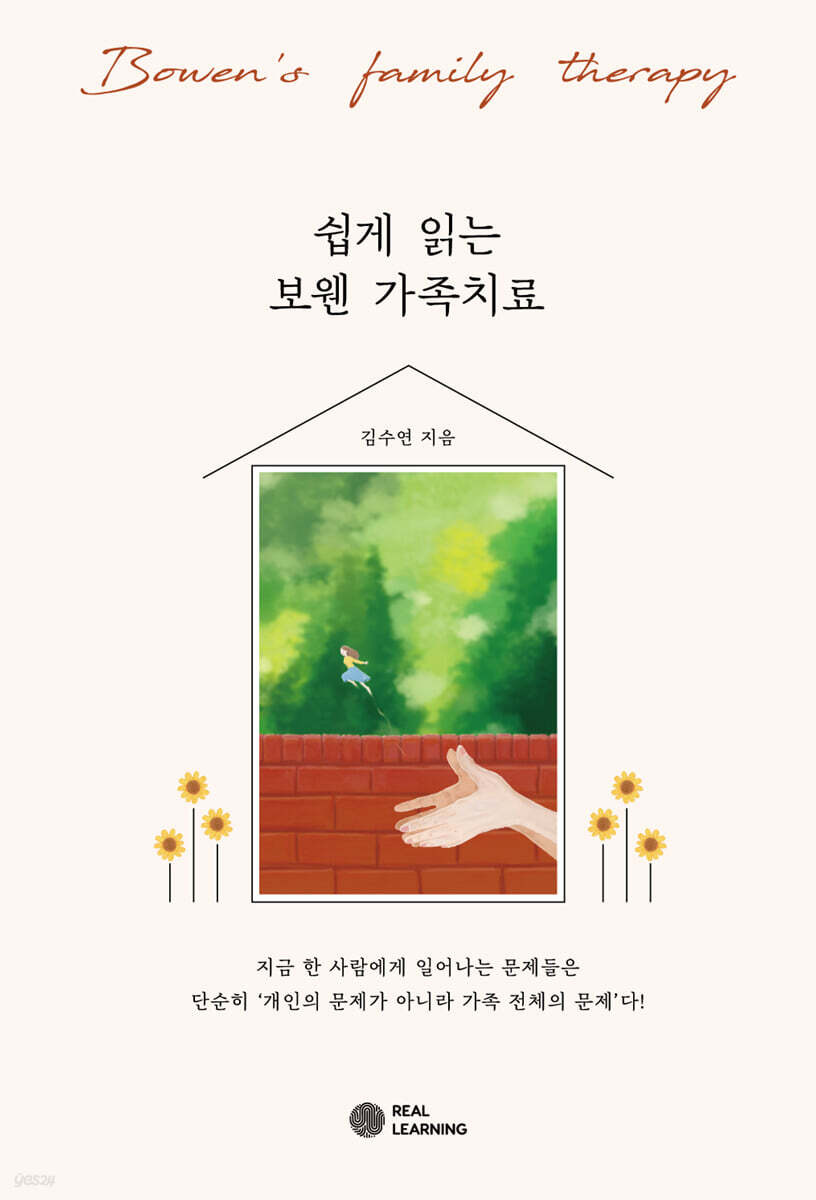
Bowen Family Therapy: An Easy-to-Read Guide
 |
Description
Book Introduction
This book introduces Bowen's family therapy theory, which reconstructs psychoanalysis into a family therapy theory, with vivid examples.
This book provides an in-depth introduction to Bowen's theory, adds recent scientific findings, and provides a multi-faceted look at the emotional dynamics within families through numerous case studies.
Additionally, this book draws family relationships as a family tree, and helps you look at your own problems objectively through the family tree, which is a huge network.
After reading this book, readers will have a completely new perspective on the family they have had up until now.
This book provides an in-depth introduction to Bowen's theory, adds recent scientific findings, and provides a multi-faceted look at the emotional dynamics within families through numerous case studies.
Additionally, this book draws family relationships as a family tree, and helps you look at your own problems objectively through the family tree, which is a huge network.
After reading this book, readers will have a completely new perspective on the family they have had up until now.
- You can preview some of the book's contents.
Preview
index
introduction
Introduction
Chapter 1.
Basic Assumptions
1.
Family and Systems Perspective
2.
brain system
3.
emotional system
Chapter 2.
Individuality and unity
1.
Individuality and unity are the lifeblood
2.
It's a problem if you get far away, it's a problem if you get close
3.
If you listen to your parents, will you really get what you want?
Chapter 3-1.
Self-differentiation
1.
A healthy alternative: self-differentiation
2.
Two types of self-differentiation: basic differentiation and functional differentiation
3.
When the level of self-differentiation is high and low
4.
The family of origin, where self-differentiation is determined
Chapter 3-2.
family tree
1.
How to create a family tree
2.
Drawing a family tree
3.
Family story
Chapter 4.
chronic anxiety
1.
The true identity of this guy called anxiety
2.
How to Deal with Anxiety - Emotional Disconnection
3.
How to Deal with Anxiety - Couple Fights
4.
How to Deal with Anxiety - Hyperfunctioning and Hypofunctioning
5.
Anxiety, self-differentiation, and family dynamics
Chapter 5.
love triangle
1.
The trap of a love triangle
2.
Growing anxiety, growing love triangle
3.
De-triangulation, getting out of a love triangle
4.
Lowering anxiety, increasing differentiation, and detriangulating
Chapter 6.
nuclear family emotional system
1.
nuclear family emotional system
2.
Choosing a Spouse, the Glasses in My Eyes
3.
Dysfunction 1.
sick spouse
4.
Dysfunction 2.
Child's disability
Chapter 7.
Family projection process and generational transmission
1.
Passing On Anxiety to Your Children: The Family Projection Process
2.
Factors that promote the family projection process
3.
The target of the projection, the child who is easily caught
4.
Anxiety passed down through generations, a process passed down through generations
5.
A word to parents
References
Introduction
Chapter 1.
Basic Assumptions
1.
Family and Systems Perspective
2.
brain system
3.
emotional system
Chapter 2.
Individuality and unity
1.
Individuality and unity are the lifeblood
2.
It's a problem if you get far away, it's a problem if you get close
3.
If you listen to your parents, will you really get what you want?
Chapter 3-1.
Self-differentiation
1.
A healthy alternative: self-differentiation
2.
Two types of self-differentiation: basic differentiation and functional differentiation
3.
When the level of self-differentiation is high and low
4.
The family of origin, where self-differentiation is determined
Chapter 3-2.
family tree
1.
How to create a family tree
2.
Drawing a family tree
3.
Family story
Chapter 4.
chronic anxiety
1.
The true identity of this guy called anxiety
2.
How to Deal with Anxiety - Emotional Disconnection
3.
How to Deal with Anxiety - Couple Fights
4.
How to Deal with Anxiety - Hyperfunctioning and Hypofunctioning
5.
Anxiety, self-differentiation, and family dynamics
Chapter 5.
love triangle
1.
The trap of a love triangle
2.
Growing anxiety, growing love triangle
3.
De-triangulation, getting out of a love triangle
4.
Lowering anxiety, increasing differentiation, and detriangulating
Chapter 6.
nuclear family emotional system
1.
nuclear family emotional system
2.
Choosing a Spouse, the Glasses in My Eyes
3.
Dysfunction 1.
sick spouse
4.
Dysfunction 2.
Child's disability
Chapter 7.
Family projection process and generational transmission
1.
Passing On Anxiety to Your Children: The Family Projection Process
2.
Factors that promote the family projection process
3.
The target of the projection, the child who is easily caught
4.
Anxiety passed down through generations, a process passed down through generations
5.
A word to parents
References
Into the book
Bowen was an American psychiatrist.
When a problem arises within a family, we often approach it with questions like, "Whose problem is it? Why did it happen? What's the cause?"
But Bowen saw his family differently.
He had two views: one was evolutionary and one was systematic.
---From the "Preface"
Bowen attempted to explain the family from a systematic perspective.
The systemic perspective is that each and every person is not isolated, but rather that everything is connected and related, forming a vast network where cause and effect cannot be clearly distinguished.
---From the "Preface"
What powers do humans need to survive? What powers are necessary for human survival? Most theories begin with answers to these questions.
It can be explained that this lack of strength is what causes wounds and initiates pathology.
Another solution can be proposed: healing requires infusing this power. Bowen called this power vitality, from which two things emerge: individuality and unity.
---「Chapter 2.
From “Individuality and Unity”
Bowen cited self-differentiation as the second factor that makes human group life possible.
Differentiation of self is the ability to balance the two forces of individuality and unity.
You can be a member of a group and accomplish tasks for the team, while at the same time living as a unique and individual human being.
Because of self-differentiation, there is no anxiety whether we are together or apart.
When humans are anxious, their emotional system, like other living things, is activated to survive, but they can also activate their thinking system, which allows them to objectively view themselves.
If only the emotional system is working, people can explode with emotions or act out of whim, putting the group at risk.
Ultimately, the health of a group depends on how much self-differentiation is achieved and how well the thought system functions.
The family is an emotional system that humans have developed as a result of evolution to survive.
The existence and health of the family determine human survival, and self-differentiation becomes a decisive factor in this process.
---「Chapter 2.
From “Individuality and Unity”
Fusion occurs when the boundaries between each are weak.
Creating boundaries strengthens my identity and protects me.
Also, in a relationship, it is not about becoming distant from each other, but rather about becoming closer.
Because when there is a boundary, there is no one-sidedness.
---「Chapter 2.
From “Individuality and Unity”
Bowen believed that for a family to be healthy, it is important for the individual to have strong strengths.
The greater the individuality, the lower the family's anxiety, and the more autonomous the family members can live.
As autonomy increases, we move forward in the direction we choose, regardless of the emotional, sentimental, and subjective pressures from others.
So you can live your life to the fullest.
Living your life the way you choose doesn't mean it's a miracle or that you're lacking in empathy.
Rather, it means breaking free from automatic reactions and being able to make choices.
---「Chapter 3-1.
From “Self-differentiation”
In a word, self-differentiation means breaking away from one's parents and becoming an individual.
Even if a child has different views and thoughts from their parents, or acts in their own way, parents respect their child's wishes without complaining or criticizing.
In this way, neither parents nor children feel anxious.
Self-differentiation means that parents and children have established a person-to-person relationship.
So, you can live a rich life of your own with your own existence.
Bowen called differentiation a way of being.
Self-differentiation, the opposite of fusion, can be seen as having the same meaning as ego strength and emotional maturity.
---「Chapter 3-1.
From “Self-differentiation”
There are two types of self: the 'true self' and the 'false self'.
Bowen said that a high level of self-differentiation means that the true self is greater than the false self.
True self, also called solid self, is knowing your own desires, thoughts, and feelings.
So I can say, 'Who am I, what am I going to do, and why am I doing it?'
...
Bowen believed that the false self is created by the power of association within a relational system.
The false self is easily influenced by relationships and exaggerates itself.
---「Chapter 3-1.
From “Self-differentiation”
Bowen broadly divided self-differentiation into basic differentiation and functional differentiation.
The basic differentiation is determined by the multi-generational emotional process, with the degree of differentiation passed down through generations of the original family.
It is usually determined around puberty and lasts throughout life.
On the other hand, it is the family's chronic anxiety that determines the level of functional differentiation.
Chronic anxiety evokes the power of association.
Then, an exchange of selves takes place in the relationship, resulting in the creation of hyper- and hypo-functional roles in the relationship.
So, to see the level of self-differentiation, we must consider both the basic level and the functional level.
---「Chapter 3-1.
From “Self-differentiation”
As anxiety increases, the pressure to move toward a 'fusion relationship' intensifies.
When this pressure becomes too strong, it creates anxiety within the group.
The group encourages certain people to absorb the anxiety.
It's about picking the most vulnerable and vulnerable person in the group and passing on the anxiety.
---「Chapter 4.
From "Chronic Anxiety"
A third way to deal with anxiety is through the interaction of overfunctioning and underfunctioning.
This is when one person adapts more to alleviate anxiety.
Those who absorb anxiety in order to adapt lose their 'self', but those who adapt less gain their 'self'.
This process is automatic.
---「Chapter 4.
From "Chronic Anxiety"
When parents overfunction under the pretext of helping their children, their children end up underfunctioning.
Children will become increasingly dependent on their parents.
If things go wrong, you can say, “I was just following my parents’ wishes.
“It’s the parents’ fault that things go wrong,” the child will say, shifting the blame to their parents.
...
It is advisable for over-functioning parents to put aside their concerns about under-functioning parents (children) and focus on their own problems.
Instead of making decisions for your children, ask them what they need and want, and listen to them as they are.
Expressing your thoughts and feelings is the first step toward differentiation.
Under-functioning people stop looking to others for answers and instead stay within themselves and find the answers they want.
Just as anxiety is contagious, so too is a calm and optimistic attitude.
---「Chapter 4.
From "Chronic Anxiety"
The incident is only a trigger for anxiety, not the actual cause of the anxiety.
Every outcome is always accompanied by anxiety.
That is, anxiety happens anyway.
So what causes the most anxiety? Bowen says relationships are the most anxiety-provoking.
Whether you're someone who denies the need for an attachment or someone who constantly seeks one, it's because you're anxious.
Both extremes are equally anxious.
Why do lower levels of differentiation correlate with higher levels of chronic anxiety? One reason is that the more undifferentiated an individual is, the more anxious they become about their very existence.
---「Chapter 4.
From "Chronic Anxiety"
A love triangle provides a conduit for anxiety to travel, and can contain greater anxiety than the three relationships alone.
When one person in a love triangle disappears, another person takes his place and becomes the third party.
The easiest way to create a love triangle is to involve the person closest to you as a third party.
Being close in itself makes you a third party.
The most important factor in a love triangle is anxiety.
When anxiety is low, the triangle is so quiet that you can't even tell, but when stress levels are moderate, the triangle becomes active.
Then, when anxiety becomes too high, multiple love triangles form and things get complicated.
In complex love triangles, anxiety cannot be dealt with effectively.
---「Chapter 5.
From "Love Triangle"
Among family members, children are prone to being caught up in love triangles.
If there are multiple children, the third party may take turns, or one of the children may be fixed as the third party.
If a third party becomes immobilized, the damage to the child involved can be severe.
The difficulty of being an only child is that you always have to take on the role of a third party.
If children continue to have love triangles with their parents after they get married, it can have a serious impact on their marital relationship.
---「Chapter 5.
From "Love Triangle"
Breaking free from the love triangle is the first step toward self-differentiation.
It's best not to get caught up in a love triangle, but if you do get caught up in one, it's important to get out of it.
It's called detriangulation.
The most important thing in the de-triangulation process is to become aware of the ways and processes by which you become entangled in love triangles and draw others into them.
---「Chapter 5.
From "Love Triangle"
The nuclear family emotional system is a concept that shows how children learn the intensity and characteristics of emotional responses in their family of origin.
It is a process of selecting a spouse with a similar level of differentiation as oneself, applying the same patterns learned from one's original family, and repeating them to pass them on to one's children.
A child's level of self-differentiation is determined by the parent's level of self-differentiation.
The level of self-differentiation achieved by the older generation determines the functioning of children, who then reproduce and reinforce the relationship process.
---「Chapter 6.
From “The Nuclear Family Emotional System”
When the level of differentiation is low, family dysfunction becomes more severe.
If anxiety is too high, no one in the family can handle it alone.
So, many people show various dysfunctions, chronically.
There is an alcoholic father and a juvenile delinquent in the family.
It's a dysfunctional display of two people absorbing and dealing with the anxiety of the entire family.
As the differentiation progresses, symptoms may only appear for a short period of time in one person.
At this time, more important than the level of differentiation is whether the family can handle the stress.
---「Chapter 6.
From “The Nuclear Family Emotional System”
Parents relive their own lives through their children.
As children age, they experience reliving their lives, and this can bring up unresolved issues for parents.
Parents who have experienced the death of a parent at the age of 8 often feel anxious that when their child turns 8, they too may die leaving their child behind like their parents.
Parents who experienced significant regret or guilt during their teenage years often become anxious when their children become teenagers.
When parents do not properly separate their families of origin, they tend to project their childhood images onto their children.
The anxieties and problems that teenagers experience today are a direct reflection of what their parents were like during their teenage years.
If parents did not properly deal with the anxiety they experienced during their teenage years, that anxiety can resurface and be passed on to their children during their teenage years.
---「Chapter 6.
From “The Nuclear Family Emotional System”
The family projection process refers to the process in which undifferentiated parents pass on their undifferentiation to their children by lowering their children's functions through a triangular relationship.
Bowen described this process as follows:
Couples deal with anxiety that arises in their relationship emotionally rather than rationally.
They form a symbiotic relationship by forming a love triangle with their children, and project their parents' problems onto their children.
The more immature the parents are, the more likely they are to choose the most dependent and ego-vulnerable of their children as their projection targets.
The intensity of the projection process depends on anxiety; the higher the anxiety, the more pronounced the projection process.
As a result of the projection process, children suffer damage that can range from mild to severe and lifelong.
Bowen believed that this process of family projection was universal and occurred in all families.
---「Chapter 7.
From “Family Projection Process and Generational Transmission”
Are the problems children face during family conflict entirely the parents' fault? No.
It's not just the parents' fault.
This process is automatic and unconscious, so parents simply inherit it from their parents.
Once parents understand the concept of family projection, they begin to realize that they have become unwittingly involved in the problem.
---「Chapter 7.
From “Family Projection Process and Generational Transmission”
Let's focus solely on increasing our level of differentiation.
Let's focus on working on our own family of origin without projecting our anxiety onto our spouse or children.
Next, let's look back on our relationship and work on improving it.
If the family of origin issue has been sufficiently addressed, working on the couple's relationship will not be so difficult.
Then your children will devote themselves to creating their own full and free lives.
It happens naturally without much effort.
When a problem arises within a family, we often approach it with questions like, "Whose problem is it? Why did it happen? What's the cause?"
But Bowen saw his family differently.
He had two views: one was evolutionary and one was systematic.
---From the "Preface"
Bowen attempted to explain the family from a systematic perspective.
The systemic perspective is that each and every person is not isolated, but rather that everything is connected and related, forming a vast network where cause and effect cannot be clearly distinguished.
---From the "Preface"
What powers do humans need to survive? What powers are necessary for human survival? Most theories begin with answers to these questions.
It can be explained that this lack of strength is what causes wounds and initiates pathology.
Another solution can be proposed: healing requires infusing this power. Bowen called this power vitality, from which two things emerge: individuality and unity.
---「Chapter 2.
From “Individuality and Unity”
Bowen cited self-differentiation as the second factor that makes human group life possible.
Differentiation of self is the ability to balance the two forces of individuality and unity.
You can be a member of a group and accomplish tasks for the team, while at the same time living as a unique and individual human being.
Because of self-differentiation, there is no anxiety whether we are together or apart.
When humans are anxious, their emotional system, like other living things, is activated to survive, but they can also activate their thinking system, which allows them to objectively view themselves.
If only the emotional system is working, people can explode with emotions or act out of whim, putting the group at risk.
Ultimately, the health of a group depends on how much self-differentiation is achieved and how well the thought system functions.
The family is an emotional system that humans have developed as a result of evolution to survive.
The existence and health of the family determine human survival, and self-differentiation becomes a decisive factor in this process.
---「Chapter 2.
From “Individuality and Unity”
Fusion occurs when the boundaries between each are weak.
Creating boundaries strengthens my identity and protects me.
Also, in a relationship, it is not about becoming distant from each other, but rather about becoming closer.
Because when there is a boundary, there is no one-sidedness.
---「Chapter 2.
From “Individuality and Unity”
Bowen believed that for a family to be healthy, it is important for the individual to have strong strengths.
The greater the individuality, the lower the family's anxiety, and the more autonomous the family members can live.
As autonomy increases, we move forward in the direction we choose, regardless of the emotional, sentimental, and subjective pressures from others.
So you can live your life to the fullest.
Living your life the way you choose doesn't mean it's a miracle or that you're lacking in empathy.
Rather, it means breaking free from automatic reactions and being able to make choices.
---「Chapter 3-1.
From “Self-differentiation”
In a word, self-differentiation means breaking away from one's parents and becoming an individual.
Even if a child has different views and thoughts from their parents, or acts in their own way, parents respect their child's wishes without complaining or criticizing.
In this way, neither parents nor children feel anxious.
Self-differentiation means that parents and children have established a person-to-person relationship.
So, you can live a rich life of your own with your own existence.
Bowen called differentiation a way of being.
Self-differentiation, the opposite of fusion, can be seen as having the same meaning as ego strength and emotional maturity.
---「Chapter 3-1.
From “Self-differentiation”
There are two types of self: the 'true self' and the 'false self'.
Bowen said that a high level of self-differentiation means that the true self is greater than the false self.
True self, also called solid self, is knowing your own desires, thoughts, and feelings.
So I can say, 'Who am I, what am I going to do, and why am I doing it?'
...
Bowen believed that the false self is created by the power of association within a relational system.
The false self is easily influenced by relationships and exaggerates itself.
---「Chapter 3-1.
From “Self-differentiation”
Bowen broadly divided self-differentiation into basic differentiation and functional differentiation.
The basic differentiation is determined by the multi-generational emotional process, with the degree of differentiation passed down through generations of the original family.
It is usually determined around puberty and lasts throughout life.
On the other hand, it is the family's chronic anxiety that determines the level of functional differentiation.
Chronic anxiety evokes the power of association.
Then, an exchange of selves takes place in the relationship, resulting in the creation of hyper- and hypo-functional roles in the relationship.
So, to see the level of self-differentiation, we must consider both the basic level and the functional level.
---「Chapter 3-1.
From “Self-differentiation”
As anxiety increases, the pressure to move toward a 'fusion relationship' intensifies.
When this pressure becomes too strong, it creates anxiety within the group.
The group encourages certain people to absorb the anxiety.
It's about picking the most vulnerable and vulnerable person in the group and passing on the anxiety.
---「Chapter 4.
From "Chronic Anxiety"
A third way to deal with anxiety is through the interaction of overfunctioning and underfunctioning.
This is when one person adapts more to alleviate anxiety.
Those who absorb anxiety in order to adapt lose their 'self', but those who adapt less gain their 'self'.
This process is automatic.
---「Chapter 4.
From "Chronic Anxiety"
When parents overfunction under the pretext of helping their children, their children end up underfunctioning.
Children will become increasingly dependent on their parents.
If things go wrong, you can say, “I was just following my parents’ wishes.
“It’s the parents’ fault that things go wrong,” the child will say, shifting the blame to their parents.
...
It is advisable for over-functioning parents to put aside their concerns about under-functioning parents (children) and focus on their own problems.
Instead of making decisions for your children, ask them what they need and want, and listen to them as they are.
Expressing your thoughts and feelings is the first step toward differentiation.
Under-functioning people stop looking to others for answers and instead stay within themselves and find the answers they want.
Just as anxiety is contagious, so too is a calm and optimistic attitude.
---「Chapter 4.
From "Chronic Anxiety"
The incident is only a trigger for anxiety, not the actual cause of the anxiety.
Every outcome is always accompanied by anxiety.
That is, anxiety happens anyway.
So what causes the most anxiety? Bowen says relationships are the most anxiety-provoking.
Whether you're someone who denies the need for an attachment or someone who constantly seeks one, it's because you're anxious.
Both extremes are equally anxious.
Why do lower levels of differentiation correlate with higher levels of chronic anxiety? One reason is that the more undifferentiated an individual is, the more anxious they become about their very existence.
---「Chapter 4.
From "Chronic Anxiety"
A love triangle provides a conduit for anxiety to travel, and can contain greater anxiety than the three relationships alone.
When one person in a love triangle disappears, another person takes his place and becomes the third party.
The easiest way to create a love triangle is to involve the person closest to you as a third party.
Being close in itself makes you a third party.
The most important factor in a love triangle is anxiety.
When anxiety is low, the triangle is so quiet that you can't even tell, but when stress levels are moderate, the triangle becomes active.
Then, when anxiety becomes too high, multiple love triangles form and things get complicated.
In complex love triangles, anxiety cannot be dealt with effectively.
---「Chapter 5.
From "Love Triangle"
Among family members, children are prone to being caught up in love triangles.
If there are multiple children, the third party may take turns, or one of the children may be fixed as the third party.
If a third party becomes immobilized, the damage to the child involved can be severe.
The difficulty of being an only child is that you always have to take on the role of a third party.
If children continue to have love triangles with their parents after they get married, it can have a serious impact on their marital relationship.
---「Chapter 5.
From "Love Triangle"
Breaking free from the love triangle is the first step toward self-differentiation.
It's best not to get caught up in a love triangle, but if you do get caught up in one, it's important to get out of it.
It's called detriangulation.
The most important thing in the de-triangulation process is to become aware of the ways and processes by which you become entangled in love triangles and draw others into them.
---「Chapter 5.
From "Love Triangle"
The nuclear family emotional system is a concept that shows how children learn the intensity and characteristics of emotional responses in their family of origin.
It is a process of selecting a spouse with a similar level of differentiation as oneself, applying the same patterns learned from one's original family, and repeating them to pass them on to one's children.
A child's level of self-differentiation is determined by the parent's level of self-differentiation.
The level of self-differentiation achieved by the older generation determines the functioning of children, who then reproduce and reinforce the relationship process.
---「Chapter 6.
From “The Nuclear Family Emotional System”
When the level of differentiation is low, family dysfunction becomes more severe.
If anxiety is too high, no one in the family can handle it alone.
So, many people show various dysfunctions, chronically.
There is an alcoholic father and a juvenile delinquent in the family.
It's a dysfunctional display of two people absorbing and dealing with the anxiety of the entire family.
As the differentiation progresses, symptoms may only appear for a short period of time in one person.
At this time, more important than the level of differentiation is whether the family can handle the stress.
---「Chapter 6.
From “The Nuclear Family Emotional System”
Parents relive their own lives through their children.
As children age, they experience reliving their lives, and this can bring up unresolved issues for parents.
Parents who have experienced the death of a parent at the age of 8 often feel anxious that when their child turns 8, they too may die leaving their child behind like their parents.
Parents who experienced significant regret or guilt during their teenage years often become anxious when their children become teenagers.
When parents do not properly separate their families of origin, they tend to project their childhood images onto their children.
The anxieties and problems that teenagers experience today are a direct reflection of what their parents were like during their teenage years.
If parents did not properly deal with the anxiety they experienced during their teenage years, that anxiety can resurface and be passed on to their children during their teenage years.
---「Chapter 6.
From “The Nuclear Family Emotional System”
The family projection process refers to the process in which undifferentiated parents pass on their undifferentiation to their children by lowering their children's functions through a triangular relationship.
Bowen described this process as follows:
Couples deal with anxiety that arises in their relationship emotionally rather than rationally.
They form a symbiotic relationship by forming a love triangle with their children, and project their parents' problems onto their children.
The more immature the parents are, the more likely they are to choose the most dependent and ego-vulnerable of their children as their projection targets.
The intensity of the projection process depends on anxiety; the higher the anxiety, the more pronounced the projection process.
As a result of the projection process, children suffer damage that can range from mild to severe and lifelong.
Bowen believed that this process of family projection was universal and occurred in all families.
---「Chapter 7.
From “Family Projection Process and Generational Transmission”
Are the problems children face during family conflict entirely the parents' fault? No.
It's not just the parents' fault.
This process is automatic and unconscious, so parents simply inherit it from their parents.
Once parents understand the concept of family projection, they begin to realize that they have become unwittingly involved in the problem.
---「Chapter 7.
From “Family Projection Process and Generational Transmission”
Let's focus solely on increasing our level of differentiation.
Let's focus on working on our own family of origin without projecting our anxiety onto our spouse or children.
Next, let's look back on our relationship and work on improving it.
If the family of origin issue has been sufficiently addressed, working on the couple's relationship will not be so difficult.
Then your children will devote themselves to creating their own full and free lives.
It happens naturally without much effort.
---「Chapter 7.
From “Family Projection Process and Generational Transmission”
From “Family Projection Process and Generational Transmission”
Publisher's Review
The problems that are happening to one person now are simply
It showed that 'it is not an individual problem, but a problem for the entire family'
Bowen's multigenerational family therapy theory
It is often said that the most difficult thing in this world is human relationships.
In particular, how a person builds family relationships clearly shows what kind of person he is.
The emphasis on a happy and harmonious family and the effort to be a good parent are also testaments to how difficult it is.
Bowen, a psychiatrist and founder of multigenerational family therapy, says that it is not the family's suffering that is caused by the person with the problem, but rather that the person appears to be the problem because he or she is shouldering the family's suffering.
The problem is not that person's problem, but that of the entire family.
Family is like a vast universe, where each and every person cannot be considered separately.
The ties that have been passed down through generations are not only connected by bloodlines, but also by various diseases and problems that occur within the family.
Family problems are a vast network where cause and effect cannot be clearly distinguished, so it is meaningless to try to determine whose fault it is.
Maybe the problem stems from the family system that was designed to happen before I was even born.
In this book, Bowen shatters our common sense.
We thought that listening to our parents and obeying them was the duty of children and filial piety.
A family without conflict or quarrels was considered a happy family.
I believed that couples should take care of each other and not fight.
But Bowen argues that a peaceful and happy family can be a sick family.
Bowen saw these families as a ball of anxiety, unable to properly handle conflict.
To avoid the loud noise, someone else is making a sacrifice by shouldering and dealing with the anxiety for them.
If you endure and try to please others, your ego will become weak and sick.
A life that has lost its vividness becomes boring and empty.
When an individual's life is buried within the family and there is no hope, he or she eventually has no choice but to cut ties with the family and leave.
This book describes in great detail and vividly the lonely and unhappy life of a person who finds it difficult to separate from his family and live as an individual, and so ultimately chooses to disconnect.
Bowen warns that enthusiastic parents who pour everything into their children beyond devotion can be toxic to their children.
In the family, Superman is not a responsible and capable leader, but rather a person who causes someone in the family to wither and become sick.
As a solution to the problem, Bowen proposed self-differentiation.
The best solution is to stand tall as an independent person without relying on anyone.
For those seeking a more mature and healthy life, this book will offer refreshing and concrete alternatives.
This book covers the core concepts of Bowen family therapy, including differentiation of the self, anxiety, triangular relationships, the nuclear family emotional system, the family projection process, and the multigenerational transmission process, with abundant examples.
It was also written in an easy-to-understand manner so that even laypeople who do not major in counseling can access it.
If it feels too theoretical and rigid, I recommend you skip the first part and start reading about the love triangle.
It showed that 'it is not an individual problem, but a problem for the entire family'
Bowen's multigenerational family therapy theory
It is often said that the most difficult thing in this world is human relationships.
In particular, how a person builds family relationships clearly shows what kind of person he is.
The emphasis on a happy and harmonious family and the effort to be a good parent are also testaments to how difficult it is.
Bowen, a psychiatrist and founder of multigenerational family therapy, says that it is not the family's suffering that is caused by the person with the problem, but rather that the person appears to be the problem because he or she is shouldering the family's suffering.
The problem is not that person's problem, but that of the entire family.
Family is like a vast universe, where each and every person cannot be considered separately.
The ties that have been passed down through generations are not only connected by bloodlines, but also by various diseases and problems that occur within the family.
Family problems are a vast network where cause and effect cannot be clearly distinguished, so it is meaningless to try to determine whose fault it is.
Maybe the problem stems from the family system that was designed to happen before I was even born.
In this book, Bowen shatters our common sense.
We thought that listening to our parents and obeying them was the duty of children and filial piety.
A family without conflict or quarrels was considered a happy family.
I believed that couples should take care of each other and not fight.
But Bowen argues that a peaceful and happy family can be a sick family.
Bowen saw these families as a ball of anxiety, unable to properly handle conflict.
To avoid the loud noise, someone else is making a sacrifice by shouldering and dealing with the anxiety for them.
If you endure and try to please others, your ego will become weak and sick.
A life that has lost its vividness becomes boring and empty.
When an individual's life is buried within the family and there is no hope, he or she eventually has no choice but to cut ties with the family and leave.
This book describes in great detail and vividly the lonely and unhappy life of a person who finds it difficult to separate from his family and live as an individual, and so ultimately chooses to disconnect.
Bowen warns that enthusiastic parents who pour everything into their children beyond devotion can be toxic to their children.
In the family, Superman is not a responsible and capable leader, but rather a person who causes someone in the family to wither and become sick.
As a solution to the problem, Bowen proposed self-differentiation.
The best solution is to stand tall as an independent person without relying on anyone.
For those seeking a more mature and healthy life, this book will offer refreshing and concrete alternatives.
This book covers the core concepts of Bowen family therapy, including differentiation of the self, anxiety, triangular relationships, the nuclear family emotional system, the family projection process, and the multigenerational transmission process, with abundant examples.
It was also written in an easy-to-understand manner so that even laypeople who do not major in counseling can access it.
If it feels too theoretical and rigid, I recommend you skip the first part and start reading about the love triangle.
GOODS SPECIFICS
- Publication date: December 15, 2022
- Page count, weight, size: 264 pages | 492g | 153*224*17mm
- ISBN13: 9791197150845
- ISBN10: 1197150846
You may also like
카테고리
korean


korean

![GQ KOREA Mark (Monthly): December [2025]](http://librairie.coreenne.fr/cdn/shop/files/8ef265dbbfbf186523ed75ba7319009d.jpg?v=1765340328&width=3840)


