

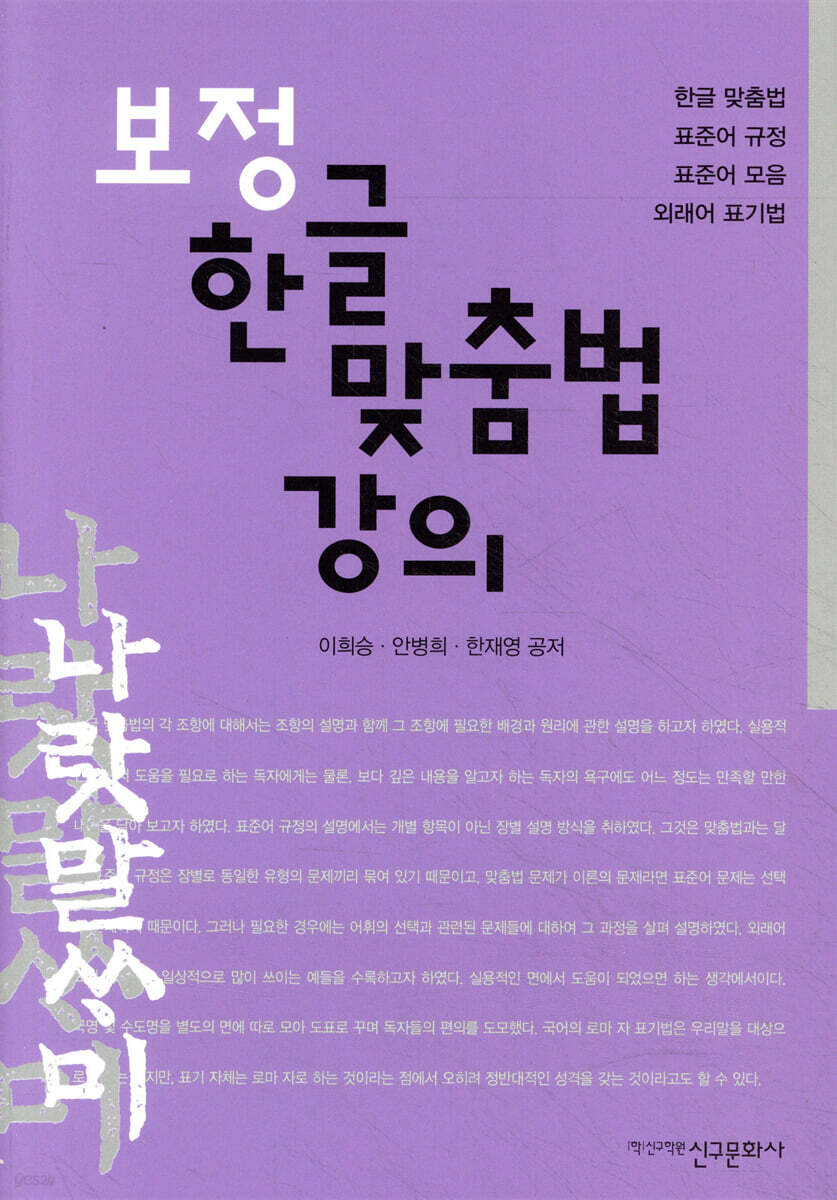
Correction Korean spelling lecture
 |
Description
Book Introduction
『Corrected Korean Spelling Lecture』 is based on the existing 『Revised Korean Spelling Lecture』 and supplements the contents of the Korean spelling, standard language regulations, and foreign language notation rules partially revised by the Ministry of Culture, Sports and Tourism notice on March 28, 2017.
Although it is not a comprehensive revision, the Korean Spelling Rules [Ministry of Culture, Sports and Tourism Notice No. 2017-12 (2017.
3. 28.)] was partially revised.
'The Korean spelling rules were revised to reflect the linguistic reality as some of the descriptions in the Korean spelling rules and the Standard Korean Dictionary did not match, causing confusion in the language life of the people.'
We have resolved spacing inconsistencies in the regulations and reorganized expressions and examples.
I am well aware that 『Revised Korean Spelling Lectures』 has been loved by readers.
I hope that readers will show their love and guidance for the 『Corrected Korean Spelling Lecture』, which was published as a result of the revision of 『Korean Spelling』.
Although it is not a comprehensive revision, the Korean Spelling Rules [Ministry of Culture, Sports and Tourism Notice No. 2017-12 (2017.
3. 28.)] was partially revised.
'The Korean spelling rules were revised to reflect the linguistic reality as some of the descriptions in the Korean spelling rules and the Standard Korean Dictionary did not match, causing confusion in the language life of the people.'
We have resolved spacing inconsistencies in the regulations and reorganized expressions and examples.
I am well aware that 『Revised Korean Spelling Lectures』 has been loved by readers.
I hope that readers will show their love and guidance for the 『Corrected Korean Spelling Lecture』, which was published as a result of the revision of 『Korean Spelling』.
- You can preview some of the book's contents.
Preview
index
Preface to the Corrected Edition/4
Preface to the Augmented Edition/6
Preface to the revised edition/8
Preface: "Korean Spelling Lectures"/10
Preface to the newly revised edition: Lectures on the Unified Korean Spelling Rules
12
Preface: Lectures on the Unified Korean Spelling Rules/13
Note/15
Ⅰ.
Korean spelling
Chapter 1 General Provisions 27
Chapter 2: Ja Mo 33
Chapter 3: About Sound 49
Section 1: 50
Section 2 Palatalization 53
Section 3: The 'ㄷ' sound consonant 57
Section 4 Collection 60
Section 5: Initial Sound Rule 63
Section 6: Overlapping Sounds 71
Chapter 4: Concerning Form 72
Section 1 Nouns and Particles 73
Section 2 Stems and Suffixes 75
Section 3: Words formed by adding suffixes 95
Section 4: Compound Words and Words with Prefixes 114
Section 5, Paragraph 125
Chapter 5 Spacing 139
Section 1 Investigation 140
Section 2 Dependent nouns, nouns indicating units, and enumerative words, etc. 141
Section 3 Auxiliary Verbs 144
Section 4 Proper Nouns and Technical Terms 146
Chapter 6 Others 148
Appendix: Punctuation 165
1.
period (.) 165
2.
Question mark (?) 166
3.
Exclamation mark (!) 167
4.
comma (,) 168
5.
Middle dot (·) 171
6.
Colon (:) 172
7.
Slash (/) 173
8.
Double quotation marks (“ ”) 173
9.
Single quotation marks (' ') 174
10.
Parentheses (( )) 174
11.
Brackets ({ }) 175
12.
Square brackets (〔〕) 176
13.
Double sickle (『』) and double angle bracket (『』) 176
14.
Single angle brackets (「」) and single angle brackets (〈〉) 177
15.
dash (―) 177
16.
Hyphen (-) 178
17.
tilde (∼) 178
18.
Exclamation mark (˙) and underscore (____) 178
19.
Hidden mark (○, ×) 179
20.
Omission mark (쭕) 179
21.
Ellipsis (……) 180
181 until it became "Korean Spelling"
Comparison of the Korean Spelling Rules and the Unification Plan 184
Comparison of the Korean Spelling Rules and the Korean Language Standards Collection 191
Ⅱ.
Standard language regulations
203 until the standard language regulations were established
Part 1: Standard Language Establishment Principles 204
Chapter 1 General Provisions 204
Chapter 2: Standard Language Regulations Based on Pronunciation Changes 205
Section 1: Consonants and Sounds 207
Section 2 Collection 210
Section 3, Paragraph 215
Section 4: Singular Standard Language 217
Section 5: Plural Standard Language 220
Chapter 3: Standard Language Regulations Based on Changes in Vocabulary Choice 220
Section 1 Go 222
Section 2 Chinese Characters 222
Section 3 Dialects 224
Section 4: Singular Standard Language 225
Section 5: Plural Standard Language 229
Part 2 Standard Pronunciation 235
Chapter 1 General Provisions 235
Chapter 2: Consonants and Vowels 235
Chapter 3: The Length of Sounds 236
Chapter 4 Pronunciation of Final Consonants 238
Chapter 5: Negative Assimilation 241
Chapter 6: Softening 243
Chapter 7: Adding Sound 245
Ⅲ.
Collection of standard language
251 until it became a "Collection of Standard Language"
Part 1 Vocabulary Selection 261
·Added standard language vocabulary list 297
Part 2 Pronunciation 307 Chapter 1 Chapter 307
Chapter 2: The Sound of Light 327
Korean Spelling, Standard Language Rules, and Standard Language Vocabulary Dictionary 333
Ⅳ.
Foreign word notation
379 until it became 『Foreign Language Notation』
Chapter 1: Basic Principles of Notation 381
Chapter 2 Notation List 384
Chapter 3 Notation Rules 415
Section 1: English Notation 415
Section 2: German Notation 418
Section 3 French Notation 420
Section 4: Spanish Notation 422
Section 5: Italian Notation 423
Section 6 Japanese Notation 424
Section 7: Chinese Notation 424
Section 8 Polish Notation 425
Section 9: Czech Notation 426
Section 10: Serbo-Croatian Notation 427
Section 11: Romanian Notation 428
Section 12: Hungarian Notation 429
Section 13: Swedish Notation 430
Section 14 Norwegian Notation 432
Section 15: Danish Notation 434
Section 16: Malay-Indonesian Notation 436
Section 17 Tire Marking 438
Section 18: Vietnamese Notation 440
Section 19: Portuguese Notation 440
Section 20: Dutch Notation 443
Section 21 Russian Notation 445
Chapter 4: Principles for Writing Personal Names and Place Names 447
Section 1 Notation Principles 448
Section 2: Notation of Oriental Personal and Place Names 449
Section 3: Rules for Notation of Seas, Islands, Rivers, Mountains, etc. 449
Appendix
Romanization of the Korean Language 453
Chapter 1: Basic Principles of Notation 453
Chapter 2 Notation List 453
Chapter 3: Notes on Notation 454
458 examples of Romanization of Korean
Foreign language transcription examples 488
1.
General foreign words 488
2.
Place name 508
go.
Country and Capital Names 508
me.
Romanized place name 515
all.
Chinese character place name 526
3.
529 people
go.
Romanized personal name 529
me.
539 Chinese character names
Reference 540
1.
List of references 540
2.
List of 547 references on Korean spelling and standard language
3.
List of reference papers on foreign language notation: 558
4.
List of 568 references on Romanization
5.
List of editorials and articles 569
Search
1.
Find examples 581
2.
Look up terms 625
Preface to the Augmented Edition/6
Preface to the revised edition/8
Preface: "Korean Spelling Lectures"/10
Preface to the newly revised edition: Lectures on the Unified Korean Spelling Rules
12
Preface: Lectures on the Unified Korean Spelling Rules/13
Note/15
Ⅰ.
Korean spelling
Chapter 1 General Provisions 27
Chapter 2: Ja Mo 33
Chapter 3: About Sound 49
Section 1: 50
Section 2 Palatalization 53
Section 3: The 'ㄷ' sound consonant 57
Section 4 Collection 60
Section 5: Initial Sound Rule 63
Section 6: Overlapping Sounds 71
Chapter 4: Concerning Form 72
Section 1 Nouns and Particles 73
Section 2 Stems and Suffixes 75
Section 3: Words formed by adding suffixes 95
Section 4: Compound Words and Words with Prefixes 114
Section 5, Paragraph 125
Chapter 5 Spacing 139
Section 1 Investigation 140
Section 2 Dependent nouns, nouns indicating units, and enumerative words, etc. 141
Section 3 Auxiliary Verbs 144
Section 4 Proper Nouns and Technical Terms 146
Chapter 6 Others 148
Appendix: Punctuation 165
1.
period (.) 165
2.
Question mark (?) 166
3.
Exclamation mark (!) 167
4.
comma (,) 168
5.
Middle dot (·) 171
6.
Colon (:) 172
7.
Slash (/) 173
8.
Double quotation marks (“ ”) 173
9.
Single quotation marks (' ') 174
10.
Parentheses (( )) 174
11.
Brackets ({ }) 175
12.
Square brackets (〔〕) 176
13.
Double sickle (『』) and double angle bracket (『』) 176
14.
Single angle brackets (「」) and single angle brackets (〈〉) 177
15.
dash (―) 177
16.
Hyphen (-) 178
17.
tilde (∼) 178
18.
Exclamation mark (˙) and underscore (____) 178
19.
Hidden mark (○, ×) 179
20.
Omission mark (쭕) 179
21.
Ellipsis (……) 180
181 until it became "Korean Spelling"
Comparison of the Korean Spelling Rules and the Unification Plan 184
Comparison of the Korean Spelling Rules and the Korean Language Standards Collection 191
Ⅱ.
Standard language regulations
203 until the standard language regulations were established
Part 1: Standard Language Establishment Principles 204
Chapter 1 General Provisions 204
Chapter 2: Standard Language Regulations Based on Pronunciation Changes 205
Section 1: Consonants and Sounds 207
Section 2 Collection 210
Section 3, Paragraph 215
Section 4: Singular Standard Language 217
Section 5: Plural Standard Language 220
Chapter 3: Standard Language Regulations Based on Changes in Vocabulary Choice 220
Section 1 Go 222
Section 2 Chinese Characters 222
Section 3 Dialects 224
Section 4: Singular Standard Language 225
Section 5: Plural Standard Language 229
Part 2 Standard Pronunciation 235
Chapter 1 General Provisions 235
Chapter 2: Consonants and Vowels 235
Chapter 3: The Length of Sounds 236
Chapter 4 Pronunciation of Final Consonants 238
Chapter 5: Negative Assimilation 241
Chapter 6: Softening 243
Chapter 7: Adding Sound 245
Ⅲ.
Collection of standard language
251 until it became a "Collection of Standard Language"
Part 1 Vocabulary Selection 261
·Added standard language vocabulary list 297
Part 2 Pronunciation 307 Chapter 1 Chapter 307
Chapter 2: The Sound of Light 327
Korean Spelling, Standard Language Rules, and Standard Language Vocabulary Dictionary 333
Ⅳ.
Foreign word notation
379 until it became 『Foreign Language Notation』
Chapter 1: Basic Principles of Notation 381
Chapter 2 Notation List 384
Chapter 3 Notation Rules 415
Section 1: English Notation 415
Section 2: German Notation 418
Section 3 French Notation 420
Section 4: Spanish Notation 422
Section 5: Italian Notation 423
Section 6 Japanese Notation 424
Section 7: Chinese Notation 424
Section 8 Polish Notation 425
Section 9: Czech Notation 426
Section 10: Serbo-Croatian Notation 427
Section 11: Romanian Notation 428
Section 12: Hungarian Notation 429
Section 13: Swedish Notation 430
Section 14 Norwegian Notation 432
Section 15: Danish Notation 434
Section 16: Malay-Indonesian Notation 436
Section 17 Tire Marking 438
Section 18: Vietnamese Notation 440
Section 19: Portuguese Notation 440
Section 20: Dutch Notation 443
Section 21 Russian Notation 445
Chapter 4: Principles for Writing Personal Names and Place Names 447
Section 1 Notation Principles 448
Section 2: Notation of Oriental Personal and Place Names 449
Section 3: Rules for Notation of Seas, Islands, Rivers, Mountains, etc. 449
Appendix
Romanization of the Korean Language 453
Chapter 1: Basic Principles of Notation 453
Chapter 2 Notation List 453
Chapter 3: Notes on Notation 454
458 examples of Romanization of Korean
Foreign language transcription examples 488
1.
General foreign words 488
2.
Place name 508
go.
Country and Capital Names 508
me.
Romanized place name 515
all.
Chinese character place name 526
3.
529 people
go.
Romanized personal name 529
me.
539 Chinese character names
Reference 540
1.
List of references 540
2.
List of 547 references on Korean spelling and standard language
3.
List of reference papers on foreign language notation: 558
4.
List of 568 references on Romanization
5.
List of editorials and articles 569
Search
1.
Find examples 581
2.
Look up terms 625
Into the book
Chapter 1 General Provisions
The spirit of the entire Korean spelling system, or what can be called the grand principles, is defined in three general articles.
A review of the contents of this provision reveals that it contains the following three elements:
(1) This means that standard language is the subject of spelling regulations.
(2) This means that words selected as standard language must be written faithfully according to their pronunciation.
(3) Even if it is a standard language and is written according to pronunciation, it must not be grammatically correct or distorted.
Based on the principle that these three elements should be well-matched and harmonious, a grand plan for future spelling regulations was established.
Among them,
(1) The first element will be covered in detail in the 『Standard Language Regulations』 of this book, so it will be omitted here, and only elements (2) and (3) will be examined.
(2) The second element is that the standard language is written with the pronunciation as we actually speak it, which is a very natural rule for Hangul, a phonetic alphabet.
However, if we look at examples of writing before the publication of the ‘Unification Plan’,
① An example of not being able to write down the actual pronunciation due to a previous writing habit
It is easy to write 'shoulder' as 'eotgae' (see Article 5)
It is easy to write 'Euteum' as 'Eutdeum' (see Article 5)
It is easy to write 'wisdom tooth' as 'love' (see Article 27).
② When writing Chinese characters, examples of pronunciations that are different from the actual pronunciation
‘Rest room’ is written as ‘lounge room’ (see Article 8)
Write 'anonymous' as 'nickname' (see Article 10)
'Birds of a feather flock together' is written as 'birds of a feather flock together'.
(See Article 13)
These examples are all based on historical notation or are incorrectly written examples. I believe that the pronunciation of examples based on historical notation would have been consistent with the letters of that notation at the time that the notation was adopted.
However, since pronunciation also changes with the times, I think that it is even more necessary in modern times, which insists on consistency in language and writing, to record the pronunciation used at present once it has changed.
(Refer to the standard language regulations in this book).
(3) The third element, that is, writing in a grammatically correct manner, is also very necessary.
If we write only the pronunciation of the standard language as it is actually used, it will be faithful to the second element above, but it will result in a significant decrease in reading efficiency.
chamberlain,
'Together' as 'value' (see Article 6)
'Smiling adult' to 'Wooderun, ? adult' (see Article 7)
'Same, same, same, same' to 'trap, trap, kata, gatni' (see Article 15)
'One by one' to 'Nannachi, Nannachi' (see Article 20)
If we write it down, the phenomenon of language is revealed as it is, but the rules of language, that is, grammar, cannot be established.
Notation that is not organized according to the rules of the language is quite inconvenient to read.
It is commonly thought that Hangul, a phonetic alphabet, should maintain a 1:1 relationship between letters and phonemes.
From that perspective, the content written in Hangul can be understood as a simple transcription of sound symbols.
However, understanding a concept through letters does not necessarily involve the mediation of phonetic symbols; rather, letters communicate directly with the concept without the mediation of phonetic symbols.
For example, there are few people who first think of the words 'together' and 'petals' when they see them.
Just as it is common to hear the phonetic symbol '죂가치죃나죂꼬니삐죃' with one's ears, it is also common to see 'ㄱㄱ'나'꽃잎' with one's eyes and immediately arrive at the concept that 'ㄱㄱ'나'꽃잎' has.
Therefore, when one concept is written with the same notation, reading efficiency is greatly improved.
Regardless of the language, there has never been a case where spelling was determined solely by phonetic rules.
Therefore, 『Korean Spelling』 establishes rules for sounds and forms (see Chapters 3 and 4), that is, grammar, so that words are written accordingly, even if they are slightly different from the actual pronunciation.
As mentioned above, the second element of “writing as it sounds” and the third element of “making it grammatically correct” may seem to be in conflict at first glance, but we cannot be bound to one side of the argument at any time, and they must be in harmony with each other.
It is necessary to pay attention to the use of the expression “as a rule” at the end of paragraph 1, which leaves room for exceptions.
The fact that 『Korean Spelling』 presents such a compromise can be said to be a consideration for the fact that letters are purely for the eyes.
【Reference】1.
For the history of spelling, see Lee Ki-moon (1963, 1980), Lee Ik-seop (1971), and Ahn Byeong-hee (1988).
Note 2.
For the phonemic principle and morphological phonemic principle, see Lee Ki-moon (1980).
Note 3.
For standard language, please refer to the “Standard Language Regulations” in this book.
The spirit of the entire Korean spelling system, or what can be called the grand principles, is defined in three general articles.
A review of the contents of this provision reveals that it contains the following three elements:
(1) This means that standard language is the subject of spelling regulations.
(2) This means that words selected as standard language must be written faithfully according to their pronunciation.
(3) Even if it is a standard language and is written according to pronunciation, it must not be grammatically correct or distorted.
Based on the principle that these three elements should be well-matched and harmonious, a grand plan for future spelling regulations was established.
Among them,
(1) The first element will be covered in detail in the 『Standard Language Regulations』 of this book, so it will be omitted here, and only elements (2) and (3) will be examined.
(2) The second element is that the standard language is written with the pronunciation as we actually speak it, which is a very natural rule for Hangul, a phonetic alphabet.
However, if we look at examples of writing before the publication of the ‘Unification Plan’,
① An example of not being able to write down the actual pronunciation due to a previous writing habit
It is easy to write 'shoulder' as 'eotgae' (see Article 5)
It is easy to write 'Euteum' as 'Eutdeum' (see Article 5)
It is easy to write 'wisdom tooth' as 'love' (see Article 27).
② When writing Chinese characters, examples of pronunciations that are different from the actual pronunciation
‘Rest room’ is written as ‘lounge room’ (see Article 8)
Write 'anonymous' as 'nickname' (see Article 10)
'Birds of a feather flock together' is written as 'birds of a feather flock together'.
(See Article 13)
These examples are all based on historical notation or are incorrectly written examples. I believe that the pronunciation of examples based on historical notation would have been consistent with the letters of that notation at the time that the notation was adopted.
However, since pronunciation also changes with the times, I think that it is even more necessary in modern times, which insists on consistency in language and writing, to record the pronunciation used at present once it has changed.
(Refer to the standard language regulations in this book).
(3) The third element, that is, writing in a grammatically correct manner, is also very necessary.
If we write only the pronunciation of the standard language as it is actually used, it will be faithful to the second element above, but it will result in a significant decrease in reading efficiency.
chamberlain,
'Together' as 'value' (see Article 6)
'Smiling adult' to 'Wooderun, ? adult' (see Article 7)
'Same, same, same, same' to 'trap, trap, kata, gatni' (see Article 15)
'One by one' to 'Nannachi, Nannachi' (see Article 20)
If we write it down, the phenomenon of language is revealed as it is, but the rules of language, that is, grammar, cannot be established.
Notation that is not organized according to the rules of the language is quite inconvenient to read.
It is commonly thought that Hangul, a phonetic alphabet, should maintain a 1:1 relationship between letters and phonemes.
From that perspective, the content written in Hangul can be understood as a simple transcription of sound symbols.
However, understanding a concept through letters does not necessarily involve the mediation of phonetic symbols; rather, letters communicate directly with the concept without the mediation of phonetic symbols.
For example, there are few people who first think of the words 'together' and 'petals' when they see them.
Just as it is common to hear the phonetic symbol '죂가치죃나죂꼬니삐죃' with one's ears, it is also common to see 'ㄱㄱ'나'꽃잎' with one's eyes and immediately arrive at the concept that 'ㄱㄱ'나'꽃잎' has.
Therefore, when one concept is written with the same notation, reading efficiency is greatly improved.
Regardless of the language, there has never been a case where spelling was determined solely by phonetic rules.
Therefore, 『Korean Spelling』 establishes rules for sounds and forms (see Chapters 3 and 4), that is, grammar, so that words are written accordingly, even if they are slightly different from the actual pronunciation.
As mentioned above, the second element of “writing as it sounds” and the third element of “making it grammatically correct” may seem to be in conflict at first glance, but we cannot be bound to one side of the argument at any time, and they must be in harmony with each other.
It is necessary to pay attention to the use of the expression “as a rule” at the end of paragraph 1, which leaves room for exceptions.
The fact that 『Korean Spelling』 presents such a compromise can be said to be a consideration for the fact that letters are purely for the eyes.
【Reference】1.
For the history of spelling, see Lee Ki-moon (1963, 1980), Lee Ik-seop (1971), and Ahn Byeong-hee (1988).
Note 2.
For the phonemic principle and morphological phonemic principle, see Lee Ki-moon (1980).
Note 3.
For standard language, please refer to the “Standard Language Regulations” in this book.
--- From the text
Publisher's Review
preface
This book was initially intended to be published as a supplement to the 『Lecture on Unified Korean Spelling』.
The "Korean Spelling Rules" that will be implemented starting in March of this year were deliberated and established by the Ministry of Education, but there is no significant difference in their content from the "Korean Spelling Rules Unification Plan" established by the Korean Language Society in October 1933.
This is because the "Korean Spelling Rules" were slightly revised to accommodate the changes in the Korean language that occurred over the half-century since the announcement of the "Unification Plan" and the problems that arose while using it.
Therefore, the contents of the ‘Unification Plan’ and ‘Korean Spelling’ are the same, and the ‘Unification Plan Lecture’ is used as is, and only the parts that have changed are explained.
Originally, 『Lectures on Unification』 was serialized in 『Hangeul』, the journal of the Korean Language Society, from January 1938, and was published as a book immediately after liberation.
Most of its contents were written half a century ago.
I feel sorry to the readers for simply reprinting the relevant part of the 『Unification Plan Lecture』 just because the contents of 『Unification Plan』 and 『Korean Spelling』 are the same.
However, I dare say that 『Unification Plan Lectures』 has received the unwavering love of readers until 『Korean Spelling』 was published, and I believe this is because the contents of the book do not deviate greatly from the readers' tastes.
Moreover, it is thought that readers who are already familiar with the 『Unification Plan Lectures』 will quickly become aware of the changes in 『Korean Spelling』 by reading only the new parts of this book, so the 『Unification Plan Lectures』 has been preserved whenever possible.
In addition to the ‘Korean Spelling Rules’, a brief explanation was also added to the ‘Standard Language Regulations’ and ‘Foreign Language Spelling Rules’ published by the Ministry of Education.
As Chapter 1 General Provisions of the Korean Spelling Rules stipulates that Korean spelling is the rule for writing standard language (Article 1) and that foreign words are to be written according to the “Foreign Word Spelling Rules” (Article 3), in order to properly use Korean letters, correct knowledge of standard language and foreign word spelling, along with spelling, is essential.
In a sense, it can be said that understanding the Standard Language Rules and Foreign Language Spelling Rules is necessary to gain proper knowledge of the Korean Spelling Rules, and in this sense, the contents and name of this book will be understandable.
Thus, this book was revised and expanded from the 『Lecture on Unification』, and included new spelling, standard language, and foreign language notation rules, along with commentary.
If you understand this book, you will be able to lead a proper life using Hangul.
I believe that using the index at the back of the book will usually solve most spelling problems that arise in real-life writing.
I sincerely hope that this book, like the previous 『Unification Plan Lectures』, will help readers broaden their knowledge of spelling and become a companion in their literary life.
May 1989
Written by the author
This book was initially intended to be published as a supplement to the 『Lecture on Unified Korean Spelling』.
The "Korean Spelling Rules" that will be implemented starting in March of this year were deliberated and established by the Ministry of Education, but there is no significant difference in their content from the "Korean Spelling Rules Unification Plan" established by the Korean Language Society in October 1933.
This is because the "Korean Spelling Rules" were slightly revised to accommodate the changes in the Korean language that occurred over the half-century since the announcement of the "Unification Plan" and the problems that arose while using it.
Therefore, the contents of the ‘Unification Plan’ and ‘Korean Spelling’ are the same, and the ‘Unification Plan Lecture’ is used as is, and only the parts that have changed are explained.
Originally, 『Lectures on Unification』 was serialized in 『Hangeul』, the journal of the Korean Language Society, from January 1938, and was published as a book immediately after liberation.
Most of its contents were written half a century ago.
I feel sorry to the readers for simply reprinting the relevant part of the 『Unification Plan Lecture』 just because the contents of 『Unification Plan』 and 『Korean Spelling』 are the same.
However, I dare say that 『Unification Plan Lectures』 has received the unwavering love of readers until 『Korean Spelling』 was published, and I believe this is because the contents of the book do not deviate greatly from the readers' tastes.
Moreover, it is thought that readers who are already familiar with the 『Unification Plan Lectures』 will quickly become aware of the changes in 『Korean Spelling』 by reading only the new parts of this book, so the 『Unification Plan Lectures』 has been preserved whenever possible.
In addition to the ‘Korean Spelling Rules’, a brief explanation was also added to the ‘Standard Language Regulations’ and ‘Foreign Language Spelling Rules’ published by the Ministry of Education.
As Chapter 1 General Provisions of the Korean Spelling Rules stipulates that Korean spelling is the rule for writing standard language (Article 1) and that foreign words are to be written according to the “Foreign Word Spelling Rules” (Article 3), in order to properly use Korean letters, correct knowledge of standard language and foreign word spelling, along with spelling, is essential.
In a sense, it can be said that understanding the Standard Language Rules and Foreign Language Spelling Rules is necessary to gain proper knowledge of the Korean Spelling Rules, and in this sense, the contents and name of this book will be understandable.
Thus, this book was revised and expanded from the 『Lecture on Unification』, and included new spelling, standard language, and foreign language notation rules, along with commentary.
If you understand this book, you will be able to lead a proper life using Hangul.
I believe that using the index at the back of the book will usually solve most spelling problems that arise in real-life writing.
I sincerely hope that this book, like the previous 『Unification Plan Lectures』, will help readers broaden their knowledge of spelling and become a companion in their literary life.
May 1989
Written by the author
GOODS SPECIFICS
- Date of issue: February 20, 2025
- Format: Paperback book binding method guide
- Page count, weight, size: 632 pages | 154*224*21mm
- ISBN13: 9788976682789
- ISBN10: 8976682785
You may also like
카테고리
korean


korean

![GQ KOREA Mark (Monthly): December [2025]](http://librairie.coreenne.fr/cdn/shop/files/8ef265dbbfbf186523ed75ba7319009d.jpg?v=1765340328&width=3840)


