

Modern Novel Education Theory
 |
Description
Book Introduction
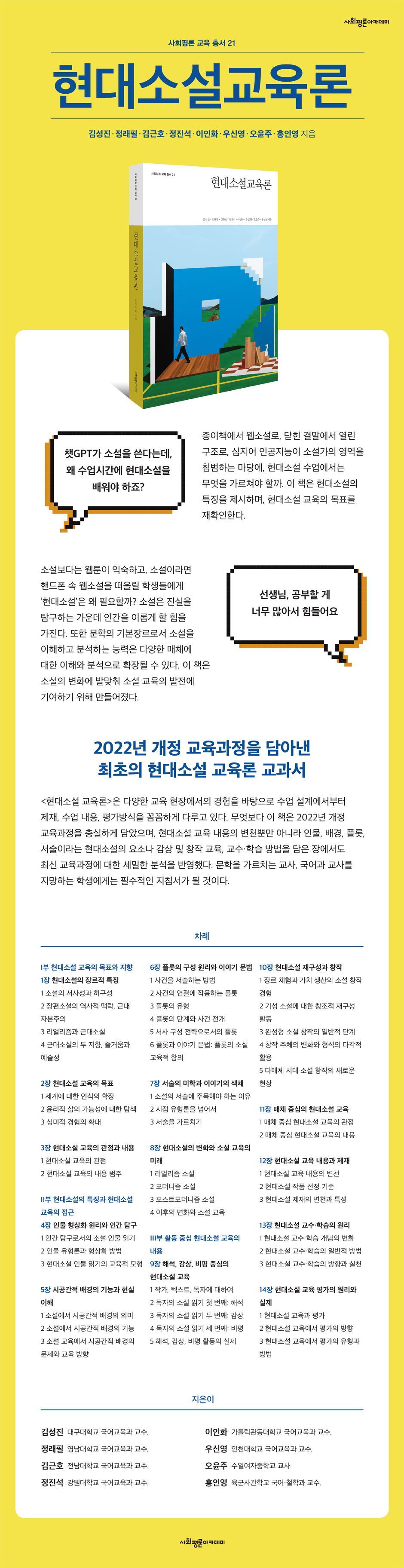
ChatGPT writes novels,
Why do we have to learn modern novels in class?
Why should we continue to teach and learn about modern fiction? From paper books to web novels, from closed endings to open structures, the genre of modern fiction itself is constantly evolving.
Even as artificial intelligence invades the realm of novelists, what should be taught in contemporary fiction classes?
『Modern Novel Education Theory』 presents the characteristics of modern novels that are still preserved even in the midst of ever-changing trends, and reaffirms the goals of modern novel education.
It also organizes the latest advanced theories on the properties of modern novels, focusing on characters, setting, plot, and narrative.
Above all, it faithfully reflects the revised 2022 curriculum, providing appreciation and creative education, material selection, and evaluation design for use in modern novel classes.
Why do we have to learn modern novels in class?
Why should we continue to teach and learn about modern fiction? From paper books to web novels, from closed endings to open structures, the genre of modern fiction itself is constantly evolving.
Even as artificial intelligence invades the realm of novelists, what should be taught in contemporary fiction classes?
『Modern Novel Education Theory』 presents the characteristics of modern novels that are still preserved even in the midst of ever-changing trends, and reaffirms the goals of modern novel education.
It also organizes the latest advanced theories on the properties of modern novels, focusing on characters, setting, plot, and narrative.
Above all, it faithfully reflects the revised 2022 curriculum, providing appreciation and creative education, material selection, and evaluation design for use in modern novel classes.
- You can preview some of the book's contents.
Preview
index
preface
Part I: Goals and Directions of Modern Novel Education
Chapter 1: Genre Characteristics of Modern Novels
1. Narrative and fictional nature of the novel
2 The historical context of the novel and modern capitalism
3 Realism and Modern Novels
4. Two Orientations of Modern Novels: Pleasure and Artistry
Chapter 2: Goals of Modern Novel Education
1. Expanding your perception of the world
2 Exploring the Possibilities of an Ethical Life
3. Expanding aesthetic experience
Chapter 3: Perspectives and Contents of Modern Novel Education
1. Perspectives on Modern Novel Education
2 Content categories of modern novel education
Part II: Characteristics of Modern Novels and Approaches to Modern Novel Education
Chapter 4: Principles of Characterization and Human Exploration
1. Reading Novel Characters as an Exploration of Humanity
2. Character typology and characterization methods
3. An educational model for reading characters in modern novels
Chapter 5: Functions of Spatiotemporal Background and Understanding Reality
1. The meaning of spatiotemporal background in novels
2 The function of spatiotemporal background in novels
3. Problems of spatiotemporal background and educational direction in novel education
Chapter 6: Plot Composition Principles and Story Grammar
1 How to describe an incident
2 Plot that acts to connect events
3 Types of Plots
4 Plot stages and development of events
5 Plot as a narrative composition strategy
6 Plot and Story Grammar: Pedagogical Implications of Plot in Novels
Chapter 7: The Aesthetics of Narrative and the Color of Storytelling
1. Why You Should Pay Attention to the Narrative of a Novel
Beyond the 2-point typology
3 Teaching Narrative
Chapter 8: Changes in Modern Novels and the Future of Novel Education
1. Realistic novel
2 Modernist Novels
3 Postmodern Novels
Changes after 4 and Novel Education
Part III: Contents of Activity-Centered Modern Novel Education
Chapter 9: Modern Novel Education Focusing on Interpretation, Appreciation, and Criticism
1 About the author, the text, and the reader
2 Reader's Novel Reading First: Interpretation
3 Reader's Novel Reading Part 2: Appreciation
4 Reader's Novel Reading Part 3: Criticism
5. Practice of interpretation, appreciation, and criticism
Chapter 10: Reconstruction and Creation of Modern Novels
1. Novel creation experience through genre experience and value production
2 Creative re-creation activities for established novels
3 General Steps in Creating a Complete Novel
4. Changes in the creative subject and diverse use of form
5 New Phenomenon of Novel Creation in the Multimedia Age
Chapter 11: Media-Centered Modern Novel Education
1. Perspectives on Media-Centered Modern Novel Education
2 Contents of Media-Centered Modern Novel Education
Chapter 12: Contents and Subjects of Modern Novel Education
1. Changes in the content of modern novel education
2. Selection criteria for modern novels
3. The evolution and characteristics of modern novel materials
Chapter 13: Principles of Teaching and Learning Modern Novels
1. Changes in the Concept of Teaching and Learning Modern Novels
2 General Methods of Teaching and Learning Modern Novels
3 Directions and Practices of Teaching and Learning Modern Novels
Chapter 14: Principles and Practice of Modern Novel Education and Evaluation
1. Education and Evaluation of Modern Novels
2. Direction of Evaluation in Modern Novel Education
3 Types and Methods of Evaluation in Modern Novel Education
Source of cited works
Search
About the Author
Part I: Goals and Directions of Modern Novel Education
Chapter 1: Genre Characteristics of Modern Novels
1. Narrative and fictional nature of the novel
2 The historical context of the novel and modern capitalism
3 Realism and Modern Novels
4. Two Orientations of Modern Novels: Pleasure and Artistry
Chapter 2: Goals of Modern Novel Education
1. Expanding your perception of the world
2 Exploring the Possibilities of an Ethical Life
3. Expanding aesthetic experience
Chapter 3: Perspectives and Contents of Modern Novel Education
1. Perspectives on Modern Novel Education
2 Content categories of modern novel education
Part II: Characteristics of Modern Novels and Approaches to Modern Novel Education
Chapter 4: Principles of Characterization and Human Exploration
1. Reading Novel Characters as an Exploration of Humanity
2. Character typology and characterization methods
3. An educational model for reading characters in modern novels
Chapter 5: Functions of Spatiotemporal Background and Understanding Reality
1. The meaning of spatiotemporal background in novels
2 The function of spatiotemporal background in novels
3. Problems of spatiotemporal background and educational direction in novel education
Chapter 6: Plot Composition Principles and Story Grammar
1 How to describe an incident
2 Plot that acts to connect events
3 Types of Plots
4 Plot stages and development of events
5 Plot as a narrative composition strategy
6 Plot and Story Grammar: Pedagogical Implications of Plot in Novels
Chapter 7: The Aesthetics of Narrative and the Color of Storytelling
1. Why You Should Pay Attention to the Narrative of a Novel
Beyond the 2-point typology
3 Teaching Narrative
Chapter 8: Changes in Modern Novels and the Future of Novel Education
1. Realistic novel
2 Modernist Novels
3 Postmodern Novels
Changes after 4 and Novel Education
Part III: Contents of Activity-Centered Modern Novel Education
Chapter 9: Modern Novel Education Focusing on Interpretation, Appreciation, and Criticism
1 About the author, the text, and the reader
2 Reader's Novel Reading First: Interpretation
3 Reader's Novel Reading Part 2: Appreciation
4 Reader's Novel Reading Part 3: Criticism
5. Practice of interpretation, appreciation, and criticism
Chapter 10: Reconstruction and Creation of Modern Novels
1. Novel creation experience through genre experience and value production
2 Creative re-creation activities for established novels
3 General Steps in Creating a Complete Novel
4. Changes in the creative subject and diverse use of form
5 New Phenomenon of Novel Creation in the Multimedia Age
Chapter 11: Media-Centered Modern Novel Education
1. Perspectives on Media-Centered Modern Novel Education
2 Contents of Media-Centered Modern Novel Education
Chapter 12: Contents and Subjects of Modern Novel Education
1. Changes in the content of modern novel education
2. Selection criteria for modern novels
3. The evolution and characteristics of modern novel materials
Chapter 13: Principles of Teaching and Learning Modern Novels
1. Changes in the Concept of Teaching and Learning Modern Novels
2 General Methods of Teaching and Learning Modern Novels
3 Directions and Practices of Teaching and Learning Modern Novels
Chapter 14: Principles and Practice of Modern Novel Education and Evaluation
1. Education and Evaluation of Modern Novels
2. Direction of Evaluation in Modern Novel Education
3 Types and Methods of Evaluation in Modern Novel Education
Source of cited works
Search
About the Author
Detailed image
Into the book
To avoid falling into the self-righteousness of absolutizing one's own experiences and failing to acknowledge the existence of others with different backgrounds or values, reflection on one's experiences is necessary.
The cognitive value of modern novels is rooted in the fact that novels provide a reflective understanding of human experience.
---From "Chapter 2, Page 42"
If you are immersed in the fictional world of a novel and fail to maintain a critical distance, it is no different from mistaking actors in dramas or movies for real people.
Furthermore, there is a risk that such a reading attitude will end up as a narrow-minded reading that stops at assessing one's liking for a particular person.
---From "Chapter 4, pages 123-124"
Even when reading the same passage from a novel, the cognitive maps drawn by students are different.
(…) Therefore, when teaching the spatiotemporal background of a novel, we can have readers understand their own cognitive map of the chronotope in the novel, compare it with that of other readers, and explore why such similarities and differences occurred.
Furthermore, it could be addressed whether the chronotopes perceived and imagined by the learners correspond well with the text's guidance, and how they are related to the novel's mood or thematic consciousness perceived by the readers.
---From "Chapter 5, pages 159-160"
The Anglo-American novel world of the first half of the 20th century argued that the narrative of a novel should shift from telling to showing.
The reason was that telling was an old narrative method that reflected the exclusive authority of the author who monopolized life lessons and promoted a vertical relationship between the author and the reader.
They sought to modernize the aesthetics of the point of view through display.
However, it is inappropriate to substitute the problem of misuse of speaking in individual works with the problem of speaking in general.
---From "Chapter 7, pages 196-197"
Through institutional changes such as the free semester system and the high school credit system, a new opportunity is approaching to break away from the standardized learning methods of existing Korean language and literature education.
In this case, middle and high school students will be able to faithfully experience creative activities.
In addition, utilizing various digital media can enable a wider range of creative experience activities.
In addition to creating written narratives, such as composing and writing creative works on paper, computer documents, or the web, it is also possible to create them by integrating them with various visual materials such as graphics or animations.
---From "Chapter 10, Page 303"
It would be appropriate for novel education to also evolve along with the genre.
Novel education should help learners understand and enjoy current genres while also developing a sensitivity to change and developing aesthetic judgment for new genres.
Novel education in this changing era should support learners in developing the insight of novel connoisseurs who independently discover the canon of novels, enjoy them aesthetically, and critically reflect on them.
The cognitive value of modern novels is rooted in the fact that novels provide a reflective understanding of human experience.
---From "Chapter 2, Page 42"
If you are immersed in the fictional world of a novel and fail to maintain a critical distance, it is no different from mistaking actors in dramas or movies for real people.
Furthermore, there is a risk that such a reading attitude will end up as a narrow-minded reading that stops at assessing one's liking for a particular person.
---From "Chapter 4, pages 123-124"
Even when reading the same passage from a novel, the cognitive maps drawn by students are different.
(…) Therefore, when teaching the spatiotemporal background of a novel, we can have readers understand their own cognitive map of the chronotope in the novel, compare it with that of other readers, and explore why such similarities and differences occurred.
Furthermore, it could be addressed whether the chronotopes perceived and imagined by the learners correspond well with the text's guidance, and how they are related to the novel's mood or thematic consciousness perceived by the readers.
---From "Chapter 5, pages 159-160"
The Anglo-American novel world of the first half of the 20th century argued that the narrative of a novel should shift from telling to showing.
The reason was that telling was an old narrative method that reflected the exclusive authority of the author who monopolized life lessons and promoted a vertical relationship between the author and the reader.
They sought to modernize the aesthetics of the point of view through display.
However, it is inappropriate to substitute the problem of misuse of speaking in individual works with the problem of speaking in general.
---From "Chapter 7, pages 196-197"
Through institutional changes such as the free semester system and the high school credit system, a new opportunity is approaching to break away from the standardized learning methods of existing Korean language and literature education.
In this case, middle and high school students will be able to faithfully experience creative activities.
In addition, utilizing various digital media can enable a wider range of creative experience activities.
In addition to creating written narratives, such as composing and writing creative works on paper, computer documents, or the web, it is also possible to create them by integrating them with various visual materials such as graphics or animations.
---From "Chapter 10, Page 303"
It would be appropriate for novel education to also evolve along with the genre.
Novel education should help learners understand and enjoy current genres while also developing a sensitivity to change and developing aesthetic judgment for new genres.
Novel education in this changing era should support learners in developing the insight of novel connoisseurs who independently discover the canon of novels, enjoy them aesthetically, and critically reflect on them.
---From "Chapter 8, Page 255"
Publisher's Review
“Teacher, I have so much to study, it’s hard.”
Today, ChatGPT is writing poetry and novels.
Why should we teach 'modern novels' to students who are more familiar with webtoons than novels, and who think of web novels on their phone screens when they think of novels?
There is an ever-increasing amount of material to learn, but what should we teach our students about modern novels and how?
First of all, the novel is interesting.
But the fun of the novel does not stop at peripheral pleasure.
Because “in the pursuit of truth, we have the power to benefit humanity.”
That's why we still learn and teach novels in schools.
However, the characteristic of ‘exploring the truth about humanity and life by creating a fictional world’ is not limited to modern novels.
It can be expanded into various narrative arts such as graphic novels, comics, webtoons, movies, and dramas.
In other words, the ability to understand and analyze novels as a fundamental genre of literature can be expanded to understand and analyze various media.
This is why we still need to learn and teach modern novels in a complex world.
This is also why the content of modern novel education must evolve so that it can be applied and expanded to various media.
『Modern Novel Education Theory』 was created to contribute to the development of novel education in line with these changes.
Omniscient author's point of view?
There is no longer such a concept in Korean language classes in middle and high schools.
Omniscient authorial point of view is a mistranslation of third-person omniscient point of view, but it has been widely used as a substitute for third-person omniscient point of view for a long time.
This is a misunderstanding that arises because the distance between the author and the narrator in a third-person omniscient novel is close, and the narrator is mistaken for the author.
However, in the future, the term 'third-person omniscient point of view' may also disappear.
This is because the method of categorizing viewpoints based on the narrator's position and speaking style, that is, the typology of first-person protagonist viewpoint, first-person observer viewpoint, third-person omniscient viewpoint, and third-person observer viewpoint, has limitations in explaining the narrative of a novel.
"Modern Novel Education Theory" explains the precise concept and limitations of existing viewpoint typologies and introduces the concept of narrative communication structure and focus to overcome them.
We also analyze how such concepts are reflected in the latest curriculum and how they can be addressed in contemporary novel classes.
And that's not all.
The diverse characters appearing in modern novels cannot be sufficiently explained by MBTI-style typologies alone.
You might wonder if it's necessary to study fictional characters, but by understanding and analyzing the characteristics of fictional characters, you can expand your understanding of humanity.
Moreover, if we cannot accurately analyze the characteristics and functions of the character, it is inevitable that we will have difficulties in appreciating and interpreting the work.
『Modern Novel Education Theory』 explains the theory of the functions of characters and methods of characterization in novels, and presents various activities that can be attempted in Korean language classes based on this theory.
『Modern Novel Education Theory』 organizes the latest theories on modern novels, including the meaning and function of the spatiotemporal background in novels, as well as narration and characters, the criteria for distinguishing between "twist" and "absurdity," plot and story grammar, and the structure of communication between the author and the reader through the work, and explains them through specific examples.
In the section that corrects misconceptions that appear in existing introductory books and textbooks, readers can check whether they understand correctly.
The first modern novel education textbook that incorporates the 2022 revised curriculum.
『Modern Novel Education Theory』 is not an academic book that compiles the research results of scholars on modern novel education.
Based on such research, this textbook was created for Korean language teachers who are considering teaching modern novels and for students who want to become teachers.
Accordingly, 『Modern Novel Education Theory』 meticulously covers everything from lesson design to materials, lesson content, and evaluation methods, based on experiences in various educational settings.
Students who are or wish to become Korean language teachers will be able to systematically learn about the philosophy of accepting modern novels and creative writing education, as well as detailed methods, through this book.
What is most noteworthy is that this book faithfully reflects the 2022 revised curriculum.
In addition to the chapters that cover the evolution of modern novel education content, the chapters that cover elements of modern novels such as characters, background, plot, and narrative, as well as appreciation and creative education, and teaching and learning methods, reflect a detailed analysis of the latest curriculum.
This will be an essential guide for students aspiring to become literature teachers or Korean language teachers.
Today, ChatGPT is writing poetry and novels.
Why should we teach 'modern novels' to students who are more familiar with webtoons than novels, and who think of web novels on their phone screens when they think of novels?
There is an ever-increasing amount of material to learn, but what should we teach our students about modern novels and how?
First of all, the novel is interesting.
But the fun of the novel does not stop at peripheral pleasure.
Because “in the pursuit of truth, we have the power to benefit humanity.”
That's why we still learn and teach novels in schools.
However, the characteristic of ‘exploring the truth about humanity and life by creating a fictional world’ is not limited to modern novels.
It can be expanded into various narrative arts such as graphic novels, comics, webtoons, movies, and dramas.
In other words, the ability to understand and analyze novels as a fundamental genre of literature can be expanded to understand and analyze various media.
This is why we still need to learn and teach modern novels in a complex world.
This is also why the content of modern novel education must evolve so that it can be applied and expanded to various media.
『Modern Novel Education Theory』 was created to contribute to the development of novel education in line with these changes.
Omniscient author's point of view?
There is no longer such a concept in Korean language classes in middle and high schools.
Omniscient authorial point of view is a mistranslation of third-person omniscient point of view, but it has been widely used as a substitute for third-person omniscient point of view for a long time.
This is a misunderstanding that arises because the distance between the author and the narrator in a third-person omniscient novel is close, and the narrator is mistaken for the author.
However, in the future, the term 'third-person omniscient point of view' may also disappear.
This is because the method of categorizing viewpoints based on the narrator's position and speaking style, that is, the typology of first-person protagonist viewpoint, first-person observer viewpoint, third-person omniscient viewpoint, and third-person observer viewpoint, has limitations in explaining the narrative of a novel.
"Modern Novel Education Theory" explains the precise concept and limitations of existing viewpoint typologies and introduces the concept of narrative communication structure and focus to overcome them.
We also analyze how such concepts are reflected in the latest curriculum and how they can be addressed in contemporary novel classes.
And that's not all.
The diverse characters appearing in modern novels cannot be sufficiently explained by MBTI-style typologies alone.
You might wonder if it's necessary to study fictional characters, but by understanding and analyzing the characteristics of fictional characters, you can expand your understanding of humanity.
Moreover, if we cannot accurately analyze the characteristics and functions of the character, it is inevitable that we will have difficulties in appreciating and interpreting the work.
『Modern Novel Education Theory』 explains the theory of the functions of characters and methods of characterization in novels, and presents various activities that can be attempted in Korean language classes based on this theory.
『Modern Novel Education Theory』 organizes the latest theories on modern novels, including the meaning and function of the spatiotemporal background in novels, as well as narration and characters, the criteria for distinguishing between "twist" and "absurdity," plot and story grammar, and the structure of communication between the author and the reader through the work, and explains them through specific examples.
In the section that corrects misconceptions that appear in existing introductory books and textbooks, readers can check whether they understand correctly.
The first modern novel education textbook that incorporates the 2022 revised curriculum.
『Modern Novel Education Theory』 is not an academic book that compiles the research results of scholars on modern novel education.
Based on such research, this textbook was created for Korean language teachers who are considering teaching modern novels and for students who want to become teachers.
Accordingly, 『Modern Novel Education Theory』 meticulously covers everything from lesson design to materials, lesson content, and evaluation methods, based on experiences in various educational settings.
Students who are or wish to become Korean language teachers will be able to systematically learn about the philosophy of accepting modern novels and creative writing education, as well as detailed methods, through this book.
What is most noteworthy is that this book faithfully reflects the 2022 revised curriculum.
In addition to the chapters that cover the evolution of modern novel education content, the chapters that cover elements of modern novels such as characters, background, plot, and narrative, as well as appreciation and creative education, and teaching and learning methods, reflect a detailed analysis of the latest curriculum.
This will be an essential guide for students aspiring to become literature teachers or Korean language teachers.
GOODS SPECIFICS
- Date of issue: February 27, 2023
- Page count, weight, size: 452 pages | 864g | 180*248*22mm
- ISBN13: 9791167070937
- ISBN10: 1167070933
You may also like
카테고리
korean


korean

![GQ KOREA Mark (Monthly): December [2025]](http://librairie.coreenne.fr/cdn/shop/files/8ef265dbbfbf186523ed75ba7319009d.jpg?v=1765340328&width=3840)


