

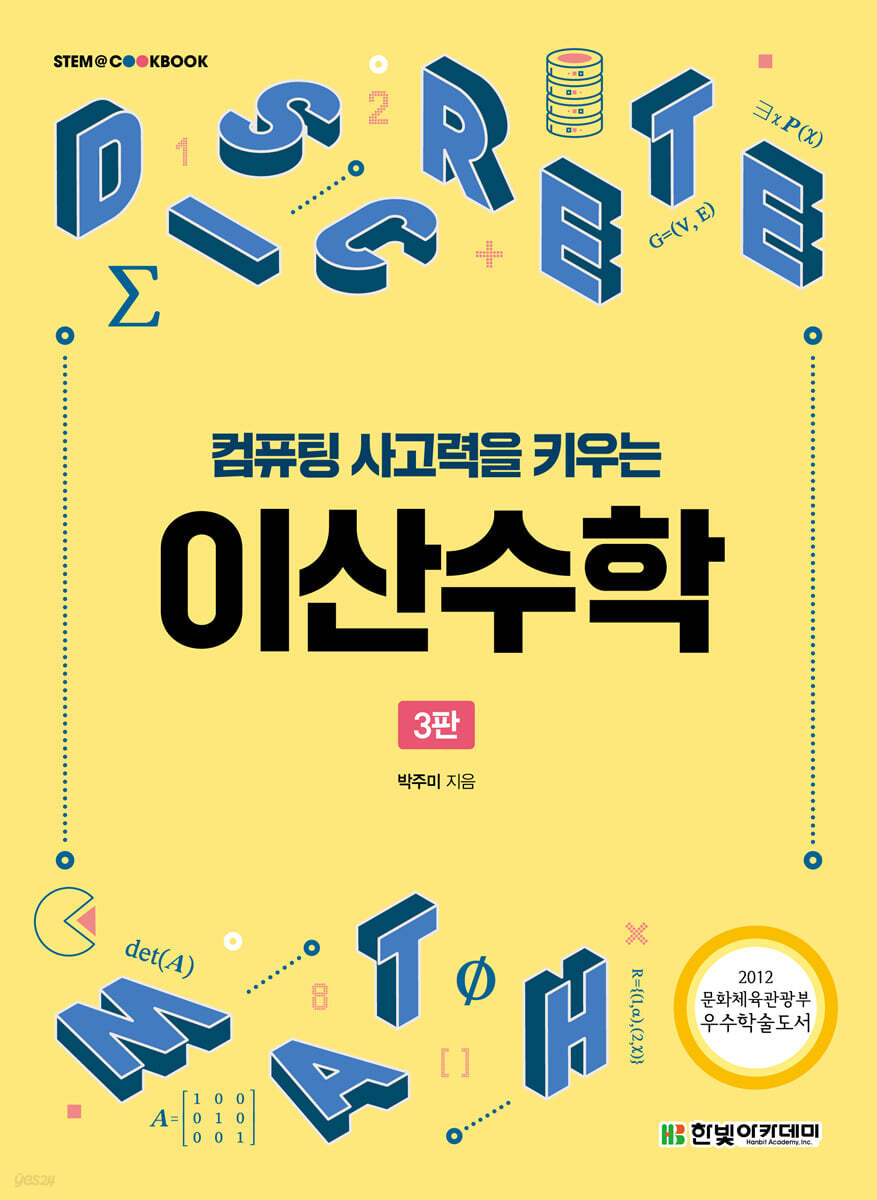
Discrete Mathematics for Developing Computational Thinking
 |
Description
Book Introduction
Anyone can easily learn with more solid explanations and abundant examples.
Discrete Mathematics Bestseller!
This is an introductory book to discrete mathematics that easily explains the mathematical theories necessary to understand computers.
The strengths of the previous edition have been preserved, and the content has been further strengthened by reflecting feedback from the Discrete Mathematics Instructor Advisory Group and readers.
You can build a solid foundation with clearer concept definitions and develop your application skills through various examples that enhance your logical thinking.
It will be a good guide for learners who are studying discrete mathematics for the first time, as it explains everything from the basics to applications in detail.
Discrete Mathematics Bestseller!
This is an introductory book to discrete mathematics that easily explains the mathematical theories necessary to understand computers.
The strengths of the previous edition have been preserved, and the content has been further strengthened by reflecting feedback from the Discrete Mathematics Instructor Advisory Group and readers.
You can build a solid foundation with clearer concept definitions and develop your application skills through various examples that enhance your logical thinking.
It will be a good guide for learners who are studying discrete mathematics for the first time, as it explains everything from the basics to applications in detail.
- You can preview some of the book's contents.
Preview
index
CHAPTER 01 Number Representation and Operations
1.1 Number system
1.2 Numerical Operations
1.3 Representation by base
1.4 Conversion between bases
1.5 Arithmetic operations by base
1.6 Representation and operation of numbers on computers
Practice problems
CHAPTER 02 Propositions and Logic
2.1 Proposition
2.2 Logical Operators
2.3 Conditional Propositions
2.4 Composite propositions
2.5 Logical Equivalence
2.6 Propositional functions and quantifiers
2.7 Inference
Practice problems
CHAPTER 03 PROOF
3.1 Understanding the proof
3.2 Direct proof
3.3 Indirect proof
3.4 Mathematical induction
Practice problems
CHAPTER 04 Assembly
4.1 Concept of set
4.2 Types of sets
4.3 Set operations
4.4 Algebraic laws of sets
4.5 Partitioning the set
Practice problems
CHAPTER 05 MATRIX
5.1 Matrix Concept
5.2 Matrix Operations
5.3 Types of matrices
5.4 Determinant
5.5 Inverse matrix
5.6 Matrices and Systems of Linear Equations
Practice problems
CHAPTER 06 Relationships
6.1 Concept of Relationship
6.2 Representation of Relationships
6.3 Nature of Relationships
6.4 Synthetic Relationships
6.5 The closure of relationships
6.6 Equivalence and partial ordering relations
Practice problems
CHAPTER 07 FUNCTIONS
7.1 Concept of Function
7.2 Properties of functions
7.3 Composite functions
7.4 Types of functions
Practice problems
CHAPTER 08 Graph
8.1 Graph Concepts
8.2 Types of graphs
8.3 Representation of Graphs
8.4 Euler and Hamilton
8.5 Using Graphs
Practice problems
CHAPTER 09 Tree
9.1 Tree Concept
9.2 Binary Tree
9.3 Using Trees
Practice problems
CHAPTER 10 Boolean Algebra
10.1 Concepts of Boolean Algebra
10.2 Representation of Boolean Functions
10.3 Logic Gates
Practice problems
CHAPTER 11 Permutations, Combinations, and Probability
11.1 Law of Sum and Law of Multiplication
11.2 Permutations
11.3 Combination
11.4 probability
11.5 Probability Distributions
Practice problems
CHAPTER 12 ALGORITHMS
12.1 Concepts and Representations of Algorithms
12.2 Efficiency of the Algorithm
12.3 Various algorithms
Practice problems
Search
1.1 Number system
1.2 Numerical Operations
1.3 Representation by base
1.4 Conversion between bases
1.5 Arithmetic operations by base
1.6 Representation and operation of numbers on computers
Practice problems
CHAPTER 02 Propositions and Logic
2.1 Proposition
2.2 Logical Operators
2.3 Conditional Propositions
2.4 Composite propositions
2.5 Logical Equivalence
2.6 Propositional functions and quantifiers
2.7 Inference
Practice problems
CHAPTER 03 PROOF
3.1 Understanding the proof
3.2 Direct proof
3.3 Indirect proof
3.4 Mathematical induction
Practice problems
CHAPTER 04 Assembly
4.1 Concept of set
4.2 Types of sets
4.3 Set operations
4.4 Algebraic laws of sets
4.5 Partitioning the set
Practice problems
CHAPTER 05 MATRIX
5.1 Matrix Concept
5.2 Matrix Operations
5.3 Types of matrices
5.4 Determinant
5.5 Inverse matrix
5.6 Matrices and Systems of Linear Equations
Practice problems
CHAPTER 06 Relationships
6.1 Concept of Relationship
6.2 Representation of Relationships
6.3 Nature of Relationships
6.4 Synthetic Relationships
6.5 The closure of relationships
6.6 Equivalence and partial ordering relations
Practice problems
CHAPTER 07 FUNCTIONS
7.1 Concept of Function
7.2 Properties of functions
7.3 Composite functions
7.4 Types of functions
Practice problems
CHAPTER 08 Graph
8.1 Graph Concepts
8.2 Types of graphs
8.3 Representation of Graphs
8.4 Euler and Hamilton
8.5 Using Graphs
Practice problems
CHAPTER 09 Tree
9.1 Tree Concept
9.2 Binary Tree
9.3 Using Trees
Practice problems
CHAPTER 10 Boolean Algebra
10.1 Concepts of Boolean Algebra
10.2 Representation of Boolean Functions
10.3 Logic Gates
Practice problems
CHAPTER 11 Permutations, Combinations, and Probability
11.1 Law of Sum and Law of Multiplication
11.2 Permutations
11.3 Combination
11.4 probability
11.5 Probability Distributions
Practice problems
CHAPTER 12 ALGORITHMS
12.1 Concepts and Representations of Algorithms
12.2 Efficiency of the Algorithm
12.3 Various algorithms
Practice problems
Search
Detailed image

GOODS SPECIFICS
- Publication date: December 26, 2021
- Page count, weight, size: 652 pages | 188*257*35mm
- ISBN13: 9791156645900
- ISBN10: 1156645905
You may also like
카테고리
korean


korean

![GQ KOREA Mark (Monthly): December [2025]](http://librairie.coreenne.fr/cdn/shop/files/8ef265dbbfbf186523ed75ba7319009d.jpg?v=1765340328&width=3840)


