

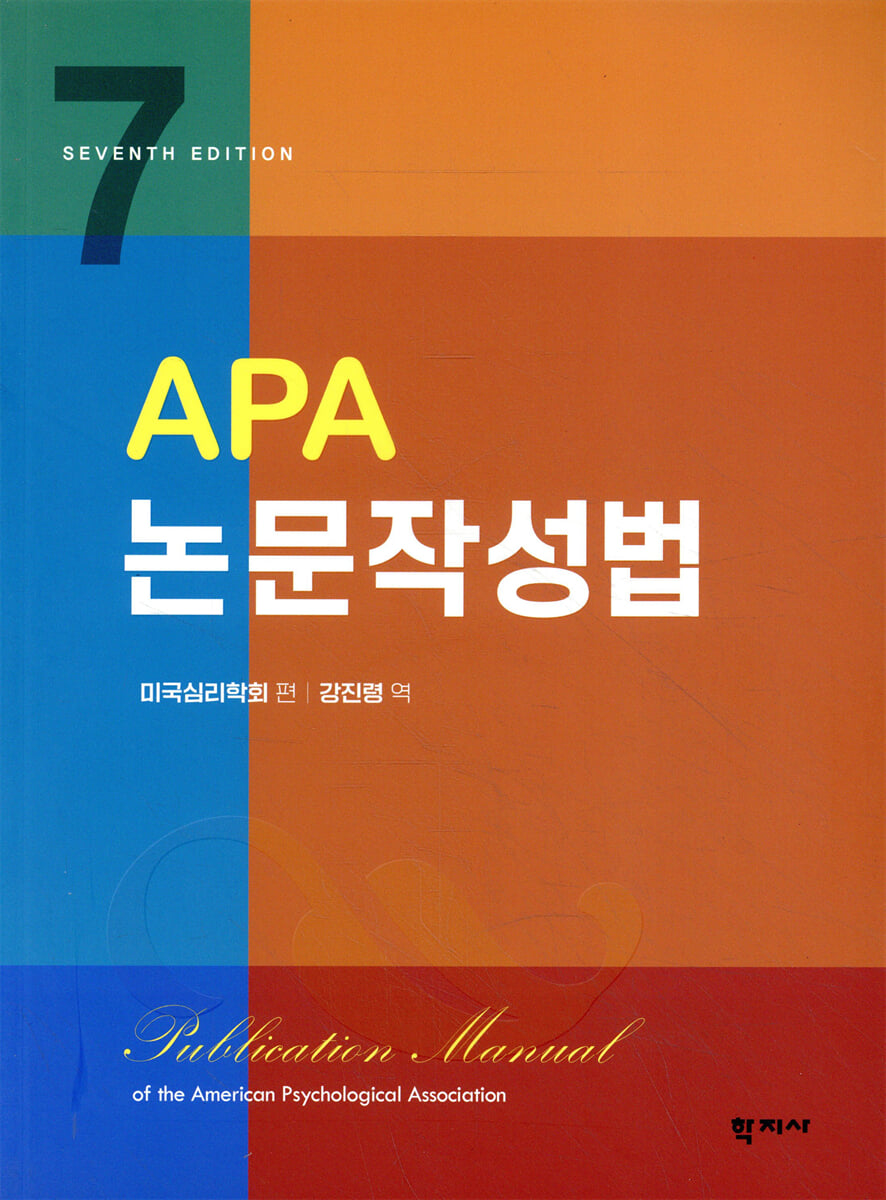
APA paper writing method
 |
Description
Book Introduction
Cheat keys for writing a thesis,
Why You Should Read This Book and Write a Paper
There are countless books in the world that can be fascinating even without having been there.
But if no one actually visits these books, who will verify the errors in them? Unverified truths are more likely to be inaccurate if no one attempts to verify them.
Research is an attempt to verify the truth, and a thesis is a record of the process and results of such attempts.
A thesis is a product of the pursuit of truth and an important means of communication among experts in various fields.
Sharing research results with other experts requires a format and system for clearly communicating the procedures and results.
This increases the readability of the paper and promotes communication among researchers.
Accordingly, the American Psychological Association (APA) developed and published a handbook that stipulated a consistent format and system for writing papers.
This handbook has been updated repeatedly to reflect the trends and needs of the times, up to its seventh edition.
Today, the APA Manual of Writing Papers has become a must-read for writing academic papers and manuscripts for psychological publications, not only domestically but also internationally.
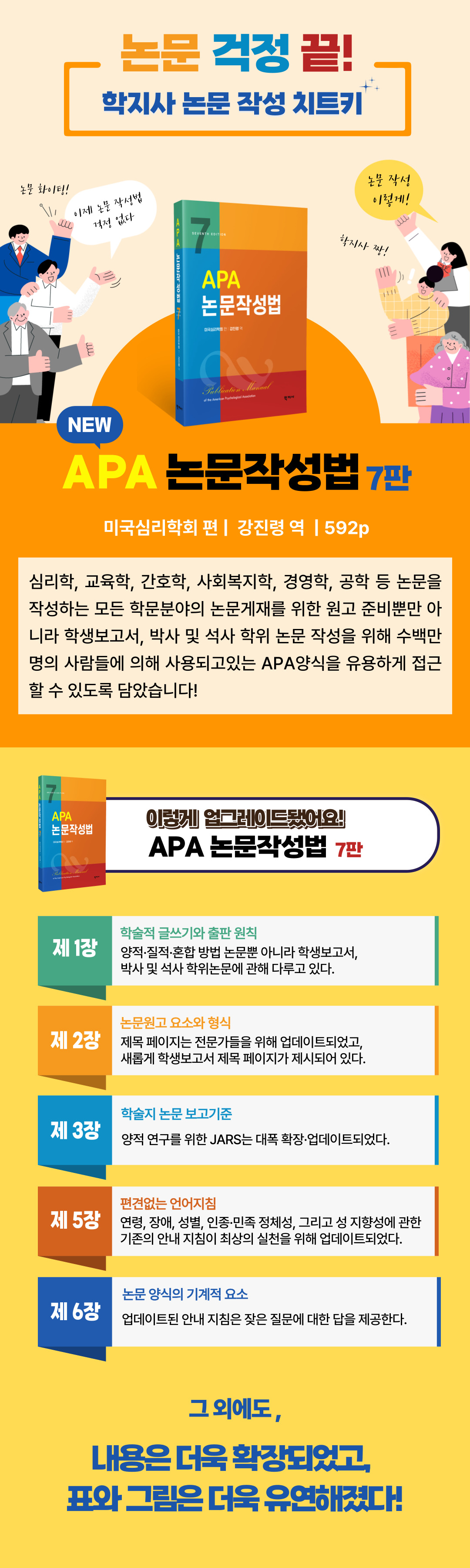
The 7th edition of the APA Manuscript Writing Guidelines sequentially covers the essential elements of writing a thesis, from Principles of Academic Writing and Publication (Chapter 1), Manuscript Elements and Format (Chapter 2), Journal Reporting Standards (Chapter 3), Writing Style and Grammar (Chapter 4), Unbiased Language Guidelines (Chapter 5), Mechanical Elements of the Thesis Format (Chapter 6), Tables and Figures (Chapter 7), Attribution in the Text (Chapter 8), References (Chapter 9), Examples of References (Chapter 10), Legal References (Chapter 11), and the Publication Process (Chapter 12).
Each chapter is structured independently and contains systematic and detailed information on how to write a paper in APA format.
In addition, the essential requirements for manuscript preparation and submission for publication are described in detail for researchers preparing papers for publication in academic journals affiliated with the American Psychological Association.
Why You Should Read This Book and Write a Paper
There are countless books in the world that can be fascinating even without having been there.
But if no one actually visits these books, who will verify the errors in them? Unverified truths are more likely to be inaccurate if no one attempts to verify them.
Research is an attempt to verify the truth, and a thesis is a record of the process and results of such attempts.
A thesis is a product of the pursuit of truth and an important means of communication among experts in various fields.
Sharing research results with other experts requires a format and system for clearly communicating the procedures and results.
This increases the readability of the paper and promotes communication among researchers.
Accordingly, the American Psychological Association (APA) developed and published a handbook that stipulated a consistent format and system for writing papers.
This handbook has been updated repeatedly to reflect the trends and needs of the times, up to its seventh edition.
Today, the APA Manual of Writing Papers has become a must-read for writing academic papers and manuscripts for psychological publications, not only domestically but also internationally.
The 7th edition of the APA Manuscript Writing Guidelines sequentially covers the essential elements of writing a thesis, from Principles of Academic Writing and Publication (Chapter 1), Manuscript Elements and Format (Chapter 2), Journal Reporting Standards (Chapter 3), Writing Style and Grammar (Chapter 4), Unbiased Language Guidelines (Chapter 5), Mechanical Elements of the Thesis Format (Chapter 6), Tables and Figures (Chapter 7), Attribution in the Text (Chapter 8), References (Chapter 9), Examples of References (Chapter 10), Legal References (Chapter 11), and the Publication Process (Chapter 12).
Each chapter is structured independently and contains systematic and detailed information on how to write a paper in APA format.
In addition, the essential requirements for manuscript preparation and submission for publication are described in detail for researchers preparing papers for publication in academic journals affiliated with the American Psychological Association.
index
Translator's Preface
List of tables and figures
Acknowledgements
introduction
1 Academic Writing and Publication Principles
Type of paper
Ethical, legal, and professional standards for paper submission and publication
Ensuring the accuracy of scientific discoveries
Protecting the rights and welfare of research participants and subjects
Intellectual Property Rights Protection
2 Manuscript Elements and Format
Essentials
Elements of a thesis manuscript
form
group
○ Sample thesis manuscript
3 Journal Reporting Standards
Overview of Reporting Standards
General reporting standards for research design
Reporting Standards for Quantitative Research
Reporting Standards for Qualitative Research
Reporting Standards for Mixed Methods Research
4. Thesis writing format and grammar
Effective Academic Writing
Continuity and flow
Conciseness and clarity
[Grammar and Usage]
verb
pronoun
Sentence structure
Strategies for Improving Writing Skills
5 Unbiased Language Guidelines
General Guidelines for Reducing Bias
Reducing subject-specific bias
6 Mechanical elements of the thesis form
full stop
spelling
Capitalization
italic
Abbreviation
number
statistical and mathematical manuscripts
Present the equation
inventory
7 Tables and Figures
General Guidelines for Tables and Figures
graph
○ Sample table
painting
○ Sample picture
8. Recognition of the work's contribution in the text
General Guidelines for Citation
Works requiring special access to citation
Quote from the text
Restatements and Quotations
9 References
Reference categories
Reference List Entry Guidelines
[References]
author
date
title
source
Reference variation
Reference list format and order
10 Examples of References
Author variation
Date mutation
Title variation
Source mutation
Text works
Datasets, Software, and Testing
audiovisual media
online media
11 Legal References
General Guidelines for Legal References
Example of a legal reference
12 Paper Publication Process
Preparation for publication
Understanding the editing and publishing process
Manuscript preparation
Copyright and Permission Guidelines
During and after publication
Sources of tables, figures, and manuscripts cited in this book
References
Search
List of tables and figures
Acknowledgements
introduction
1 Academic Writing and Publication Principles
Type of paper
Ethical, legal, and professional standards for paper submission and publication
Ensuring the accuracy of scientific discoveries
Protecting the rights and welfare of research participants and subjects
Intellectual Property Rights Protection
2 Manuscript Elements and Format
Essentials
Elements of a thesis manuscript
form
group
○ Sample thesis manuscript
3 Journal Reporting Standards
Overview of Reporting Standards
General reporting standards for research design
Reporting Standards for Quantitative Research
Reporting Standards for Qualitative Research
Reporting Standards for Mixed Methods Research
4. Thesis writing format and grammar
Effective Academic Writing
Continuity and flow
Conciseness and clarity
[Grammar and Usage]
verb
pronoun
Sentence structure
Strategies for Improving Writing Skills
5 Unbiased Language Guidelines
General Guidelines for Reducing Bias
Reducing subject-specific bias
6 Mechanical elements of the thesis form
full stop
spelling
Capitalization
italic
Abbreviation
number
statistical and mathematical manuscripts
Present the equation
inventory
7 Tables and Figures
General Guidelines for Tables and Figures
graph
○ Sample table
painting
○ Sample picture
8. Recognition of the work's contribution in the text
General Guidelines for Citation
Works requiring special access to citation
Quote from the text
Restatements and Quotations
9 References
Reference categories
Reference List Entry Guidelines
[References]
author
date
title
source
Reference variation
Reference list format and order
10 Examples of References
Author variation
Date mutation
Title variation
Source mutation
Text works
Datasets, Software, and Testing
audiovisual media
online media
11 Legal References
General Guidelines for Legal References
Example of a legal reference
12 Paper Publication Process
Preparation for publication
Understanding the editing and publishing process
Manuscript preparation
Copyright and Permission Guidelines
During and after publication
Sources of tables, figures, and manuscripts cited in this book
References
Search
Detailed image
Publisher's Review
Taking into account the characteristics of the handbook, the translator focused on faithfully translating the contents of the original book into Korean.
Additionally, to help readers understand and improve readability, key titles and terms are included in the original text.
However, readers who are familiar with our country's editing style will sometimes notice an unfamiliar form of editing style.
Examples include capitalization, italics, double/one and a half/single spacing, title case (translated as 'title notation') or sentence case (translated as 'sentence notation').
Accordingly, we have attempted to help readers understand the editing style and terminology that differ from ours through the translator's notes.
Excellence in writing is crucial for success in many academic and professional endeavors. APA style is a set of clear and precise guidelines designed to help authors—both novice and experienced—achieve excellence in writing.
These guidelines have been used by millions of people to prepare manuscripts for publication, as well as student reports, doctoral and master's theses, in fields ranging from psychology and nursing to social work, communication to education, business to engineering, and other academic fields.
APA format provides the foundation for effective scholarly communication by helping authors present their ideas in a clear, concise, and organized manner.
Unity and consistency allow readers to ① focus on the ideas presented rather than the format, and ② quickly review the work's key points, results, and materials.
The format guidelines help authors fully present key information and eliminate unnecessary distractions (e.g., inconsistencies or omissions in punctuation, capitalization, reference citations, and statistical presentation).
When a writing style functions optimally, ideas flow logically, sources are appropriately credited, and the paper is structured consistently and predictably.
People are described in language that recognizes their worth and dignity.
Authors establish a plan for ethical compliance and report important details of the research protocol, enabling readers to evaluate the results and enabling other researchers to replicate the study in the future.
Tables and figures present data in an attractive and consistent manner.
"APA Paper Writing" has long been the authoritative resource for academic writing, and this edition includes guidance and support services specifically for students.
Regardless of their career path, all students can benefit from mastering academic writing as a way to develop their critical thinking skills and hone their communication skills with accuracy and clarity.
Additionally, to help readers understand and improve readability, key titles and terms are included in the original text.
However, readers who are familiar with our country's editing style will sometimes notice an unfamiliar form of editing style.
Examples include capitalization, italics, double/one and a half/single spacing, title case (translated as 'title notation') or sentence case (translated as 'sentence notation').
Accordingly, we have attempted to help readers understand the editing style and terminology that differ from ours through the translator's notes.
Excellence in writing is crucial for success in many academic and professional endeavors. APA style is a set of clear and precise guidelines designed to help authors—both novice and experienced—achieve excellence in writing.
These guidelines have been used by millions of people to prepare manuscripts for publication, as well as student reports, doctoral and master's theses, in fields ranging from psychology and nursing to social work, communication to education, business to engineering, and other academic fields.
APA format provides the foundation for effective scholarly communication by helping authors present their ideas in a clear, concise, and organized manner.
Unity and consistency allow readers to ① focus on the ideas presented rather than the format, and ② quickly review the work's key points, results, and materials.
The format guidelines help authors fully present key information and eliminate unnecessary distractions (e.g., inconsistencies or omissions in punctuation, capitalization, reference citations, and statistical presentation).
When a writing style functions optimally, ideas flow logically, sources are appropriately credited, and the paper is structured consistently and predictably.
People are described in language that recognizes their worth and dignity.
Authors establish a plan for ethical compliance and report important details of the research protocol, enabling readers to evaluate the results and enabling other researchers to replicate the study in the future.
Tables and figures present data in an attractive and consistent manner.
"APA Paper Writing" has long been the authoritative resource for academic writing, and this edition includes guidance and support services specifically for students.
Regardless of their career path, all students can benefit from mastering academic writing as a way to develop their critical thinking skills and hone their communication skills with accuracy and clarity.
GOODS SPECIFICS
- Publication date: December 30, 2021
- Page count, weight, size: 592 pages | 1,190g | 188*255*25mm
- ISBN13: 9788999725470
- ISBN10: 8999725472
You may also like
카테고리
korean


korean

![ELLE 엘르 스페셜 에디션 A형 : 12월 [2025]](http://librairie.coreenne.fr/cdn/shop/files/b8e27a3de6c9538896439686c6b0e8fb.jpg?v=1766436872&width=3840)


