

History of Pie
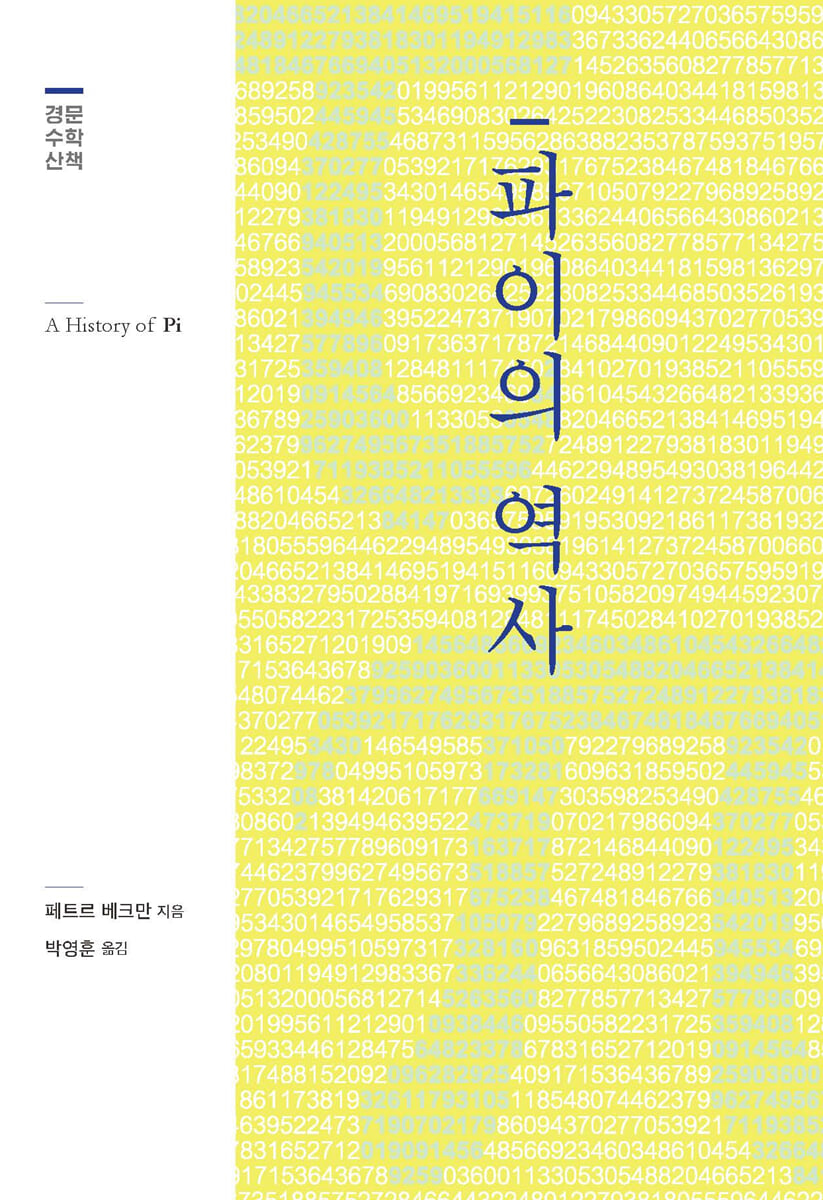 |
Description
Book Introduction
The tearful history of research by mathematicians who have studied pi
How have people calculated pi from ancient times to the present?
The history of π can be likened to a small but strange mirror that reflects the history of mankind.
From the story of Archimedes, who discovered the value of π in a way that was unparalleled for some 2,300 years, to the story of medieval bishops who condemned it as the devil's number, to the story of a Cleveland businessman who made a fuss about making a great discovery by publishing a book in 1931 that found the value of π that the Egyptians had already used 4,000 years ago, numerous incidents and anecdotes related to π that have spread throughout human history unfold in an interesting way.
Why has pi been so captivating to so many people for over 2,300 years? It's said to be due to the "irregular pattern of pi," which never repeats itself but unfolds in a complex pattern. This irregularity has led to its use as a yardstick to test the computational power of 21st-century computers.
Why does the simple definition of "the ratio of a circle's circumference to its diameter" reveal itself in such a complex way? To answer this question, mathematicians continue to study pi today.
I recommend this book to everyone in this country who only memorized the number 3.14 without learning the charm of pi during school classes.
By the way, Einstein's birthday is March 14th.
How have people calculated pi from ancient times to the present?
The history of π can be likened to a small but strange mirror that reflects the history of mankind.
From the story of Archimedes, who discovered the value of π in a way that was unparalleled for some 2,300 years, to the story of medieval bishops who condemned it as the devil's number, to the story of a Cleveland businessman who made a fuss about making a great discovery by publishing a book in 1931 that found the value of π that the Egyptians had already used 4,000 years ago, numerous incidents and anecdotes related to π that have spread throughout human history unfold in an interesting way.
Why has pi been so captivating to so many people for over 2,300 years? It's said to be due to the "irregular pattern of pi," which never repeats itself but unfolds in a complex pattern. This irregularity has led to its use as a yardstick to test the computational power of 21st-century computers.
Why does the simple definition of "the ratio of a circle's circumference to its diameter" reveal itself in such a complex way? To answer this question, mathematicians continue to study pi today.
I recommend this book to everyone in this country who only memorized the number 3.14 without learning the charm of pi during school classes.
By the way, Einstein's birthday is March 14th.
- You can preview some of the book's contents.
Preview
index
Translator's Preface v
Preface ix
Chapter 1: The Rising Civilization
Chapter 2: Belt of Civilization 15
Chapter 3: Ancient Greece 37
Chapter 4: Euclid's Geometry 49
Chapter 5: The Black Death Called Rome 63
Chapter 6: Archimedes of Syracuse 73
Chapter 7: The Twilight of Civilization 87
Chapter 8: Civilization in Darkness 95
Chapter 9: The Age of Enlightenment 107
Chapter 10: Number Hunters 123
Chapter 11: The Last Archimedes 139
Chapter 12: Prelude to Change 153
Chapter 13: Newton, the All-Purpose Scientist 169
Chapter 14: Mathematician Euler 185
Chapter 15: Monte Carlo Methods 199
Chapter 16 Transcendental Numbers 211
Chapter 17: Modern Problem Solvers 221
Chapter 18: The Computer Age 233
Reference 245
Chronology 251
Search 255
Preface ix
Chapter 1: The Rising Civilization
Chapter 2: Belt of Civilization 15
Chapter 3: Ancient Greece 37
Chapter 4: Euclid's Geometry 49
Chapter 5: The Black Death Called Rome 63
Chapter 6: Archimedes of Syracuse 73
Chapter 7: The Twilight of Civilization 87
Chapter 8: Civilization in Darkness 95
Chapter 9: The Age of Enlightenment 107
Chapter 10: Number Hunters 123
Chapter 11: The Last Archimedes 139
Chapter 12: Prelude to Change 153
Chapter 13: Newton, the All-Purpose Scientist 169
Chapter 14: Mathematician Euler 185
Chapter 15: Monte Carlo Methods 199
Chapter 16 Transcendental Numbers 211
Chapter 17: Modern Problem Solvers 221
Chapter 18: The Computer Age 233
Reference 245
Chronology 251
Search 255
Publisher's Review
Translator's Note
This book is not a math book.
And this book is not a history book.
It's a book about mathematics and a book about history.
Perhaps the reason I was able to fully experience the atmosphere of the mask dance performance, which satirizes the Joseon Dynasty's aristocracy while maintaining the excitement of a play, while reading this book, was because I saw Dr. Beckman's erudition and his human side, which did not try to be overly formal.
In this book, he shows his activities, traveling across time and space, armed with a vast amount of data.
He would drag the pretentious philosophers and mathematicians into his stage and make them dance the mask dance, and he would cast the great Roman Empire, which had left its mark on world history, into a fiery hell from which no matter how hard they tried, they could never escape. He would also mercilessly mutilate and burn at the stake the Christians of the Middle Ages who boasted of conversing with God and ignored humanity.
And that too with one small number, π.
This book is not a math book.
And this book is not a history book.
It's a book about mathematics and a book about history.
Perhaps the reason I was able to fully experience the atmosphere of the mask dance performance, which satirizes the Joseon Dynasty's aristocracy while maintaining the excitement of a play, while reading this book, was because I saw Dr. Beckman's erudition and his human side, which did not try to be overly formal.
In this book, he shows his activities, traveling across time and space, armed with a vast amount of data.
He would drag the pretentious philosophers and mathematicians into his stage and make them dance the mask dance, and he would cast the great Roman Empire, which had left its mark on world history, into a fiery hell from which no matter how hard they tried, they could never escape. He would also mercilessly mutilate and burn at the stake the Christians of the Middle Ages who boasted of conversing with God and ignored humanity.
And that too with one small number, π.
GOODS SPECIFICS
- Publication date: November 1, 2021
- Page count, weight, size: 272 pages | 153*225*20mm
- ISBN13: 9791160735024
- ISBN10: 1160735026
You may also like
카테고리
korean


korean

![GQ KOREA Mark (Monthly): December [2025]](http://librairie.coreenne.fr/cdn/shop/files/8ef265dbbfbf186523ed75ba7319009d.jpg?v=1765340328&width=3840)


