

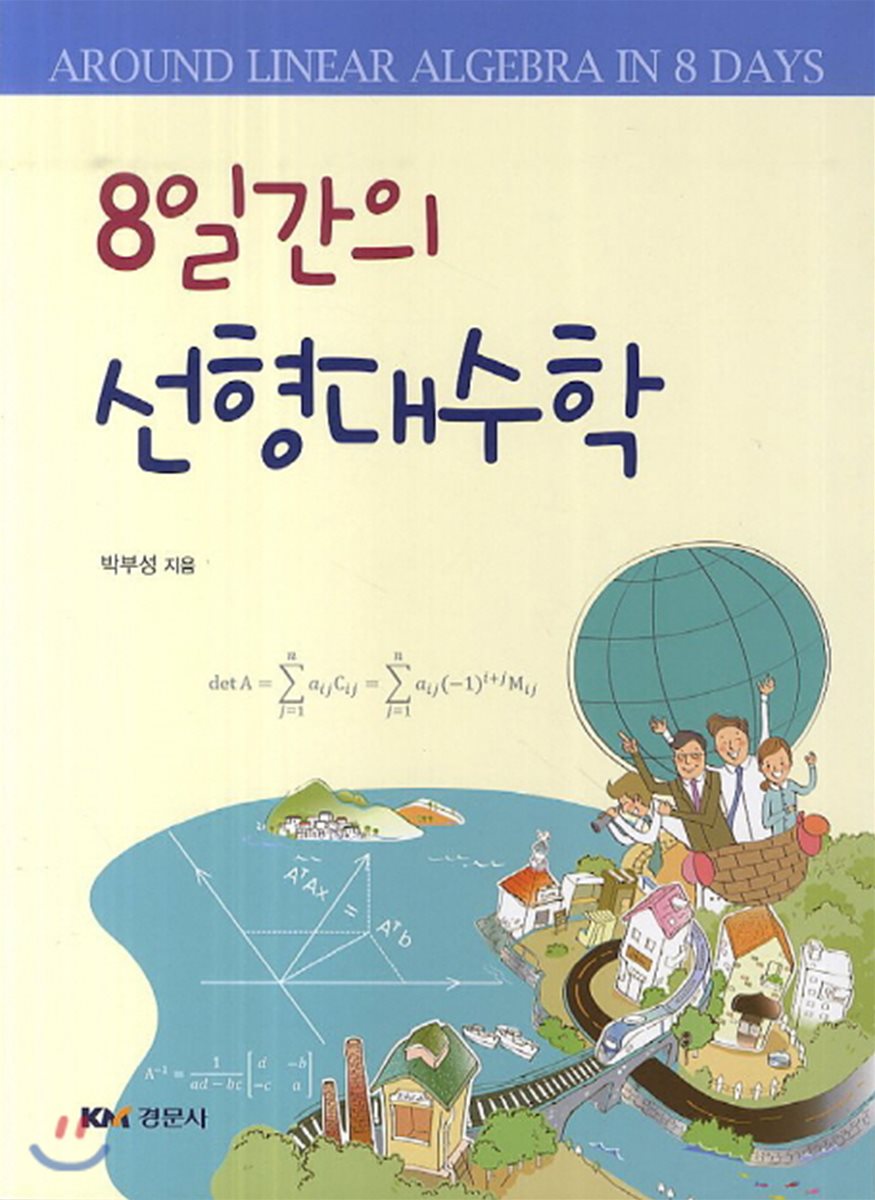
8 Days of Linear Algebra
 |
Description
Book Introduction
Although linear algebra is a subject that serves as the foundation for almost all fields of mathematics, there were many students who were unable to grasp the overall structure because they were engrossed in simple calculations.
For these students, a textbook that could view various topics in linear algebra from an integrated perspective was needed, but it was not easy to find a textbook that suited the purpose.
Above all, most books are designed for one or two semesters of classes, so they are too voluminous to cover linear algebra in a short period of time.
Therefore, it was necessary to develop a textbook that covered only the essential content while being easy to read.
This book consists of a total of 8 chapters, each of which is about 10 pages long.
I tried to explain it as simply as possible, but due to space limitations, there are some parts where the explanations are somewhat lacking, and many of the questions were replaced with practice problems in place of detailed explanations.
In some chapters, the title of the last section is marked with an asterisk (*).
This is a topic that corresponds to the application of linear algebra, so students who have not studied linear algebra much can skip it.
For these students, a textbook that could view various topics in linear algebra from an integrated perspective was needed, but it was not easy to find a textbook that suited the purpose.
Above all, most books are designed for one or two semesters of classes, so they are too voluminous to cover linear algebra in a short period of time.
Therefore, it was necessary to develop a textbook that covered only the essential content while being easy to read.
This book consists of a total of 8 chapters, each of which is about 10 pages long.
I tried to explain it as simply as possible, but due to space limitations, there are some parts where the explanations are somewhat lacking, and many of the questions were replaced with practice problems in place of detailed explanations.
In some chapters, the title of the last section is marked with an asterisk (*).
This is a topic that corresponds to the application of linear algebra, so students who have not studied linear algebra much can skip it.
index
West Gate v
Some symbols ix
First day simultaneous linear equations
1.1 The important thing is the coefficient!
1.2 Gaussian elimination
1.3 Formula for the roots of a system of linear equations
1.4 Composition of ideas and multiplication of matrices
1.5 Gaussian Elimination Revisited
1.6 Matrix representation in history
Second day determinant
2.1 Existence of the inverse matrix
2.2 Geometric meaning of determinant
2.3 Various methods for finding the determinant
2.4 Jacobian determinant?
Third day vector space
3.1 Physical Vectors
3.2 Mathematical vectors
3.3 Abstraction
3.4 Euclidean space
3.5 Inner space
3.6 External?
Day 4: Basis of Vector Space
4.1 Primary binding and generation
4.2 Primary Independence
4.3 Base
4.4 Orthogonal basis
4.5 Representing the components of a vector
4.6 Fourier series?
Day 5: Linear Thought and Matrix
5.1 Linear mapping
5.2 Dimensional Theorem
5.3 Coefficient Theorem
5.4 Basis transformation
5.5 Euclidean space and linear mapping
5.6 Least Squares Method
5.7 Dual Spaces and Differential Forms?
Day 6: Eigenvalues and Eigenvectors
6.1 Diagonalization of matrices
6.2 Diagonalizability
6.3 Quadratic form
6.4 Cayley-Hamilton theorem
6.5 Minimal polynomial
6.6 Markov process?
Seventh day complex vector space
7.1 Scala
7.2 Complex inner product space
7.3 Diagonalization of complex matrices
Day 8 Disassembly and Organization
8.1 Jordan Standard
8.2 First decomposition theorem
8.3 Second decomposition theorem
Practice problem solutions
Search
Some symbols ix
First day simultaneous linear equations
1.1 The important thing is the coefficient!
1.2 Gaussian elimination
1.3 Formula for the roots of a system of linear equations
1.4 Composition of ideas and multiplication of matrices
1.5 Gaussian Elimination Revisited
1.6 Matrix representation in history
Second day determinant
2.1 Existence of the inverse matrix
2.2 Geometric meaning of determinant
2.3 Various methods for finding the determinant
2.4 Jacobian determinant?
Third day vector space
3.1 Physical Vectors
3.2 Mathematical vectors
3.3 Abstraction
3.4 Euclidean space
3.5 Inner space
3.6 External?
Day 4: Basis of Vector Space
4.1 Primary binding and generation
4.2 Primary Independence
4.3 Base
4.4 Orthogonal basis
4.5 Representing the components of a vector
4.6 Fourier series?
Day 5: Linear Thought and Matrix
5.1 Linear mapping
5.2 Dimensional Theorem
5.3 Coefficient Theorem
5.4 Basis transformation
5.5 Euclidean space and linear mapping
5.6 Least Squares Method
5.7 Dual Spaces and Differential Forms?
Day 6: Eigenvalues and Eigenvectors
6.1 Diagonalization of matrices
6.2 Diagonalizability
6.3 Quadratic form
6.4 Cayley-Hamilton theorem
6.5 Minimal polynomial
6.6 Markov process?
Seventh day complex vector space
7.1 Scala
7.2 Complex inner product space
7.3 Diagonalization of complex matrices
Day 8 Disassembly and Organization
8.1 Jordan Standard
8.2 First decomposition theorem
8.3 Second decomposition theorem
Practice problem solutions
Search
Publisher's Review
Linear algebra is the study of methods for solving equations, more precisely, systems of linear equations, and the related theories.
“Linear” means linear, and “algebra” means a method of finding answers by manipulating symbols.
However, linear algebra in the modern sense can be said to be a fusion of three major theories.
First, the solution of simultaneous linear equations, which is also the historical origin of linear algebra; second, the manipulation of matrices; and third, the theory of abstract vector spaces.
A system of linear equations can be expressed and solved using matrices, and the solution set of a system of linear equations becomes a vector space.
Meanwhile, a “good function” defined between vector spaces can be represented using a matrix.
In this way, the three elements of linear algebra - systems of linear equations, matrices, and vector spaces - are closely related to each other, allowing one to approach a single problem from three different perspectives.
Looking at these three elements from the perspective of their intertwining will greatly help us understand many areas of mathematics.
This book is a product of the department capacity enhancement project promoted by Gyeongnam National University.
Although linear algebra is a subject that serves as the foundation for almost all fields of mathematics, there were many students who were unable to grasp the overall structure because they were engrossed in simple calculations.
For these students, a textbook that could view various topics in linear algebra from an integrated perspective was needed, but it was not easy to find a textbook that suited the purpose.
Above all, most books are designed for one or two semesters of classes, so they are too voluminous to cover linear algebra in a short period of time.
Therefore, it was necessary to develop a textbook that covered only the essential content while being easy to read.
This book consists of a total of 8 chapters, each of which is about 10 pages long.
I tried to explain it as simply as possible, but due to space limitations, there are some parts where the explanations are somewhat lacking, and many of the questions were replaced with practice problems in place of detailed explanations.
Above all, one of the shortcomings of this book is that there are not many problems that allow you to experience the “hands-on” feeling of calculating things one by one by hand.
In some chapters, the title of the last section is marked with an asterisk (?).
This is a topic that corresponds to the application of linear algebra, so students who have not studied linear algebra much can skip it.
If we think about the purpose of writing in reverse, this book is not very suitable as a textbook for studying linear algebra.
It would be appropriate to use it as a supplementary material to review parts that are difficult to understand while studying the main textbook or to summarize previously learned parts.
There are hundreds or thousands of linear algebra textbooks, but the basic book is “Linear Algebra and Groups” written by Professor Lee In-seok.
Of course, the goal of this book is not that high, and above all, due to the author's lack of ability, it falls short of showing the world of mathematics as brilliantly and profoundly as Professor Lee In-seok's book.
If you can get a glimpse of linear algebra, the fundamental discipline of mathematics, then this book has fulfilled its purpose.
“Linear” means linear, and “algebra” means a method of finding answers by manipulating symbols.
However, linear algebra in the modern sense can be said to be a fusion of three major theories.
First, the solution of simultaneous linear equations, which is also the historical origin of linear algebra; second, the manipulation of matrices; and third, the theory of abstract vector spaces.
A system of linear equations can be expressed and solved using matrices, and the solution set of a system of linear equations becomes a vector space.
Meanwhile, a “good function” defined between vector spaces can be represented using a matrix.
In this way, the three elements of linear algebra - systems of linear equations, matrices, and vector spaces - are closely related to each other, allowing one to approach a single problem from three different perspectives.
Looking at these three elements from the perspective of their intertwining will greatly help us understand many areas of mathematics.
This book is a product of the department capacity enhancement project promoted by Gyeongnam National University.
Although linear algebra is a subject that serves as the foundation for almost all fields of mathematics, there were many students who were unable to grasp the overall structure because they were engrossed in simple calculations.
For these students, a textbook that could view various topics in linear algebra from an integrated perspective was needed, but it was not easy to find a textbook that suited the purpose.
Above all, most books are designed for one or two semesters of classes, so they are too voluminous to cover linear algebra in a short period of time.
Therefore, it was necessary to develop a textbook that covered only the essential content while being easy to read.
This book consists of a total of 8 chapters, each of which is about 10 pages long.
I tried to explain it as simply as possible, but due to space limitations, there are some parts where the explanations are somewhat lacking, and many of the questions were replaced with practice problems in place of detailed explanations.
Above all, one of the shortcomings of this book is that there are not many problems that allow you to experience the “hands-on” feeling of calculating things one by one by hand.
In some chapters, the title of the last section is marked with an asterisk (?).
This is a topic that corresponds to the application of linear algebra, so students who have not studied linear algebra much can skip it.
If we think about the purpose of writing in reverse, this book is not very suitable as a textbook for studying linear algebra.
It would be appropriate to use it as a supplementary material to review parts that are difficult to understand while studying the main textbook or to summarize previously learned parts.
There are hundreds or thousands of linear algebra textbooks, but the basic book is “Linear Algebra and Groups” written by Professor Lee In-seok.
Of course, the goal of this book is not that high, and above all, due to the author's lack of ability, it falls short of showing the world of mathematics as brilliantly and profoundly as Professor Lee In-seok's book.
If you can get a glimpse of linear algebra, the fundamental discipline of mathematics, then this book has fulfilled its purpose.
GOODS SPECIFICS
- Date of issue: March 5, 2014
- Page count, weight, size: 300 pages | 288g | 188*254*20mm
- ISBN13: 9788961057097
- ISBN10: 896105709X
You may also like
카테고리
korean


korean

![GQ KOREA Mark (Monthly): December [2025]](http://librairie.coreenne.fr/cdn/shop/files/8ef265dbbfbf186523ed75ba7319009d.jpg?v=1765340328&width=3840)


