

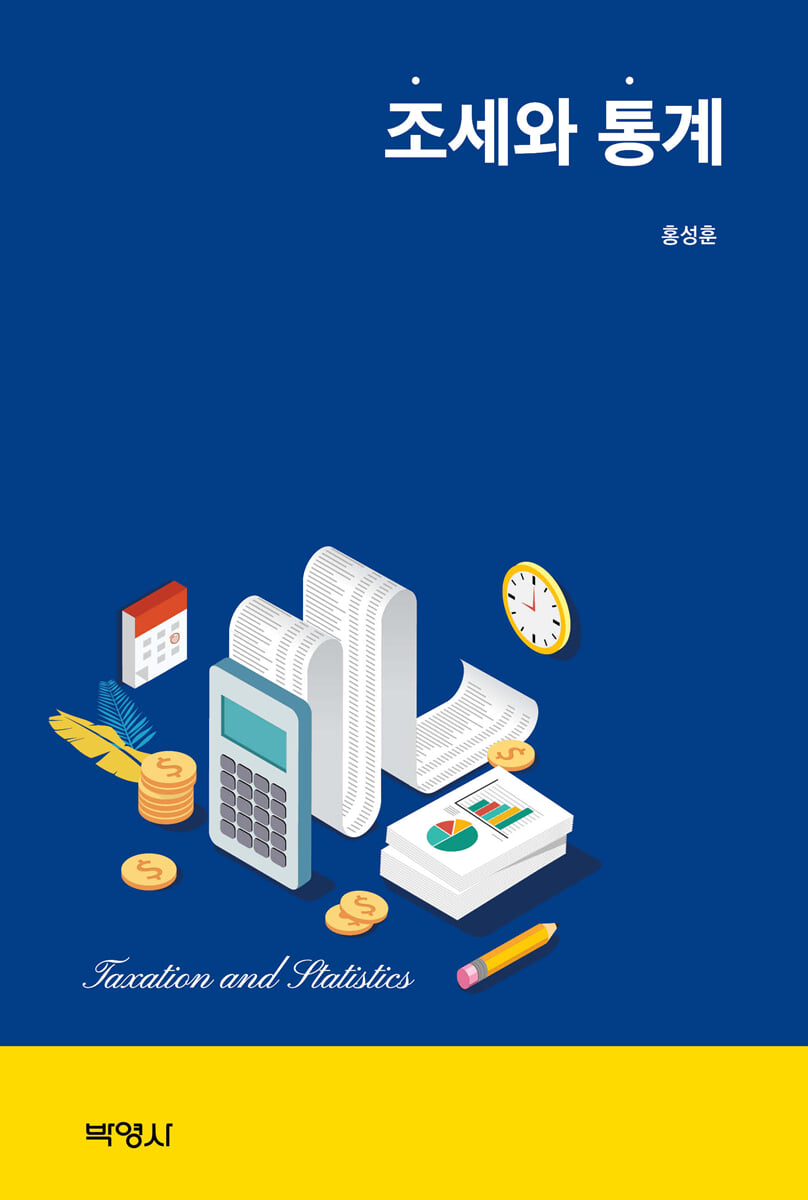
Taxation and Statistics
 |
Description
index
CHAPTER 01 Why Learn Statistics?
1 Purpose of studying statistics 11
2 Types of Statistics 13
3 Population and Sample 14
4 Types of data 16
5 Experimental and Empirical Studies 17
Practice Problem 20
CHAPTER 02 Variables, Distributions, and Histograms
1 Types of Variables 23
2 Distributions and Histograms 25
3 Histogram using income tax sample data 26
Practice Problem 31
CHAPTER 03 Statistics
1 Average 35
2 standard deviations 38
3 Reasons for dividing by when calculating standard deviation 39
4th quartile 40
5 Statistics on Income Tax Sample Data 42
Practice Problem 45
CHAPTER 04 Random Variables and Normal Distribution
1 random variable 49
2 Normal distribution 51
3 Characteristics of the Normal Distribution Curve 53
4 Income Tax Sample Data and Normal Distribution 54
Practice Problem 57
CHAPTER 05 Correlation
1 Joint Distribution and Scatterplot 61
2 Correlation coefficient 65
3 Characteristics and Limitations of Correlation Coefficients 69
4 Income Tax Sample Data and Correlation Coefficient 71
Practice Problem 73
CHAPTER 06 REGRESSION ANALYSIS
1 Change in the conditional mean 77
2 Linear Approximation 79
3 Least Squares Method 81
4 Standard error 85
5 coefficient of determination 87
6 Linear relationship between income and tax amount in income tax sample data 89
Practice Problem 91
CHAPTER 07 Expected Value and Standard Error
1 Stochastic Process 95
2 Expected values and standard errors 97
3 Number of extractions and number of trials 99
Practice Problem 101
CHAPTER 08 Sampling Distribution
1 Sample distribution 105
2 Confidence interval of the population mean 109
3 Poll confidence interval 110
Practice Problem 114
CHAPTER 09 Significance Test
1 The Logic of Black 119
2 Hypothesis Setting 121
3 Test statistics and p-values 122
4 Type I and Type II Errors 124
5 Multiple Samples - Statistics 126
6 Regression Analysis and Statistics 126
7 Significance Test 131
Practice Problem 133
Reference 136
Appendix 138
1 Purpose of studying statistics 11
2 Types of Statistics 13
3 Population and Sample 14
4 Types of data 16
5 Experimental and Empirical Studies 17
Practice Problem 20
CHAPTER 02 Variables, Distributions, and Histograms
1 Types of Variables 23
2 Distributions and Histograms 25
3 Histogram using income tax sample data 26
Practice Problem 31
CHAPTER 03 Statistics
1 Average 35
2 standard deviations 38
3 Reasons for dividing by when calculating standard deviation 39
4th quartile 40
5 Statistics on Income Tax Sample Data 42
Practice Problem 45
CHAPTER 04 Random Variables and Normal Distribution
1 random variable 49
2 Normal distribution 51
3 Characteristics of the Normal Distribution Curve 53
4 Income Tax Sample Data and Normal Distribution 54
Practice Problem 57
CHAPTER 05 Correlation
1 Joint Distribution and Scatterplot 61
2 Correlation coefficient 65
3 Characteristics and Limitations of Correlation Coefficients 69
4 Income Tax Sample Data and Correlation Coefficient 71
Practice Problem 73
CHAPTER 06 REGRESSION ANALYSIS
1 Change in the conditional mean 77
2 Linear Approximation 79
3 Least Squares Method 81
4 Standard error 85
5 coefficient of determination 87
6 Linear relationship between income and tax amount in income tax sample data 89
Practice Problem 91
CHAPTER 07 Expected Value and Standard Error
1 Stochastic Process 95
2 Expected values and standard errors 97
3 Number of extractions and number of trials 99
Practice Problem 101
CHAPTER 08 Sampling Distribution
1 Sample distribution 105
2 Confidence interval of the population mean 109
3 Poll confidence interval 110
Practice Problem 114
CHAPTER 09 Significance Test
1 The Logic of Black 119
2 Hypothesis Setting 121
3 Test statistics and p-values 122
4 Type I and Type II Errors 124
5 Multiple Samples - Statistics 126
6 Regression Analysis and Statistics 126
7 Significance Test 131
Practice Problem 133
Reference 136
Appendix 138
Publisher's Review
When publishing a book
Can we cover all the concepts and theories underlying statistical inference in a single semester of statistics study or teaching? Can we also provide hands-on practice in managing and analyzing data based on statistical theory? Using actual, observed and recorded data, rather than fictional data, can we explain the context in which the theory should be learned and convey the experience of learning from data through hands-on practice?
Over the past five years of learning and teaching statistics, I've constantly asked myself these questions.
There is probably no right answer, but through experience and trial and error, I have learned the following:
If you want to cover the basics of statistics and practical applications in one semester, you need to learn the theory within 10 weeks.
To lay the foundations of statistical inference in this amount of time, you need to focus only on what really matters.
Focuses on statistics, linear regression, least squares, sampling distributions, and significance testing.
We don't have the time to cover probability theory, distribution functions, variable transformations, matrix operations, and sampling, all of which statistics and econometrics majors have covered for several semesters.
These contents are introduced intuitively only when necessary.
To use data without worrying too much about the sampling process or representativeness of the data, you must use reliable data.
We use the income tax sample data, which is administrative data provided by the National Tax Service.
In reality, the results of people's choices and actions can be observed in data such as income and tax payments.
Because the data is extracted from income tax returns, it is not data that relies on people's memories or imaginations, and it is certainly not completely virtual and computer-generated.
As we will discuss later, the income tax sample data also contains a small number of hypothetical observations.
It's not that there are no shortcomings in the data structure and variable definitions.
Nonetheless, it is difficult to find a better resource for explaining the basic concepts of statistics and practicing data analysis.
I taught a subject called tax statistics alternately at undergraduate and graduate schools.
At first, I thought it was similar to economic statistics among economics majors or business statistics among business administration majors, but later I realized that there were two important differences.
There is no major subject that deals with advanced statistics that follows tax statistics, and considering the complex major structure of the Department of Taxation and the Graduate School of Taxation, there is no reason to take tax statistics.
So, while covering all the basics of statistics in one semester, it was necessary to provide motivation for students to study from time to time so that they would not feel tired or bored.
So, whenever possible, I tried to provide examples related to tax systems and policies.
And we planned to learn by using actual data, including the National Tax Service's income tax sample data, and coding in programs such as Python, R, and Stata.
I prepared lecture notes on tax statistics, added content to the lectures each semester, and wrote this book.
When I first prepared my lecture notes, I referred to Professor Ryu Geun-kwan's statistics textbook at Seoul National University, and was also inspired by the lecture notes of various teachers I had accumulated during my school days.
In my tax statistics class, students would ask questions, look bored, or write incorrect answers to exam questions, which helped me figure out what I needed to explain more about and when to stop.
Team Leader Jang Gyu-sik and Manager Tak Jong-min of Park Young-sa helped me transform my manuscript into a wonderful book during the publishing process.
This book was written with support from the 2023 Seoul Metropolitan University Basic and Convergence Sciences and Research and Development Infrastructure Development Project.
I would like to express my gratitude to everyone who helped me during the writing process.
August 2025
Hong Seong-hun
Can we cover all the concepts and theories underlying statistical inference in a single semester of statistics study or teaching? Can we also provide hands-on practice in managing and analyzing data based on statistical theory? Using actual, observed and recorded data, rather than fictional data, can we explain the context in which the theory should be learned and convey the experience of learning from data through hands-on practice?
Over the past five years of learning and teaching statistics, I've constantly asked myself these questions.
There is probably no right answer, but through experience and trial and error, I have learned the following:
If you want to cover the basics of statistics and practical applications in one semester, you need to learn the theory within 10 weeks.
To lay the foundations of statistical inference in this amount of time, you need to focus only on what really matters.
Focuses on statistics, linear regression, least squares, sampling distributions, and significance testing.
We don't have the time to cover probability theory, distribution functions, variable transformations, matrix operations, and sampling, all of which statistics and econometrics majors have covered for several semesters.
These contents are introduced intuitively only when necessary.
To use data without worrying too much about the sampling process or representativeness of the data, you must use reliable data.
We use the income tax sample data, which is administrative data provided by the National Tax Service.
In reality, the results of people's choices and actions can be observed in data such as income and tax payments.
Because the data is extracted from income tax returns, it is not data that relies on people's memories or imaginations, and it is certainly not completely virtual and computer-generated.
As we will discuss later, the income tax sample data also contains a small number of hypothetical observations.
It's not that there are no shortcomings in the data structure and variable definitions.
Nonetheless, it is difficult to find a better resource for explaining the basic concepts of statistics and practicing data analysis.
I taught a subject called tax statistics alternately at undergraduate and graduate schools.
At first, I thought it was similar to economic statistics among economics majors or business statistics among business administration majors, but later I realized that there were two important differences.
There is no major subject that deals with advanced statistics that follows tax statistics, and considering the complex major structure of the Department of Taxation and the Graduate School of Taxation, there is no reason to take tax statistics.
So, while covering all the basics of statistics in one semester, it was necessary to provide motivation for students to study from time to time so that they would not feel tired or bored.
So, whenever possible, I tried to provide examples related to tax systems and policies.
And we planned to learn by using actual data, including the National Tax Service's income tax sample data, and coding in programs such as Python, R, and Stata.
I prepared lecture notes on tax statistics, added content to the lectures each semester, and wrote this book.
When I first prepared my lecture notes, I referred to Professor Ryu Geun-kwan's statistics textbook at Seoul National University, and was also inspired by the lecture notes of various teachers I had accumulated during my school days.
In my tax statistics class, students would ask questions, look bored, or write incorrect answers to exam questions, which helped me figure out what I needed to explain more about and when to stop.
Team Leader Jang Gyu-sik and Manager Tak Jong-min of Park Young-sa helped me transform my manuscript into a wonderful book during the publishing process.
This book was written with support from the 2023 Seoul Metropolitan University Basic and Convergence Sciences and Research and Development Infrastructure Development Project.
I would like to express my gratitude to everyone who helped me during the writing process.
August 2025
Hong Seong-hun
GOODS SPECIFICS
- Date of issue: September 30, 2025
- Page count, weight, size: 180 pages | 153*224*20mm
- ISBN13: 9791130324135
- ISBN10: 1130324133
You may also like
카테고리
korean


korean

![ELLE 엘르 A형 (여성월간) : 1월 [2026]](http://librairie.coreenne.fr/cdn/shop/files/3b70e1cf77cf67d6da56e0eb041901e8.jpg?v=1767265322&width=3840)


