

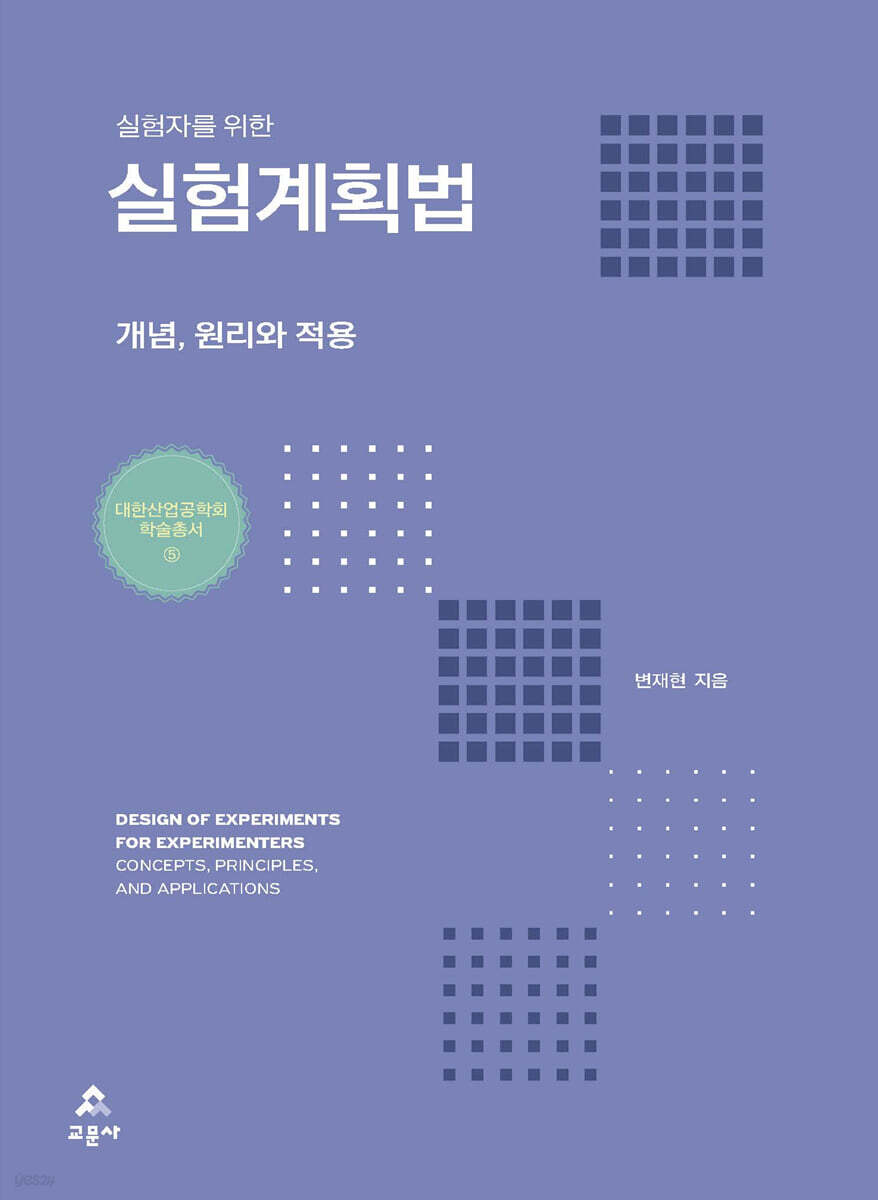
Experimental Design for Experimenters
 |
Description
Book Introduction
This book is not a theoretical book on Design of Experiments (DOE).
It is not a handbook that introduces various methods of experimental planning.
This book is based on the author's reflections from over 40 years of studying experimental design and lecturing and advising university students, researchers, and practitioners in the field. It is more like a guidebook that explains the concepts and principles of experimental design and focuses on various case studies so that readers can easily apply them to their own experiments.
The features of this textbook are as follows:
① Statistical concepts and methods were explained as simply as possible and only the essential parts were presented.
② Questions and opinions were added to the text based on frequently asked questions during lectures.
③ Contents that were not sufficiently explained in the main text or that might be of interest to readers are presented in the Look Ahead section at the end of each chapter.
④ Various examples were presented not only in the text but also in practice problems to help students understand the applicability of DOE.
⑤ Since it is theoretical content, sections that can be skipped when studying for the first time are marked with an '*' after the section number.
⑥ To help readers analyze experimental data, the basic program DOEasy and its execution manual are provided separately in the data room of the GyoMoon website (www.gyomoon.com).
Chapter 1 provides a general introduction to the necessity, main principles, application procedures, and various methods of experimental design.
Chapter 2 presents the minimum statistical methods required for DOE.
I believe that even people who do not know statistics will be able to understand the statistical concepts and methods presented throughout this book if they study Chapter 2.
Anyone who has studied statistics may not need to read this chapter.
Chapter 3 introduces the analysis of variance method for analyzing multilevel experimental data and the residual analysis method for examining the model's suitability.
The two-level (complete) factorial arrangement method and the partial factorial arrangement method, which can be considered the basics of experimental design, are covered in Chapters 4 and 5, respectively.
Chapter 4 explains the concept of two-level factorial arrangement using design matrix and design space, and presents data analysis methods using two simple examples.
Chapter 5 explains the fractional factorial method and screening experimental design, which allow for conducting experiments with a small number of experiments when there are many potential factors to be included in the experiment, with various examples.
In addition, various important experimental design and analysis methods are covered in Chapter 6. Regression analysis for DOE is covered in Chapter 7, and general response surface methods and secondary response surface design and analysis are covered in Chapter 8.
Chapter 9 describes the mixture experimental design to find the optimal composition ratio in experiments mixing multiple components, and Chapter 10 presents the experimental design and data analysis method for optimizing multiple response variables simultaneously.
Chapter 11 covers robust design, which seeks to minimize the impact of noise on the product's characteristics before developing the product and moving it into mass production.
This textbook aims to help experimenters understand the necessity and development principles of various experimental design methods, thereby enabling them to conduct experiments efficiently.
We also hope that this book will be helpful not only to students majoring in industrial engineering or statistics, but also to students in engineering, natural sciences, agricultural life sciences, and pharmaceutical sciences who conduct experiments, and to researchers and practitioners in companies or public institutions who seek to develop or improve systems/processes through experiments.
※ You can find the ‘DOEasy program and execution manual’ in the data room of the Gyomunsa website (www.gyomoon.com).
It is not a handbook that introduces various methods of experimental planning.
This book is based on the author's reflections from over 40 years of studying experimental design and lecturing and advising university students, researchers, and practitioners in the field. It is more like a guidebook that explains the concepts and principles of experimental design and focuses on various case studies so that readers can easily apply them to their own experiments.
The features of this textbook are as follows:
① Statistical concepts and methods were explained as simply as possible and only the essential parts were presented.
② Questions and opinions were added to the text based on frequently asked questions during lectures.
③ Contents that were not sufficiently explained in the main text or that might be of interest to readers are presented in the Look Ahead section at the end of each chapter.
④ Various examples were presented not only in the text but also in practice problems to help students understand the applicability of DOE.
⑤ Since it is theoretical content, sections that can be skipped when studying for the first time are marked with an '*' after the section number.
⑥ To help readers analyze experimental data, the basic program DOEasy and its execution manual are provided separately in the data room of the GyoMoon website (www.gyomoon.com).
Chapter 1 provides a general introduction to the necessity, main principles, application procedures, and various methods of experimental design.
Chapter 2 presents the minimum statistical methods required for DOE.
I believe that even people who do not know statistics will be able to understand the statistical concepts and methods presented throughout this book if they study Chapter 2.
Anyone who has studied statistics may not need to read this chapter.
Chapter 3 introduces the analysis of variance method for analyzing multilevel experimental data and the residual analysis method for examining the model's suitability.
The two-level (complete) factorial arrangement method and the partial factorial arrangement method, which can be considered the basics of experimental design, are covered in Chapters 4 and 5, respectively.
Chapter 4 explains the concept of two-level factorial arrangement using design matrix and design space, and presents data analysis methods using two simple examples.
Chapter 5 explains the fractional factorial method and screening experimental design, which allow for conducting experiments with a small number of experiments when there are many potential factors to be included in the experiment, with various examples.
In addition, various important experimental design and analysis methods are covered in Chapter 6. Regression analysis for DOE is covered in Chapter 7, and general response surface methods and secondary response surface design and analysis are covered in Chapter 8.
Chapter 9 describes the mixture experimental design to find the optimal composition ratio in experiments mixing multiple components, and Chapter 10 presents the experimental design and data analysis method for optimizing multiple response variables simultaneously.
Chapter 11 covers robust design, which seeks to minimize the impact of noise on the product's characteristics before developing the product and moving it into mass production.
This textbook aims to help experimenters understand the necessity and development principles of various experimental design methods, thereby enabling them to conduct experiments efficiently.
We also hope that this book will be helpful not only to students majoring in industrial engineering or statistics, but also to students in engineering, natural sciences, agricultural life sciences, and pharmaceutical sciences who conduct experiments, and to researchers and practitioners in companies or public institutions who seek to develop or improve systems/processes through experiments.
※ You can find the ‘DOEasy program and execution manual’ in the data room of the Gyomunsa website (www.gyomoon.com).
index
Chapter 1: Overview of Experimental Design
Chapter 2: Understanding Basic Statistics for Experimental Design
Chapter 3: Haninja Experimental Plan
Chapter 4 Two-Level Factorial Alignment
Chapter 5: Level 2 Fractional Factorial Arrangement and Selection Experiment Design
Chapter 6: Various Experimental Designs and Analysis
Chapter 7: Basic Regression Analysis for Experimental Design
Chapter 8: Response Surface Design and Analysis
Chapter 9 Mixture Experimental Design
Chapter 10: Optimization of Multiple Response Variables
Chapter 11: Experimental Planning for Robustness
Appendix statistical distribution table
Chapter 2: Understanding Basic Statistics for Experimental Design
Chapter 3: Haninja Experimental Plan
Chapter 4 Two-Level Factorial Alignment
Chapter 5: Level 2 Fractional Factorial Arrangement and Selection Experiment Design
Chapter 6: Various Experimental Designs and Analysis
Chapter 7: Basic Regression Analysis for Experimental Design
Chapter 8: Response Surface Design and Analysis
Chapter 9 Mixture Experimental Design
Chapter 10: Optimization of Multiple Response Variables
Chapter 11: Experimental Planning for Robustness
Appendix statistical distribution table
GOODS SPECIFICS
- Date of issue: August 29, 2025
- Page count, weight, size: 596 pages | 188*257*35mm
- ISBN13: 9788936326814
- ISBN10: 8936326813
You may also like
카테고리
korean


korean

![ELLE 엘르 A형 (여성월간) : 1월 [2026]](http://librairie.coreenne.fr/cdn/shop/files/3b70e1cf77cf67d6da56e0eb041901e8.jpg?v=1767265322&width=3840)


