

The First Step to Reinforcement Learning with Physical AI
 |
Description
Book Introduction
This book covers the fundamental theories of reinforcement learning that are essential for practical application.
The purpose of this book is to provide a solid foundation for in-depth research for those pursuing professional studies in Physical AI, and to systematically establish theories for those with extensive practical experience.
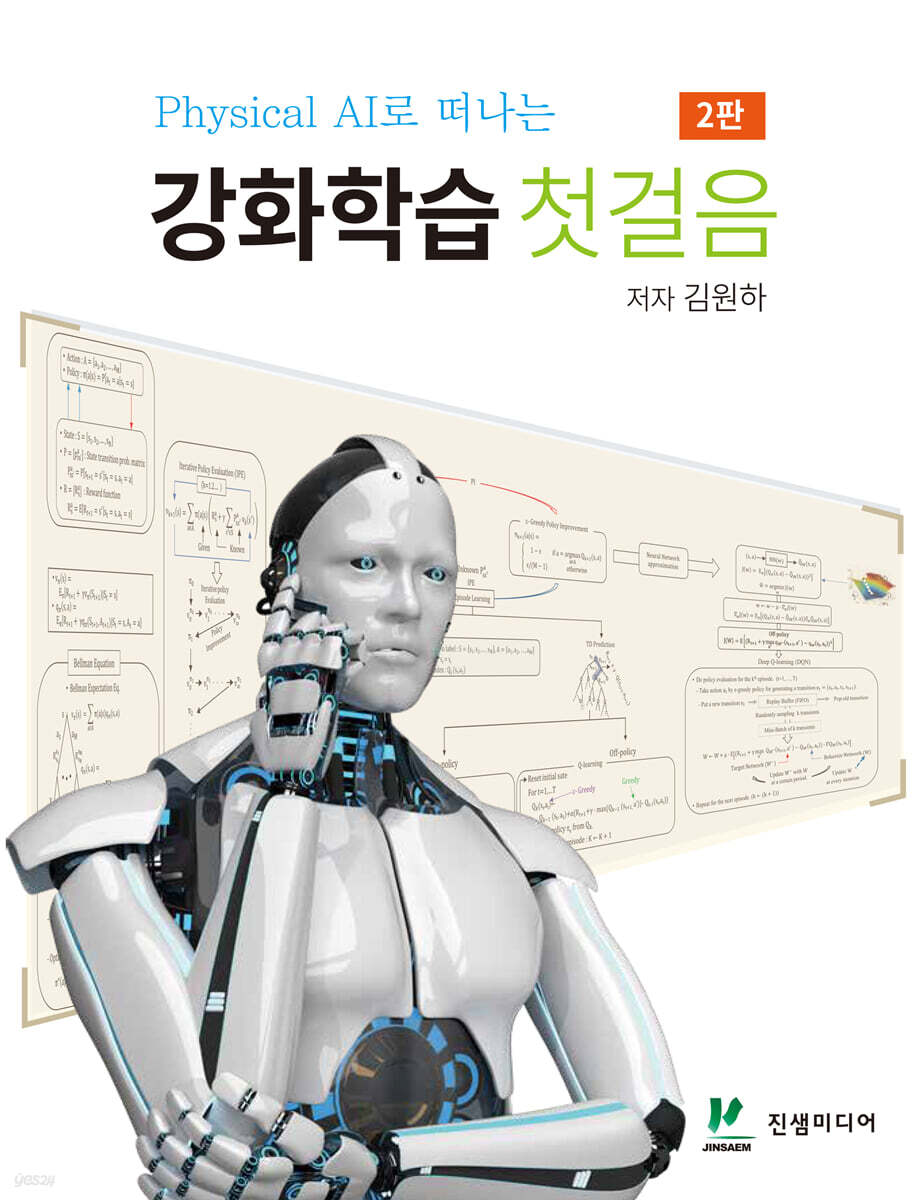
To visually represent the flow of thought, each element of thought was classified and connected step by step and diagrammed.
This will help you experience it rather than having you infer the logic.
Therefore, this book is closer to a picture book.
We minimized the use of mathematics and used only essential mathematics.
The mathematics used in reinforcement learning is primarily for representing situations rather than for calculations.
In fact, this math can be more difficult.
Beginners may find this confusing, especially because of the subscripts attached to variables.
Every time a difficult or confusing mathematical concept is presented, we faithfully explain and clarify it so that even beginners can easily understand the theory.
By making the examples experiential, we have ensured that those studying this book will not only understand the theory but also feel it.
The purpose of this book is to provide a solid foundation for in-depth research for those pursuing professional studies in Physical AI, and to systematically establish theories for those with extensive practical experience.
To visually represent the flow of thought, each element of thought was classified and connected step by step and diagrammed.
This will help you experience it rather than having you infer the logic.
Therefore, this book is closer to a picture book.
We minimized the use of mathematics and used only essential mathematics.
The mathematics used in reinforcement learning is primarily for representing situations rather than for calculations.
In fact, this math can be more difficult.
Beginners may find this confusing, especially because of the subscripts attached to variables.
Every time a difficult or confusing mathematical concept is presented, we faithfully explain and clarify it so that even beginners can easily understand the theory.
By making the examples experiential, we have ensured that those studying this book will not only understand the theory but also feel it.
index
CHAPTER 1.
Explore Reinforcement Learning
1.1 Purpose of Reinforcement Learning
1.2 Elements of Reinforcement Learning
1.3 Sequential process of reinforcement learning
1.4 Differentiation of reinforcement learning learning methods
CHAPTER 2.
Reinforcement learning modeling
2.1 MDP Environment Modeling
2.2 Reinforcement Learning Modeling of MDP
2.3 Reinforcement Learning Problem Classification
2.4 Summary and Summary
CHAPTER 3.
Bellman equation
3.1 Bellman Expectation Equation
3.2 Bellman optimality equation
3.3 Summary and Summary
CHAPTER 4.
Reinforcement Learning When the Environment is Known: Planning
4.1 Model-based reinforcement learning
4.2 Iterative Policy Evaluation
4.3 Policy Iteration
4.4 Value Iteration
4.5 Summary and Summary
CHAPTER 5.
Reinforcement Learning I: Prediction in Unknown Environments
5.1 Monte Carlo (MC) method
5.2 MC-based episodic learning
5.3 Model-Free Prediction
5.4 Prediction Technique Analysis
5.5 Summary and Summary
CHAPTER 6.
Reinforcement Learning II: Control When the Environment Is Unknown
6.1 Learning using the action-value function
6.2 Control
6.3 Control Algorithm
6.4 Pathfinding for Autonomous Robots
6.5 Python Code: Gridworld
6.5 Summary and Summary
CHAPTER 7.
Environmental approximation
7.1 The Need for Environmental Approximation
7.2 Environmental approximation functions
7.3 Neural Network
CHAPTER 8.
Value-based reinforcement learning
8.1 Agent Classification
8.2 Learning the Value Network
8.3 Deep Q-Network (DQN)
8.4 Python Code: Cartpole
8.5 Summary and Summary
CHAPTER 9.
Policy-based reinforcement learning
9.1 Deterministic policy and stochastic policy
9.2 Policy Network Learning
9.3 Actor-Critic
9.4 Python Code Implementation: Cartpole
9.5 Summary and Summary
Explore Reinforcement Learning
1.1 Purpose of Reinforcement Learning
1.2 Elements of Reinforcement Learning
1.3 Sequential process of reinforcement learning
1.4 Differentiation of reinforcement learning learning methods
CHAPTER 2.
Reinforcement learning modeling
2.1 MDP Environment Modeling
2.2 Reinforcement Learning Modeling of MDP
2.3 Reinforcement Learning Problem Classification
2.4 Summary and Summary
CHAPTER 3.
Bellman equation
3.1 Bellman Expectation Equation
3.2 Bellman optimality equation
3.3 Summary and Summary
CHAPTER 4.
Reinforcement Learning When the Environment is Known: Planning
4.1 Model-based reinforcement learning
4.2 Iterative Policy Evaluation
4.3 Policy Iteration
4.4 Value Iteration
4.5 Summary and Summary
CHAPTER 5.
Reinforcement Learning I: Prediction in Unknown Environments
5.1 Monte Carlo (MC) method
5.2 MC-based episodic learning
5.3 Model-Free Prediction
5.4 Prediction Technique Analysis
5.5 Summary and Summary
CHAPTER 6.
Reinforcement Learning II: Control When the Environment Is Unknown
6.1 Learning using the action-value function
6.2 Control
6.3 Control Algorithm
6.4 Pathfinding for Autonomous Robots
6.5 Python Code: Gridworld
6.5 Summary and Summary
CHAPTER 7.
Environmental approximation
7.1 The Need for Environmental Approximation
7.2 Environmental approximation functions
7.3 Neural Network
CHAPTER 8.
Value-based reinforcement learning
8.1 Agent Classification
8.2 Learning the Value Network
8.3 Deep Q-Network (DQN)
8.4 Python Code: Cartpole
8.5 Summary and Summary
CHAPTER 9.
Policy-based reinforcement learning
9.1 Deterministic policy and stochastic policy
9.2 Policy Network Learning
9.3 Actor-Critic
9.4 Python Code Implementation: Cartpole
9.5 Summary and Summary
GOODS SPECIFICS
- Date of issue: September 10, 2025
- Page count, weight, size: 238 pages | 175*235*20mm
- ISBN13: 9791194907039
- ISBN10: 1194907032
You may also like
카테고리
korean


korean

![ELLE 엘르 A형 (여성월간) : 1월 [2026]](http://librairie.coreenne.fr/cdn/shop/files/3b70e1cf77cf67d6da56e0eb041901e8.jpg?v=1767265322&width=3840)


